
Translated material
Landau Institute can be left without a director

In the summer of 2018 at the Institute of Theoretical Physics of the Russian Academy of Sciences. L. D. Landau should be replaced by the director: the term of the current head of the Institute Vladimir Lebedev expires. According to the existing procedure, the institute nominates candidates for the director, agrees or does not coordinate these candidates or does not coordinate the Presidium of the Russian Academy of Sciences, then a certain commission under the President of the Russian Federation, then voting at the institute, then the director approves the Fano. Before the coordination of the Presidium, the draft decision is prepared by the Bureau of the Refine Department of the Russian Academy of Sciences, in this case, the Bureau of the Department of Physical Sciences (OFN).
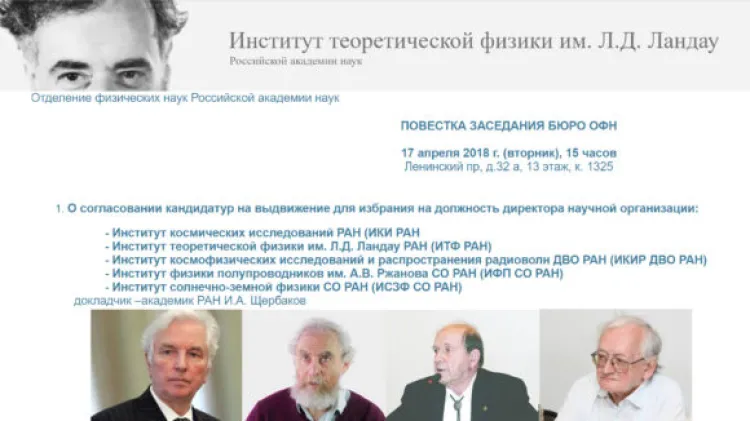
The Landau Institute nominated two candidates: Igor Kolokolov and Mikhail Feigelman - both deputy directors of the institute. OFN Bureau, where candidates from the Institute named after Landau, gathered on April 17, 2018. Quorum hung up with difficulty. Academicians of the Russian Academy of Sciences, former director Fian Gennady month and former director of the Institute for High Plants of the Russian Academy of Sciences, Sergei Stishov, performed at a meeting against Mikhail Feigelman. As a result of the vote, the candidacy of Kolokolov was agreed, and Feigelman's candidacy was rejected. 10 members of the bureau voted for Feigelman, against 11. Thus, the elections at the Institute of Theorfiziki turned out to be disrupted, there should be at least two candidates for their holding. Subsequently, the scientific council of the Institute. Landau expressed bewilderment of what happened and on April 20 turned to the Presidium of the Russian Academy of Sciences with a request to revise the decision on the candidacy of M. Feigelman ( http://itp.ac.ru/ru/news/announcements/ ).
I asked for a member of the OFN Bureau, an employee of the Institute. Landau, academician Alexei Starobinsky to comment on what happened at the meeting of the OFN Bureau. My choice was due to the fact that Alexei Alexandrovich was the only present at the bureau of those whom I know well and who trust. He said that the decision of the Bureau was a complete surprise for him even after criticism of Feigelman was addressed, and added that it was extremely disappointed not only by the result of voting, but also by the principle of making decisions - there are doubts that the collegial decisions of the Academicians group are more meaningful than the decisions of officials subordinate to certain rules.
According to Alexei Starobinsky, Mikhail’s blame was that he introduced the inhabitant of the citation index (in fact, this can rather be accused of the author of this note, which 17 years ago began to compile lists of citation of Russian scientists) and acted as an architect of the Reforms of the Russian Academy of Sciences of 2013. The latter is generally absurd, especially since Feigelman actively participated in the “resistance movement” to the idiocy of that reform. At the same time, Mikhail Viktorovich’s many years of work was not discussed at all as deputy post. The director of the ITF was not made a single critical remark or doubt about his professional level in scientific and organizational activities within the institute.
Now my comment. Mikhail Feigelman is a kind of ascetic, defending the principle of transparency of decision -making in science. He is the leader of the project “Corps of Experts”, in which I participated in an early stage. This project was an attempt to create a community of scientific experts “from below” using simple understandable rules. It turned out to be very difficult to do, a huge job was required.
Nevertheless, the attempt was partially successful: the “case of experts” exists, although not for all areas of science, and is used to a lesser extent than it could. Mikhail also participated in the long and viscous activities of the Fano Commission on the assessment of the effectiveness of scientific organizations, developing the rules for evaluation and achieving their clarity and meaningfulness.
It is clear that in both cases he acquired ill -wishers: both with the “corps” (not all academicians were chosen to “People’s Experts”, and in general, what kind of alternative to the Russian Academy of Sciences is this?!), And with the commission to evaluate performance (not all institutions got into the first group). In short, a man fought for transparency and against the decisions “according to concepts” and was completed.
Generally speaking, the department of physical sciences, in my opinion, is the most healthy part of the Russian Academy of Sciences. Especially sad.
Boris Stern