
Translated material
Links of one chain

Having just received two “masks” for the “passenger” of Mecherslav Vineberg (the best work of the conductor - Oliver von Dokhnanya, the best female role - Nadezhda Babintsev), and a couple of years ago - one for the “Satyagrakh” Philip Glass (special prize choir), the Yekaterinburg opera again went from the trump card and realized the next Russian premiere of the important score from the second half of the twentieth century. Director Andrei Shishkin does not hide that in this way he decided to attract Russian and international attention to his theater - not “travis” and “peak ladies”, but with absolutely incredible names a fundamentally inextricable properties.
Now the "Greek passions" of Boguslav Martin are set here. The fact that this is the last, sixteenth (!), Opera of the Czech composer, as well as the estimated number of volumes of his recently starting complete works (106!), Which should completely keep up with the 2068 (!) Cultural shock. Martin in Russia is almost unknown. The world is also not in the forefront. At home, it takes a stable fourth place after the thigh of the sour cream, Antonina Dvorzhak and Leosh Yanachek. He did not fall into the titans of the twentieth century, bypassing his trunk paths, most of his life-from the late 30s to his death in 1959-spent in exile, never had much success and, moreover, did not fit into an adventional agenda at the end of his life. But from the end of the last century, interest in its colorful, unconventional creativity is growing. In addition, the topic of refugees, which was available in its most famous opera, Greek Passions, has been very close to the time.
 © Olga Kerelyuk
Turning such material into a trump card is a difficult task, but the Yekaterinburg Theater already has developed methods. The case is not limited to one premiere. Work goes to her, during and after. The exhibition in the theater’s lobby, the stage reading of the novel by Nicos Kazanzakis “Christ is crucified again”, according to which the libretto, a symphony concert from the works of Martin, the presentation of the project in Moscow, the mighty landing of Chekhov, the impressive research booklet, a round table in Yeltsin Center on “Opera and Religion” were written. Consultants - from the director of the Institute of Boguslav Martin in Prague Alyosha Brzhezin to hegumen Veniamin (Rainikova) from the Yekaterinburg diocese, and this is not a formality at all.
I would never have thought that I would have been a glass of wine to lively discuss the opera premiere with the representative of the Russian Orthodox Church! The dialogue with the church, which was started by the director Shishkin at the very beginning of rehearsals, is generally an unprecedented move. And very competent. A person similar to Mahatma Gandhi is already in the repertoire of the theater. Now there is a man similar to Christ. So you understand.
 © Olga Kerelyuk
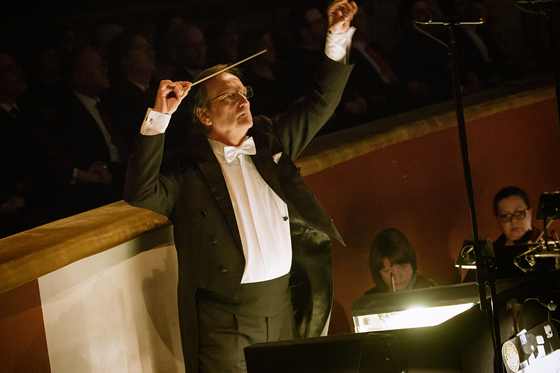
“Greek passions” Martin wrote twice. For the first time-for Covent Garden (therefore, in English, for the Russian production a translation of Sophia Averchenkova was used) and his friend conductor Rafael Kubelik, who was supposed to fulfill them in 1957. But the Board of Directors of the theater rejected the score. And the composer distributed most of the pages to friends for birthdays and other holidays. The second time he wrote this opera for Zurich, but before the premiere, held in 1961, did not live. Now this is called two editions, although Alesh Brzhezin, who gathered around the world for three years scattered pages of the first “Greek passions”, considers them two different operas. The second is much smoother, the first - shaggy, all consists of mounting, very cinematographic speakers, where colloquial speech, different types of singing, folklore quotes, Christian hymns and an emotional, colorful orchestra are mixed. In musically, the orchestra component (behind the remote control in Yekaterinburg is the main conductor of the theater Oliver von Dokhnanya) is the most interesting. For the first time, the restored version was performed in 1999 at the festival in the Austrian Bregen (where in 2010 the stage life of the Vainberg passenger began in 2010). And it was she who chose the opera for the Russian premiere.
 © Olga Kerelyuk
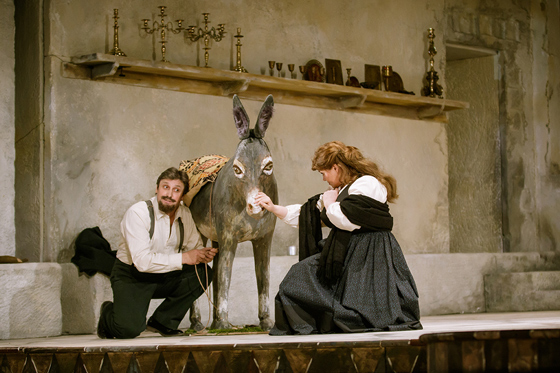
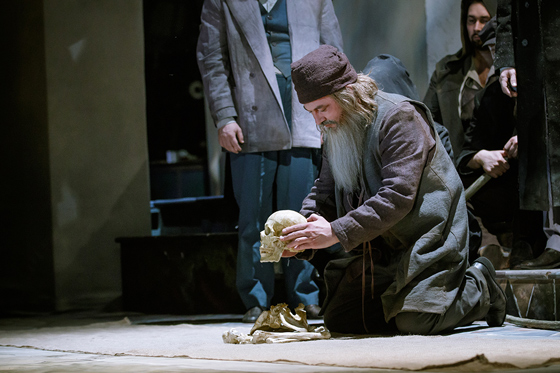
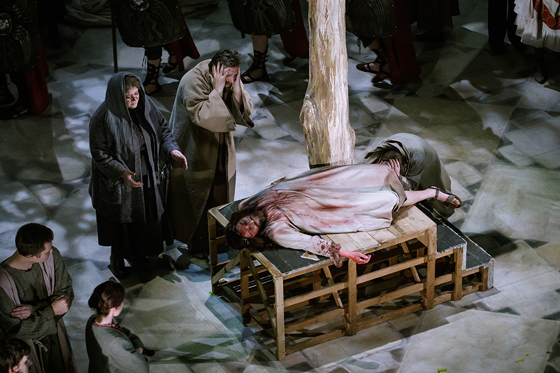
In the lost Greek village of a hundred years ago, a well -established, calm life flows. They play weddings, celebrate holidays. The same closed cycle from birth, death and resurrection is repeated from Easter to Christmas. Two events break it. Refugees from another, ruined by the Turks, the village, led by the fanatical father of Fotius (Mikhail Korobeinikov), ask for help, food and land. Local elders, led by the savvy father Grigory (Alexander Krasnov), refuse them. Another performance of the mystery is approaching the passions of Christ, which is made in the village once every seven years; Of the locals, those who depict the apostles of Peter and John, Mary Magdalene, Judas and Christ himself choose. In the process of preparing with all participants, a serious spiritual and psychological transformation occurs, they are the only ones interviewed for refugees, the shepherd Manolos (Evgeny Kryukov), chosen for the role of Christ, is fond of the most, refuses the bride and normal life, gains popularity among fellow villagers, preachs, even calls for a revolution-that is, it becomes dangerous for those who are valid. Stability. As a result, Father Gregory accuses him of heresy and easily manipulates a crowd that kills Manolos, and Father Fotius leads his people to wander further. Christmas comes.
 © Olga Kerelyuk
This parable can be told with completely different accents. The American Tadeusz Straussberger (production, scenography, light), already familiar from Satyagrah and Passenger), tells her as if as if it were not an author’s theater, but a folk route. But the continuous flickering of good and evil against the backdrop of thin ethnic sketches (good costumes of the English artist Kevin Knight) gives a directorial position. There are no right and wrong ones, everyone is worthy of compassion, even Judas is necessary so that the story continues. As in the final of the “passengers” the director planted opposite each other Marta and her former overseer from Auschwitz Lisa Franz, on the last tactes of “passions” he reconciled nearby on the forefather of all the main characters of his vertep - and both of the enmity leaders, and Manolos in the bloodied roof and thorns of the crown, and his former The bride, who happily married a normal guy.