
Translated material
Owl and globe
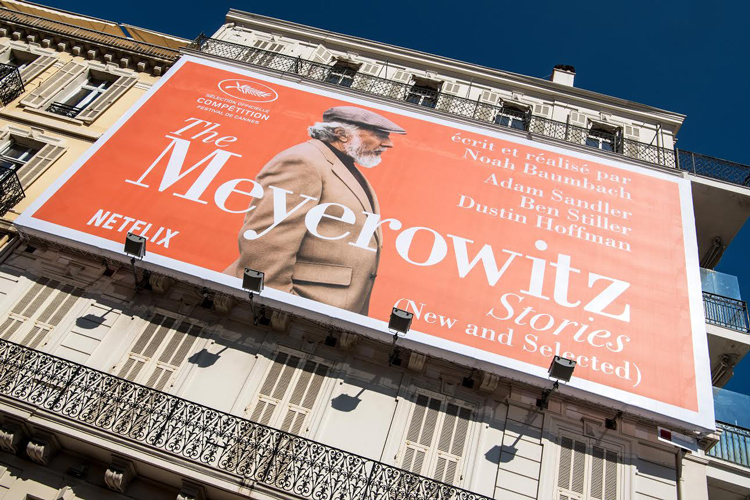
The day before the announcement of the official program of the 71st Cannes festival, it became known that the Netflix online platform, removed from the participation of in the main competition, recalls its films from all parallel programs. The struggle of the interests of Netflix and Cannes for three years now, but only now, among other similar skirmishes, it went beyond the cinema. This confrontation itself is partly similar to what is happening between Roskomnadzor and Telegram : the state structure requires a private player in compliance with the rules that contradict his business model. In fact, like ours, this is a multi -level worldview conflict, in which “old”, “new”, “bad” and “good” do not necessarily form stable synonymous couples.
Netflix produces series and films for streaming broadcasting through its own global Internet platform. Showing in cinemas is possible, but has never been a priority. In France, where a complex system of relations between production and distribution is built, there is a norm that fixes a multi -month window between the premiere on the large screen and stream. Spectators know that they will not see the picture for a long time if they do not get up from the couch and do not buy a ticket. And Netflix produces its product online at the same time for the whole world and is not ready to make an exception for France, delaying the release for one territory for 36 months. Failure to comply with this rule forced Cannes to forget the well -known motto of the “New Wave” “All films are born equal” and refuse Netflix products to compete for the “Palm Branch” without closing for it, however, extra -curric programs ( Netflix , for example, reached the unfinished Orson Wells project , which no one could cope with forty years). But Netflix withdrew as a result - and now they will not see Cruisette Wells.
The additional problem is that the prizes are interested in the platform (they provide additional attention), the festival is interested in films corresponding to high criteria, and there are not so many of them in the world. But even in America, the opinion is expressed that Netflix films are not quite films; Stephen Spielberg believes that they cannot be nominated for an Oscar - let them be nominated for the Emmy television Award. Last year, the art director of the filmmaker Thierry Fremo included two Netflix paintings in the competition-the premieres went under the hooting of the French press, and he almost lost his job under pressure from the distributors. Zugzwang.
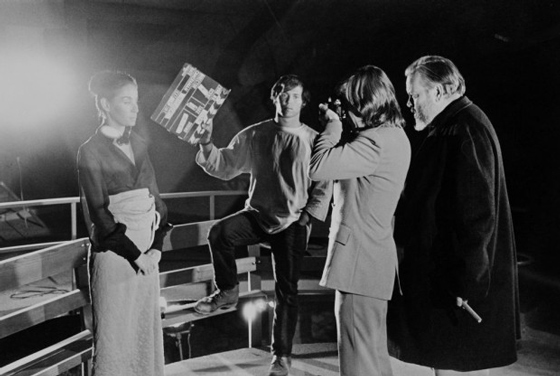 On the set of the "other side of the wind" Orson Wells
The rhetorical arrangement of protectionist measures is talking about the protection of cinema demonstration as magical collective experience. The conflict of individual and mass views is rooted in the XIX century and tangently hurts the theme of the cultural confrontation of America and France. The American Edison invented a film a cinema with eyepieces for one viewer. The French Lumier came up with a device projecting the image on the screen for dozens of spectators. The boxes were roads, a ticket to the boarding house of the cinema, or in a plush chair cost noticeably cheaper, the birth of the movie coincided with the peak of industrialization, the influx of the population into the cities, the division of time to “work” and “leisure” - therefore the Lumier model won, and the entire 20th century, the age of the movie, went under the unspoken patronage of France. Today, it is she who protects the good old totalitarian movie show, when you are locked for two hours in a dark room with strangers and broadcast a directorial vision from somewhere above. (Although in digital reality, individual viewing no longer cancel the collectivity of experience: the next season of the Game of Thrones is watched alone or in a small company, but discussed in social networks with the whole world.)
It is not easy to give in to the old world: the snails of Escargo are attacking Hamburgger, Lumier - Edison, and French actresses - American fighters with a harassment. Everywhere there is a taste of politics; Those who scold the festivals for political decisions do not understand what they are talking about - cinema is impossible to unhook from it in any aspect. The whole system of large European film festivals arose as a projection of the political situation of the middle of the 20th century: the first of them, the Venetian bridge, is the beloved toy of Mussolini and Goebbels; The Cannes festival was conceived in 1939 as an anti-fascist counterweight, but took place only after the war, and Berlinel arose in the western enclave to tease the Soviet ones from behind the wall. After the disappearance of the USSR, it was possible to somehow redistribute the functions and pull the old festivals on a new globe-but here, as luck would have it, the Internet appeared.
In the XIX century, another supporting design of the Cannes festival is also rooted - it stands in the film market, and the film market is on the author’s law, the main idea of which was formulated by the Berne Convention of 1886. 130 years have passed. Content, as a spirit, is worn over the ground, but films are still sold “on the territory”, by countries - and no one dares to break or reform this system, tightly related to the two -century concept of the national state, which today, as they say, in Question . For Netflix , it’s not that there are no state borders at all (packages for different territories differ) - but they are purely technically easy to ignore.
In addition, the paradox is that the struggle for sovereignty in the global world often leads to opposite results. So, Russia, which defended Crimea and itself from NATO aggression, has no borders legally recognized by the world today, and the international from the International Moscow Festival, due to football, has been shifted from June to April, there are no dates - like a medieval peasant, lives on the cyclic calendar of key events; The festival without clear dates in the annual world film industry, by definition, cannot have anything to do with it. It turns out that genuine isolation is possible only with synchronization with the world. Susynchronization deprives the ability to dictate its conditions.
Conditional Netflix strikes on other, less noticeable, supporting constructions of the Cannes festival. Throughout his history, he relied on Auteur 'A-the patriarchal figure of the director-demiurge, the earthly projection of the Abrahamic God (women-director and today-rare guests on the Cannes path, while some "Tripe" easily brings their presence to 46%). Netflix , like other manufacturers of multi -part content, relies, rather, on the figure of Showranner, which combines the functions of the screenwriter and creative producer. The director of the episode of the Black Mirror can be Joe Wright or Noun, but his author is alone - Charlie Brooker, who never got up to the camera. Auteur 'function and from the 20th century - to dominate, the function of Showranner is to come up with stories and concepts. In this model, the director is about horror - an ordinary artisan, one of many.
Netflix is an even more serious threat to the power of the curator - priest, Thierry Fremo or Zhakoba’s housing, an obligatory intermediary between Demiurge and the flock. All people are so different, and the content is so omnipresent that right before our eyes, films cease to be divided into “bad” and “good”. Dozens of arbitrarily combined circumstances become a factor in viewing or non -view; The “taste” of the curator or criticism fades into the background, knowledge of the audience and the ability to interest it come to the fore - but algorithms that already today know more about us than the closest relatives are much better.
With the beginning of the stormy changes in the world of content, the Cannes festival took the position “over the fight”: any trend must first prove its solidity. The existence of TV shows on Croazett was noticed five years ago: in 2013, Jane Campion, the only woman-the Golden Palm branch winner, who led the main jury, spoke somewhere on the side of the “top of the lake” (in 2017, David Lynch with Twin Pixes had to be launched already along the main ladder). It remains to understand whether the festival has seen from its height something important.
They may object to me that Cannes have existed for seventy years and will easily survive Netflix . Yes, this is so, because the festival is a window of state policy of the country that spends a lot of money on culture, and Netflix is a purely capitalist enterprise and tomorrow, having lost competition, leave the stage. While there is a political will, the Cannes festival will continue to exist, even if it turns into an analogue of Eurovision-a show of provincial ambitions and geographically marked freaks, which is not related to the modern musical industry (something is already squeamish: my colleague, seeing the films of directed directors in their countries, joked that this year “Russia and Iran would compete, who more of them are more of them. North Korea").
The question is not who will win - Netflix or Cannes; The question is how much the victory will get. It is possible that Thierry Fremo will soon agree with Netflix . But, judging by the comments of Russian or American spectators who are not immersed in the topic, the reputation losses of the festival, a clamping progressive content of the content, are more today than the Internet platform. Too active defense of its borders in the eyes of users turns the Cannes festival into an analogue of cinema Roskomnadzor. The English -language press is unanimous: the recent podcast of the portal Indiewire is called “Cannes against the whole world” - it discusses whether it is time for North America to acquire the “palm branch” with its own analogue. Alas, the Google search schedule for 2004-2018 shows a stable global decrease in interest in the most brilliant festival and its prizes - and this is very sad.
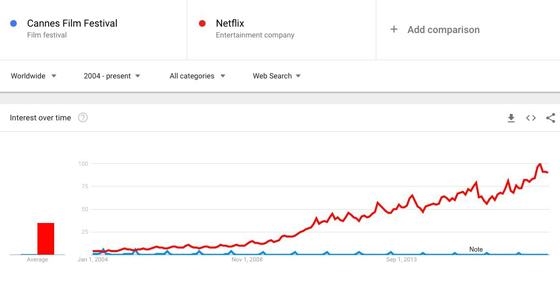 A comparative schedule of interest in the Cannes festival and Netflix in Google Trends
But there is another, even more serious, question that arises in connection with this conflict. How much progress can a person can endure? And are those who are trying to insert his sticks into the wheels - at least for a while, until the protective mechanisms are developed? The recent performance of Mark Zuckerberg in the American Senate with a mass consciousness was reduced to the joke, in which the grandfather asks her grandson to connect the printer. But the horror of the situation is not that senators and congressmen do not understand how Facebook works - the horror is that Tsuckerberg himself does not fully understand this, who answers the questions too often: “ I Don ' t KNOW " .
The plot with “Russian hackers”, data leaks and a political scandal in connection with the intervention of a foreign state into the elections gradually out of the election and opened a much more serious problem. It turned out that a person, as in antiquity, is again surrounded by forest - digital jungle, where he was impaired by the dangers that have yet to be described and explored. And it turns out that the pioneers of the “Economics of attention”, creating algorithms that help to keep the user on the site as long as possible, did not at all imagine the political consequences or their influence on the human psyche. They did not know that the red icon of the new notification would be perceived as an irreversible stimulus (on Facebook , they first wanted to make it blue, and then world history would have developed differently) and that the movement of a finger on the smartphone’s screen, like a dog Pavlov, is synchronized with dopamine remuneration for likes and would cause narcotic dependence. They did not think that personal data could easily be stolen and used to manipulate the elections - as well as algorithms that automatically load the next video for you, similar to the previous one (therefore, there was more incriminating evidence for Hillary Clinton on YouTube and it was given to users more often than a Trump compromise). And if the old -fashioned film claims to lock us in the cinema and gobble up for two hours of our time, then the option “look next” on YouTube (or at the same Netflix ) claims to eat time for days, infecting our consciousness with viruses of unknown origin.
It is possible that all these current problems and new generations of digital natives will develop something like mental antibodies, and in a hundred years they will remember about Facebook in the same way that they recall the Spanish epidemic today, at the previous stage of globalization of 100 million people. Recent studies show that representatives of the X generation (that is, people born between 1965 and 1981) use social networks 40 minutes a week more than the following millennials. In addition, middle -aged people - and this is a large and most economically active group - less often than others put down smartphones at the dining table and more often use several devices at the same time. And it is precisely to these people, one foot standing in the 20th century, and the other in the XXI, today you have to rush between the "old", "new", "bad" and "good", to break between growing contradictions - and to comprehend them.
When they try to pull the owl on the globe, we must not forget that the owl is alive and it hurts.