
Translated material
Language contacts in the north: what is it about?

What languages speak in the north of our planet? Who speaks on them today and how did the ancestors of these people interact with each other in the past? How did these contacts affect the original languages of the North and in Russian? Are the language contacts that we see in the north, compared to those that linguists in other parts of the world, are unique?
We are trying to give answers to all these questions in the framework of the project “Dynamics of language contacts in the circuspolar region”, based at the Institute of Linguistics of the Russian Academy of Sciences (with the support of RNF). The topic itself in some sense is vast: the northern languages are about seven dozen, and in order to carefully trace the structural changes that occurred due to contacts with other languages, collective work of about the same number of specialists will be required.
We decided to go by Case Studies: we took five linguo-geographical areas in various parts of the circumpolar region (the Arctic region in the eastern and western hemispheres) and for their languages we create detailed contactological descriptions, with the idea to expand, extrapolate that specific for the north, which will be found as a result of this part of the world at all.
When linguists talk about language contacts, they mean long-term interaction between neighboring language communities: in some cases we are talking about ten years, even about hundreds. The interaction takes place, of course, at the level of specific people, and not abstract communities: specific people communicate with their neighbors with another native language. For example, in the market, in general for residents of several multilingual villages, or during regular meetings to exchange livestock (in order to increase genetic diversity), or in the case of interethnic marriages, or simply because the local administration decided to organize the village and “translate into settlement” representatives of different ethnic groups, each with its own language, we are already moving to the history of the Soviet North in the 20th century.
Language contacts
However, before, a few more words about why language contacts are generally interesting to linguists, and not just anthropologists or sociologists.
Firstly, it is interesting in what language people are explained with each other: it happens differently. In some situations, some neighbors learn the language of others, in others-everyone learn each other's languages, and in some, the third language is used, usually the language of the dominant social group of this region (for example, Russian in Siberia or English in North America). It happens that everyone speaks their own language, but everyone understands each other - this is especially common in contact of closely related languages, but not only.
As a language of communication, pidzhins can be used-as linguists call the spontaneously arising simplified variants of some kind of language. For example, in Taimyr in the middle of the twentieth century, Pidin “Govorka” was used, in which the vocabulary was mainly Russian, and the grammar was partially local, that is, Nganasan, Dolgan, possibly also of the Evenki and Ennetskiye (“ Do you need a product ?” - how much do you need the goods? ”,“ I don’t have a sled - “I have no sanya”, “I can’t soar the early year old - relatives in relatives in relatives in relatives The antiquity could not marry each other ”, etc.).
Secondly, language contacts most often do not pass without a trace for the native languages of contacting people themselves. If a person regularly speaks two languages, in the sentences in one language he can begin to use the words of another language, and with some words this happens so often that they become part of the first language vocabulary (this is how in the 19th century the borrowing from French entered the Russian language). With these words, new sounds, or phonemes may appear, atypical actually for this language. Or tracing paper from another language begin to be used in the language (cf. I have to say in the speech of Russian -speaking people living in English -speaking countries).
It should be noted that multilingualism was generally very widespread around the world before the appearance of strong large states with a single standardized language, so our modern mono -language is a rarity in the language history of mankind. So, regular contacts between different linguistic communities often end in changes in these languages, and after centuries it is not so easy to distinguish that the language was inherited from its proto-language, which developed independently and what was borrowed as a result of contacts.
Along with this, the identification of such contact changes for each specific language can tell us something new about the history of its native speakers. Multidisciplinary research is especially fruitful: data from archeology, population genetics and history are used by linguists to search and explain contact changes in the language.
The essence of the project
So, after the theoretical retreat, we will return to our project dedicated to language contacts in the circumpolar region. On the one hand, we are engaged in sociolinguistic reconstruction, that is, clarifying the one with whom and in what language people communicated, who today speak the languages we are studying, and on the other hand, the search for contact phenomena in these languages themselves.
This is possible, because each of the members of our team specializes in his own language, or his languages, is no longer the first year, which allows you to move from purely descriptive work - what kind of phonemes, toxes, affixes and ways to combine words in sentences are to search for foreign language elements: phonetic, lexical or grammatical ones. At the same time, foreign -language elements can only be found only in close cooperation with specialists in the languages from where these elements came, that is, this is really collegial work.
What kind of linguistic-geographical areas do we study?
- The upper pelvis and the middle Yenisei (the languages of this area: North Selkupsky, South Selkupsky, Ketsky, Evenki, Russian) - O. A. Kazakevich, E. L. Klyachko, Yu. E. Galyamina.
- Taimyr (Tundra Nenets, Tundra Ennetsky, Forest, Nganasan, Dolgan, Evenki, Pidin “Ralge” on the Russian basis, Russian) - O. V. Khanin, V. Yu. Gusev, M.K. Amelin, O. A. Kazakevich, E. L. Klyachko.
- Lower Kolyma (Yukagir, Even, Chukotsky, Yakut, Russian) - M. Yu. Pupynin, M. A. Sidorova, D. D. Mordasheva.
- The Kenaean Peninsula of Alaska (Alutik, Dena'ina, Alaskan Russian, Russian, English) - M. B. Bergelson, A.A. Kibrik.
- Inner Alaska (Verkhneku-Kovim, Dena'ina, Koyukon, Ingalik, Central Yupik, Russian, English)-A. A. Kibrik, M. B. Bergelson.
We also included in the sphere of our interests the linguistic-geographical area “Lower Amur and Sakhalin” (Nanai, Ulchsky, Orochsky, Negidal, Evenki, Nivkh, Ainsky, Russian-V. M. Sustanova, O. A. Kazakevich, E. L. Klyachko), because he is practically no different from it from culturally from Circumpolar, but from the point of view of geography belongs to a completely different region. For us, this zone is a control group, which will help to separate the features that unite all the autochthonous communities of Siberia, from truly Arctic.
The vast majority of languages of the circuspolar region are languages without a developed written tradition, and therefore the historical memory of who and in what situations spoke in what languages it is exclusively orally. So that in the situation of the universally developing language shift to the state languages of the region (Russian, English, Norwegian, Swedish, Finnish), this historical knowledge was not lost, we are engaged in an important matter of fixing these stories, while the last media of historical memory are alive. To do this, we annually go to linguistic expeditions to the north.
In recent years, a lot of literature on the topic of language contacts has appeared, however, the circumpolar region has almost never the subject of such a study - despite the fact that there are objective parameters that are characteristic of this region and, possibly, affecting the features of language contacts:
- extremely low population density;
- Large distances between different language communities, and often between members of one language community;
- annual migrations for hundreds of kilometers;
- difficult climatic conditions and universal features of adaptation to them;
- Hunting and collecting, partially cattle breeding in the complete absence of agriculture, which means a much smaller degree of binding to a particular territory.
In addition to the research of specific linguistic-geographical areas, we also study the features of the Russian language of the bilingual native speakers of the autochthonous languages of Siberia (N. M. Resonova, P. S. Pleshak, I. A. Khomchenkova). For example, we have already discovered and described such curious phenomena as spatial and temporary expressions with the veneration of the preposition, like we lived, pluskvam percessual constructions, like there were non-standard compositional constructions, such as flour-da crook-da.
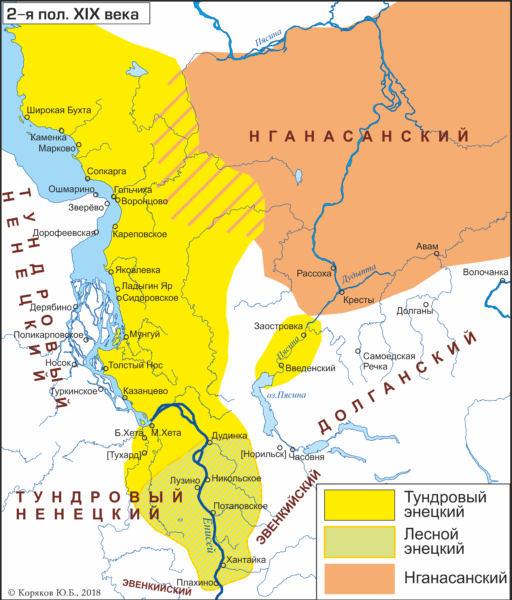
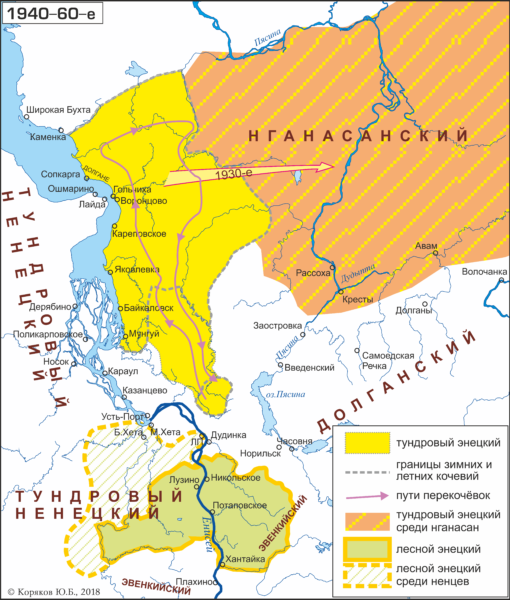
Finally, we make a geographical settlement database for all Arctic languages with visualization in the form of printed and electronic language cards (Yu. B. Koryakov). Maps created by us on the basis of these censuses, various ethnographic works and our own sociolinguistic interviews with modern media, tundra Nenets and Nganasan languages clearly show how the geography and nature of the contacts between two groups of the Ents-forest and tundra, as well as their contacts with None and Nganasan neighbors.
These cards are interesting not only in themselves, but also as an important addition to the catalog of lexical and grammatical borrowings in these languages that we create. In this case, all Taimyr’s languages are related to each other (that is, they have a common primary language), therefore, contact influences are cases of secondary convergence of languages, especially interesting for historical linguistics.
Ultimately, we hope to gradually unravel the tangle of the interaction of Taimyr languages, so that it becomes clear who, how and when to affect each other and what common features were inherited from the proto -language and which developed as a result of contacts. Similar tasks are also performed for the rest of the linguistic-geographical areas: Lower Kolyma, Taza-Senisei, Kenay Peninsula of Alaska and Inner Alaska.
Olga Khanina,
Art. scientific. sore. Institute of Linguistics of the Russian Academy of Sciences,
The head of the project "Dynamics of language contacts in the circumpolar region"