Translated material
I saw these books burn
Can a book be considered garbage?
We continue a series of materials about garbage and culture. We already talked about books that tell how garbage changes the world. Today we are talking about the fate of the discarded book.Books are still persistently anthropomorphic - they have a human fate. They are described by humanoid cultural metaphors. There is a main book, a book god, in the image and likeness of which each of them is created. The book, like people, produces garbage itself - it has a black and final options. The book has a code, sign order - DNA; Writing flour is described in obstetric terms.
I give the most general view of the book, a profane judgment, a wiped metaphorical series, but it forms a mass attitude to the book. And this is exactly what we will talk about. The book, like a person, has three destinies - individual, communal and global. Individual (fate of one copy) is little predictable. And it depends on rock, planids - unthinkable, underwear adventures of the book (as things) are possible, its perfect unclaimed is possible. The communal, tribal fate already depends on internal book content. This is the total fate of all copies of the book belonging to the pen of one author - and depending on the status of the author, their share is approximately similar: how is the fate of the inhabitants of one state is relatively similar. Is it rich, safely - all members of the community to one degree or another share general success and failure, contentment or collective sorrow of their almost state community. And there is also a global fate - the fate of the book in general, as part of the universal culture. In the same way as we (all living and all dead) are an additional universal fate.
And if you see the heading in the mass edition - for example, “The Death of the Book”, then you, having stuck a conditional greyhound for the love of drama, of course, will immediately think that we are talking about the widest issues, suppose that electronic media is supplanting the paper.
And if we are talking about the death of a book of, say, writer Alexei Kuzmich Yugov “On the Big River”, the publishing house “Young Guard”, a cardboard binding, 1960 release, 574 pages, circulation - 27,000 copies? There is no copy number, and it should not be - it is not put in mass publications.
The book “On the Big River” was bought in 1963 by Illarion Ishchenkov, a young engineer. Why is God the news, it is about the construction of the Volga hydroelectric power station. But perhaps the young engineer wanted to read about the construction of the Volga hydroelectric power station, especially since there was hope that in front of him is a production, but the novel is on the cover of a young man in a checkered jumper look at the girl with a beautiful sixties gaze, affectionate, condescending, hot. Like an Yan-prisoner yin-maid. In the family of Illarion Ishchenkov, replenishment was expected. The sun was hotly shining for half a day; The book, right, was read. Time passed. The young moved to the new -built panel house in the submarcade distance. This was not a sign of sadness and failure. Yugov moved with them and received a new regiment - the young built racks throughout the wall. Without any glasses, simple, from mental warmth and sticks: racks - the center of the house of Soviet pupils. The book meeting grew: the signature publications went, it was possible to get “World Literature”. There Yugov stood forty -five years. They never touched him - but this is also happiness and peace, the Lord also does not often take us from the shelf and grinds. When they grind, scary. Sometimes it hurts. And then one day the Yugov was removed from the shelf (the racks went under demolition, the apartment came to at least somehow update), then I had to go through the audit: did Yugov go up to his respectable years or fell; Is he an elderly lad (all the best - in his youth) or antiques. Also an unpleasant check, and we have to go to this viewing.
Yugov was taken to the entrance, to the first floor, to the mailboxes. There one woman took him. And she knocked, and sighed, and laid it back. Impression for Yugov. For a long time to remember this, standing on a shelf. But in the morning, the “Big River” along with B. N. Patrikeev, who called “Thirty years with a spaniel”, was taken to the trash and laid on the cardboard. Two ladies passed, sighed: Oh, oh, where is our spirituality? And then two pleasant young people - Azamjon Rizoev and Chupon Nakhmiddinov - took him to ride a bicycle and took him to another wonderful person, to the Businovsky hill. Yugov’s man stroked the cover and shook a little in his arms. And then the Yugov was gutted, put on a conveyor and taken to such a large boiler where the paper mass is spinning. And he died.
But Ishchenkova survived. And the lady who leafed through him in the entrance was me. And I remember this big river. But the whole point is that the Creator of our Yugov is the eldest, so to speak, Yugov, Alexei Kuzmich is a writer not only about the hydroelectric power station, but he was also a fairly obscurantist and insisted on the Slavic origin of Ahides. But I did not read the first lines of the book and still somehow pulls-was it difficult to read? The first lines say so much, but no one read the book this century. And on the Internet there is no text “Big River”, if only in the RSL. You won’t even know what is written in the first words.
Yugov’s history is a typical story. We are free from the Soviet libraries. The data of the Levada Center are as follows: in 1990, 10% of families in the USSR had more than one thousand books in the USSR, in 2009-2%. I suppose that now this figure has changed little - nevertheless, the persistent rabs are held by two percent - but we are talking about mass movement.
The book made to the garbage tank is a familiar picture. But at the same time, there is still a reason for a dramatic conversation. Can a book be considered garbage? Become a full part of garbage traffic?
What protests against this event in us? Is this book anthropomorphism? Upbringing? Fear of darkness? The idea of the book as a sacred subject? And in the circle of Christian culture, the book is originally unconditionally sacred?
I collected a list of opinions (if you do not call their leisure conversations) on the topic “Can I throw books?”, Passing the forums, where they asked this question. Forums are very different, mainly parental forums. These are comfortable sites for such questions. The most common answer is “No, the book is sacred.” Even in places that position themselves as an enlightened spaces (for example, the Moscow VKontakte group “Bukinist. Service for the salvation of books”) can be found this convenient judgment: “The book is holy. If you found us, then you are just such an opinion. Here you can change with each other found and almost missing books ... ". Missing books. We enter the sacred field.
Other typical answers are “a book like bread, it cannot be thrown away. This is a sin. Minus to karma ”,“ The book is living; And you throw away the old cat when you get tired of it? ” A few more types of answers are the following: the book is a product of labor, primarily spiritual (high), and therefore not a thing, and is not subject to a great clothing recycling path.
So: holy, living, sacred (throwing - sin), not a thing, more than a thing.
Assigning the status of holiness (“children are holy”, “grandfathers are holy”) - the tradition of recent times. And only such a statement sounds - every dispute stops on any forum or on a social network, excluding Facebook (there children do not ride there). Assigning this is a way to build a hierarchy of inviolable around you. Allows anyone who wants to create a protective cocoon - a harmonious, archaic, inactive model of “correct” world order.
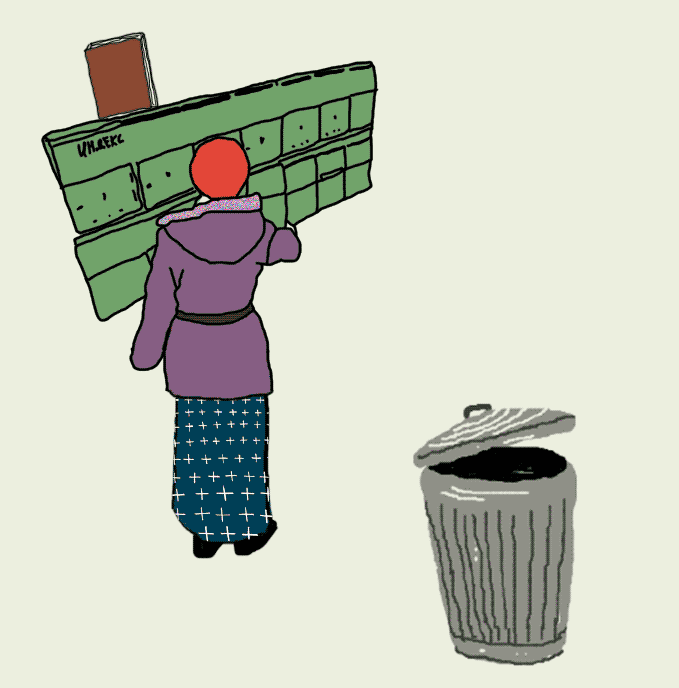
In Facebook, the expulsion of books on the trash (that is, turning the book into garbage) is rarely discussed, more often an intermediate link is discussed - the removal of books on the windowsill in the entrance. This action is not quite accurately called bookcrossing. When discussing exile, the theme of the “bad” book always sounds: the book was put on the threshold, because it is bad. Put in a corner. This allows you to give everything that happened to the shade of a pure, well -intentioned business, but excludes the idea of bookcrossing: is it possible to voluntarily share what is bad? The speakers often add: “He only put the book to the entrance, they immediately took it. So, someone needs it! " Most often, books are taken (and hand over to waste paper) house workers. But - that you do not see, that does not exist.
But all this is a philistine attitude to the new “garbage” status of the book. Professionals do not see further, but more.
So far, in good houses, they referred “Bukrossing” Bad books, in Tver Mikhail Arkureev, a book editor, an intellectual, a lover of book collapse and flea markets, a book seeker, walked along the streets and muttered: “What to do? To do something "?.
So the name of his Bukinistic store was established. However, he thought whether he would call him “Lolita”, or “decline and destruction”, or “who is to blame?”. The store "What to do?" So far, the network. Now this is from the VKontakte page with 473 subscribers and anxious (for starting business) activity. In the future, Mikhail plans to make a kind of media out of the group, and the store is transferred from the Internet to reality.
During the biblinochichi, he performed in the Tver Gorky, talked about his book finds, about Bukinistic trade in Russia. The name of his speech was rattling - "I saw how these books burn."
But in fact, Mikhail did not see the books burn. We - perhaps for the time being - live a life that is quite protected by everyday life and did not see much of what we know not as a picture of the world, but as a picture, as a “distant terrible”. Not each of us saw dying, and not many saw even such a little death as a burning of a book. But the type of book burned is a powerful cultural blow: the book execution is filled with too many connotations and meanings. Books burn badly, hard. And if the book in the stake is revealed, then the pages standing under the fire on end begin to wrap up, and it turns out something like an ash rose-an additional neurasthenic gift to the viewer.
Here is Evgeny Gintov, the owner of the Irkutsk "Book Shelter", saw how books burn. On the shore of the Ushakovka river in winter, homeless houses burn books to warm up. And here, in general, you can’t say anything: winter night in Irkutsk without a fire is easy to freeze to death. Here the books are needed to death - another conversation. Although the well -known sense of incorrectness and, possibly, irreparable incorrectness remains: “In the same way, the apostle Peter warmed up by the fire on the bonfire,” the student said, holding out his hands to the fire. - So, then it was cold. Ah, some kind of scary night, grandmother! Until extremely dull, long night! ” This is a sense of connectedness of everything with everything with the student (“touched one end, as the other tremble”) breaks at the Irkutsk night fire, where also a terrible, dull, long night, and a clear misfortune - and yet books burn in this stake.
Mikhail Archireev and Evgeny Gintov are busy with the same thing - they save books, withdrawing them from garbage everyday life. Moreover, they are completely different people, and are engaged in this work for reasons excellent from each other. Michael - wants to return the book its value, Eugene - to maintain the right life order.
Michael in his work is faced with an unusually interesting situation that has developed in Tver. The fact is that in the city, since the fifties of the last century, two powerful printing plants have been working: the Tver (Kalininsky) polygraph complex of union subordination and the plant of children's literature of republican subordination. These were powerful enterprises that produce really millions of books - a day of 150-200 thousand each - with their mythology, with their history of well -being and falling, with the love that workers have for the Soviet years of prosperity of enterprises. To their "imperative." But the truth of the devices of Soviet labor, a kind of work rent (although Simon Cordons, the author of the term, will rather call this by assigning a resource) such that the workers in the mass order carried the products of their own labor effort from the factory - namely the books. They stole them, roughly speaking.
Mikhail's monologue:
- Tver is scored by books, I saw apartments where the older relatives worked at the Polygraph Combine of Children's Literature, forced by children's books, which no one had ever discovered. There are several thousand books. This is my topic - the wrong side of the book culture, the new story of the existence of the book. What is the status of the book in such a space? Half -car, half -beam. That is, they perceive the book as a kind of free resource, they want to get rid of it, but at the same time they want to get some money for it. As a book prospector, I see a lot of frank paintings. Recently I bought a posthumous library of an archaeologist, a good specialist, a collector. Two thousand volumes.
I enter the garage and see that if not gold, then silver of Russian culture, unique collections of low-engine literature, from the 1950s to the 1980-1990s, rare things, and I see that the books are already dying. Relatives, of course, are completely indifferent, they would be free to free the garage. But not free!
And the waste paper? There, in tons are handed over in a skip, for a small bribe, books. Recently I was at one of these bases, they say: in a month 16 tons were brought.
You asked about burning books. I have a different element - water. I saw how they rot, how hundreds of books lie in a puddle. This is my fire that I really saw. Recently, I had a successful find - in the flea market I managed to buy three magazines, two hedgehogs and one Chizh, the very ones that are so loved by all of us, the classic of the genre. They sold them to me for 300 rubles. I do not know how and what the sellers came out there, but they wet the magazines. In the cold, they were caught, they could knock on each other, and they rang-bam-bum. Two ice hedgehogs and one Chizh. Although I dried them very carefully - of course, they lost their shape. For collectors, two magazines are now uninteresting at all. I immediately saw that the two were very bad, but they looked at me and said: "Buy us, please." And this happens in the flea market, where people have a commercial idea, a commercial component.
I would not want to talk about barbarism, and even more so new barbarism - this is stupid. Barbarism is the usual state of the life of culture.
But what is happening now with books makes me think about something else.
I have the feeling that people want to get rid of the past. The book is often associated with the past, they want to get rid of them and make naked walls. Minimize other people's voices so that the walls do not make noise so that they do not ask questions. And books ask questions. You read the roots, and something begins to turn over, even if you read the name "Russian spelling dictionary." Perhaps this desire for silence is associated with an attempt to minimize information.
Suppose I want to relax so that it does not make noise around, so that there are naked walls, so that there are no extra questions, while the person is in his space. Previously, this was not - they ran after the information, the book was almost the only source of information. But, on the other hand, I am now opening a buckwork store and open it for one simple reason. My buyers are people of 20-30 years old, whose parents have already made bare walls, and now they want to fill them with the right things, the right issues - if we consider the rook of the book as a question and as a challenge. And they are ready to pay if this is a beautiful book, if it is talked about well.
There is a certain barrier of a trouble -free waste. For myself, as a seller, I installed it intuitively. This is 300 rubles. People are almost always ready to spend 300 rubles on a book - and this is half as much as on the ozone.
What is the meaning of our store? In our city there are no intermediaries who would connect two worlds - the world of waste paper, the world of burning books, with the world of people. In Tver, there is no Bukinist for 4 years. People have already begun to forget that the book could cost something, that you can not drag it into the trash and not to take it to the base, but try to take it to knowledgeable people. The lack of institutions gives rise to a neglect of the book. The place where there is an expert, ready to return the book to the current space, is the same basic thing as a university, like a clinic. In my understanding. The intermediary should not only evaluate, but also recommend the book. To captivate it, to show her. This is a kind of public book criticism. Returning the book of reputation.
I made a VKontakte group, because Facebook is arrogant, it is more about good text and for older people, and VKontakte is just the target audience that I spoke about twenty to thirty -five, creating unbearably pleasant publics, about music, about books. For 2 weeks, I scored 473 subscribers, and this is a lot, because in the provincial city there are a thousand subscribers, two, three - this is very good. Strength went from libraries to other places, here is VKontakt. In addition to our - new groups, there is, say, the community of the Tver Bukinist. A powerful book exchange, a thousand seven hundred and thirty subscribers - this is a very good story.
Life cannot be canceled, as Alice said. “Never happened to nothing.” There is no Bukinist in the city. And many books. And garages. And water. And people themselves are organized to establish book traffic. I'm not afraid of competition - I want to get as many books as possible from this fire.
And Evgeny Gintov has a different metaphor, another shock. Он открыл «Книжный Приют» во дворе своего дома. Дом в частном секторе Иркутска, деревянный, во дворе Евгений поставил промышленного размера навес и жестяные стеллажи. Так на личном участке он призревает сейчас 40 тысяч книг. Все они были выброшены.
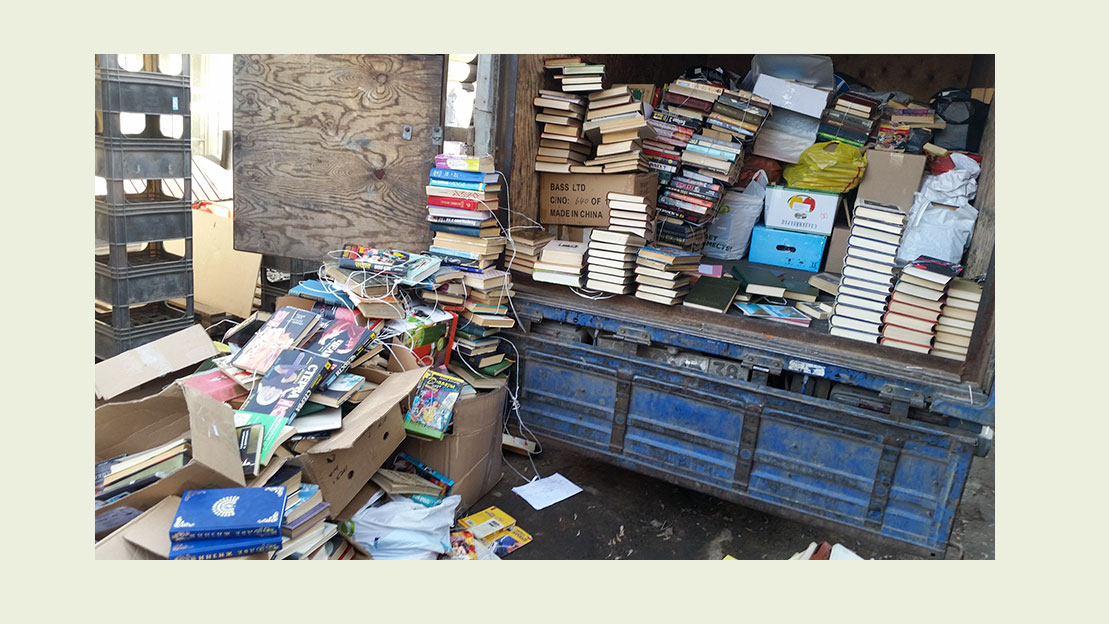
Фото: Книжный приют в Иркутске
Евгению двадцать восемь лет, он хорош собой. Это совсем другой человеческий тип. Он лейтенант в отставке. Криминалист, закончил институт МВД. Не захотел служить, потому как там — система. А он человек с идеями. Перебирал работы, служил в десанте.
Открыл небольшое дело по сбору и утилизации макулатуры.
И столкнулся с тем, с чем и Михаил, — с массовым вымыванием книг из домов.
Своей макулатурной приемкой он занимается три года. За это время сдал на переработку 400 тонн макулатуры и заработал 3-ю степень остеохондроза.
Это интересная история — из чего сейчас она состоит, макулатура? Где ты, мусорный археолог? Бумаги, как мне кажется, в домах меньше, чем книг. Состоит, помимо книг, вот из чего: из огромного количества глянцевых журналов, детских тетрадей и секретной документации. Бумагой сейчас пользуются только чиновники и дети.
А вот документацией Гинтов как раз и занимается. То есть, собственно, заключает договоры с фирмами, которые обязаны сдавать свои архивы на утилизацию. Это и фирмы, которые заинтересованы в сохранении коммерческой тайны, и госструктуры, в бумагах которых присутствуют персональные данные граждан. В этом деле есть свои тонкости: разные степени секретности и разные степени измельчения (если пускать бумагу в шредер). Но — во многих организациях по регламенту положено сжигать бумаги.
А Евгений за эти свои макулатурные три года добивался, чтобы архивы не сжигали, а «пускали в производство». Он говорит: «Брал на себя ответственность за данные и пытался дать жизнь переработке, потому что если мы еще будем все свои бумаги сжигать, то туалетную бумагу и салфетки станем у китайцев покупать. Although what am I talking about? И так покупаем. Маленько у нас система построена не совсем адекватно: к чему сжигать бумагу, потому что кому-то надо отчитаться? Почему бы не замешать в чан, не отделить краску, не переработать? Никто не хочет заморачиваться. Ну вот, а мной 400 тонн сохранено и пущено в переработку, поэтому я, можно сказать, целую деляну леса спас.
Хотя когда проезжаешь мимо железнодорожных путей (у нас улица есть, Трактовая, я постоянно по ней езжу) и видишь в просвете домов платформу со срубленными деревьями, уложенными выше трехэтажного дома, и она проплывает мимо тебя, со всей этой своей несообразной высотой, со всей мощью — нерадостной мощью, — я просто не понимаю, что делаю. Крупинку какую-то вношу, а она тут же растворяется. И лес уходит этими гигантскими платформами в тот же Китай — на салфетки».
Но Гинтов работает: устраивает акции по сдаче макулатуры не за деньги, а за саженцы. Даже и живо все проходит. Евгений говорит: «Мужчина один приехал, сказал: „Я закрываю фирму, уничтожьте мои данные и дайте мне елку. Я назову елку в честь фирмы”. А ведь я, если подсчитать, спас практически девять тысяч деревьев».
Гинтов — спасатель. Спасает макулатуру, лес, книги. «В городе выбрасывают очень много книг», — говорит Гинтов.
Он привозит их под свой навес. Пять в дней в неделю собирает макулатуру, два дня разбирает книги. Прийти к Гинтову в приют может каждый желающий, в хорошие недели бывает человек пятьдесят.
До определенного времени Евгений отдавал книги бесплатно. Но были нерадостные случаи. У него два телефона: один для макулатурного сбора, другой личный и приютский. И так случалось, что в выходные приходили к нему жаждущие света и набирали мешки книг. А в понедельник звонили ему же — как сборщику — и приносили эти книги сдавать. «Я же криминалист, — говорит Гинчев, — я людей помню. Книги помню. Однажды обратился ко мне детский дом — и я собрал для детей небольшую, но крепкую библиотеку. Выбирал хорошие детские книги. А через неделю звонят мне оттуда же, но уже на телефон приемки: ой, приезжайте, макулатура у нас завалялась. Приехал, вышел из машины. Они, конечно, узнали меня. Что ж, ну покраснели. Я просто забрал книги и уехал».
С тех пор каждая книга в приюте стоит 50 рублей. Приют устроен как книжный развал — свою книгу там надо искать. Но в этом есть и удовольствие. Гинтов не исправляет нравы — он возвращает книгу на положенное ей место: «Люди жалуются на цены в магазинах — и приходят, и ищут. Книжный приют создает баланс между теми, у кого переизбыток книг и у кого нехватка. Вот же она, книга, лежит, и если она может послужить кому-то, то в этом и цель».
Евгений вообще-то человек жесткий. Он не видит проблемы в утилизации книг — если они «с утратами». Но не согласен делить книги на «плохие» и «хорошие». Он не может не видеть, что книги перестали быть всеобщей ценностью, одобряемым социальным капиталом. Он видел учителей, которые во время школьных субботников позволяли детям сдавать в макулатуру книги собраниями сочинений — и не говорили не слова: «Дети все это наблюдают, и скоро вырастет поколение, которое будет без всякого чувства вины считать, что книга — это и есть макулатура. Без задней мысли будут так думать. Без тени сомнения».
Утилизация книг не новая история. Профессионалы книжного дела совершенно спокойно сдают книги на переработку. Любой библиотекарь — жрец, хранитель — уничтожил больше книг, чем самый злонамеренный обыватель. This is fine. Техническая литература устаревает. Мировая традиция переработки одноразовых томиков в бумажных обложках совершенно естественна, и идея «плохой книги», которая не может рассчитывать на сбережение, в европейской практике не нова: в благотворительном магазине Южного Уэльса в прошлом году выстроили декоративную стену из экземпляров «50 оттенков серого» (роман этот был продан каким-то египетским множеством экземпляров), но оказалось, что разврат и авторская глупость — две вещи несовместные. Не получилось у Эрики Леонард Джеймс тонко развратничать. Книга эта и точно феномен: первый раз в истории цивилизации роман о БДСМ написан будто бы мисс Клак из Уилки Коллинза, бессменной участницей попечительского комитета «по перешиву панталон прогулявшихся отцов в детские штанишки для их невинных сыновей».
Но то, что происходит сейчас с книгами в России, отчасти локальная история. Происходит массовое перемещение большого количества недостаточно востребованных, «перепроизведенных» в свое время (в 1970–1980-е годы речь идет об идеологически заряженном, контролируемом книгоиздательстве, в 1990-е — о бесконтрольном издательском буме) книг из традиционных мест обитания (жилые пространства) в места «дожития». И, как следствие, введение книги в мусорный обиход.
Мусор — это отчуждаемое. Отчуждаемое всегда враждебно. Чем ближе тебе то, что ты отторгаешь, тем быстрее и с большей силой ты должен это вывести в поле неприемлемого. Самая враждебная часть отходов — то, что было частью тебя. Книга своего рода часть тебя. Твоя память, твое взросление, твои первые сентиментальные и чувственные восторги как минимум. Выброшенная, она должна по всей логике мусорного дела стать страшной — как страшны, например, оставленные игрушки. Но книга, идущая на переработку, выглядит жертвой. Лишенная статуса художественной ценности, она приобретает новый — свидетельства и документа.
«Знаете, о чем я мечтаю? — говорил мне Архиреев. — Я мечтаю о небесном экспертном совете. Не в смысле — за пределами жизни, а просто это такая небесная история. Чтобы был такой огромный „Букинист”, в котором каждая книга оценивается экспертами.
Это люди, которые знают и антикварную книгу, и редкие научные издания, как я, но одновременно они с уважением относятся даже к романам Донцовой: потому что есть читатели, которым Донцова нужна, — и пусть она им достается бесплатно. И вот по решению небесных несуществующих букинистов распределяются книги: какие продавать (и за сколько), какие раздавать, какие отправлять на дожитие. Царство книжной справедливости. Я лишь отчасти могу взять на себя такую миссию. Когда мне звонят и говорят: „Тут вот есть пять тысяч книг на продажу. В гараже. Приезжайте”, — у меня волосы на голове шевелятся. Ну что я буду с ними делать? У меня дома две тысячи книг лежит, мне жить скоро будет негде».