Translated material
Children of the Society of the performance
The book about where the celebrities came from
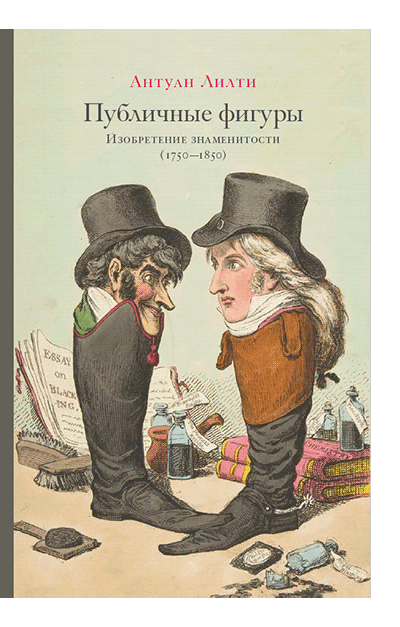
The media space today is packed with all kinds of “stars”-pop artists, TV presenters, athletes and so on. However, the phenomenon of the celebrity itself arose much earlier than the massive spread of television and the Internet, in the XVIII - XIX centuries, and among the first world stars, Voltaire, Rousseau and Byron were. The book about this is published by the “Publishing House of Ivan Lumbach”, it is called “Public figures: the invention of celebrities (1750–1850)”: at the request of “Gorky” about this work and its author, Antoine Lilti, says Maria Nesterenko.Antoine Lilti. Public figures: the invention of celebrities (1750–1850). St. Petersburg: Publishing House of Ivan Limbakha, 2018. Translation from FR. P. Kashtanova
Antoine Lilti is a historian, a lecturer école normale supérieure, is known primarily as the author of a fundamental study on the history of the 18th -century French salon (Le Monde des Salons: Sociabilité et Mondanité à Paris Au XVIIIE Siècle. P.: Fayard, 2005). “Public figures” in a sense can be considered as a continuation of the main line of the study of Lilti-from the space that played an important role in the invention of a celebrity, to the phenomenon himself. It arises at the same time, in the XVIII century, "in the course of a deep transformation of public space and the first attempts to commercialize entertainment."
The concept of "public space" today cannot be used without looking at the concept of the public sphere of Jurgen Habermas. The German sociologist idealized the new enlightened liberal society, which appeared in the 18th century, and interpreted it as an opposition, configured critically in relation to the state. Lilty polemicizes with Habermas and his followers and indicates that often “a political ideal (public discussion of issues) is projected on an era of education so that it is easier to criticize in our modern world everything that does not correspond to this ideal.” Through the idealization of the 18th century, the idea of the public as a whole is also distorted.
The study of the celebrity phenomenon, according to Lilty, allows you to look at the public as “a collection of anonymous readers, united by the fact that they read the same books, and from the 18th century - the same newspapers. The audience is not formed by the exchange of rational arguments, but by the general curiosity of something and the general faith in something, interest in the same things at the same moment and the awareness of the synchronism of the manifestation of this interest. ” Then the perception of publicity is changing. If earlier everything that was connected with the royal authority was related to this, then in the XVIII century public - this is what can be seen by everyone.
The main idea that Lilti puts forward is “a celebrity is not a product of the modern world, testifying to the sunset of culture and the crisis of the public sphere, <...> the celebrity is an indispensable attribute of all modern societies, the form of prestige, the form is unreliable, balancing on the verge of permissible and illegitimate.” Sometimes Lilty recedes from the principles of strictly historicism and reinforces his study by deliberate anachronisms. So, for example, speaking about the romantic phenomenon of a woman seduced by the “great man”, he compares them with Groupie - the phenomenon of the twentieth century. The introduction of Lilty also begins with the most outstanding anachronism-the phrases “But Maria Antoinette is Lady Dee!”, Which Francis Ford Coppola said on the set of the film of his daughter, Sofia Coppola. The intentionally anachronic Coppolic “Maria Antoinette” is no coincidence that Lilti attracts attention: “It is worth paying attention to the image of Maria Antoinette, bred in the role of“ diva ”even before this concept itself was formed, in the role of a woman whose whole life occurs in front of others.” Thus, the author emphasizes the idea of continuity between the XVIII century and modernity.
First of all, Lilti is dealing with terminology. He distinguishes concepts that can sometimes be perceived as synonyms: glory, reputation and celebrity. Glory is “a recognition obtained by a certain outstanding person for some special achievements <...>. Glory spreads mainly posthumously as a memory of a hero, ”and reputation is a collective judgment about a person. The celebrity is the third form of recognition, it is based on another principle: curiosity that causes this or another bright person in contemporaries. Among the characters of the book by Voltaire, Russo, Maria Antoinette, Byron and many others, but all of them are needed in the first place in order to show how the mechanisms of popularity work on specific examples. The author allocates in the narrative “Two strong points: the appearance on the public stage of Jean-Jacques Rousseau in 1751 and the grandiose tours of Ferenz Liszt Liszt in Europe, which gave rise to the real“ leaflet ”around 1844 in Paris and Berlin. The threads connecting these two events are much more than it is customary to think. ”
 Lilty devotes the first chapter to the textbook episode of visiting Paris by an eighty -three -year -old Volter. Many wished the Ferney old man to see “live”, but the main event was the crowning of a laurel wreath of a bust of the writer on the stage of the theater. “Usually,” writes Lilti, “this episode is considered a symbol of the“ writer's triumph ”, the moment when the prestige of philosophers-educators in society and culture ascended to an unprecedented height.” This event resembled Voltaire's contemporaries of another “coronation”: Petrarch on the Capitol in 1341. But then, in the award of the great poet, the representative of the king Robert Neapolitan participated, and here - only the audience of Comedy Frances, which allowed some contemporaries to perceive what is happening as a farce (Lilty gives fragments from memoirs).
The famous plot was needed by Lilty in order to show: now the monarch that is not patronizing him, but the public, affects the reputation and glory of the poet. Voltaire was distinguished from the great writers of the past of Voltaire that contemporaries were well aware of how he looked, thanks to a series of portraits made by Jean Gyber. The artist portrayed the thinker in an intimate environment: drinking coffee pulling on his pants (“The Morning of the Philosopher”): “The picture resembled a sketch made from nature, alive, so that the viewer looking at it gave the impression that he sternly made his way to the bedroom of the great writer.”
For the second chapter, Lilty took the name from the famous Manifesto of Guy Deborah - “Society of the performance” - it tells about the general hobby of the theater in the XVIII century and how this contributed to the birth of a celebrity. It is during this period that the director of theaters realize the benefits of promoting actors who are popular among the audience: “In addition to commercial interest, this is due to a number of new mechanisms caused by the commercialization of entertainment, which favors the culture of the celebrity. This is primarily about the rapid development of the press, specializing in theatrical productions <...>, about the release of portraits of actors and singers, etc., etc. The practice of benefits appears, income from such performances came completely at the disposal of the actor. The reference to the Deborah is not accidental: although Lilty calls it the book “The Thin-Science of the Neo-Marxism and Black Romance”, he still believes that the formula “Society of the performance” itself has not lost its values, “recalling that the“ media ”economy, which fills the public space with famous figures, originates from urban performances of the XVIII century.”
From theatrical paper, a stone's throw to the "first media revolution." Lilty refutes the rooted idea that the phenomenon of celebrity owes his appearance to new technologies for the mass reproduction of the appearance of a person - from photography to cinema and newspapers. He shows that the origins of this should really be sought in the same XVIII century, when the number of competent people increased and the number of entertainment newspapers increased, which were happy to read: "Scandals and gossip occupied no less space in the chronicle than the battle and peace agreements."
As visual arts can make a celebrity literally from anyone, Lilty shows on the example of the famous Lady Hamilton. A girl named Emma Lion worked as a prostitute and periodically posed for artists. Once her portrait was written by George Romney. The work was a huge success. The girl posed for him about two hundred times, “she was drawn not because she was famous; She became famous because she was drawn. At first, her face became famous, only then - the name. "
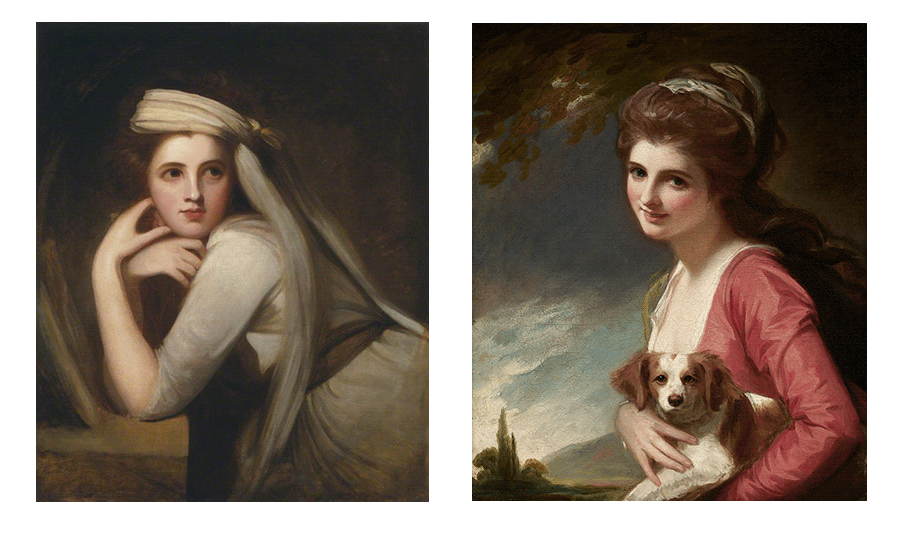
On the left: George Romney. Portrait of Emma Hart (later Hamilton) in the image of a bacchanka. Right: George Romney. Lady Hamilton in the form of "nature"
Photo: artchive.ru
The head of the “Loneliness of the famous man” is dedicated to Jean-Jacques Rousseau. Here Lilti explores the paradoxes of the celebrity phenomenon: the unknown Rousseau has become super -known, suddenly receiving the Award of the Dijon Academy. In the Geneva philosopher, Lilti is attracted primarily by the fact that he reflected a lot about the burden of glory that fell on him: “Rousseau in correspondence and autobiographical works, then rising to the peaks of social philosophy, then falling into paranoid nonsense, fascinatingly discusses the consequences of a celebrity, which is called“ fatal ”.”
The real expanse for the researcher of the celebrity phenomenon is the era of romanticism. Lilty writes that romanticism characterizes “the mediatization of cultural life, on the one hand, and attempts to establish direct contact between the author and the reader, on the other,” and the romantic creator often visited the genius of PR and the embodiment of sentimentality. On the example of Byron Lilti, he shows that his popularity (Anna Isabella Milbenk, Byron's wife, even came up with the term “byromania”) is due not only to and not so much the artistic merits of his works, but the stormy life that he led. Lilty here does not add anything new to what was said by literary critics about the romantic poet, but otherwise puts accents. He is interesting to the author of the book as the “archetypal figure of the famous writer”: “Byron at once comes up with the hero, and he himself embodies him-the image of a disappointed rebel-idealist, refusing to obey the generally accepted morality and alternately puts on the mask of the exposure, seducer or sufferer.”
In connection with the romanticized cult of the celebrity of Lilti, the phenomenon as “the figure of a seduced fan” is considering. "Is it not about a banal cliche, male fantasy, which quickly turned into a stereotype?" - the author asks a question. Lilty writes that here we see the difference between the attitude to the “public” man and the “public” woman: “The famous man seduces the female part of the audience and is forced to escape from her obsessive persecution. The famous woman, on the contrary, is an unacceptable image, worthy of censure. The opportunity on her part to seduce male fans is certainly considered immoral, and lowers it to the position of a whore or a courtesan. ” Lilty writes that women were forced to choose between fame and normal life for quite some time.
Although Lilti’s study is tied to specific historical realities, it falls into a wide context of studying the phenomenon of popularity. Here you can name the relatively recently translated book “Songs of Songs. Inside the Factory of Hits ”by J. Sibruk, and the work of the philosopher Mikhail Kurtov, and generally studies of pop culture. The book of Lilty, although it is dedicated to the XVIII - XIX centuries, highlights the present, so it will be interesting to read it not only to lovers of history, but also to those who are worried about the phenomenon of modern “Stars”.