
Translated material
Greenpeace criticized the upcoming launch of the floating nuclear power plant "Academician Lomonosov"
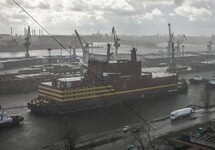
Greenpeace criticized the upcoming launch of the world's first floating nuclear power plant "Academician Lomonosov", which on Saturday left the Baltic Plant to St. Petersburg and went to Murmansk to load nuclear fuel and launch reactors. The relevant publication appeared on April 28 on the website of the Russian branch of the organization.
In 2019, the nuclear power plant is supposed to be towed 5 thousand kilometers east along the Northern Sea Route and put into operation near the Chukchi port of the Peevek. The station has two reactors with a total capacity of 70 megavatts.
“The emergence of a floating nuclear power plant is by no means caused by the real needs of Chukotka,” commented on the situation by the project manager of the Russian Greenpeace Energy Program Rashid Alimov. “Now they say that a floating nuclear power plant could work there as a demonstration exhibit for potential foreign customers, although there is significant potential for the use of wind energy.”
A year ago, Rosatom intended to load fuel and test the nuclear power plant right at the Baltic Plant, located in the center of St. Petersburg, 2 kilometers from the St. Isaac's Cathedral. However, on July 21, 2017, the decision was changed. The causes of Greenpeace calls the support by citizens of his petition against a nuclear experiment in the center of St. Petersburg, as well as the pressure of the countries going to the Baltic Sea - they protested against the transportation of radiation dangerous cargo through their territorial waters.
Meanwhile, they resemble Greenpeace, and Murmansk with a population of about 300 thousand people is a large city. “The transfer of the tests of this nuclear“ Titanic ”away from the public’s eyes does not make it less dangerous,” said Jan Haverkamp, an expert on the atomic energy of the Greenpeace department in Central and Eastern Europe.
According to Russian media, they note in NGOs, Rosatom intends to launch mass production of floating nuclear power plants. The state corporation is negotiating with representatives of Asia, Africa and Latin America. One of the tasks that will solve such power plants is to provide electricity for oil and gas field intelligence. 15 states, including China, Indonesia, Malaysia, Algeria and Argentina, have already expressed interest in renting floating nuclear power plants.
Meanwhile, Haverkamp noted: "The nuclear power station cannot move itself and has a plane case. Therefore, contrary to assurances in its safety, it is especially vulnerable to the tsunami. But there are other serious risks: severe ice conditions, the danger of terrorism, nuclear waste."
The Baltic Plant, where the Academician Lomonosov was built, is the structure of the United Shipbuilding Corporation, which has been under US sanctions since 2014.