
Translated material
Army of the fourth period
Why Putin went to the reforms of the armed forces and why he himself refused reforms
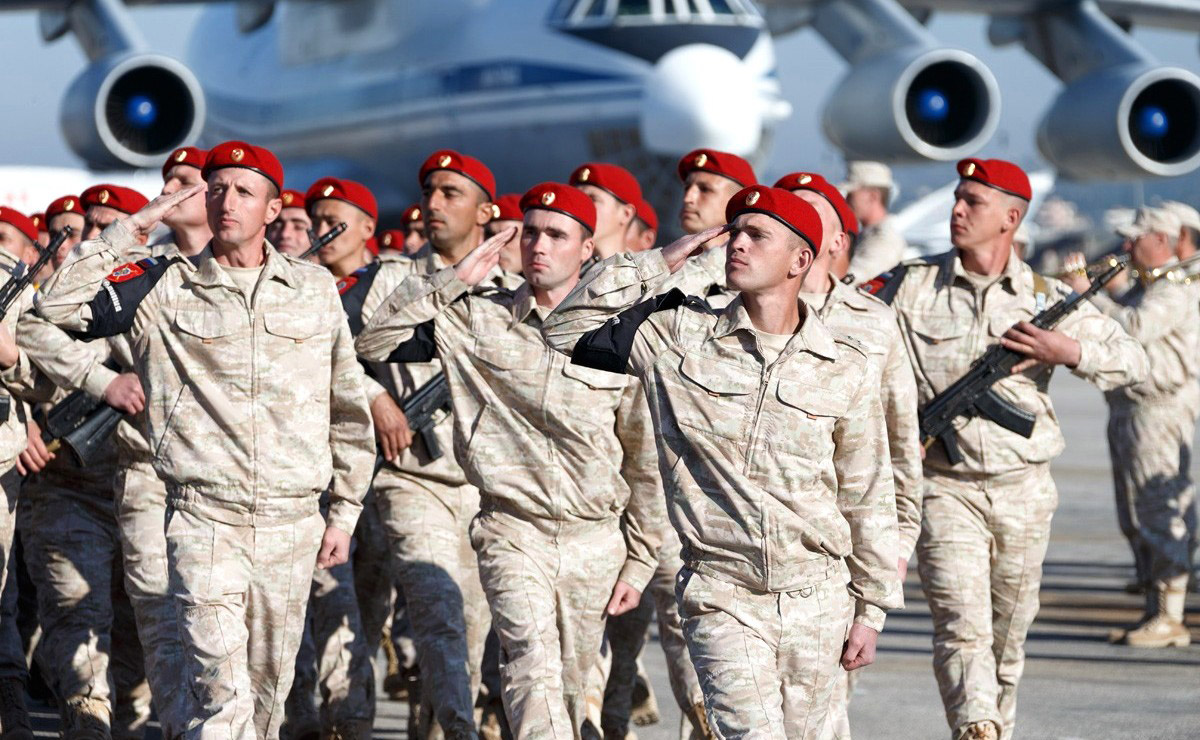
Photo: kremlin.ru
Vladimir Putin has a long and, at first glance, mutual love with the Russian army. We do not go away for the Supreme Commander -in -Chief to give tribute to the heroes who, both on their native land and abroad, provide the country's defense and security. Military personnel reciprocate Putin - multiple “cheers” addressed to him does not stop at the Kremlin techniques, where officers and generals are present. Moreover, military victories, military power today represent the most important source of authority Vladimir Putin. The most replicated moments of his presidential campaign were, firstly, the next withdrawal of troops from Syria with the next announcement of a complete victory over terrorists and, secondly, the presentation of achievements in the field of nuclear weapons, which occupied the third of the Putin message to the Federal Assembly. In his fourth presidency, Putin enters the halo of a military leader.
Together with the Kursk atomic boat, the Putin Vera drowned to the highest military leaders. It turned out that they could brazenly lie in the face of the supreme commander
Farewell to illusions
The president’s novel with the armed forces began difficult. Putin came to power in complete confidence: the army hierarchy, based on the strict unity of command, is ideal for organizing the management of not only the armed forces, but also the country as such. That is why the federal districts were created, the rights of governors were cut, and the federal meeting turned into a subdivist of the presidential administration. This system soon began to be called the vertical of power. The paradox, however, was that in the early 2000s the armed forces themselves were in a deep crisis.
The Second Chechen War quickly deprived the supreme commander in chief of illusions regarding the effectiveness of his army. Putin from his own experience was convinced of the absence of the combat effectiveness of the Soviet-style mass mobilization army, the device of which the domestic generals successfully protected from attempts to reform the entire 1990s. The essence of this system is that in peacetime almost all military formations are heavenly by definition. Because they are unimportant. They can fight only after replenishing with reservists. That is why it took several weeks to deploy troops in Dagestan, when Chechen militants burst there in August 1999. As Vladimir Putin admitted, who was just then appointed prime minister, the Kremlin was a step away from the announcement of universal mobilization. “For an effective response, terrorists needed to collect a group of at least 65 thousand people. And in all the sinuscular troops, in the warhead units, - 55 thousand, and those are scattered throughout the country, ”the president recalled, referring to the Federal Assembly in 2006. - The army is 1.4 million people, and there is no one to fight. So they sent unwatted boys under the bullets. ”
And then there was a disaster of the Kursk submarine. Together with the atomic submarine, Putin's faith also drowned to the highest military leaders. It turned out that they could brazenly lie in the face of the Supreme Commander. When the news of the tragedy came, the admirals recommended Putin to abandon foreign assistance, arguing, contrary to the facts that they had everything necessary for a rescue operation. Then, for a year and a half, the highest military was absolutely unprovenly argued that the cause of the disaster is a clash with a foreign submarine.
All this plunged Putin into a state of deep confusion. This is evident from the interview that he gave RTR in September 2000. He seemed to understand that “our armed forces must comply with the needs, on the one hand, and the possibilities, on the other hand, the state. The army should be compact, but modern, well paid. ” But Vladimir Putin claimed something directly opposite. That his goal is to “restore the army and navy,” and brought down his anger at the attackers, who allegedly ruined them for ten years. The supreme commander, it seemed, did not even realize that the formulated tasks - to create armed forces corresponding to the capabilities of the state, and restore the Soviet army and navy - directly contradict one another.
At the same time, it is known that in the beginning of the fall of 2003, Vladimir Putin got acquainted with the proposals on military reform, which, in case of implementation, could significantly change the Russian armed forces (its main provisions as a whole coincided with what Anatoly Serdyukov made five years later). The reform assumed a decisive reduction in the number of formations and, as a result, the dismissal of officers who served there. The president, obviously, considered this option too radical. Anyone who would take responsibility for the implementation of the reform would decide to play the role that Yegor Gaidar played in relation to the Russian economy. The fate of the reformer in this case is easily predictable - a significant part of the officer corps will be cursed. And Putin did not dare to go this way. Instead of military reform, he threw a man to the army, whom he trusted then more than anyone else. The Minister of Defense was appointed Sergey Ivanov.
The Minister, who never made it difficult to find out the difference between the unit and the union, quickly turned from the Putin representative in the military department into a representative of the interests of the generals before the president
Running on the spot for big money
The next six years have been frankly failure from the point of view of the modernization of the Armed Forces. The Minister, who never gave himself the difficulty of finding out the difference between the unit and the union, quickly turned from the Putin representative in the military department into a representative of the interests of the generals before the president. He eagerly repeated the nonsense that the Supreme Military inspired him: that grandfather is ineradicable in principle, and that the Russian army is doomed to remain recruiting, and that the VPK is able to modernize fixed assets, relying only on internal reserves.
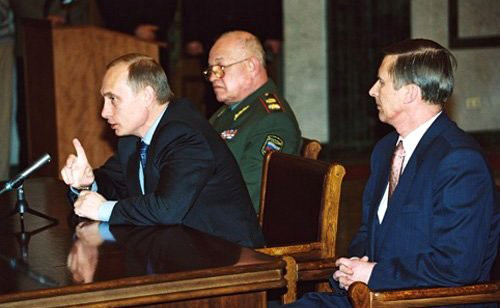
The Ministry of Defense is new
Defense Minister Sergei Ivanov, Moscow,
March 28, 2001 Photo: Kremlin.ru
Despite the fact that due to the take -off of world energy prices, Putin annually increased the military budget by 20%, the army did not improve. Because the military department managed to preserve albeit three or four times a reduced, but purely Soviet model of the armed forces. Such an army can be at least any efficient if the whole economy of the country worked for it and if the entire male population was considered the so-called “mobilization resource”, which can be, at least in theory, to call for banners at any time. Of course, such a system can only operate in a totalitarian state.
Since in the 2000s there was, albeit very specific, but still a market economy, and at least the fundamental rights and freedoms were declared, as well as the rule of law, an attempt to preserve the Soviet military system turned into decomposition and a structural crisis. First of all, this applied to the set. Formally, a universal military duty acted in Russia. However, the young men of conscription age were seen, and not without reason, in the army service the form of legalized slavery and sought to avoid it in all available ways. Those who did not want to serve chose half- and completely illegal ways of evading the army. The country has developed a huge criminal industry for the provision of deferrals. In 2005, the analytical center “Indem” evaluated the annual turnover of this corruption mechanism of $ 350 million. In the early 2000s, the Ministry of Defense did not manage to gain the required number of soldiers. Recruits did not even meet even minimal intellectual, physical and moral requirements. The morals were not too different from the prison. Sergei Ivanov admitted that in 10 months of 2002, 531 soldiers died as a result of “crimes and incidents”, and 20 thousand were crippled. Deserter then took the character of a real epidemic. The soldiers left military units with platoons and companies.
Putin frankly annoyed it. He quite toughly demanded modernization. Under its pressure in 2003, a federal program designed for five years was adopted for a partial transfer of the Armed Forces to a contract service. Initially, it was supposed to increase the number of contractors by 147 thousand, while forming 79 formations completely from soldiers' soldiers. The military department quickly turned the federal target program into a kind of financial pyramid. It has achieved the right to conclude contracts with the carrier soldiers. And then the fathers-commanders with the help of deception, threats, and sometimes physical violence forced 18-year-old boys to sign a contract. As a result, the number of deserters increased significantly. And the commanders were in no hurry to report on the flight of soldiers and calmly assigned their salary. In short, the federal program failed with a bang. Even according to official figures, the number of contractors increased by only 50 thousand people. All this scam was revealed during the war with Georgia in 2008. It turned out that the military units, which were considered long-transferred to the contract, were still equipped with carrier soldiers-in the entire group there were about one third.
In the Ground Forces, the number of formations decreased by more than 10 times - from 1.890 to 172. Three times - in the Air Force and the Navy. As a result, the remaining formations were equipped with wartime states
Serdyukov's reforms
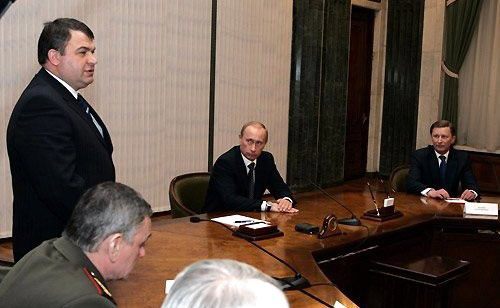
collegiums and leadership of the Ministry
defense. Left in the photo - Minister of Defense
Anatoly Serdyukov, Moscow, February 15
2007 Photo: Kremlin.ru
However, by that time, Putin had already found Anatoly Serdyukov, a man who could conduct extremely unpopular transformations in the army and who did not belong to the circle of presidential friends - an ideal performer who could be turned if necessary into a scapegoat. And the former head of the tax service completed a very difficult task. Almost all parts and compounds of incomplete composition were eliminated. In the Ground Forces, the number of formations decreased by more than 10 times - from 1.890 to 172. Three times - in the Air Force and the Navy. As a result, the remaining formations were equipped with wartime states. From the point of view of the General Staff, this made the compounds to combatguom, capable of executing the order just a few hours after its receipt. This provided the Russian army with coveted mobility. As part of the Serdyukov reform, it is mercilessly, quite in the Soviet way, in many cases without providing the promised social package, he fired about 115 thousand officers. For the most part, these were those who served in the “paper divisions” in the 1990s, learned to survive, but not to fight.
Vladimir Putin prudently distance himself from the Serdyukov reforms, allowing the Minister to do dirty work. Formally, the plans of the reformers were approved by the then ZIC-President Dmitry Medvedev. However, in 2012, when Serdyukov and his entourage came close to the qualitative modernization of the armed forces, a change in the military education system and service, Putin, who had returned to the Kremlin by that time, dismissed the minister with shame, accusing him of corruption.
Serdyukov’s reforms, who gave the armies those qualities that ensured victories, have now conflicted with the ambitions of the Kremlin
Refusal of reform
Putin was not slow to use the strategic mobility of several dozen elite formations for the annexation of Crimea, in the "hybrid" war in the Donbass, operations in Syria. Moreover, these military operations have demonstrated that Moscow has a certain military superiority even over the West. The case is in the speed of decision -making. The political structure of Russia is now such that its supreme ruler has no need to coordinate his decisions with anyone-he makes them single-handedly.
However, Serdyukov’s reforms, who gave the army those qualities that ensured victories, have now conflicted with the ambitions of the Kremlin. To trouble with reforms. All new tasks are assigned to the army. The actions of Russia in Ukraine provoked NATO countries to deploy a quick response and heavy equipment forces in the Baltic countries, Poland and Romania. Now Moscow had to “answer”. The creation of new divisions in the “western direction” has already been announced. However, even Vladimir Putin and Sergei Shoigu cannot change the demographic situation. According to the plans of the Ministry of Education, the number of armed forces was supposed to grow in 2016 by 10 thousand military personnel. This is negligible to form dozens of new formations. And the number of contractors has not been growing for two years: few people seek to connect their lives with the army, which arranges secret funerals and whose military personnel spend their leave in the war zone.
There is only one way out - to forget about the Serdyukov reforms, to again create the assassinated parts, where there will be almost more officers than ordinary officers. It was no coincidence that it immediately became clear that the lack of commanders suddenly formed in the armed forces (and until recently, the lieutenants were appointed to sergeant posts from the overabundance of officers).
Thus, it turned out that it was Vladimir Putin who did not need too radical reforms. And he began to refuse them.
Meanwhile, the Kremlin is doomed to reduce military costs. According to a number of economists, due to the fact that since 2012, inflation has not been indexed, it has attended almost all the sharp increase in the officer’s salary that occurred under Serdyukov. So the rolled -up “cheers” in honor of the president will sound less and less sincere.