
Translated material
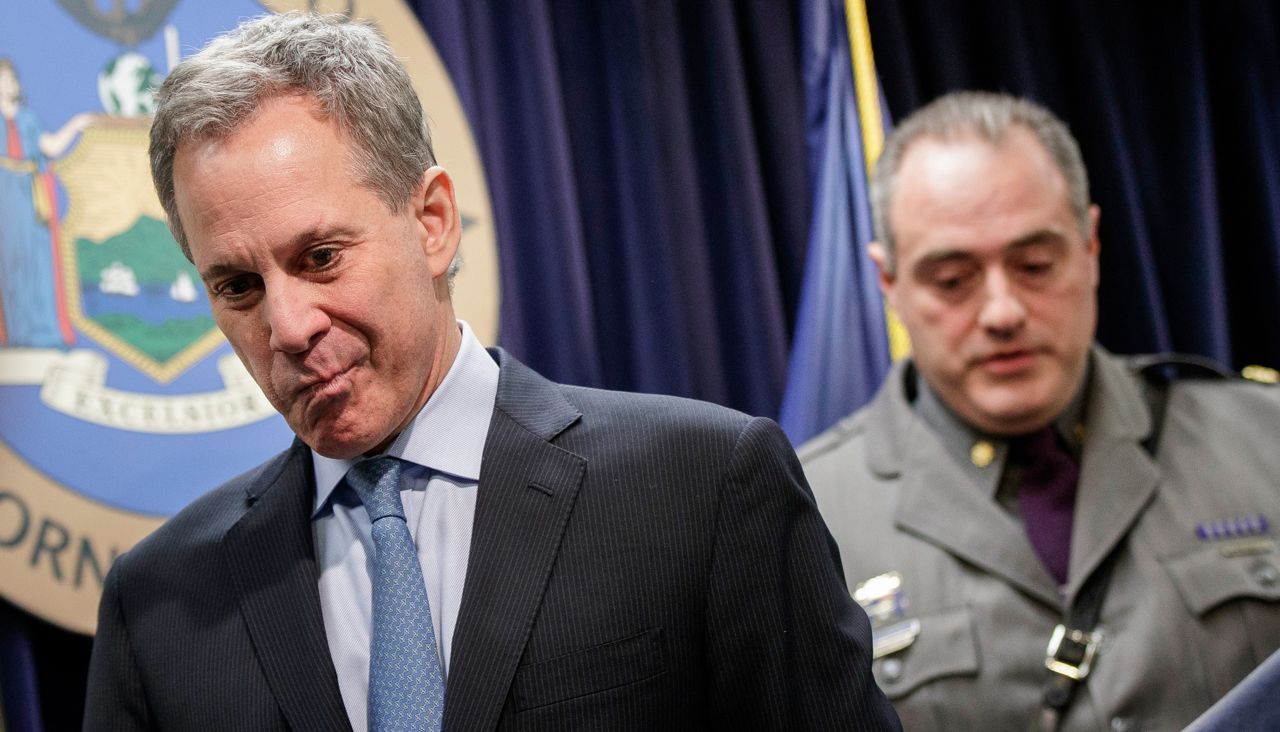
The Prosecutor General of New York was accused of violence by four former partners. He was an active defender of women's rights
Serious accusations
On May 7, the New Yorker magazine was an investigation about Eric Schneiderman-a lawyer who held the post of general prosecutor of the state of New York since January 2011. The article states that Schneiderman, supposedly, subjected his partners to physical and psychological violence - beat, strangled, spit in the face, humiliated, controlled their appearance and depreciated achievements. This was told by four women who met with Schneiderman from 2013 to 2017. Two of them talked with the publication “under the recording” and revealed their names, and two asked about anonymity out of fear of persecution.
The authors of the investigation are The New Yorker Jane Mayer and Ronan Farrow, who wrote a series of materials about harassment and sexual violence by film producer Harvey Weinstein in the fall of 2017.
According to The New York Times, immediately after the publication of the article, officials demanded the resignation of Schneiderman; Among them was the Governor of New York Andrew Kuomo. Soon, Eric Schneiderman announced his resignation. “Over the past few hours, serious charges have been made against me that I deny. And although these accusations do not affect my professional behavior, they will not allow me to effectively do my work at this critical point. Therefore, I am resigned, this decision comes into force after the end of the working day on May 8, 2018, ”the Schneiderman statement said .
Unrivaled work to protect women's rights
Throughout his career, Eric Schneiderman publicly supported and defended the rights of women. In 2010, he proposed a bill according to which an attempt to strangle a partner would be considered a cruel crime; In the same year, the American feminist organization National Organization for Women noted his “unsurpassed work” to protect women who became victims of domestic violence. In the fall of 2017, Schneiderman supported the movement against sexual violence and harassment #Metoo - and even filed a lawsuit against The Weinstein Company, accusing the film company of gender discrimination, sexual harassment and pressure on women.
As stated in the article by The New Yorker, the public position of Schneiderman caused indignation in several of his former partners who knew him from a completely different side. One of those who agreed to openly tell the publication about his experience was the political activist and blogger Michelle Manning Barish. She met with Schneiderman from the summer of 2013 to the end of 2015; During this time, they parted and converged several times.
Barish said that at first Schneiderman seemed to her like -minded, but soon began to control how she looked (for example, ordered her to remove the tattoo), and a month after the start of their relationship, he first raised her hand to her. She recalls that both drank and argued in the bedroom before going to bed. Schneiderman called her a whore, then tumbled down on the bed, gave a strong slap in the face and began to strangle. “It was not a sex game in which something went wrong. When this happened, we did not have sex. I was completely dressed, it was absolutely unexpected and shocking. I did not give any consent to physical violence, ”Barish explains. She managed to break out - and she immediately left, saying that she would never return.
The activist told about this several friends, including the former boyfriend, writer Salman Rushdi (friends Barish confirmed The New Yorker that they heard from her about the attack of Schneiderman). However, Schneiderman soon persuaded her to return. Since then, according to Barish, he has repeatedly beat her in the face (including during sex), criticized her appearance, controlled what she eats, and forced to drink alcohol, in particular, forcibly poured wine into her mouth. During their relationship, she lost 13 kilograms (her weight fell to 46 kilograms with a height of 170 centimeters), her hair began to fall out. Barish recalls that once Schneiderman threatened: if she decides to leave him, he will kill her.
After they broke up, Barish mentioned Schneiderman in Tvit on the topic of politics, which was in no way connected with their relationship, after which he called her and ordered not to write anything about him - otherwise she would regret it.

"The fairy tale quickly turned into a nightmare"
The second woman who gave an interview to The New Yorker under her own name was the writer, actress and producer Tanya SelvaTnem. They met with Schneiderman in 2016 and immediately agreed on the basis of general views (Selvaratnam - feminist). She also stated that "this fairy tale quickly turned into a nightmare." Schneiderman demanded that her spend more and more time with him, and when they became close, he began to use physical violence in bed. He also insisted on the three of them, although she did not want to, and demanded that she find another woman for this.
“Sometimes he ordered me to call him the master and beat him in the face until I pronounced it,” recalls Selvaratnem. He also called her “brown slave” (she is from Sri Lanka) and ordered to say that she was his property. Schneiderman strangled Selvaratnam and spat on her, criticized her appearance, demanded to remove scars from the operation, enlarge his chest and buy clothes to his taste.
Like Barish, Selvaratnam claims that Schneiderman drank a lot and forced her to drink alcohol with him. Once he got drunk so that he fell and injured - and he had to lay the seams. The writer says that her inability to break this relationship for more than a year may look inexplicable, but even independent women can fall into such a situation. She explains that in such a relationship you are gradually losing yourself, you begin to doubt yourself, you blame yourself for all problems and believe that everything will change. Fear interfered with parting: “He repeatedly said that he would have to kill me if I tear me with him. He also said that he could install surveillance for me and listen to my phone, ”says Selvaratnam.
Selvaratnam also talked about what was happening to her friend, writer Danji Senne. She was so shocked that she wrote down her story and sent her husband to preserve certificates if something happens to Selvaratnem. This document is at the disposal of The New Yorker, it is dated September 2017. Selvaratnem spoke about the behavior of Schneiderman and another friend, journalist The New Yorker Jennifer Gonnerman. She decided to make certificates of other partners of Schneiderman; So it turned out that at least another woman complained that the prosecutor beat her in the face and spat on her during sex.
"Too important figure for the democrats"
Two more women told about similar stories of The New Yorker - but anonymously. Both of them said that Schneiderman beat them in the face and threatened them. One of them says that she was so scared that she described in detail all the cases of violence on his part, locked these records in a safe cell and gave the keys to her two friends. She talked about the experience of violence with her friends, but many advised her to be silent, explaining that Schneiderman was a too important political figure for the Democrats and he could not be lost. This reaction, according to her, broke her heart.
The fact that several former Schneiderman partners at once were subjected to the same type of violence on his part, some of the participants in the investigation were recognized in the process of his preparation. This is what influenced Michelle Manning Barish to speak. She believes that she had three options for a choice: to lie, say silence (which would be a betrayal of other women) or tell the truth. She explains that the decision to oppose an influential policy is not easy: “This affects your life. And not at all in a pleasant way. "
Tanya Selvaratnam also says that information about other victims influenced her. She wondered: who will become the next? “The silence of the women [who met with Schneiderman] led to me that I also suffered. I realized that I could not live with this if I find out that he would do something similar with another woman in a few months or years. ” She added that she was “sick” from Schneiderman’s hypocrisy: “This man built his whole career, all his public person on the fact that he defended women's rights in words. But behind closed doors he mocked them. And this had to be done obvious. "
Olga Strachovskaya