
Translated material
Who will carry out Putin's "Breakthrough"
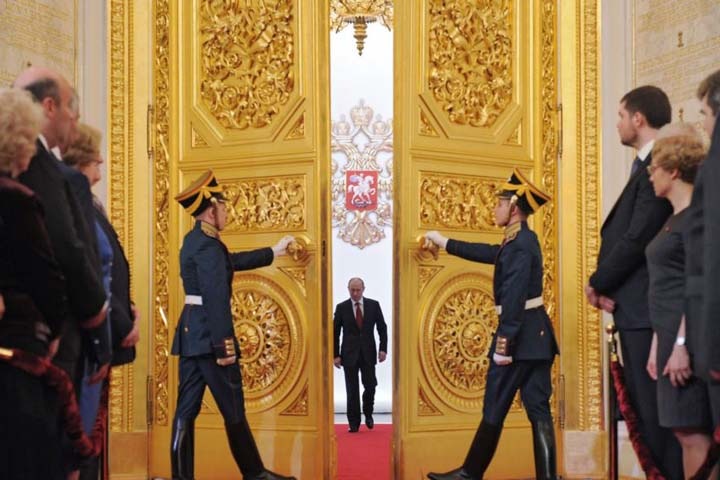
On May 8, Russia woke up with the new-Sr. President, who speaks of “breakthroughs in all spheres of life” and the struggle against the “dead”. Soon, the country will receive a new-old government Dmitry Medvedev, who makes a classmate to his deputy. Alexey Mazur discusses the desires and decisions of Vladimir Putin.
90% of Russians believe that the country needs changes, follows from the recently published VTsIOM survey. The figure, frankly, is impressive. Almost the same, like 82 % of Russians supporting Vladimir Putin, according to the same survey.
Putin himself is aware of the need for change. He directly spoke about them in his inaugural speech: “We need breakthroughs in all areas of life. It is deeply convinced that such a breakthrough is able to provide only a free society that perceives everything new and all the advanced and rejects injustice, inertness, dense protection and bureaucratic dead man - everything that fetters people from fully revealing, realizing themselves, their talents, and therefore limits the aspiration into the future of our country. ”
139548
However, between the awareness of the problem and the real breakthrough is a huge distance. What should be a breakthrough, what? Who will carry it out? There are no answers to these questions yet.
The previous three presidential terms (and Medvedevsky 2008-2012) Vladimir Putin ruled, “freezing” the system and based on reliable, but very conservative management tools. A system of control was built throughout the country - first of all, over political competition and financial flows. Key positions were controlled by people proven and long -known people. This made it possible to stabilize the system at the beginning of the “zero”, to achieve some “handling”. The non -payment of salaries and delays in pensions have been a thing of the past, which, along with the other way, provided a high rating of the president.
But these same mechanisms led to the overlap of all social elevators. The hypertrophied role of controlling organizations led to the actual impossibility of creating development institutions. As soon as someone does something successful, someone immediately comes to him-from competitors to security forces.
Development institutions are a subtle business. More than 90% of startups “dies” in the USA, and there is an industry of cultivation, selection, there are investment funds. There is nothing in Russia, the role of the “incubator” for startups is forced to take on the state. A significant part of the projects that finance government structures (the same “Rusnano”) end in failure. Only in Novosibirsk we can recall the “Innovation Company San” and “Lytech”, which became bankrupt after receiving money from Rusnano.
139449
That is, failures in development are logical, and in our country they are aggravated by the lack of experience and inadequacy of assessments of high -tech products. Well, corruption.
So, on the one hand, we have a “development market” with gigantic risks, and on the other, a huge repressive machine in the person of inspection, control and planting organs. He put the state ruble “in the wrong way” - wait for you to come for you. In Novosibirsk, we saw a showdown around the state academic park and a biotechnical park. But these are structures that are at least built, function and can be considered successful. They came to them. By the way, for some reason, the complete failure of the “industrial-logistics park” or “Lyotha” for some reason does not cause such enthusiasm among the inspectors.
Will there be many people who want to engage in development against such a background?
Obviously, Russia needs to build its development institutions almost “from scratch”. It makes no sense to blindly adopt American experience - it will turn out the same as with a banking system or insurance companies. 2 trillion rubles were spent on plugging holes in banks during the current economic crisis, and there is a clear understanding that this is not the limit. Because in Russian banks there was an insufficient level of competence and responsibility. At some point, the bankers faced a dilemma-to recognize a defeat and begin bankruptcy or turn into a financial pyramid. The vast majority chose and chooses the second. We observe similar processes in the construction market.
With development institutions, it is even more difficult. For them to earn, three components are needed:
1) A clear understanding of what exactly we want to get, what are the criteria for success. Examples are frequent when, according to any exhibitions and presentations, frank fakes are “wandered” (budget money on an air -habarose station was spent in Novosibirsk, which, in principle, could not work on the “fuel burner”).
2) you need to change the system of responsibility for "state innovators". Not a report for each ruble spent in a thousand forms and using 44-FZ, but the result. The fate of the project manager should change depending on him. Under Stalin, this system worked in a very radical version, today you can apply a more humane one.
3) competition. In the USSR, the same task was given at once by several design bureaus, between which there was a rigid competition. So far, everything goes through one channel, on which friends of those who make decisions sit down.
We see Putin's concern about development issues - for example, a source of synchrotron radiation will be built in Novosibirsk. On the other hand, old habits and affection are preserved. On May 8, Dmitry Medvedev will become our new Prime Minister, his classmate Anatoly Chuychenko-Deputy Prime Minister, and Vitaly Mutko, having defeated everyone in sports, will now be responsible for construction (an industry with extremely neglected problems) and regional politics.
Which of the trends will prevail - we will find out soon.