
Translated material
Nuclear president against nuclear vehicles
How America came out of a “bad” nuclear deal with Iran and why as a result, the world can get a big war in the Middle East
Photo: Pixabay / Gerealt
On April 30, 2018, French President Emmanuel Macron, ascending on board the A-330-200 presidential aircraft, who was supposed to take him away to distant Australia, contacted Vladimir Putin on the phone (the video clip of this conversation then Macron later posted on his Twitter). A few days earlier, the owner of the Champs Elysees returned from Washington, where he was on a state visit - and returned with a sense of an unfulfilled mission. Behind the ocean there were many smiles, handshakes, patches on the shoulder and other manifestations of “tactile diplomacy” along with verbal assurances in allied love and friendship. But the main French guest did not succeed in the main one - he was not able to convince President Trump to postpone with the exit from the agreement with Tehran under the Iranian nuclear program.
Mission Macron
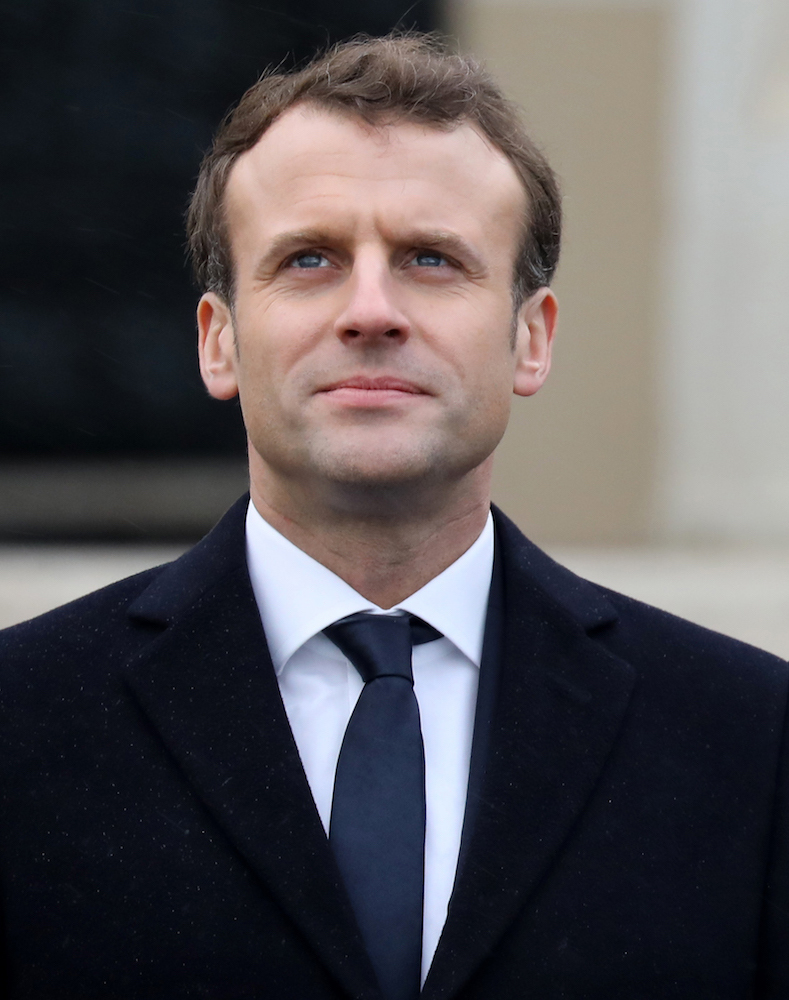
Emmanuel Macron
Photo: Flickr / Donq Question
At least four times, the French diplomatic sources of NT say, Macron tried to dissuade Trump from a sharp step - after the official negotiations, both leaders agreed that Iran a) should not access nuclear weapons, b) should not have the means of its delivery, c) should refuse to support terrorist movements (read: “hamas” in the gas sector and gas sector and gas Hezbollah in Lebanon) and political expansion in the Middle East. “On the fields” of the visit, as diplomats expressed, Macron offered Trump a compromise: a number of a joint comprehensive action plan (SVPD, Joint Comprehensive Plan of Action, the official name of the agreement concluded by Tehran with the “six” of international intermediaries on July 14, 2015, then in the text - the agreement) does not suit the agreement) The United States by the fact that Iran’s policy is considered in it too much in a narrow perspective, you can, without leaving it, invite Iran to negotiations for all three points - A, B and C. But the American counterpart was adamant.
A couple of months before meeting with Macron Trump received secret information from the Israeli Prime Minister Netanyahu that Iran had secretly stored a nuclear archive in an inconspicuous building in the Tehran district of Shrabad after signing the agreement. Mossad agents not only tracked the fact of the relocation of the archive, but also managed to steal half a ton of documents regarding the Iranian nuclear program. In Paris, however, the fact of the preservation of the nuclear archive was not perceived as a violation of the agreement. Firstly, because the deal did not provide for unconditional destruction of all documentation. Secondly, Macron had its own intelligence: Iran, in general, observes an agreement, the enrichment of Uranus at three objects-Natanz, Ford and Arak-does not exceed the 4-percent threshold agreed by the agreement.
As a result, Trump promised Macron “to think more”, but it was already clear: the United States, most likely, will get out of the agreement, thereby putting a fat cross on the immutable rule - Pacta Sund Servanda (“Agreements should be observed”). Then Macron volunteered to personally go to Tehran and convince President Rowhani to agree to sign a new document. Trump agreed - “good idea” - and made it clear that the United States is ready to wait for the results of these negotiations.
Exit without warning
On April 29, Macron called Rowhani and, during an almost hour conversation, personally made sure of Iran’s position: either the 2015 sample agreement, or nothing. However, the presidents agreed to meet, most likely - in Tehran at the end of May.
The next day, April 30, Macron calls from the side of his liner Putin, tells him that Trump seems to intend to seriously get out of the agreement if Iran does not go to expand the list of claims under the agreement. But it is still possible to save him, there is still a little time in reserve, Rowhani is ready to talk. France hopes that Russia will influence Iran so that it has to extent the appetites in Syria and stops threatening Israel, ”says Macron Putin. Otherwise, the nuclear deal cannot be saved.
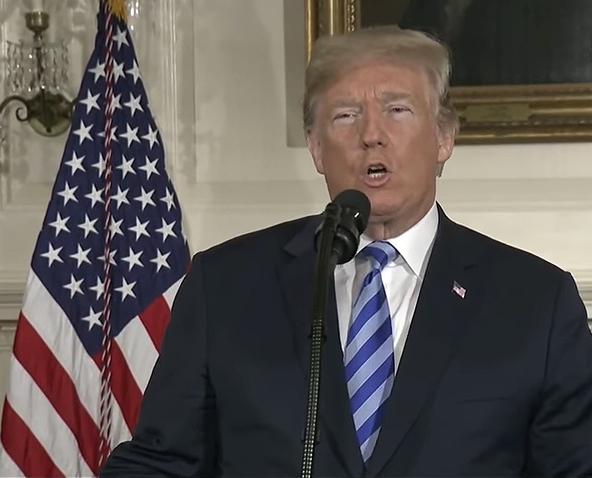
Application for the exit of the United States from the Agreement
Photo: YouTube.com screenshot
But on May 8, at 14:00 in Washington time, Trump makes an application for the exit of the United States from the agreement and restore sanctions against Iran to 90-day (for a number of state institutions) and 180 days. Trump did not specify exactly what sanctions will be imposed against Iran, but analysts converge in the fact that at least the United States will return to the restrictions of 2011-2012, when Iranian banks were disconnected from the international transaction system SWIFT, the accounts of the State Bank of Iran and its private banks were blocked, and Iranian oil was introduced. The result was inflation-44%, 25 percent unemployment, a decrease in foreign trade by 30% and annual losses from the embargo on Iranian oil of $ 40 billion (read more details here ).
In addition, the United States will begin to punish foreign companies in 180 days, which intend to continue cooperation with Iran bypassing sanctions. “This is a significant blow to the interests of French and German business, which has already resumed cooperation with Tehran in the field of energy and high technology, more than 20 companies have been working in Iran,” an independent Iranian journalist Ali Mokhsen Firuzi explained NT.
"Iran would never agree not only to the audit-even to some editing of the agreement"
CCU warned France - just like that, not European allies, but France - about leaving the agreement, reported on May 9, the day after Trump's high -profile statements, with reference to the informed source of The New York Times . But representatives of the Elisean Palace in a conversation with Reuters denied this information: yes, Trump and Macron telephone conversation were the day before, but “Trump did not make any hints about his decision”.
“Trump, in fact, deceived Macron, who tried in unofficial quality to negotiate on behalf of other international intermediaries,” explains the French journalist Jean-Claude Galli. - Nevertheless, they understand: with the release of the United States, the agreement loses its meaning, even if formally everyone else, including Iran, states that they remain "in the transaction." US sanctions will affect not only Iran, but in general everyone who violates them. ”
However, the initiative of Macron in any case was doomed to failure, said Vladimir Sazhin, a famous Russian expert on Iran from the Institute of Oriental Studies of the Russian Academy of Sciences. “Iran would never have agreed not to the audit-even to some editing of the agreement, and even more so to the fact that Iran’s nuclear program-two more-Iranian missile programs, including the creation of ballistic missiles, and regional policy, explained Sazhi NT to the fundamental subject of the agreement. According to Sazhin, Macron in a hurry came up with a variant of the “compromise application to the agreement in order to somehow soften Trump’s position and save the agreement itself-after all, neither Paris nor Berlin have data on violations by Iran.”
Tehran's reaction
On May 10, Trump, speaking to his supporters in Erkhart (Indiana), declares the desire to achieve a “good, honest deal” with Tehran in return for the former who, as Trump assures, “could not prevent the possibility of nuclear weapons into the hands of Iran,” and therefore Washington introduces “the most severe sanctions” against him. Trump also makes it clear that the United States may require Iran to admit to secret military facilities, "to make sure that they are not fraud." And then an amazing phrase follows: "Of course, we are sure that they do not deceive, but just in case."
However, “every case” may no longer come. The first signs have already appeared that Trump’s decision could be fatal.
On May 10, the head of the Foreign Ministry of Iran Mohammad Jafad Zarif announces the intention of his country to return to the 20 percent enrichment of Uranus sufficient for the production of nuclear weapons. In parallel, the situation at the Syrian Theater is sharply aggravated. On May 9, while at the celebrations in connection with the Victory Day in Moscow, the Israeli Prime Minister Netanyahu notifies Putin about Israel’s determination to “finish” (they say that Netanyahu used this word - “finish”) with the Iranian military infrastructure in Syria. And the next day, Israel applies a massive air service in three dozens of Iranian facilities in Syria. Moreover, for the first time in the entire time of the Syrian campaign, since 2012, according to the Israeli Air Force commander Amir Eshel , his country inflicted more than 100 strokes to Iranian military escorts in Syria - the Israelis confirm the fact of an air attack.
On May 11, during the Friday prayer at Tehran University, a member of the Council of Experts ( one of the highest clerical structures in Iran. -NT) Ayatollah Hatam again, like the president of Ahmadinejad, collapses with direct threats at Israel: “We are ready to expand our missile opportunities, and if Israel continues to behave stupidly, then Haifa and Tel Aviv will be destroyed. "
The situation threatens to get out of control, and this bothers Moscow. Putin, according to the Arab newspaper Aharq Al-Awsat , is instructed by Sergei Lavrov to urgently send a special representative to Tehran to cool the ardor of ayatall. Sergey Ryabkov’s deputy Lavrov flies to Tehran. He, according to ASHARQ AL-AWSAT, convinces the Iranians to show responsibility and refrain from response to the Israeli attack. President Rowhani agrees.
Meanwhile, in the Iranian National Security Council, hot debate continues on how to behave further. According to Asharq Al-Awsat, Rowhani accused the head of the General Staff of the Iranian Army, Major General Bagheri of the Sabotage of a Nuclear deal. Talking detail.
“Immediately after Trump spoke about his intention to reconsider the 2015 deal, the military in Iran began to demand a suspension of the process of centrifuga deactivation”
“Immediately after Trump spoke about his intention to revise the 2015 deal, the military in Iran began to demand suspension of the process of decommissioning centrifuges,” says Ali Mokhsen Firuzi. “They say that there were even several meetings of Bageri and the commander of the Guardian Corps General Salah with the director of the Iranian atomic energy agency Salehi, about which Rowhani knew nothing.”
Israel, almost the only country that was negatively related to the agreement from the very beginning, of course, there were reasons not to trust Iran, Firuzi agrees, but "Trump only raised a degree of no confidence, while Barack Obama noticeably reduced it."
Calculations and reality
“If one US administration concludes a transaction, and the next one terminates it, then what conclusion will Ayatolles come to? That's right - it is better not to deal with the United States at all, ”Sazhi argues. At the same time, in his opinion, serious arguments against the agreement - “excellent in all respects of the transaction” - neither Israel nor the United States presented.
Netanyahu says that Iran is disabled “not the same” centrifuges (such as IR-1), and “those centrifuges” (IR-6 and IR-8), on the contrary,, according to the agreement, will put into operation in 2023, thereby preserving his nuclear potential. “The threat is not that Iran does not violate the agreement, but that it fulfills it,” Netanyahu remarked sarcastically in a recent interview with CBS.
Opponents of the agreement in the USA and Israel are also afraid that Iran uses the agreement as a screen, behind which, like Kim Jong -un, will steadily advance to the goal - the possession of nuclear weapons.
“Israel and the United States make a calculation that new sanctions will cause a new explosion of popular dissatisfaction in Iran and finally shake the ayatoll regime”
On the other hand, the US unilateral exit from the transaction is also a reason for Tehran to think: is it not better to act in the Landr logic-that is, to go ahead, to conduct tests, in spite of any threats and sanctions, and, having achieved his own, sit down at the negotiating table, already having de facto nuclear status.
By the way, the Lebanese analyst Anik Aun is sure: the main objections to the agreement are not related to the execution or non -fulfillment of Iran of the agreement, but with the fact that since 2015 Iran has sharply strengthened its position in the region. “Iran created a powerful military infrastructure in Syria, seriously affects the political process in Lebanon and Iraq (in both countries there are soon parliamentary elections), and supports the Hussitis rebels in Yemen. Israel and the United States make a calculation that the new sanctions will cause an explosion of popular discontent in Iran, that we have already observed at the end of last year, and finally shake the ayatoll regime, ”explained Aun NT.
However, Sazhin believes that before that “still needs to survive”, while destabilization throughout the Middle East is a very real prospect. With the exit of the United States from the agreement, the war in Syria entered the new phase: “proxy-strokes” and the game of cat mouse go into the past, Israel and Iran moved to an open confrontation. In addition, Iran in the near future will surely resume the enrichment of Uranus, which will cause Israel to tempt a blow to its nuclear objects. However, even if Israel refrains from sharp steps, no one can vouch for another ambitious regional player - Saudi Arabia, for which Iran’s geopolitical ambitions are bone in the throat.
“At what angle, consider the US withdrawal from the agreement, the costs are outweighed,” summarizes Vladimir Sazhin.
* According to the SVPD, USA, Great Britain, Germany, China, Russia, France and the European Union, agreed to abandon the sanctions that destroyed the Iranian economy, in exchange for Iran’s refusal to take further steps to develop a nuclear program, limit themselves to an exclusively peaceful atom and open the doors of its nuclear complex for inspections from the International Magate Atomic Energy Agency. According to the agreement, Iran, which had 20 thousand centrifuges to enrich Uranus, had to leave only 5 thousand centrifuges workers - this made the creation of a nuclear bomb extremely difficult for Iran. Iran also abandoned 97% of his reserves of enriched uranium, retaining only 300 kg of reserves of 10 thousand kg, and also agreed to other measures that would make it difficult for Iran secretly to continue the military nuclear program. The SVPD agreement was considered one of the most important achievements of the previous US President Barack Obama