
Translated material
Revolution of nightclubs
Following Armenia, Tbilisi came out in the square - the protest is contagious, although everywhere for him his reasons
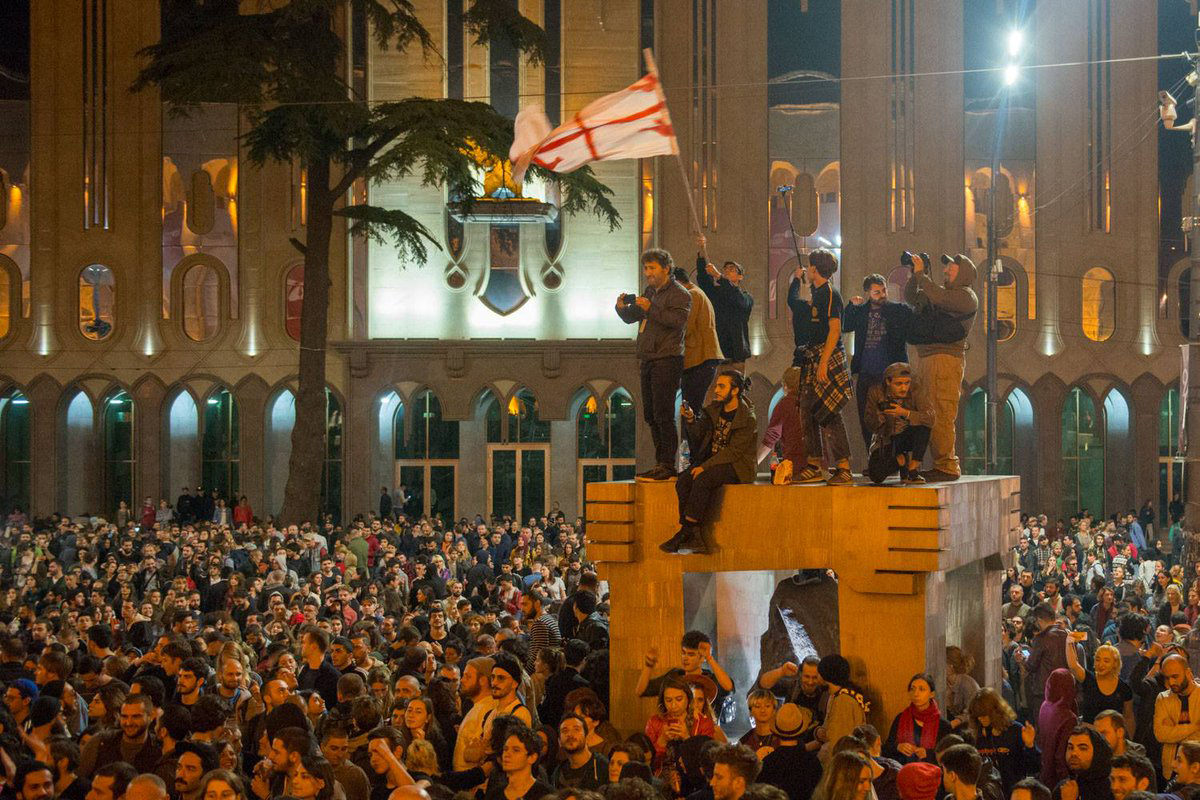
Photo: Twitter / #Newstbilisi
50 years after May-1968 and Prague Spring-again the revolution. Peaceful Armenian - according to Karl Marx, from poverty and from the fact that the deception was tired. Tbilisi - according to Seymur Lipset, in defense and in continuation of the lifestyle of the new middle class. And only the Russian revolution is sexy, according to Sigmund Freud. Well, partly still according to Marx-for this is the indestructible union of libido, capital and bureaucracy. It occurs mainly on individual hyperelite yachts. We do not think, in fact, that Oleg Deripaska is one so unique-solves the issues of a close union with the highest bureaucracy, an ornamented escort services. Everyone so approximately the same issues solve, but have not yet been lit up. But now it's not quite about that.
The action on Rustaveli Avenue was politicized with lightning speed - tents, tents, the name - “For freedom”. The resignation requirements of the Minister of Internal Affairs were supplemented by the requirements of the resignation and the prime minister
Democracy of electronic music
The road that led to the temple led to a night club, and then - to Rustaveli Avenue.
The revolution of nightclubs in Tbilisi, which began on May 11, after the anti -drug raid of the police at night institutions and excessive use of force, could be called a revolution of stinging with fat. Well, in fact, the police solved their problems - what to arrange around this riots? However, such actions of the authorities in modern society are evaluated as an unmotivated invasion of private space - perhaps there were other methods of catching drug dealers. In addition, many protest actions that post -facts call the revolution sometimes begin about, which seems insignificant. The revolutionary situation arises from an absurd dialogue-such as a conversation back in January 1968 Daniel Con-Bendy with the Minister of Youth and Sports Francois Misoff (by the way, the hero of the resistance), who, according to the future leader of May-1968, did not reveal the topic of sexual problems of young people in the report on the affairs of youth. A little later, the issue of admission of Yunosha students to the female hostel became a trigger of unrest, and then a universal strike.
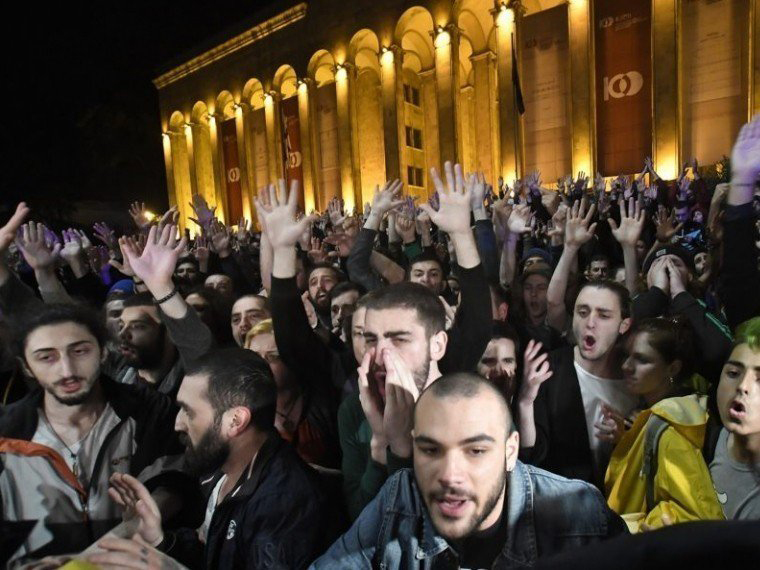
The action on Rustaveli Avenue was politicized with lightning speed, becoming in the form of a political one - tents, tents, the name “for freedom”. The resignation requirements of the Minister of Internal Affairs were supplemented by the requirements of the resignation and the Prime Minister. The popular mayor of Tbilisi, the former footballer - the defender of Milan, Kakha Kaladze, called for the negotiations, and he came out of the position of the authorities: “... we hear different speculations that the allegedly police special operation struck the development of night economics, a blow to club music. We categorically disagree with this. ”
Probably Kakha Kaladze is right. But sometimes the form of restoring order cancels the content of democracy. And there are countries whose inhabitants of whose capitals are sensitive to violation of the boundaries of the entire private. Tbilisi, which in recent years has become extremely cosmopolitan and fashionable among tourists by a city where the protesters have adhere to the traditions of Georgian choral singing on the street, but in English speak better than in Russian, this also applies. Democracy has to be relaxed and defended - every day. Human rights - even the right to sit in a nightclub - has to be rejuvening each time, there is nothing and for all. As the Socialist -Revolutionaries said, "you will find your right in the struggle." In the modern world, the authorities will have to test the border of the permitted, otherwise, each time in Russia is called “resistance to the legal representative of power” will become an impetus for protests. Without any hand of the State Department.
And then it all depends on the persistence of those who go out. Nikol Pashinyan brought the situation to a logical end, realizing that he would lose everything if he stops.
The form of conversation between power with protesters becomes a tester of the quality of democracy and/or political culture in the country
Night people
Of course, the Georgian revolution of the raver does not look like a caricature - rather an attempt to repet off a successful Armenian action. The revolution is contagious. Or even infectious. And the form of conversation between power with protesters becomes a tester of the quality of democracy and/or political culture in the country. Modern Georgian state elites are young - at the age of the older brothers of those whom the police put face to the wall in nightclubs. But they are already being held for the elderly, who either squeezed out or launched achievements - recognized achievements - the "revolution of roses."
Such is the fate of the post -Mepers of the post -Soviet states - transformations, modernization, revolutions do not have time to end in one political cycle. Who is linked to what - in compromises, counter -revolution, stagnation, corruption, police officer, inefficiency. After some time, the “catching up revolutions”, as Jurgen Habermas called them, return. Most often-so that again everything goes into the usual cycle “Revolution-Stabilization-Stagnation”, but sometimes still changing the consciousness of the nation and elites.
A lot depends on whether the Pashinan revolution will become a history of success or the visual lesson of the managerial weakness of the revolutionaries who came to power. In case of failure in Armenia, they will point a finger like the Arab countries after the Arab Spring - it all started well, but it ended badly, there was stability, and now the mess. A traditional argument in favor of dull authoritarianism as a medicine for uncertainty.
The only problem is that it is precisely the authoritarianism itself that generates uncertainty. It gives rise to revolution, refusing the people to subjectivity.
As it turned out, visitors to nightclubs are also citizens. This is a people. Who would have thought.
* Author - head of the programs of the Moscow Center of Carnegie, permanent columnist NT
The author’s opinion may not coincide with the opinion of the editorial office