
Translated material
Sergey Solovyov about Teyama
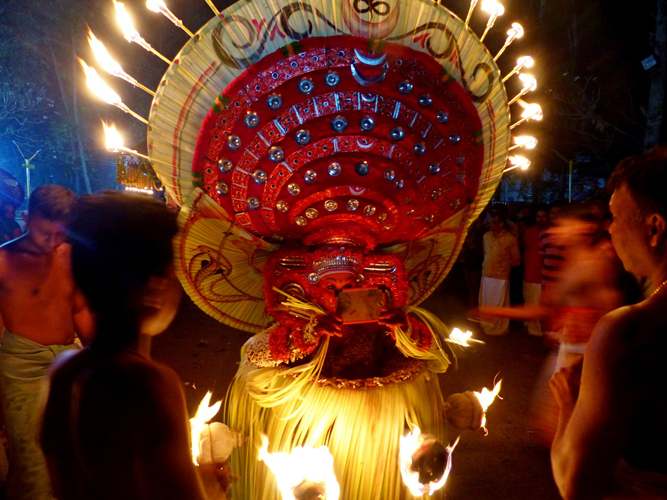
Where to start, as Sasha Sokolov said? With a secondary, from a wardrobe? From which would the most exquisite-derish couturier be numb, and the outfits of the theater but would look nearby almost like a school uniform? Despite the fact that all this multi -tier beauty space is made by ordinary peasants of the lower caste in the outback of India for millennia and is never shown outside the village district of a small town.
Or so. Imagine that today, somewhere in the outback of Greece, the ancient drama continues-and precisely in the authentic form, which was originally. Or imagine the same about the Eleusine Sacraments. And add here that we not only do not know about it, but also that they once existed, we have very vague performances.
In its own way, this is the case with Teyam-the great-pagan pagan rite of extraordinary magical beauty and strength, which has not stopped throughout this darkness of centuries, and now anyone can see it-it is enough to come to the Indian state of Kerala and get to the town of Cannur, in the vicinity of which this fantastic mysteries are happening in the winter months.
But it is better to start looking for what it is about. This is a trailer for the video material I shot.
Amazingly, there are still no intelligible information about Teyama. In any case, everything that I managed to find in the English -language field of information can be laid in half a page. We have almost nothing. Perhaps in the languages of India, first of all, on the Kerel Malayalam, there is a possibility of opening this veil. But I will not be very surprised if we find a little more there. And one of the answers to this paradox: India is the same full miracles of the world, which today continues to be only slightly ajar (for us, for Western thinking with its idea of values, historiography, etc., and for the Indian it is just the air that they breathe, and if they are “analyzed”, then in a completely different way). And overwhelming discoveries here are still possible at every step, as we have during it. There were enough cases even in my memory. For example, when the village Zmeelovs showed on a cliff behind the farm the caves of five thousand years ago discovered by them. And there they connected me on a mobile phone with a professor at the University of Bombay, which confirmed: yes, he came with a small group of specialists, dated and postponed the research until the next time. And when will he come - in the next south? Since this and different "good"-half anger. And on the other side of that farm there was an abandoned and unknown small “Stonehenge”, around which goats walked around. Or here is a huntsman in one of the reserves of Maharastra tells me: here we are the other day, digging a pond for animals, we found a dinosaur, we’ll go with a glance - maybe you can tell you what to do with it. Or, laying the route in the outback of Karnataka, I came across an amateur site of Hindu on the Web, which has been traveling around the villages for years and describes ancient temples; So, there are almost no information about half of them, and among them are world -class temples. Well and so on. Even new species of animals are still found in India. So it’s no wonder that we know so little about Teyam.
 © Sergey Soloviev
I learned about him by chance several years ago and only this year I got to those edges. But first about the town of Cannur. This is the Northern Kerala, which is inactive by visitors, the tourist terrain is located a lot south: it is there - Ayurveda, spa, beaches, the Kathakali Theater, Turavananuma Temples, etc., and here is a town surrounded by military and police garrisons, which are not very decided to intervene in his life: on the one hand - violent corruption and well -coordinated cries, on the other hand, on the other hand, on the other hand. The restless marching committee, leading in this region. Both sides, not to mention many others, in an inseparable embrace. The streets are in the rowan red flags, the bridge in the sick-youth tattoo, and there are huge puppet, homominically beautiful figures or just the heads of Lenin, Mao, Che Guevara and Marx, as if Parajanov, a couple of people with a bush. Despite the fact that the town itself, with its purely modern buildings and hibar, gives the impression of a somewhat curious between NEP and military communism - with a cheerful adjustment to India and the XXI century. Add here still Christian missionaries who seized on this state as any other and, apparently, feeling their inferiority in these lands, inflating themselves to exorbitantly pathos scale with illuminated surveillance temples the size of a Taji mahal. Well, the general degree of abusive patriotism and self -esteem: Kerala is the best of all - in education, and in medicine, and in beauty, and in climate, and in general.
 © Sergey Soloviev
I’ll return for another minute to Lenin and amuse you before continuing with Teyam. Once on the street of Cannur, I talked with an intelligent secular man of middle-aged. Upon learning that I was from Russia, he asked how long I saw Lenin. In the mausoleum, he added, seeing that I was a little taken aback. Moreover, starting with the word "Lenin" his voice turned into some shy-not-free register, and his gaze settled over my head. I don’t know, he said if I dare to ask you about it, but ... when you will be in Moscow ... go to him. And I would be happy if you sent me a photo: you and he.
And then I remembered another episode: two weeks before the much less than the Communists, Maharastra, in the small town of Dapoli, which the locals pronounced as “Napoli”, not having the idea of Naples, I sat in a police station, talking with the main inspector of the region, in whose name the “larks” was heard in English, and “100 thousand in the local dialect-100 thousand Rupiy ”, and we talked about five minutes after meeting the comments of Shankar to the Upanishads. I must say that foreigners in this region see infrequently, and even capable of conducting such conversations. With each word, a small lotus blossomed in it, he finally could not stand it and cried out: Shiva! A two -meter grenadier arose at the door, dancing a seven -raised dance of honor, and stretched out in front of him. We are the best to us! And we continued, somehow shifting to lamasism. And when he heard that I was personally familiar with the Dalai Lama, he fell silent for a minute, then leaned over the table and whispered in my face: "My dad ... called ... Lenin." "How!" - I recoiled slightly. Yes, he said, sitting down, and the full name ... Then he spoke something unpronounced. What meant: Lenin-man-son-minute.
 © Sergey Soloviev
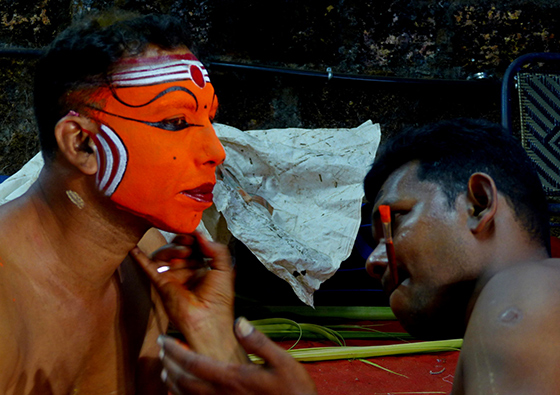
But back to Teyam. I was incredibly lucky. The fact is that it occurs mainly in the winter months, on average once a week and each time in another village. To find out where and when, it is also not easy: the few ads written in the local language are pasted around the city, but we still have to find them among hundreds of thousands of others, and then only by the picture, and then catch passers-by, among which not everyone speaks English, and then still get to that village with wordless rickshaws, where the mistake in the same shelter in the name of the place is in a completely different village. It was lucky that it was on these days that Teyam walked all 12 days in a row - in different villages and performed by different troupes. And all these 12 days and nights-and the performance, as a rule, begins in the evening and lasts until the morning, and even two or three days and nights continuously-I drifted along with the troupes from the village to the village, slept, or rather, moved with them right on the ground near the stars on the temple farmsteks and returned to the hotel in a day or two only to wash and change. So, my conversations with the “actors” of Teyama (with those counters with whom it was possible to at least somehow explain in English) only confirmed the extreme degree of ignorance of information about Teyama: as soon as my questions went deeper than superficial ones-about accessories or plot conflicts of the presentation-and concerned the history of this rite on his weight, how much the millennial path, hung up the irresponsible. perplexity. But the happiness was already that I, having gottenions and friends with many of them, could be freely in the hrymerki huts and observe the whole process of preparation for Teyama, usually hidden from prying eyes.
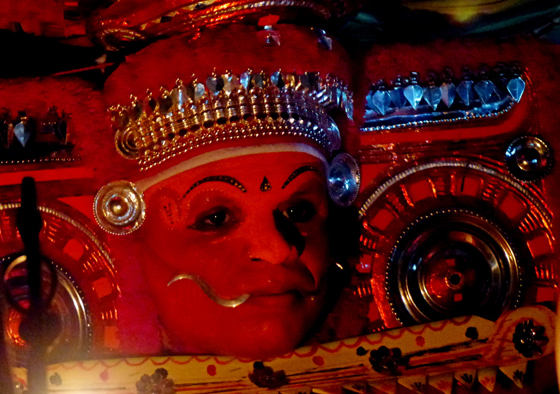 © Sergey Soloviev
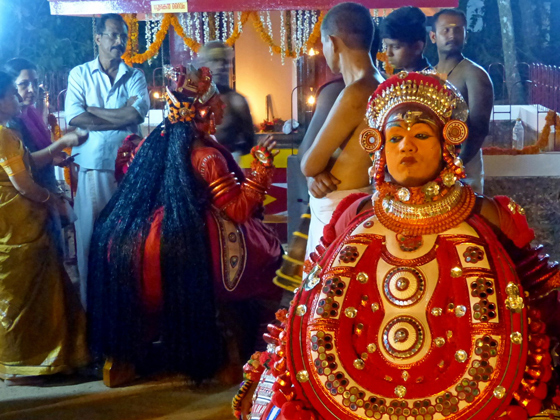
Now in order. To begin with, I will try to briefly summarize what we know about Teyam. The word "team" means both the very process of the magical ritual, and the name of God, the spirit (or clouds of spirits). The essence of this mysterious rite is the calling of the Tayama spirit, its entry in the dancing medium (bhagavata) and the translating of its divine energy. This action is preceded by a long stage of sophisticated preparation, including scenery and breathtaking beauty, an outfit into which Bhagavata is removed. The troupe consists of about 20 people, half of them are musicians (drums and winds), Bhagavat-one, but there are two or three, acting alternately or together. The rest prepare the space of action on the temple compound (fire, symbolic decorations, etc.) and participate in the mystery on the second or third roles. There are about a dozen such troupes in the district, and they are all from one of the lower castes called Vannan. But only two of them have an unlimited right to fulfill this mystery. In time immemorial, according to legend, it was received by them from the king, and since then these two troupes convey the right and experience of inheritance - from father to son. Each of the troupes has its own differences in the repertoire and its own characteristics. There is one plot - extreme, where it comes to literally about life and death for the performer: entering the fire. Nowadays, only two people can fulfill this team, as I told me. I saw one of them, below I will tell in more detail and show these videos that were not easy for the perception of the video that managed to shoot.
Usually, Teyam is ordered by the family of trustees of the temple together with the village community, which covers expenses and pays a symbolic fee to the performers. Symbolic, since Teyam is not a profession and not earnings, but ministry. On average, the performer receives a month of salary, housekeepers in a month. And if we take into account that Teyam is only in the winter time, this is a penny at all. Everyone in the troupe has their own profession and work, to which he returns after Teyam.
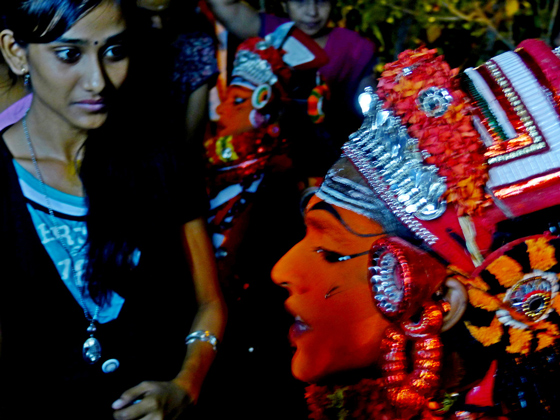 © Sergey Soloviev
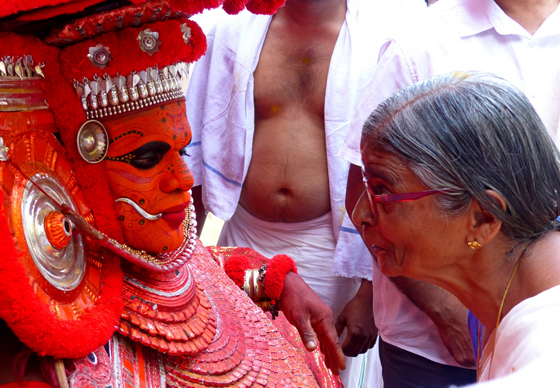
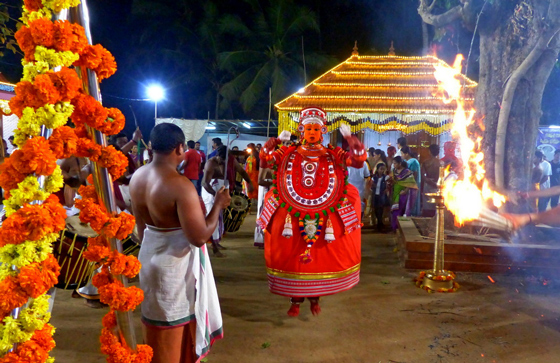
A performance begins with a certain prologue: one of the troupe (the second medium), as a rule, naked to the waist, in a lightweight make -up, standing by the fire, calls on Teyyam with a meditative song to the deep sound of a slow drum, announcing the beginning, “opening the channels”. Then Bhagavat comes out, and the main action begins, lasting about two or more hours. Entering a trance, he performs a dance telling one of the plots that refer either to “Mahabharata” or to Puranas (legends). It is followed by a retinue with torches, musicians and other participants. They write that there are about 400 plots, but they told me that in fact no more than 20-30, including local legends and legends. The action occurs without words, but the audience seems to be clear - what kind of plot and what is happening at any point in dance. Even on the facial expressions of Bhagavat, the movements of his hands, fingers, which is also a separate performance. For a stranger, albeit a friend with sources, it is difficult to understand this. Bhagavat can, for example, be divorced into a woman with hemispheres of halves of coconut depicting breasts, dressed in a semblance of matron in the manner of a samovar woman, but play the role of a man. Or dance some battle with death (pit), but when I asked my retanger friend, he was deeply surprised by my reading. Firstly, the “death” turned out to be just a servant, secondly, no battle, but ministry, thirdly, even if it were death, he said, what can there be a battle with her? Only love. Both of God and man. And it is true: “Tat to the attachments of Asi” (“you are that”) - of the basic principles of Hinduism: you are never you, but there is a cloud, for example, but it is, only because it is that tree, and so on, until the whole universe, returning you to the only real semantic outlines - like the whole universe without a trace. But the action in Teyama can also be plot -mowing, simply entering the image of one of the gods - into the king of monkeys Hanuman, for example. At the end of the mystery - sacrifice. In former times, it could be a buffalo or a black goat, now, as a rule, a grocerian chicken. After the final, Bhagavat sits on the “throne”, blesses the retinue and musicians, then the line of the audience is built to it. Everyone whispers to his ear of his cares-grinding, he quenches them, encourages them, blesses. All this is very informal, friendly, and laugh and amazed to each other. But - not that they feel reverence for him, but special delicate respect - as the messenger of God's mercy. So, for example, when Bhagavat, dancing, approaches the audience sitting on the ground, they get up, folding the palm of the palm of his chest.
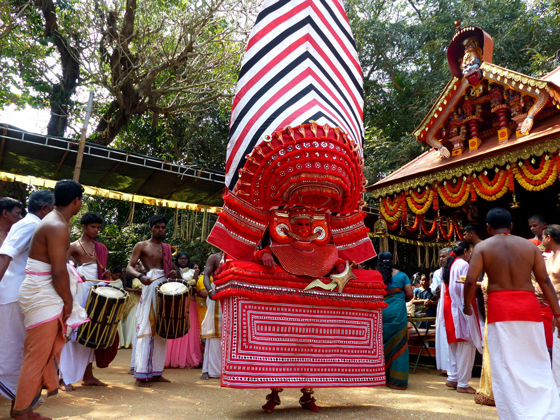 © Sergey Soloviev
The first references to Teyam, made in Tamil, go back to the middle of the first millennium BC. It is clear that we are talking about a rite that existed long before these records. Geographically it is the south of India, the land of Dravids, one of the sources of civilization. And although historically Tayyam is correlated with Keralan, it is now difficult to say how, where and when he was born. In any case, Kerala and Tamil-Nada are neighboring and interpenetrating territories. Then, weaving into Hinduism, Teyam partly transformed, getting closer to him, adopting a lot, but at the same time in an amazing way without losing his authenticity. So the gods of Hinduism entered the Teyam, among which - one of the key figures for Teyam - Durga. Rather, the one who was in the initial, archaic time of Teyayam Durgha, the patroness of agriculture, the many -sided, the beautiful and terrible goddess, whose name is Kalo, being a obsolete burgundy, one of the wives of Shiva, which arose, according to one of the versions, from the black discarded skin of Parvati. One of the Hypostases of Durghi is an inexorable Kali, a black goddess, who, in turn, has (for) the ultimate appearance with a sagging look - Chandika. It is on the farmsteles of the temples of the Durga that the mystery of Teyama is played.
Apparently, this powerful and long connection with the Dark (and the one that preceded it), as with the female energy as a whole, at the beginning of our era turned Tayyam towards Shakti’s worship - the one without which no one and nothing in the universe breathes. Having absorbed this experience, Tayyam after several centuries returned to his outlines again. As far as one can judge, despite the further ups and downs, it has come about these outlines and has survived to this day. Somewhere in the XVII century, in Kerale, the Kathakali Theater is now known throughout the world, one of Teyama’s light scenic discovers. And on the other side of India, in Oriss, in the same impending centuries as Teyam, a jaganate was born, which is considered one of the early branches of Hinduism. This folk “heresy” and now has millions of followers, its temples and its pantheon of the gods, whose iconography is very similar to Teyam with the difference that in the jaganate these are parsuns and images, and in Teyama there is a living mystery. I wonder if there are studies of these comparisons.
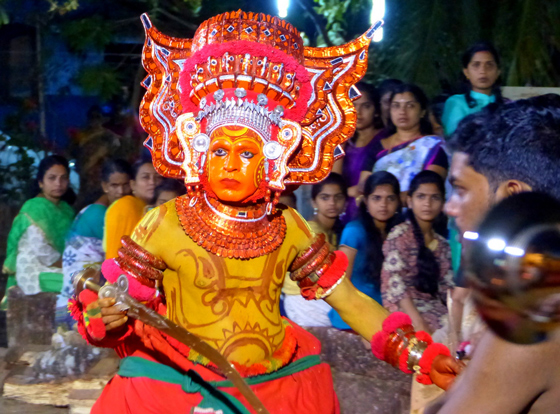 © Sergey Soloviev
It remains, before moving on to the promised extreme Teyam, to say a few words about the unexpectedly created film, which I mounted from the shot material. Suddenly - for several reasons. Firstly, I did not swing the film, but shot, as they say, for myself. Secondly, not very suitable for this camera, in hand, in conditions almost impossible for shooting: a night that blinds the light of spotlights from all sides, wherever you turn, a quick and unpredictable dance, moving throughout the temple retardation, crowds of spectators, rushing after which it was sometimes not to squeeze out. Add here still my passion, my heart of attention to close plans, meditative details, especially in dressing rooms. Nevertheless, I brought about 10 hours of recording. And in amazement he discovered that sometimes the mercy of God managed to remove the same as he did not go. At the output, a film turned out in two versions (short - 80 minutes, to which a link is given, with the ability to see the full version) with my only periodic comments. Since - I understood this during the shoot - a continuously accompanying comment, with all our desire and apparent need, excessed. This house of speech, where we live, looking out the window, is not needed. I think that another experience of perception is more important here, freed from a grasping reflex of intelligence. Moreover, remaining there strangers, especially in relation to Teyam, no matter how we are equipped, even in the best case we will deal with a comfortable, but pseudo -understanding. And in general, as the ancient Indians said, the content is secondary, the ideas are numbered, the plots are known, the thing ends where its form is accomplished. That is, what we came to only recently, for them it was clear almost initially.
 © Sergey Soloviev
And yet - I can’t resist - about the unbearable pleasure of observing the work of the Indians. About close -ups and, in particular, about shooting in make -up artists. What a good movement of movements, what kind of hands are singers! And what a marvelous sense of beauty, from which sleeve they take it out? (I remember how, in the town of Dapoli mentioned above on a stormy market street, a smiling eight-handed dwarf-port picked up a ladder to me to remove the measurement, and sewed a magical one.) And what an astronomical speed by our standards! Та, при которой кажется, что все происходит как в замедленной съемке или почти недвижно. А потому что точность волшебная, музыка жеста, а не какофония. Вот, например, весь этот умонепостижимый космос, в который обряжают героя, — где-нибудь в закулисье высоких подиумов Европы этот процесс требовал бы, наверное, в десятки раз больше времени и рук, а тут — два-три человека делают это непринужденно, почти не глядя. Вот эти слова — ладность, радивость (последнее даже словарь подчеркивает красным как несуществующее) — как-то все обреченнее уходят из нашего обихода. А о чем это говорит? О вписанности в жизнь. О нашем танце с ней, о тактильном даре. Вот они, индусы, танцуют легко и не касаясь земли. А мы то и дело наступаем на ноги — и ей, и себе, зачастую даже не замечая этого. Да и живем зачастую не там, где она, не с ней и потому не так. Хотя любим пофилософствовать про «здесь и теперь». И про Бога, который «везде и нигде». Это мы — везде и нигде, а он — в каждом мгновении — всклянь. Там, где нас нет или почти нет.
 © Sergey Soloviev
Но вернемся в гримерку, где все это есть или почти есть. Казалось бы, почему бы им весь этот астрономический скарб декораций, нарядов и аксессуаров не возить в готовом виде от тейяма к тейяму? Нет же, только часть, основу держат неизменной, а вторую часть, завершающую, делают всякий раз на месте — строят, режут, плетут, шьют… Да, есть то, что не может быть сделано однажды и надолго, — например, нарезка и плетение тысяч стеблей и волокон кокосовой пальмы для интерактивных декораций и особых нарядов (о которых ниже). Но, казалось бы, есть и многое из той кропотливейшей ручной работы, что не нужно делать всякий раз заново. Однако, оказывается, иначе нельзя, потому что это не конвейер, а служение в реальном «здесь и теперь». И, например, семиметровой высоты головной убор изготавливается всякий раз сызнова. А где-то на задворках храма в темноте сидит какой-нибудь зеленщик или рикша и ворожит в отблесках костра над бижутерией к одной из частей наряда бхагавата. И вот я снимаю его незаметно, как он перебирает в шкатулке какие-то стекляшки, взвешивает, разглядывает на ладони две почти одинаковые, прикладывает, меняет… и это длится бесконечно долго. Ну возьми уже эту, любую, ведь их же как звезд на небе в этом наряде, никто никогда не разглядит этих крошечных отличий… Нет, сидит, перебирает, колеблется, светает уже, а рядом мальчик сидит, сын, зажал в губах ожерелье, чтобы освободить руку для серфинга в мобильном. Сын, который скоро займет место отца.
И еще об одном не до конца осознанном мною наблюдении. Большинство, если не все, из дошедших до наших дней магических ритуалов и разного рода сакральных действ неумолимо утрачивает свою аутентичность: либо профанируется на пути широкой публичности, монетизации, выхолащиваясь в шоу, либо постепенно мертвеет, уходя в герметичность, конспирологию, обволакиваясь искусственным туманом с позолотцей. Удивительно, но с тейямом этого не происходит. При всей открытости публике он сохраняет неразменный запас достоинства, мастерства и служения. Парадоксальным образом, будучи развернут к зрителю, он весь погружен в себя, и мистерия эта, по моему ощущению, разыгрывается не для публики. Даже при взаимодействии со зрителями они как бы не отражаются в зрачках исполнителей. Так океан открыт берегу, соприкасаясь с ним, но все его пространство и время — по ту сторону, в непрогляди. Такое чувство. И не случайно, начинаясь вечером и идя всю ночь по нарастающей, представления тейяма строятся так, что самое высокое и мощное действо происходит перед рассветом, когда почти не остается зрителей (за исключением того редкого тейяма, о котором ниже, но там мотивация публики понятна). И еще: необъяснимо, но, как ни играй зумом восприятия, приближая и отдаляя происходящее, — не улавливается эта тонкая грань в тейяме, где «кончается искусство и дышит почва и судьба» не на словах, а на самом что ни на есть деле, где человек сгорает.
 © Sergey Soloviev
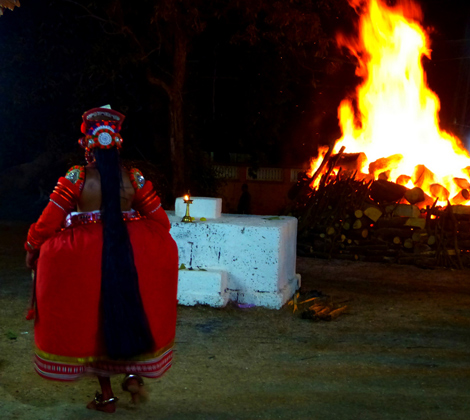
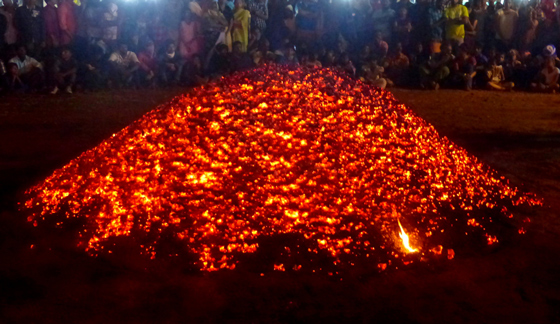
Вот мы и подошли к огню. С вечера в деревню было завезено 20 тонн распиленного тамариндового дерева. На погребальные костры в Индии берется баньян, тоже плотное дерево (около 350 кг на одно тело), но жар от тамаринда адов и долгоиграющ. Неподалеку от храма выстраивается из поленьев высоченный зиккурат — особым образом: так, чтобы, когда затеплится огонь у верхушки, у темени, он медленно прогорал внутрь — от верхней чакры к нижней, а очертания его стояли до последнего, не сгорая. Несмотря на то что костер возводился за оградой храма, все работы выполнялись босиком, обувь лежала в стороне, по завершении была совершена пуджа с ритуальным обходом костра как живого божества. Догорев к рассвету, этот циклопический костер превратился в Солярис жара, к которому приблизиться и на десять-то шагов казалось немыслимым. Тем временем по другую сторону храма, пока на его подворье всю ночь разворачивалась мистерия тейяма со сменяющими друг друга бхагаватами и сюжетами, того, кто войдет в огонь, готовили к предстоящему. В течение нескольких часов я был рядом, снимая на камеру весь ход подготовки, вглядываясь в лицо этого медиума лет тридцати на вид (но бог его знает, сколько ему было на деле). Как я ни вглядывался, казалось, ни горних отсветов, ни божественной дрожи и вообще ничего героического не было в нем, работа шла тихо и буднично. Балагуря между собою и с ним, четверо помощников обряжали его в нарезанные из кокосовой пальмы юбки. Я насчитал около восьми таких юбок — от бедер до пят. Затем двое взметывали его над собой, а один затягивал влет на нем эти юбки как можно туже. К верхним краям этой защиты по сторонам от бедер будут приторочены две скрученные стеблевые косы, за которые всякий раз, когда он оббежит этот раскаленный ад по кругу и бросится в него ничком, двое помощников будут его вытаскивать оттуда. И так будет происходить… это невозможно вымолвить: более ста раз. Сюжет сегодняшнего тейяма, как мне сказали, восходит к сказаниям о некоем споре Вишну с богом огня Агни. Вот Вишну и должен войти в него, в бхагавата. И выйти живым. И самое удивительное в том, что здесь нет никакого фокуса, все по-настоящему: тело и огонь, никаких хитростей между ними. И это знают все зрители. Босые ноги, открытые, незащищенные лицо и ладони. И только древесный шелестящий наряд, верхняя половина которого (смотрите внимательно в фильме) на втором дыхании этого смертельного танца будет снята. Да, есть передаваемый издавна опыт, наработанная техника, но все это открыто, очевидно для взгляда и уж вовсе не объясняется физикой — и от этого еще удивительнее и страшнее. Да, в момент броска он выгибается, чтобы лицом и грудью не соприкасаться с жаром, и, наверное, задерживает дыхание, а перед и после тейяма глотает ложку топленого масла (ги), ну еще что-то из этого же ряда. И всё? В этом смысле — да, всё. Я не к тому, что отсюда надо переходить к объяснениям сверхъестественного свойства. Есть разные подходы и их сочетания, и подумать тут есть над чем.
And yet. Приготовьтесь к тому, что это зрелище, похоже, будет несколько не тем, что вы ожидаете. Не хочу опережать ваше впечатление, но у меня, когда я смотрел, как человек на глазах превращался в живую тряпку, раз за разом швыряемую в огонь, в силу механичности этого повтора все предвосхищение чуда, подвига, магии, черт знает чего — обессмысливалось, чувства сволакивались с тех замирающих высот куда-то вниз, в сторону и даже хуже… Но вместе с тем я подумал, что, наверное, так и выглядит крупным планом все неприкрытое: смерть, война, страдание и тот же подвиг. Расхожая мысль, но отдающая жаром, когда по-горячему.
И еще подумал об этом бхагавате: вот он отдышится, переоденется, сядет на свой мотороллер и поедет утренними проселочными в свою деревню, к своей семье, детям, если они у него есть, и вернется к своей работе — тачать сапоги, печь пироги или растить рис… До следующего тейяма.
И в заключение: вот здесь можно увидеть весь фильм «Семь ночей тейяма» (обе версии) — сегодня, в связи с этой публикацией, его премьера.