
Translated material
Without contact
A year by the ban on Russian social networks in Ukraine. Material "Gromadsky"
The ban on Russian resources - Yandex, as well as Mailru Group sites - postal service, social networks "VKontakte and Odnoklassniki" and others entered into force in Ukraine a year ago. President Petro Poroshenko signed a decree after a decision on this Council of National Security and Defense of Ukraine. The ban was presented as an economic measure so as not to replenish the budget of the aggressor state, but in addition, this was done for security reasons and restrictions on the spread of Russian propaganda. The Gromadskoye figure out whether the blocking of its goals reached.
Natalia Tikhonova , "Gromadskoye" with the support of the "Russian -speaking media network"
Why banned
The Decree of the President of Ukraine is about economic and other restrictive measures in relation to Russia. The document itself does not explain why such a decision is made and what consequences it should lead to.
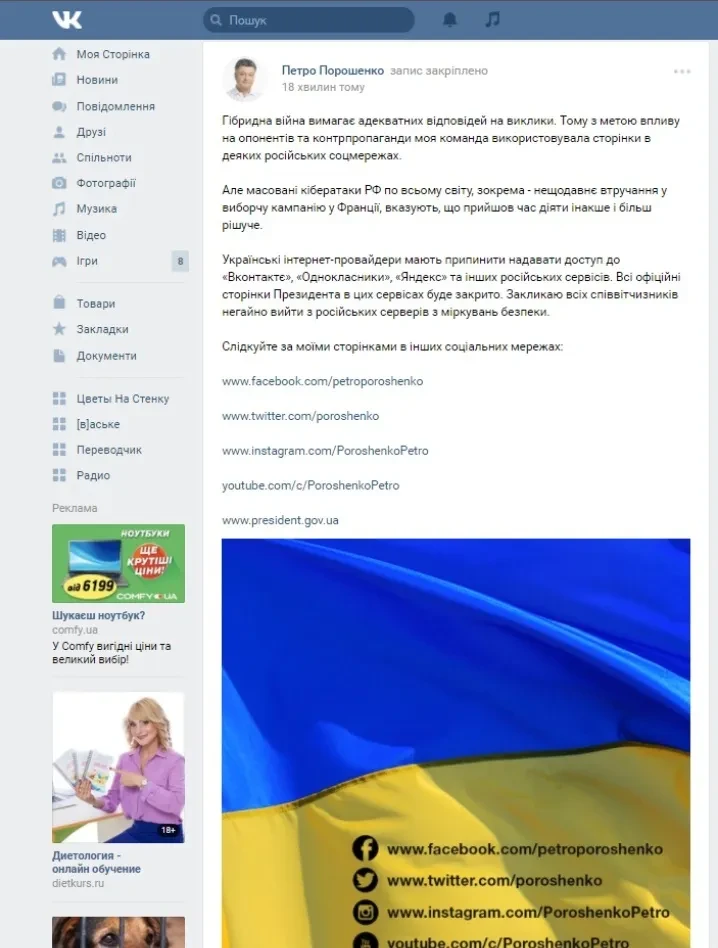
Immediately after the ban, Petro Poroshenko promised to leave Russian social networks VKontakte and Odnoklassniki, writing a farewell post on these resources. In it, he explained his actions to security considerations:
“Hybrid war requires adequate answers to challenges. Therefore, in order to influence opponents and counter -propaganda, my team used pages in some Russian social networks. But the massive cyber attacks of the Russian Federation around the world, in particular - a recent intervention in the election campaign in France, indicate that the time has come to act differently and more decisively, ”the president wrote.
The head of the Council for National Security and Defense of Ukraine, Alexander Turchinov (RNBO), said that the initiator of the blocking of Russian sites was the SBU. As reasons, he called the spread of pirate content there and the ability to replace part of the resources with Ukrainian analogues.
How users reacted
In May 2017, the ten most popular sites in Ukraine included four Russian resources, and VKontakte occupied the third place. A year later, all Russian sites from dozens of doused, VKontakte now stands in 11th place.
“The VKontakte audience in Ukraine amounted to 13 million users,” says the representative of the Internews-Ukraine, media analyst Vitaliy Moroz, “after blocking it was reduced by 30%.”
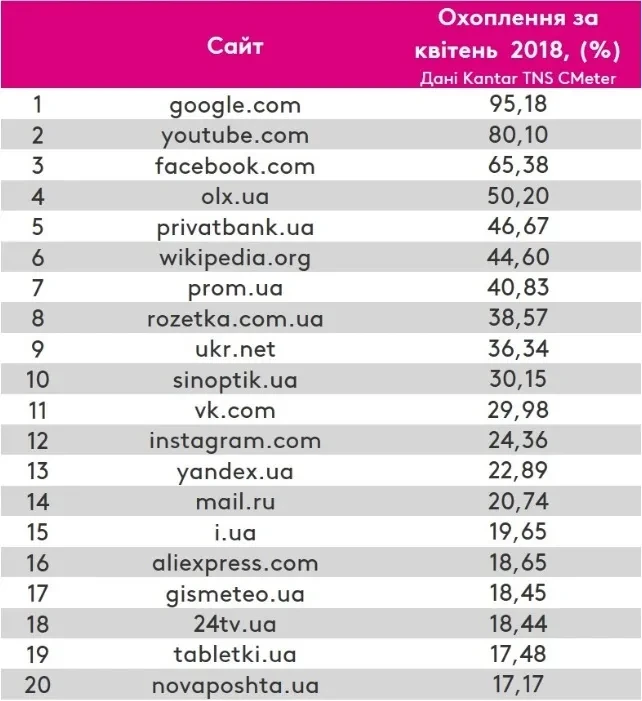
At the same time, the number of users of other social networks, such as Facebook, has increased. “In May 2017, this network had 6-7 million users, but after a few months its audience reached 10 million,” explains Vitaly Moroz.
Some users remained true to the usual resources and continued to use them through the VPN. “Probably, we all got into a taxi in which the driver through the VPN uses Yandex cards. This is very funny, but it means that people want to use these services for their reasons, ”says Matthew Shaf, director of the Freedom House representative office in Ukraine.
How much has lost the budget of Ukraine
Yandex and Mailru Group companies had representative offices in Ukraine, which closed after blocking their resources. Employees were offered work in Russian offices of companies.
“The total number of personnel in Yandex.Chorin as of the beginning of 2014 is more than 500 people, including the office in Simferopol and“ Homefold ”. Then, of course, there were fewer of them. As far as I know, more than 300 people worked in the company a year ago, ”says Sergey Petrenko, the ex-head of the Ukrainian representative office of the company, he held this post until 2014.
Most of the employees decided to stay in Ukraine, only a few dozen people accepted the move about the move, according to Sergey Petrenko.
The Ministry of Economic Development of Ukraine Gromadsky said that they did not calculate the economic effect of sanctions against Russia.
However, from the departure of the company from the Ukrainian market, the country's budget suffered significant losses, Sergey Petrenko believes: “On average, Yandex. Ukraine paid several million dollars of taxes and was one of the largest taxpayers, even received letters from the tax service. In the period from 2013 to 2017, the company did not pay a penny outside of Ukraine, including because the National Bank of Ukraine prohibited the withdrawal of such funds, and all income was reinvested in the development of Ukrainian services. ”
Moreover, the company was involved in the attraction of investments, Sergey Petrenko believes: “In the fall of 2016, Yandex.Taxi. Ukrainian, which was invested in several million dollars, was created. This is public data - the company's authorized fund amounted to 180 million hryvnias (almost $ 7 million). ”
How much Russian companies lost
Russian social networks have lost advertising income in the Ukrainian Internet segment. Analysts believe that we are talking about tens of millions of dollars: “Mailru. Group and Yandex are now losing millions, tens of millions of dollars, because marketers who are developing marketing companies of large brands now usually do not include Russian social networks in their plans - they do not place advertising there, that is, they do not pay to Russia, ”explains Vitaliy Moroz.
Advertising in Yandex was extremely popular, said the ex-head of the company's representative office in Ukraine Sergey Petrenko: “At least a hundred advertising agencies cooperated with the company, most likely more. As of 2014, the number of customers who bought advertising in Yandex in Ukraine was more than 40 thousand enterprises and entrepreneurs. ”
However, on the general capitalization of Yandex and Mailru Group, the loss of the Ukrainian market affected weakly. Mail.ru Group CEO Boris Dobrodeev said that Ukrainian business did not make a significant contribution to the company's revenue. The share of Ukraine in the total income of Yandex was several percent, Sergey Petrenko explains: “Yandex. Ukraine’s income in 2016 did not exceed $ 40 million. Rather, 30-35. In 2016, the income of the entire Yandex company amounted to $ 1.25 billion. The result of 2017 of the total Yandex - $ 1.63 billion, that is, an increase of 24%. ”
On the quotes of the Yandex shares on the NASDAQ exchange, the resource blocking in Ukraine did not affect. The company's securities show growth, which affected only the introduction of the United States of anti -Russian sanctions.
However, the successes of Russian Internet companies are primarily connected with the popularity of this market, according to media analyst Vitaliy Moroz: “Globally, all technological companies in the world and in Russia are now getting more and more income, because the Internet is growing. Therefore, the indicators of Yandex, Mailru. Group is growing globally, and the share of income from Ukraine, which they do not receive, is not so significant for them. Because globally they earn billions of dollars, and losses in Ukraine are dozens, up to hundreds of millions of dollars. ”
Safety VS Freedom
The blocking of Russian Internet resources was, in fact, the first restrictive measure in a free Ukrainian Internet. Gromadskoye sent requests to the Security Service and the National Security and Defense Council of Ukraine with a request to explain how effective these measures were, but has not yet received an answer.
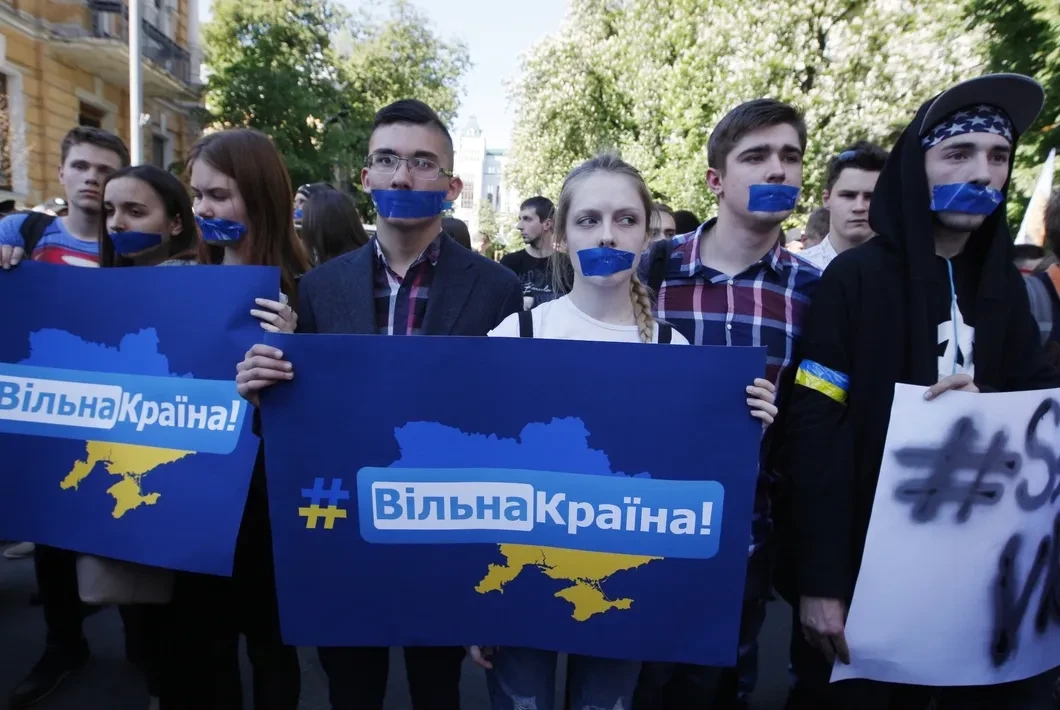
Ukrainian human rights activists believe that the ban on Russian resources in Ukraine did not help to stop the spread of propaganda, but it has become a serious restriction of freedom on the network, explains Irina Chulivskaya, head of the “Digital Security Laboratory”: “VKontakte and other Russian social networks are only the platform on which people communicated. Since people were there, this propaganda spread among them. They closed this resource, opened the next - it all started from the beginning. It is impossible to prohibit and limit technical means to propagate propaganda on the Internet. So the Internet is arranged, then you need to disconnect it at all. ”
Only the content that is dangerous should be blocked, the head of the Freedom House representative office in Ukraine Matthew Shaf believes: “We believe that if the authorities have found some dangerous information on the network, it should be checked, and if there is a threat to young Ukrainian democracy, it must be prohibited. But this decision should not be made in the shade. It is wrong when decisions on blocking content for millions of people are taken behind a closed door, without the participation of network users and companies. ”
The limitation of the Internet is the world trend, and the measures taken by Ukraine are not as harsh as the actions of Russia, experts believe. There, the decision to block sites is adopted by the Federal Service for Supervision of Communications, Information Technologies and Mass Communications (Roskomnadzor), and the resources that help to circumvent the ban - VPN and anonymizers should also be blocked under the new law. In addition, due to the refusal to provide the encryption keys to the ban in Russia, the Telegram messenger fell, Roskomnadzor has been in vain to block it for several weeks.
“The government gave a signal to the society that not everything is in order with these sites. At the same time, Ukrainian users can access these sites, no one forbids them to do this. They can use VPN, anonymizers, this complicates access a little, but technically everything is possible, ”says the media analyst Vitaliy Moroz.

At the same time, experts unanimously talk about the danger of the Russian path to regulating the Internet and the importance of attracting civil society.
“Ukraine will need to balance without refusing the democratic foundations of the country's functioning, to offer decisions where there would be self-regulation and joint regulation of the Internet-together with IT specialists and civil society,” said Vitaly Moroz.
It is necessary to fight Russian propaganda, taking reasonable steps for a long perspective, Irina Chulivskaya says: “It is necessary to develop the media literacy of the population, to show how to distinguish manipulations, to show people what is happening, and how they can protect themselves from this. The state should not be such a “older brother” who says that these are all the little people are illiterate, they will not figure it out, where is propaganda and where not, let me forbid them something. This step is paternalistic, populist and simply ineffective. ”