
Translated material
1968: Revolution, which is early to judge
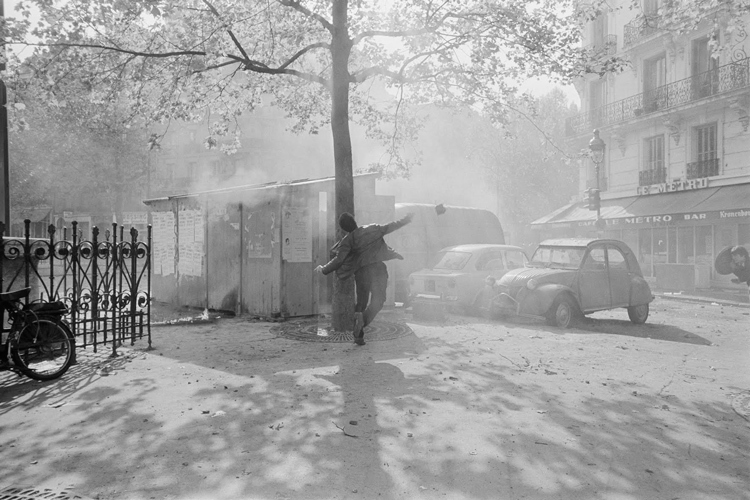
The current fiftieth anniversary of the events of 1968 seems to cause not many emotions. Of course, we are not talking about academic or cultural interest-the depolitized “spirit” of the 68th still inspires art exhibitions or historical conferences, however, discovering complete impotence in the field of politics. The ghost of this revolution, unlike other great revolutions of the past, does not come to life in the struggle of contemporaries, and her heritage looks not only unclaimed, but even shameful. For the Western elites of 1968, today it serves as a consensus point than a cause for concern. After all, like nothing else, this event confirms the old conservative truth: contrary to naive conceit, the revolution ultimately only strengthens what was directed against.
Instead of ending capitalism, 1968 breathed new forces, ingenuity, and the energy of an individual riot. The modern ideological justification of the market, having successfully mastered the rhetoric of youth protests of the fifty years ago, violently attacks the predictability and everyday life of the present for the creative development of the future. Even in his famous book “New Spirit of Capitalism”, the French sociologists of Boltan and Kyapello with merciless persuasiveness showed how this radical criticism of the system became a means of renewing it. The rebellion against the post-war bureaucratized capitalism of the 1960s turned into the triumph of the neoliberal “world of projects”, based on the deregulation of the markets and the privatization of the public sphere. The spirit of protest turned into a new “spirit” of even more soulless orders.
Over the past decades, we continue to indifferently observe the phantasmagoric picture of the appeal of each of the values of the 68th to its opposite: “Liberation of the Personality” now means only an unbridled desire for individual success, and the creative transformation of life-“creativity” as the very chassis itself. The very concept of the revolution turned out to be empty, deprived of any substantial social change, and was reduced to the political technology of promoting everything that seeks to present himself to the disorientated voter as a “new” (it is enough to recall the recent electoral “revolutions” of Obama or Macron). From the gloomy figure standing in the way of youth and imagination, the entrepreneur turned into a rebel of our days, a dreamer and a utopian, embodied in the Tsuckerberg Mark or Paul Durov.
For the “new left” from the distant 68th “liberation of consciousness” was nothing more than the liberation of life from the power of the alienated society that enslaved it. Calling the challenge to the omnipotent “circumstances” that determines the existence of everyone, a person himself ceases to be part of them. The practical revolutionary should not only decisively act, but, first of all, survive the experience of “liberation from illusions”, how to look at the world again in order to finally stop unconsciously to take care of its reproduction. The Western “New Left” offered a wide selection of such practices that liberate the consciousness - from participating in the partisan struggle to an inalienated “psychogeographic” study of urban spaces, from collective self -education, which rejects the university hierarchy, to experiments with LSD.
Even on the last, most vulnerable to criticism, an example can clearly trace the transformation of the strategy of reality resistance into a strategy for reconciliation with it. We are talking about “microdoses” - a daily regulated use of a slight amount of drugs, which has now gained mass distribution among creative inhabitants of the Silicon Valley. Microdoses have not just become a “soft” version of the initial meaning of the use of the drug, but fundamentally changed its meaning. The tamed LSD does not change relationships with the world, but helps in its cash to increase individual competitiveness.
The modern legalization of marijuana in America, the use of which was previously considered as a challenge and firmly associated with the 1960s and the hippie movement, also looks like another convincing victory of “liberated” consciousness over repressive Puritan conservatism. However, in paradoxically, the legalization of marijuana today seems to be the implementation of the traditional American values of the free market and the personal responsibility of the consumer, and in this sense it is not much different, for example, from arguments on the free sale of weapons or tobacco.
In general, the concept of “microdoses” can be used as a metaphor for everything that happens with most “liberation” ideas of the 1960s. For example, the struggle of minorities for recognition, which was inextricably linked with the demand for the social and political progress of society as a whole, in its “microdosized” form turned into a formal and hypocritical statement of the rules of “political correctness”. Instead of destroying the boundaries created by the system between the “majority” and the “minority”, “political correctness” only strengthened them, turning the possession of the “correct”, an irrepressive language into the privilege of the minority of educated and enlightened citizens. Not everyone was allowed into the world of "liberated consciousness" as it turned out. The revolution seemed to have happened to universities and the cultural sphere, but completely bypassed the lower classes.
It was the cultural differences, strengthened by the “microdosized” spirit of 1968, that made it possible for today's European right-wing populists on behalf of the people to attack multiculturalism and political correctness. After all, these concepts now carry nothing but justification of the existing state of things, which causes growing discontent from below.
Despite the fact that the global 1968 practically did not leave traces in the actual Russian context, its normalizing role is quite successfully replaced by the nostalgic cult of the Khrushchev thaw, which filled our cultural space. In this modern myth of the thaw, the paradoxical unity of anti -Soviet (modernism, internal freedom, cosmopolitanism, anti -Stalinism and the triumph of individuality) and Soviet (flight of Gagarin, foreign policy power) are formed. The modern Russian state acts as a bearer of this synthesis, creating the possibilities of comfortable coexistence of the “patriotic majority” and formed classes.
The reconciling myth of the thaw also cultivates the hidden dream of a liberal intelligentsia about a change in society, which is not a political, but natural, biological character. The transition from the horrors of Stalinism to the kingdom of youth and freedom (which in numerous modern films or exhibitions the Soviet 60s are presented) is natural-just as another generation is replaced by another, and spring comes in winter.
Now, at the time of the fiftieth anniversary of 1968, it may seem that his dominant “spirit” does not mean anything other than surrender, hypocritically presenting himself as a victory. However, such a pessimistic state of affairs still cannot be the basis for the final verdict. The heritage of the Global 1968-from Paris to Warsaw, from Prague to Islamabad, from Rome to Mexico-refers to those revolutions, the consequences of which are too early to judge. But in order for the supplanted tradition of the genuine revolution of the 68th-the tradition of struggle against the conformist submission of human life to Mirage “success” and “productivity”-has become part of the experience of the new generation, it is necessary to accept the tragedy of its historical defeat. In the end, getting rid of illusions is not a loss, but acquisition.
The text was originally published on the Opendemocracy.net website. We are grateful to the editorial offices of Opendemocracy and the author for the possibility of recovery.