
Translated material
Cannes-3: well-forgotten future

In the second week of the festival, it became quite obvious: the path to the future is a roundabout, through the past. Cinematographers of all countries are universally nostalized in the era of innocence. For some, these are the nineties: in comparison with the current times of increased anxiety, then a decade is a beautiful one, even if the war in the bay was going on and the AIDS raged. Others, for sure, go down the historical scale just lower - in the eighties, but some are quite satisfied with the two thousandths. Even the Khan Solo turned out to be a prequel; Eh, how fun it was to plow the galaxies on the oncoming lane, not tormented by existential reflection.
Here Alice Rorvaker, who overtook Pavel Pavlikovsky in his ratings, in his unexpected parable with far from new social subtext (“Happy Lazarus”) is touched by the bucolic atmosphere of agrarian Italy. The time of action is conditional “not our days”, but according to the Walkman player and music rushing from headphones, you can guess that this is just the line of the 1980s-1990s. In a certain village of Inviolato - it seems to be completely in the wilderness, and it seems like the capital is nearby - amazing injustices are happening. The caricature marquise, nicknamed the poisonous viper (Nicoletta marriage, familiar to us from the work of Roberto Benini) makes the peasants work on their tobacco plantations for bread, water and electric lights. In the picturesque crowd of the landzan, expertly turned by the Great Helen Louvar camera into conditional “ angelus ” Mille, a young man with a speaking name Lazarus, strongly looking like the characters of the Umbrian school, stands out. Lazarus is a typical fool at the holiday: he meekly fulfills the orders of other workers, wears a drawn grandmother back and forth, unloads the drawers with food, and is injected for two in the field. The hint is transparent. The marquise oppresses the serfs, and those, in turn, enslaved Lazarus. The bad infinity, which will interrupt only the divine intervention, an absolute miracle. Lazarus, as expected, will die, and then will resurrect. But already at other times, when the peasant is one road - from arable land to the conveyor for the same miserable pennies. In this half of the film, Rorvaker strikes a rough social grotesque, whose victims will be not only capitalists and corrupt officials, but also ministers of the Catholic Church, who forgot about their direct duty to help small.
The "Happy Lazarus" will imbue the spirit of some naive Soviet dissidentism, as if Rorvaker filmed not living, but the tale of Evgeny Schwartz. Outwardly, all these “labors and days”, of course, are in no way inferior to Highlights of Italian neorealism, in particular, the Cannes winner - the “tree for shoes” by Ermanno Olmy, but in fact they are a rather speculative and elaborate attempt to enter the river water, whose direction has long passed.
 Frame from the film "Black Clan"
Spike is deepening even further, in the 1970s. His overly straightforward human rights Dramed-Rartro “Black Clan” tells the invigorate story of the black detective Ron Stalvort, who was wise at the end of that flared decade to establish contact with members of the local co-click-clan cell and circle them around the finger. The author is happy to fill the frame with attributes of the sweetest for the cinema, the textured era-with wide trousers, Afro and the rhythms of the Soul, but in each stage, hung up on Trump, quotes Twitter-rustles of an unworthy White House of the race. Lee mounts the “birth of a nation” of Griffith with a “Shaft”, gives the dramatically completely superfluous Cabbage to Harry Belafonte, frightening the youth by the Lynch court, joking a lot and clearly, and in the end shows the public a documentary cutting of clashes in Charlottsville (2017).
 Frame from the film "Ash - the cleanest white"
Jia Zhanke, on the contrary, seems to be extremely serious. He does not want to give any indulgence unjust Chinese society in anything, but at the same time does not reduce the diversity of life to ideological simplification. “Ash is the purest white” - a strong genre story of Gangster Bin, who had confused all the “concepts” and who came with his beloved woman as a trace of fraer. A fighting girlfriend will sit for Bin in prison, forgive me, will accept years later, already seriously ill and paralyzed, back. A truly loving woman, she, like a country of China, will endure everything: any blows of fate, bad people at the helm. Although she adapts to circumstances, she removes from his place, builds the hearth again, changes his work and habits, but remains the same, devoted, ready for any victims. The background of the decade of short meetings and long wires of bina and Qiao (2000s) is the external evolution of the PRC. The new cities of the Sun in Shanxi’s province grow like mushrooms after rain - leaving for a term, Qiao left the ugly miner Datun, and having freed, she sails on the ship no longer on a fragmented log - to a futuristic marine station made of glass and concrete. Perhaps the rewards for the best acting of the Cannes 2018, and the “ashen is the cleanest white”, contrary to the name, is full of fire, which does not weaken until the final itself deserves a rewards for the best acting work. Of all the competitive paintings, only in Zhanke, the beating of life can be heard without a stethoscope.
Many read many as a testament, which was shown outside the contest “House built by Cannes, forgiven by the Cannes, as a testament. And indeed, Trier quickly moved from Eros to Tanatos. The place of sexual excesses of the “nymphomaniacs” was taken by the dismemberment (ducklings of children), as well as a swift jack, who had already cut the skull of the mind of Turman at the beginning of the film. Here is our answer to the frenzied feminism - the director declares unequivocally. But why interpret the self -portrait as a dying summary? Not necessarily. LFT, it seems, was simply noted in the current festival agenda: such a Check-in from Cannes for spiteful people.
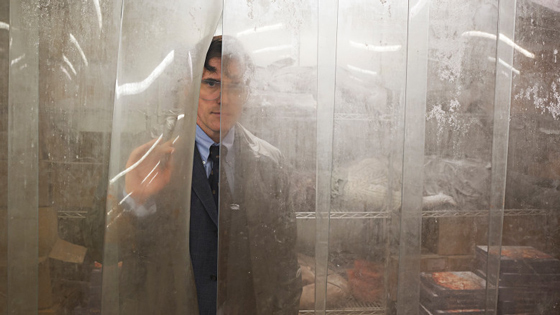 Frame from the film "The House built by Jack"
The protagonist of the “House” is Jack (Matt Dillon), an engineer with a man of architect. He travels to the American Linchev-Koene Retroglubin (all cops-idiots, the entire civilian population-freaks) on the red van and from time to time kills women and children (both in the Cannes program is really disproportionately). Jack Velereti tells about his atrocities to a certain Verja (Bruno Ganz), a bald old man with an artistic bow instead of a tie, who will recall the interlocutor and, like all the elderly, terribly sentimental - remembers love, condemns violence. Even the most inexperienced viewer deciphers all the metaphors and allegories of Trier: we have the approximate film adaptation of the “Divine Comedy”, weighed by philosophical comments in the form of a collage from the monuments of world culture - Gauguin, Picasso, Brothers Capen, Delacrois, and even on trifles. Of course, it was not without Hitler, who also thought of himself an architect, and ended up the manager of the bloody bath.
In an unlucky chance for von Trier, his loud ranting about the nature of art (humanity - consumables, genius and villainy, the birth of tragedy from the spirit of music) look after the vruisms amid the defaults of Godard. The latter in his snobbery abandoned speech, Lars von Trier for the same reasons - from images. As a result, the bulky design of the “house that Jack built” is hard to take out not only to the audience (just bored), but also to the characters - the author took too much on the shoulders of each of them: won Verej - he is both Virgil and the Angel from the sky over Berlin, and the devil from the “bunker”.
But the sense of proportion and humor still did not leave Trier: on the final credits of the "House that Jack built", Ray Charles's composition " Hit The Road Jack And Don ' t You COME Back No More " . Let's hope that the next time the elevator will no longer teach or make excuses, but will speak with us on equal terms, as adults who have survived a middle -aged crisis and any other catabasis to people.