
Translated material
Master of the city of Freiburg
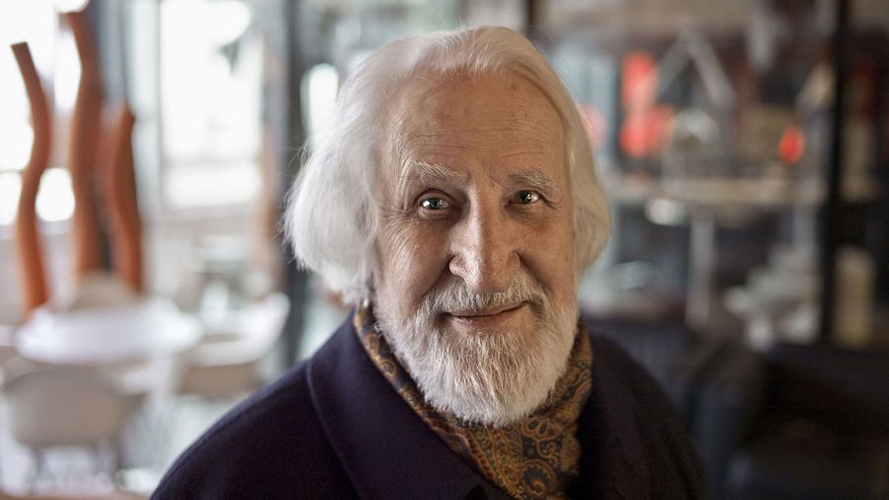
On May 21, in the Rakhmaninovsky hall of the conservatory, the ensemble "Studio of New Music" gives a monographic concert from the music of Claus Khuber (1924-2017). The Swiss composer and teacher is a very significant figure that directly or indirectly influenced the development of the latest musical art. In his vast work, Hubert was not afraid to work on the border of genres and styles, whether it be the musical traditions of the East, new techniques for the game on classical instruments or a microton composition. He raised many composers, whose names have already become cult for modern music: among them Brian Fernihou , Wolfgang Rome, Mikael Zharrel, Kaya Sarariho, Yon Ha Pak-Paan, Tosio Hosokava. To show the scale of his personality and methods of educating composers, Colta.ru publishes the memoirs of several famous students from the 2017 Musiktexte magazine, which was entirely dedicated to the memory of Khuber. Translation by Sergey Chirkov.
Johannes Schölhorn
Studying in the class of composition by Claus Khuber allowed to open the world of culture in all its diversity. Composers came to him from all over the world, we met, got acquainted with such unusual instruments as Sakuhati or Kemanch. All this caused us a craving for distant wanderings, but in order to subsequently return home. Cultural exchange, internationalism and fundamental openness - all this characterized our class. We learned to accept (and not just tolerate) the “non-understanding” that arises between us.
We also learned to avoid the principle of "or - or." For example, Klaus gave us (which, in essence, spoke and Adorno) the same respect for Schounberg and Stravinsky instead of contrasting one to another. He taught us to think over the categories of our thinking independently, and not just apply them.
Claus’s thinking was always dialectical, and we also learned to open the old one in the new and vice versa. Klaus was fond of the past and history in the broad sense of the word - both in the meaning of historical science, and in the sense of the story, the narrative. These two values were inseparable for him.
In the musical world of Claus there is no place for real ideas that would not be associated with sound. He would have signed up under the words of Cooperation (he himself quoted them) that music that is not performed is not music. I got the impression that Klaus could not start working, referring only to Plato's ideas. The idea should sound, and the idea of Claus itself can become happy, as in the name of the composition of Cooper - “Les Idées Heureuses” . <...> He was encouraged by curiosity and enjoyment of sound and time (he, of course, knew how to value time). In his work, one can find and survive both heavenly and hellish temporary segments if you wish. He realized this, and this was part of his dialectics "Time-Cosmos". Of course, Klaus was a cosmopolitan - and here we are again talking, on the one hand, about a holistic, comprehensive and internally contradictory, and on the other, about beauty. At the beginning of this cosmos lies attention to particular - to the only sound, for example, to the smallest details of the score in which the world opens.
The craft part of his work was always open, all his sketches and materials lay on the table during seminars, and we, participants in these seminars, could ask about every detail of the drafts. <...> The very process itself was very important for Claus. In addition to the scores, I had to bring all my handwritten sketches, and he suggested that I rewrite whole plays so that I could better understand them. This advice was very useful to me.
In his composer and teaching, Klaus was rather a tireless collector, and not a cabinet scientist. He liked to conduct “excavations”, as a result of which something new grew, to call in memory what was already inaccessible. Bruno Schulz, Hildegard Bingenskaya, Claude Le Wouses-these names during my studies could hardly be heard in some other conservatory. And the fact that this situation has changed is also a merit of Claus. <...>
His obelisk is directed into the future, and the words “new and living” will always be carved on it. And the story of this obelisk will never turn into stone.
Wolfgang Rome
In 1973, the Freiburg Conservatory was still located in a historical place - in the house of Venzinger near the cathedral. The new Professor Klaus Hubert immediately turned this building into a house, the doors of which are always open. The old floorboards creaked under the feet of avant -garde guests, freedom reigned. Everything that seemed important was discussed openly, everyone who was performed in Donaueshingen was invited for seminars.
The conservatory occupied the premises of the second floor. The large windows of the main hall took to the cathedral. The old frames crackled during the execution of the latest works, in between the bells were heard in breaks. Individual classes took place in a small room on the left. And there, on the other side of the window glass, in the niche on the corner of the neighboring building, our colleague - St. Joseph, who reminded with his beard and long hair, resembled “Mayster Claus”. No, he didn’t get a job: he stood there, blessing and continuing to observe. He was our companion from a story who, obviously, managed to survive the destruction of Freiburg, and now, painted white, he stood like a lighthouse, standing out against the backdrop of the blue plaster of the building. Saint Joseph looked across the street to class and laughed and cried. This is really so! The old rough windows of the house of Ventsinger revived his face. The feeling was created that he repeats all changes in the mood of the teacher and student in the classroom. And in this company he soon became the third, so we could not look at the score without eyes not to ask his silent advice. What would St. Joseph say? We looked at him - and he smiled. Or cried, and not so much from bitterness as from disappointment. <...> Usually I followed his advice without hesitation, no matter how I interpret them.
Klaus Hubert was an outstanding teacher. He and St. Joseph often brought me out of despair, but they always made me stronger. If the windows in the classroom were even and the general atmosphere were less marked with the seal of history, today I would not have enough. This house, discovered for everyone, this dialogue, devoid of vanity and schoolchlar, this upbringing. In those years, Klaus Hubert was a master of the city of Freiburg, and his apprentices were Brian, Andre and Arturo. And, of course, St. Joseph. Can I imagine the best teachers? We students could come and go. We can even today.
Brian Fernihou
Like most of the significant figures of post -war music, Klaus Khuber could not avoid a template classification. The less known the music and personality of the composer are, the easier it is to create an image in one dimension, filled with ordinary rooted stylistic and moral cliches. And, on the contrary, for those of us who are lucky enough to get acquainted with the wide range of its composer and critical activity, the rich depth, openness and (can I put it so?) The complexity ( Complexity ) of its historical position become obvious. Unlike many of his contemporaries, the work of Khuber, who did not deny the fact that his music is rooted in medieval and serial composer practices, it is impossible, however, to reduce to the situation of stylistic prints. Each of his work is an extremely individual reaction and an answer to many clearly formulated and technically honed issues, and it represents an accurate rethinking of the relationship of modern music languages and a real imperfect world into which they are integrated.
Common to all his works are excellent, really virtuoso possession of instrumental and textual capabilities, a deep, natural introversion of expression (all the more stunning in cases of conscious projection of expression outside) and unsurpassed control of musical time. His art is musical humanism in the double sense of the word: the fidelity of the traditional concept of craftsman’s skill, on the one hand, and tirelessly (but fairly) requests for music as the last prophetic means to achieve high moral ideals, on the other hand.
At the same time, Hubert in no way becomes a hermit, a mystic of the late modern. Unlike Adorno, he is alien to the agnostic point of view that the integral autonomy of the progressive work of art is the need and a sufficient guarantee of its authenticity. On the contrary, his Christian faith encourages him directly to turn to the fact that he perceives as a dual mission of art, to move the listener to a specific social reflection and realize the image of a righteous life fulfilled by the hope.
Both the principles and with a person - this is confirmed by the experience of subsequent generations of young composers, who, like me, was lucky to become witnesses of the enormous power of the pedagogical talent of Khuber “first -hand”. Those who can confirm his complete openness and critical understanding of a wide variety of aesthetic approaches, cultural codes and intended goals.
I would like to hope that the unique combination of the fragility of expression and the non-consulting power of intention-target will continue to excite the hearts and the mind of those who seek to open this music in its entire broad spiritual sphere.
Tosio Hosokava
Four years of studying at Claus Huber in Freiburg (from 1983 to 1987) became the most striking and intense period of my education abroad. At that time I was twenty -seven years old, and I was in the search for my musical roots and my identity. Claus's recommendations, his participation and goodwill have always been very valuable to me. So, on his advice, I returned for six months to Japan to plunge into the world of Japanese traditional music and the Japanese image of thoughts. <...>
These were the heyday of the Freiburg Conservatory: there were taught outstanding performers as Hinz Holliger and Orel Nicola, and the Institute of New Music, led by Claus Khuber and Brian Fernihou, offered students a diverse and rich program. Each semester was dedicated to the work of one of the composers, such as Ligeti, Nono, Lahenman, Kurtag, Lutoslavsky and Globokar; We studied his work, and at the end of the semester the composer himself came to the concert, where his works were performed by students. In this open and creative atmosphere, I first contacted the works of the authors who were at the forefront of European music. <...>
Our relationship with Claus and Yong Hi Pak Paan remained after the end of training. At my invitation, he visited Japan twice. A lot of impressions remain in my memory, and especially the visit of Claus and Yong Hu to my hometown near Hiroshima. My mother prepared a lunch for them, which they really liked. Two hours were planned for the lecture of Klaus at the University of Hiroshima, but he spoke enthusiastically four hours in a row, despite the fact that students began to leave the audience one after another. The day before, he read the story of Masuuji Ibuse “Black Rain” I donated about the consequences of the atomic bombing of Hiroshima, and this story captured him so much that the next day he began his lecture through tears. We also visited the Holy Island of Miyadzima - an exciting look from the mountain peak to the inner Japanese sea remains an unforgettable experience.
I really love Klaus's music and still constantly listen to it, especially the Tempora violin concert , a concert for Alta ... ohne Grenze und Rand " , string trio " des Dichters PFLUG ” , Intersi piano concert and many other works. Far from Europe, in my Japanese corner, I will continue to carefully listen to his work and convey the beauty of his music to my young colleagues.