
Translated material
The sovereign dejavu
Sometimes the expeditions into the past end unexpectedly: it is amazing, but the Muscovy of the 17th century was very similar to our today's “Moscow kingdom”

Photo: The New Times Studio
The expectation of the arrival of the Antichrist, followed by the Apocalypse, is an almost integral plot of folk Russian life during the time of Moscow Rus'. Mass psychosis on this basis became especially strong at the next line of centuries or in the transfer or other transition of power. So, in the late XVII - beginning of the 18th century, many believed that the “Kingdom of Antichrist” will be established with the advent of Peter I. Then the “meeting of the end of the world” was accompanied by massive self -immolations. And in February 1917, when a meteorite fell near the city of Kashin in the Tver province, the locals understood what happened as a correct sign: they scored the whole cattle, they welded moonshine from the stock of bread and so finally they drank it together, that the next year they could have been recorded in the comables. Of those places, by the way, the "All -Union Starost" Kalinin.
Comparing with the XVII century
Meanwhile, not only Cossacks, shamans and certified sorcerers can serve as an example of a wooden-out-of-dumping past in our computer and nanotechnological present. Knowing the plots of three hundred-hundred-hundred-hundred-year-olds, you involuntarily catch yourself thinking: technology and technology have changed, and the morals and a general way of life are all the same. Moreover, on a number of foundations, today's Russia is quite comparable not so much with 1917 as with the 17th century of its history. Of course, not in the superior way of the Moscow Kingdom, which was drawn in the minds of the Slavophiles of the century before last, where the council is allegedly ruled, and the master and man were “one family”. Real Muscovy is the way it looks in the descriptions of contemporaries and on the basis of preserved documents, much closer to us than it could be presented.
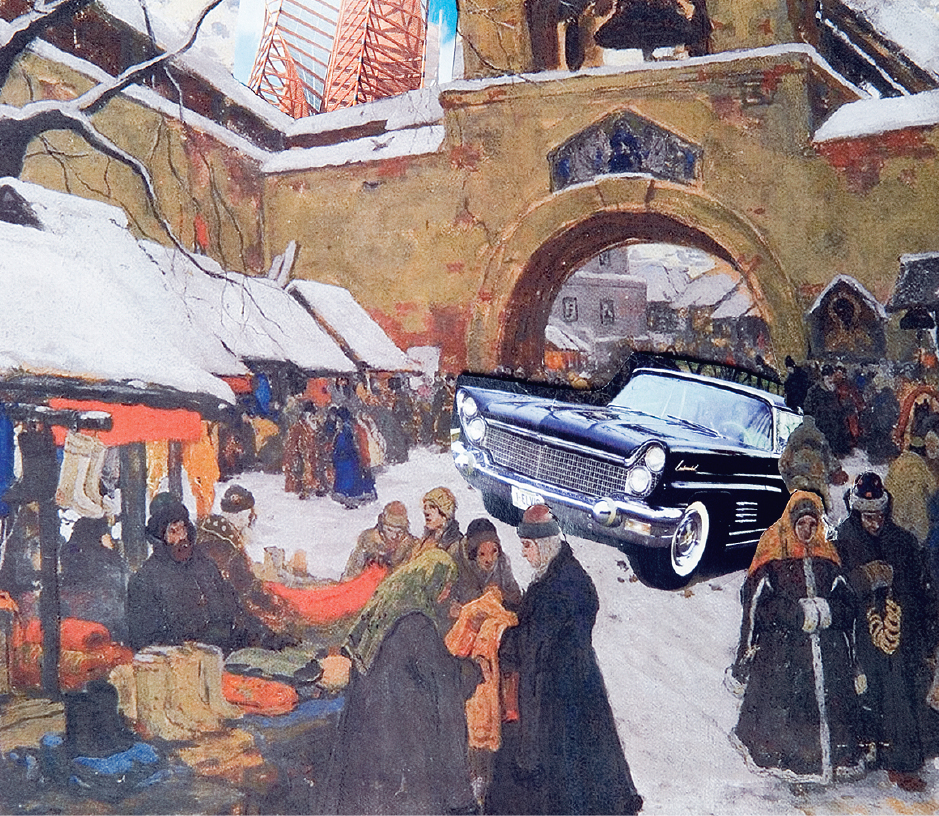
Even the geopolitical position is similar: by the end of the XVII century, the most western point of the country was Smolensk, and in the east - Kamchatka. Most of the Ukrainian lands were still alien. Almost one sixth of the land is already there, and what to do with it is unknown, the economic and political centers of the then world, where new technologies were invented and developed, this territory was either not noticed at all, or perceived as a potential threat. In 1649, after the Russian authorities declared the boycott of England in connection with the democratic revolution and the execution of King Charles I, the activities of the “Russian company” was rolled up without significant losses for London. Muscovy was on the periphery of transatlantic trade routes and had no idea, as they would say now, of serious investment interest. Unless it was possible to quickly earn on corruption transactions with the local order by the administration. Poland and other countries of Eastern and Northern Europe stood in the way of Russian transit to the West. And if Peter I chopped a window to Europe, conquering trading ports in the Baltic, then today the Kremlin builds the North European gas pipeline in the same sea.
The national pride of the Muscovites was wounded. An attempt to become the heirs of the Byzantine Empire based on the sovereign ideology of Moscow - the Third Rome suffered a crushing defeat during the Livonian war. If in the east, where the remnants of the Golden Horde were in full decline, the conquests were successful, if the raids of the Crimean Tatars from the south were very least able to reflect, then in a clash even with the most developed European countries of the early New Age, the troops of the Grand Duke of Moscow inevitably suffered the collapse. The difference in technical development was affected.
Tsarist insults
What can I say, Europeans offended Moscow. For example, they did not want to recognize the Russian rulers to the kings, everyone strove to humiliate them, calling simply the Grand Dukes of Moscow. How many negotiations were disrupted due to the “wrong” announcement of the tsarist title! How many embassies failed, because Russian diplomats spent two -thirds of time in negotiations on clarification of protocol details so as not to drop the “honor of the power”! Westerners, of course, could be understood. The king is the emperor, and empires in Europe itself in a couple of thousand years to count on the fingers. Well, our Ivan the Terrible and Alexei Mikhailovich did not fall under the standards of Julia Caesar and Karl the Great. And I really wanted to be great ... When foreign ambassadors came to Moscow, they were specially carried on city streets for a long time filled on such an occasion by military militia. Sagittarius and noblemen put up “on the floor”, along with “dates” from serfs, in armor and weapons, with maximum splendor (within the framework of accessible aesthetics, of course) demonstrated the strength of the Moscow king. In the second half of the 17th century, however, the cost of incredible efforts - up to 90% of the budget was spent on military needs - Russia managed to build almost the largest artillery in Europe. After the famous siege of Polotsk and Vilna, Russian guns scared East European cities no less than today's missiles.
Vertical and "oligarchs"
In domestic politics, at the end of the Time of Troubles of the beginning of the 17th century, stabilization took place, however, very gradual. Folk riots, due to the unsettled life of the “lower classes”, occurred from time to time. In 1648, the authorities, hiding in the Kremlin, lost control of the capital for several days, but since, as a rule, there was no intelligible political program at the leaders of the street, the “tops” twisted the nuts little by little. The Zemsky cathedrals, who often ruled the country during and immediately after the Time of Troubles (from 1613 to 1619, the Zemstvo Cathedral met almost continuously), gradually lose their role and come down to naught. About the elected monarchy according to the Polish model, the beginnings of which many are seen in the statement by representatives of the “whole land” Boris Godunov, Vasily Shuisky and Mikhail Romanov, by the middle of the century there was no longer any speech. Vertical triumphed in local self -government: elected label elders (possible Russian analogue of the Sheriff Institute) were replaced by the power of the governor and ordered clerks appointed from Moscow. The Ukrainian Cossacks of Bogdan Khmelnitsky, after 1654, under the power of the Moscow Tsar and feeling what it means to be “sovereign slaves”, quickly regretted so unpromitably lost volumes.

The political weight of “strong people” was determined by the degree of proximity to the monarch’s person. Thus, the famous favorite of Alexei Mikhailovich Boris Morozov, forced to leave all state posts after the Moscow uprising of 1648, nevertheless remained in the royal retinue, was invariably present at all the dinners, went to the bathhouse with the sovereign, went hunting and in pilgrimages in holy places - and this was precisely what allowed him to remain actually the second person in the state. From the treasury, he received a tremendous salary, for nothing he bought land from the state, his enormous economy, trade and usury operations, and the fees for lobbying activities brought income comparable to the income of today's oil oligarchs. And the final, according to the observation of the American historian Richard Pipe, was logical: after the death of the “oligarch”, most of his estates and the fortune passed into the royal treasury.
Waiting for the antichrist
Spiritual life was routine. Unlike Europe, there was not a single university in the country. In the middle of the XVII century, the authorities, with the help of Epiphanius of Slavinetsky and Fedor Rtishchev, tried to develop a system of secondary educational institutions for nobles, but without much success. Where knowledge was especially required - in military affairs, court medicine - hired specialists, mainly from Scotland, Germany and other European countries, were used. The then expanses lived separately in the German settlement on the outskirts of the city. Communication with them gradually became fashionable for part of the elite, and even among the future Tsar Peter Alekseevich.
Of the periodicals for some time, only Vesti-Coirs came out, focused on a narrow audience of employees of the embassy order, the Kremlin administration and foreign diplomats. The main phenomenon of mass folk culture was buffoons that entertained the street by comic staging and verses at the “below the waist” level. A few even a layer, but a group of relatively educated (that is, who owned Greek and Latin, who read secular books brought from Vilna and Warsaw) Russian people tried to influence power, realizing that fundamental changes in the foreseeable terms were impossible. As now, Europeans and Russians familiar with Europe on the streets of Moscow could often be determined by the uncharacteristic for most clothing and hairstyle. Meanwhile, the most ardent traditionalists, resisting the inevitable modernization, went to sectarians, threatened with antichrist and the end of the world.
The Dark Kingdom
After there was much: from the point of view of some historians, the reforms of Peter I, no less important from the point of view of the enlightenment of the innovation of Catherine II, the liberal undertakings of Alexander and the great reforms of Alexander II, the conservative utopia of Pobedonostsev, the manifesto of October 17, 1905 and the February revolution of 1917, finally, the grand Bolshevik experiment of the 20th century. However, the Oldmoskovsk darkness is still with us-either in the faces of the masses, then for officials on TV screens. Sometimes it even seems that it has become larger, the benefit of spreading others. This darkness, like a cosmic black hole, being absolutely self -sufficient, remains unchanged for centuries. Despite any reforms and revolutions! All the same, the sovereign’s slaves beat the sovereign, the clerks and governors are stealing, “walking and dashing people” robb, they lie and drunk priests, and the holy fools are waiting for the end of the world.
First published in NT No. 21 dated May 26, 2008