
Translated material
Faith and nation
Why does Vera, uniting people, do not reject the national?
- The Moscow Patriarchate demonizes the Ukrainian Orthodox Church of the Kiev Patriarchate .
- The persecution of Metropolitan Adrian (antiquity) since the beginning of the 1990s has been carried out by the Russian Orthodox Church MP together with the state.
- In 1997, the Russian Metropolitan Juvenal called for "ending with Khokhlatsky evil."
- The Ukrainian Metropolitan Adrian (antiquity) hopes for the restoration of friendship of Ukrainians and Russians as two equal peoples and independent states.
Yakov Krotov: This release of the program is dedicated to a meeting with Metropolitan Bogorodsky Adrian (antiquity) . But first a few words about the context in which our conversation takes place. The fact is that recently all the media are discussing the desire of the Ukrainian Orthodox to become an independent autocephalous church. And at the same time, few people know that there is a Ukrainian Orthodox Church of the Kyiv Patriarchate. Here is the lord just from the Kyiv Patriarchate. A number of Russian problems are associated with this.
This is how the famous Russian Orthodox publicist Viktor Aksyuchits said about the Ukrainians recently: “In our Constitution, during the Russophobic policy of the Yeltsin regime, in the 90s there was a significant phrase:“ We are a multinational people. ”It is pointless, because in fact all big nations are multinational, but the core of this multinational people is the Russian people, and many of their ethnic core are many. Russian nations, the main ones - Great Russians, Little Russians and Belarusians. " It turns out that there are no Ukrainians at all, but there are only Little Russians. There is no Ukrainian Church of the Kiev Patriarchate, headed by His Holiness Patriarch Filaret , about which Victor Aksyuchits speaks like this: “Being a traumatic fact that he was not elected in 1990 by the Patriarch of Moscow, he gave himself to the Patriarch of the Church, which he does not exist. For self -deception, he wears patriarchal ries. The church is a tool to destroy a true, true Orthodox Church. "
And before us, Vladyka Adrian, a bishop of the very Ukrainian Kyiv Patriarchate, who earned such a strict characteristic of Viktor Vladimirovich.
Vladyka Adrian, where does the surname come from for Russia - the old man?
Adrian Starina: This is a Ukrainian surname, I come from the Dnieper (Dnepropetrovsk).
Yakov Krotov: Vladyka Adrian - Metropolitan Bogorodsky, while there is no city of Bogorodsk.
Adrian Starina: I was a deputy of the Moscow Regional and Noginsk City Council and insisted for eight years that the city of Noginsk would be renamed Bogorodsk. And Vladimir Laptev, the mayor of the city, the governor of the district, very much achieved this decision, but it did not work out - finances, obviously. But he managed to erect a monument to His Holiness Patriarch Pimen, who is from Noginsk (Bogorodsk). The monument is almost next to the Epiphany Cathedral.
Yakov Krotov: Vladyka Adrian is an absolutely wonderful figure! This year, 30 years, as you graduated from the Moscow Theological Academy, and most of this time you spent by leaving the Moscow Patriarchate. This is a very difficult lifestyle, a constant confrontation, and on the annals of the history of the modern Russian church, which, of course, is wider than the Moscow Patriarchate, events in Noginsk in 1992. For the first time, the security forces, riot police were thrown to you then. Why did such a conflict occur that riot police broke into the Cathedral of Noginsk?
Adrian Starina: Omonovites burst into the cathedral in 1997, and in 1992 it was still more or less cultural. First, in the Moscow diocese, the leadership organized a small meeting to transfer me to another parish, while I was with the blessing of Metropolitan Juvenal in Vienna. Dozens of tons of humanitarian aid came to our country, and we handed it out to people, fed for free, organized canteens, so I really wanted to go and personally thank them.
Yakov Krotov: And I was always amazed at how ungrateful those who ate buckwheat and peanut oil in 1992 turned out to be ungrateful.
Adrian Starina: And now I arrived in Vienna, and literally on the second day they call: "Don’t worry, you are all fine, only they give you an even better parish than you have in Noginsk." I say: "There is no better arrival than the one that I created in the Russian Orthodox Church."
And I received a dilapidated Epiphany Cathedral. We restored it, built ten brick two -story buildings, formed a lyceum of arts, an Orthodox secondary general educational gymnasium, made three free canteens, a health post, a library, and subsidiary farm. What else could be the best parish in 1992, when the church has just begun to revive?
Three days later, I arrived in Moscow, I was met without agreeing what happened, and on the second day I arrived in Noginsk, to the cathedral, and there hundreds of people were waiting for me from October 1 to October 3, did not disperse, on duty so that no one would capture the cathedral. When I arrived at the cathedral, there was a great joy! On some central channel, Vladislav Flyarkovsky then worked, and in the evening of the 1st day, on the day when they wanted to capture the cathedral, he said that the people's deputies could envy his father Adrian, who was protected by believers, did not allow the cathedral until he was on a business trip.
Recently, all the media are discussing the desire of the Ukrainian Orthodox to become an independent autocephalous church
Yakov Krotov: Now you are with the jurisdiction of the Kiev Patriarchate?
Adrian Starina: Yes, since December 1993.
Yakov Krotov: How important is this for you? After all, you were closely connected with the current Patriarch of Kyiv, Vladyka Filaret.
Adrian Starina: Yes. In Kyiv, a Vladimir Patriarchal Cathedral and Kiev Pedagogical University were built nearby, and in my free time I always came to the cathedral to pray.
Yakov Krotov: Are you from hereditary believers?
Adrian Starina: No. I came to Vera from the age of five. My father died, there were five children: four brothers and sister, my mother worked from morning to night to feed us, and the aunt took me all the time to the temple, I asked her to take me with her. And I am so used to the temple that I no longer imagined my life without it. Somewhere from eight to nine years I began to travel to the Dnieper, to the Tikhvinsky convent, and since thirteen to fifteen years I had already moved to the cathedral, began to sing in an amateur choir.
Yakov Krotov: By my acquaintances, I know that faith is not inherited, and the children in the church are boring ...
Adrian Starina: I was not bored! It’s just that children are not instilled in love for God, for the Church, for Christianity.
Yakov Krotov: Here is 1992, poverty and nasty, we get humanitarian aid from abroad, and at the same time you managed to create such a charity town.
Adrian Startina: You know, the Lord helped us in everything. Firstly, in Noginsk (Bogorodsk) people are special. In Soviet times, it was a pro -communist city, there was not a single temple there, and there were only three temples in the area, and that is far away. And when I was sent here the Holy Patriarch Pimen and Metropolitan Juvenal, everything has changed here! They gave me a decree - to restore the Epiphany Cathedral. I arrived, believers met me. And inside the cathedral there was once a factory, and we seized everything in half a month, cut off, cut, and already on Easter we had a service. There were thousands of people!
Yakov Krotov: And where did this go? Everyone remembers the enthusiasm of the early 90s, and indeed, people carried the last, worked, there were a huge number of those who were baptized: 70 people each. After 1997, there was a sharp decline, and now stabilization is at a very low level. So many parishioners now? And how many of them in the temple, which you once restored and which you were deprived of?
Adrian Starina: Now there are very few parishioners, because the propaganda of the Moscow Patriarchate is working.
Yakov Krotov: That is, the overall level of religiosity has subsided.
Adrian Starina: Yes, but in Soviet times, the bishops were respected among the people. But in 1992, in Moscow they began to judge the blessed Metropolitan of Kyiv Filaret only because he wanted to restore historical justice, restore autocephaly in Ukraine, and even his monastic name was seized. After that, the attitude to all the bishops immediately changed. And in our time, the bishop or patriarch can judge and ridiculed not only behind the scenes, but even by any program.
Yakov Krotov: How much was it that you are Ukrainian? Until 1988 there was a Soviet people, a Soviet man lived in Baku, whether it was an Armenian or Azerbaijani ... And suddenly pogroms, ethnic conflicts, and it turned out that everyone has some kind of nationality except "Soviet". Did you feel all these Soviet years with a Ukrainian?
Adrian Starina: I loved and knew the Ukrainian language. There was also a special jealousy for Ukrainian culture, history. After all, Ukraine was treated with bias, enmity between the peoples was sowed. I remember that under the Soviet Union in Russia, there were no Ukrainians in Moscow, but there were crests. And still - "Khokhlanda, Khokhlandia" ...
Ukraine was treated with biases, enmity between the peoples was sowed
That's when the riot police captured our cathedral in 1997, about a hundred people were sent by none other than the mayor of Moscow Yuri Luzhkov, and they even drank a little and treated us very rudely. They threw us away: both priests, and gymnasium students, and believers, just on the street at ten in the evening: rain with snow, cold, and people were semi -naked, without documents. And on the second day, police with rifles arrived and began to look for someone. I follow them and say: "Friends, who are you looking for?" - "Khokhlov!" - "So here I am in front of you, too, a crest, and I am not running away from you." - "So you are ours, Russian crest, and a lot came to you from Ukraine, and they are hiding here." There was a very great hatred! And even Metropolitan Krutitsky and Kolomensky Juvenal, whom I respected when we had already taken away the cathedral, and he arrived to re -ify it, said in his sermon: “Thank God that we committed from Khokhlyatsky evil spirits!”
Yakov Krotov: What, in your community there was some kind of increased percentage of Ukrainians?
Adrian Old Azerina: There was nobody, but now it’s all the more. And I never allowed to speak Ukrainian in the parish so that there was no hatred, so that they would not poke a finger at us.
Yakov Krotov: Maybe it was wrong, and there was no need to be ashamed of its identity?
Adrian Old Azerina: I was not ashamed, but did not give a reason to make fun of my language, my culture, history and my whole past.
Yakov Krotov: It was in the 18th century, and in the 70s I myself was partly witnessed by this-among the Russian clergy there was a sustainable idea that there was a Ukrainian church mafia, Ukrainians dragging each other to Moscow, and a certain Ukrainian clan is being formed. Did this correspond to reality?
Adrian Starina: No. I remember that under the Metropolitan of Kiev Peter Mogil, at the beginning of the 17th century, the Kiev-Mogilyansk Academy was formed, and it flourished, and then there was not a single educational institution in Russia. And next to her, the Ostrog Academy flourished, where the Moscow typo printer Ivan Fedorov was hiding. Now they say that Ivan Fedorov is a hero of Russia, but if he remained and did not run away to Ukraine, this hero would be hanged or burned. In Ukraine, there were two famous academies that overwhelmed the number of students and graduates, because not only Ukrainians, but also Russians, and Croats, Bulgarians, and Serbs studied in it. And already at the end of the 17th century, under Patriarch Adrian, the Moscow Slavic-Greek-Latin Academy, formed by professors of the Kiev-Mogilyansk Academy, arose, and they arrived to help gather people in Christ. And what did you do in Moscow? All of them were sent back to Kyiv, and invited the Likhudov brothers from Greece, who continued the issue of higher education in Moscow. And in Siberia, the university was formed again by Ukrainians, Metropolitan John! And in Rostov the Great, Metropolitan Dimitri Rostov translated 12 volumes of the life of the saints.
Yakov Krotov: Rather, he even wrote, but the books were subjected to rather rigid censorship in Moscow, and at the command of Patriarch Adrian, theater aids were seized, which spoke of the Mother of God, as it seemed in Moscow, in an overly Catholic spirit, with the mention of the immaculate conception, which was revered by Metropolitan Dimitriy Saint. But then it turns out that, both in the 17th century, and today you, Ukrainians, the channel of alien Western influence on the Russian world.
Did you feel some kind of gap among yourself, a Ukrainian with a Soviet background, and Ukrainians abroad?
Adrian Old Azerina: I felt it, and this is still. Firstly, at a meeting, they do not believe me that I lived in Russia in Soviet times and at the moment too, and that I live as a Ukrainian, I can freely and calmly exist here.
Yakov Krotov: Do you think this is freedom?
Adrian Startina: Well, to some extent. They did not trust me, because there were a lot of such moments in history ... For example, to take, for example, the accession of the Kyiv Metropolis to the Russian Orthodox Church of the Patriarchate of Constantinople ...
Yakov Krotov: What events do you mean? Initially, the Russian Church is part of the Kyiv Metropolis, since 1438 the Russian Church goes into a split and exists regardless of Constantinople - not canonically, but autonomously.
Adrian Old Azerina: Part!
Yakov Krotov: Well, the Russian part, Ukrainian - near Constantinople, everything is canonically.
Anyway, the time will come when we will again be in the same friendly relations, which have always been!
Adrian Starina: But then the "Ukrainian" did not sound, but the "Russian Orthodox Church" sounded. And this split the Kyiv Metropolitan of the Russian Orthodox Church (Moscow reign).
Yakov Krotov: That is exactly what Metropolitan Filaret will be accused of later.
Adrian Starina: Exactly! This is what was done under the Metropolitan of Moscow Iona. But services were performed, canonization, everything was, and this is normal. And the fact that Ukraine in the 90s decided to restore its historical fair business in its country, it was wrong.
Yakov Krotov: How important was the national element in your conflict with the Moscow Patriarchate? What was an emerging conflict? The economic aspect is that you had the carelessness to restore the cathedral well? The political aspect is that you were perhaps more democratic than others? Or national?
Adrian Starina: In Noginsk on July 21, 1991, there was the first stop when transferring the relics of St. Seraphim of Sarov . All this was headed by His Holiness Patriarch Alexy II, and I already had the cathedral in Noginsk ... In 1989, we received it destroyed, and already in 1991, His Holiness Patriarch Alexy performed a worship there and did not rest in the Noginsk hotel, but in our cathedral. For two years! Metropolitan Juvenal to Noginsk and treated me with great respect, because we worked day and night. In the Lyceum of Arts, for example, our children learned sewing, even sewed church vestments. A comprehensive school worked. But the careerists managed to bring my name to him in such a way in order to free the cathedral from me.
Yakov Krotov: You were a deputy, and the chosen ones.
Adrian Starina: Yes, and the deputies treated me well, defended: both in the region and in Noginsk. I remember, already in 1991, in the deeper autumn, I was in the Moscow diocese, and Vladyka Juvenal, treating me with tea, asked: "How are you, father Adrian, treat the Metropolitan of Kyiv Filaret?" Well, I say with confidence: “You know, this is a wonderful, jealous person,” and began to give examples. And he also said that I liked the character of Metropolitan Filaret, when he was elected by the locomotive of the Patriarchal throne of the Moscow Patriarchate. In 1991, there was some kind of meeting in the palace of the congresses, deputies and statesmen gathered, including invited Metropolitan Filaret to say his word regarding the development of the law on freedom of conscience and religious associations. And he, standing behind the tribune, says: "This is not a law, but a bomb of a slow action." I told Vladyka Juvenal: "It was a very bold statement about this law, and I was very grateful to him for everything." Vladyka Juvenal did not say anything: neither good nor bad - but the main thing is that in 1992 I went with deputies of the Supreme Council to Jerusalem.
Yakov Krotov: What is your view of how the Orthodox relations of Ukraine and Russia should be built today?
Adrian Old Army: I would say that there will never be a merger ...
Yakov Krotov: But in fact there is: there is a church of the Moscow Patriarchate in Ukraine!
Adrian Starina: This is an artificial merger. In Ukraine, bishops are mainly Ukrainians, there are Russians - Odessa Metropolitan Agafangel from Penza or Tambov and several more, but they are devoted to the Moscow Patriarchate. And surprisingly, when the Cathedral of the Ukrainian Orthodox Church, headed by the Primate of the UOC, Metropolitan Filaret, worked in Kyiv in 1991, all the bishops then raised their hands for disconnecting from the Moscow Patriarchate. The Moscow Patriarchate is not a Russian Orthodox Church, it is a Russian Orthodox Church, it began to be called Russian only under Stalin, it was headed by the Moscow Metropolis, and then the Moscow Patriarchate. Ukraine went its own way, but now especially.
Яков Кротов: Но позиция многих российских верующих заключается в том, что это все-таки ошибка, потому что налицо славянское единство, даже триединство – Беларусь, Украина и великая Россия, и разъединение здесь губительно, прежде всего, для украинцев.
Адриан Старина: Что такое Белая Русь, Киевская Русь и Московская Русь, с точки зрения истории? Ведь когда торжествовала Киевская Русь, Московской Руси еще не было, да и саму Москву основал киевский князь Андрей Боголюбский, Ярославль возглавил Ярослав Мудрый; так же и Владимир, и Суздаль, и другие города. Теперь Русская Православная церковь, которая была возглавлена Киевом…
Яков Кротов: Но будущее ведь не выводимо из прошлого. Сегодня для вас быть украинцем в России – это вообще крест: ваше участие в будущем Украины, служение Христу? Вы останетесь верны Украине, или верность Богу подразумевает отречение от национального?
Адриан Старина: Я считаю, что здесь нет места национальности. Ведь я прибыл в Ногинск не по своей воле, а получил направление, и мы так привязались друг к другу – я к верующим, а верующие ко мне, что мы – как единое целое. По телевидению часто укоряют и оскорбляют украинцев, когда речь идет о десятках каких-то нехороших людей, управляющих в данный момент Украиной, но с ними связывают весь украинский народ, и мне это очень обидно как украинцу. А как богослов, как священнослужитель я понимаю, что сатана не дремлет, старается нас поссорить. Но все равно придет время, и оно очень близко, когда мы опять будем в тех же дружественных отношениях, какие были всегда! Это всегда было: и при Екатерине второй, и так далее.
Яков Кротов: Но это дружественные отношения двух равных и независимых…
Адриан Старина: …государств и народов!
-
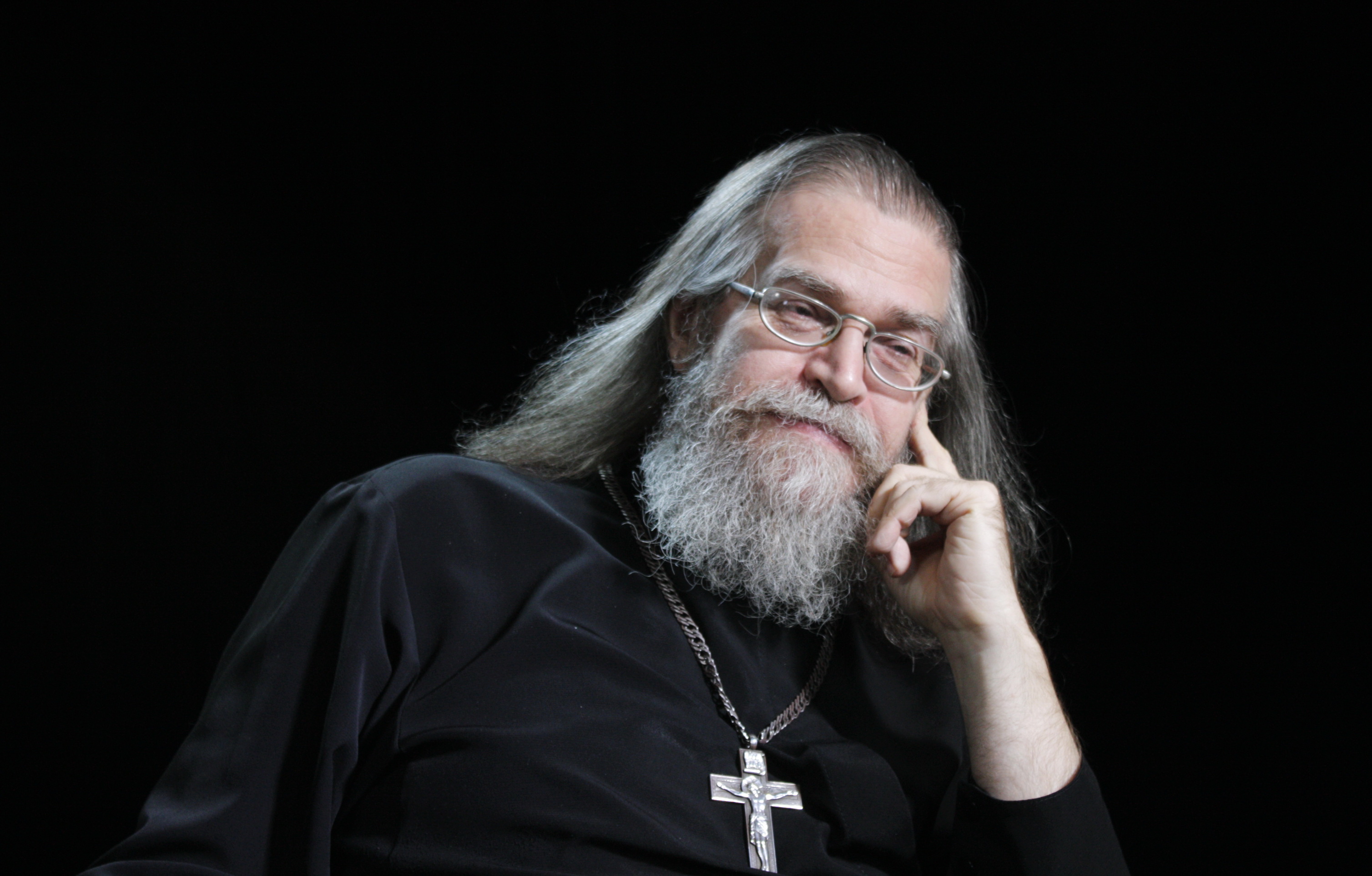

Yakov Krotov
Historian and priest, leading Radio Freedom Radio "Between Vera and Belief"
ykrotov@yahoo.com