
Translated material
Stripping in the Baltic laundry
Clients of Estonian banks laundered Russian money according to Latvian schemes: scandal!

On May 25, the financial intelligence of the Estonia police published an annual report, from which it follows that in 2011-2016 more than 13 billion euros were washed through the country's banks - mainly from Russia, Moldova and Azerbaijan. Most of the dubious transactions went through non -residents in Estonian banks.
For several months, neighboring Latvia has been trying to cope with the consequences of the banking scandal for several months: in February, the US financial intelligence was accused of one of the largest banks, ABLV, corruption, money laundering and relations financing the North Korean missile program. As a result of the outflow of capital, which followed the publication of the report of the American financial exploration, the bank announced self -destruction, and Latvian officials started talking about new laws that would better fight the laundering of funds. The main measures are the ban on banks to work with the so-called dummies that have already been accepted, and the restriction of the number of non-residents among bank customers up to 5% in the country is still in the plans.
In Estonia, they have not yet been talked about the restriction of non-residents at the legislative level, but banks are increasingly tightening the requirements for foreign clients.
Four landromates
According to a report published last Friday, Estonia in recent years has been actively used to launder funds. Most of the schemes in which the country's banks were involved, in one way or another, are known in neighboring Latvia. So, about 1.6 billion dollars was carried out through Estonia according to the Russian-Moldavian Landromat scheme in 2011-2014.
Within the framework of the “Landromat”, the money was withdrawn from Russia as follows: two foreign companies entered into a fictitious loan agreement, the Russian company and citizen of Moldova acted as guarantors of the transaction; When the time of payment of fictitious debts came, the foreign company appealed to the Moldavian court, which obliged the Russian company-fighter to fulfill the claims and transfer money to the Moldavian bank. Already from there they were transferred to the accounts of foreign companies in European banks.
In addition, Estonian banks were involved in the Moldavian “theft of the century”: withdrawing one billion dollars from the accounts of the three largest Moldovan banks. Again, for the most part, the money was withdrawn through Latvia, only a few million passed through Estonia.
A much more significant amount (3.9 billion dollars) was withdrawn through Estonia as part of the Azerbaijani Landromate.
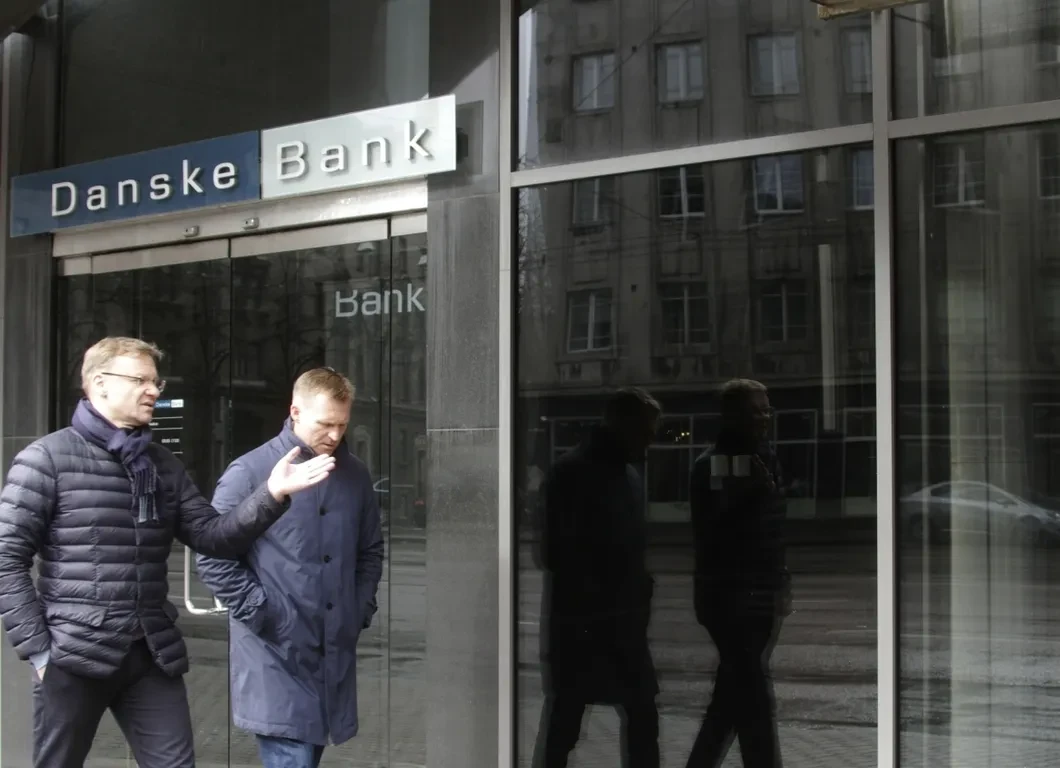
In the period from 2012 to 2014, representatives of the ruling elite of Azerbaijan transferred money to the accounts of dummies in foreign banks. Then this money was used, among other things, for bribes to European officials in exchange for lobbying for the interests of official Baku at the international level, where the mass arrests of Azerbaijani human rights defenders and journalists caused sharp criticism. The main part of the funds then went through the Estonian branch of the Danish Danske Bank. In 2017, the bank was fined 1.7 million euros for non -compliance with the legislation of Denmark to combat money laundering.
In addition, according to the report, since 2012, many dubious transactions from Russia have passed through Estonia for a total of 7.3 billion euros. In most cases, the scheme was this: Russian companies bought various shares and bonds, then transferred them to companies or individuals (mainly non -residents) having accounts in Estonian banks, and after that securities were sold. The proceeds, as a rule, were transferred to other European countries. According to the head of the financial intelligence of Estonia, Madis Reymanda, there are no sufficient evidence to connect this money with specific crimes, but the massive nature of such transactions, as well as
The fact that the proceeds did not return to Russia, but went on, allows, according to Reimand, to consider them dubious.
New Law
Unlike neighboring Latvia, where before the scandal from ABLV, non -residents had about a third of all deposits, in Estonia, the number of non -residents is, according to the latest data, 11.7% of all banking customers. However, it is the maintenance of non -residents who often cause problems. At the end of March, the European Central Bank, at the proposal of Estonian financial intelligence, annulled the Versobank license, owned by Ukrainian citizens Vadim Ermolaev and Stanislav Vilensky. The license, according to the official press release of the Bank of Estonia, was canceled in connection with a systematic violation of the law on laundering. In particular, Versobank in 2016 ended up in the center of the scandal in Latvia, where he was not registered either as a branch or as a subsidiary, but in fact provided banking services: first of all, serving Russian customers and offering them various ways of legalizing funds.
In Estonia, Versobank also mainly served non -residents - they accounted for about 87% of deposits.
At the official level in Estonia, they are not yet said that it is even more reduced and so a small number of non -residents. Great hopes are assigned to the new law on countering money laundering and financing terrorism, which entered into force at the end of November.
In accordance with the new law, the penalty for financial violations for individuals increases from 32 to 400 thousand euros. If we are talking about the proven fact of money laundering, the bank can be fined 5 million euros, or 10% of the annual turnover.
In addition, the law obliges banks to study its customers better: in particular, to check not only the legality of the origin of their funds, but also the validity of transactions.
Bureau of data on money laundering (a special police unit, whose functions include tracking dubious transactions) insists on the need to reform the legislation further in order to facilitate the fight against laundering. Now to prove the fact of a crime, if there are grounds for suspicions, the police should - in fact, the presumption of innocence. However, in the banking sector it does not always work effectively.
“Now the bureau has the opportunity to freeze the transaction for 60 days and conduct an investigation, but often this investigation does not lead to anything, and then they are obliged to skip the transaction,” says Estonian financial analyst Dmitry Kuvukin. - This is the only tool that law enforcement agencies can use, and in most cases it ends with the fact that the ban is simply removed. They achieve to change the system: if there are suspicions, then the client will be obliged to prove that funds are from a legal source. ”
Foreigners say no "no"
Meanwhile, although the regulator has not yet limits banks in working with non-residents, banks themselves are increasingly willingly opening accounts for foreign customers. This is understandable: firstly, in the light of new fines to work with potentially more risky customers, the legality of the transactions of which is more difficult to trace, it may be simply unprofitable. Secondly,
Estonia is monitored by an example of neighboring Latvia, where the problems of a bank focused on non -residents, as a result, affected the financial system of the whole country.
“In Estonia, there is no ban or restrictions on working with non-residents,” says Dmitry Kuvukin. “But this is the position of banks: they often decide to refuse a non -resident in order to reduce the costs of personnel who are involved in the laundering of funds and not to risk large fines.”
For the state, the position of banks gives rise to certain problems. In Estonia, an e-resident program has been operating for several years, which allows any citizen of another country who wants, for example, to conduct a business with Estonia, to get the status of an e-resident and his unique identification number. This gives a number of advantages: the ability to easily and quickly register a commercial association and remotely manage it, sign documents with a digital signature, submit in digital form tax returns, and so on. However, for any business you need an account with a bank, and with this, non -residents of Estonia have big problems in recent months.
“This is a pretty funny situation,” says Dmitry Kuvkin. -There is an e-residential program that is supported by the state. On the other hand, it is very difficult to open an account to the e-resident, like any other non-resident. This applies not only to individuals, but also to companies where there are non -residents. Now the trend is that if non -residents are in the board or structure of the company's ownership, then banks are afraid to serve them. There are real examples of people who are involved in the Estonian economy, but their accounts were closed by banks. ”
And at this time
& Nbsp
Representatives of the US Foreign Assets Office (OFAC) visited Cyprus, after which the financial authorities of the most popular offshore among Russians noticeably tightened the rules of the game.In particular, now Russians require confirmation of tax sources and taxes for two years, an extract on the status of a bank account for the year, real estate documents, as well as documents on the right of ownership of business and a description of the essence of the business. In case of failure to provide complete information, the account may be blocked.
Moreover, this applies not only to Russian citizens, but also in any way of the companies that were ongoing with them. Thus,
Cyprus actually ceased to be offshore and, in terms of the rigidity of the requirements, was equal to other EU countries.
This is a continuation of the US line to combat Russian money, which was previously successfully implemented in the Baltic states.