
Translated material
Russian rebellion: What is the salt?
In early June, 370 years old from the beginning of the salt riot - the famous Moscow uprising of 1648. Some historians at the beginning of the 20th century even called these events the "Russian revolution." The New Times was looking for historical parallels
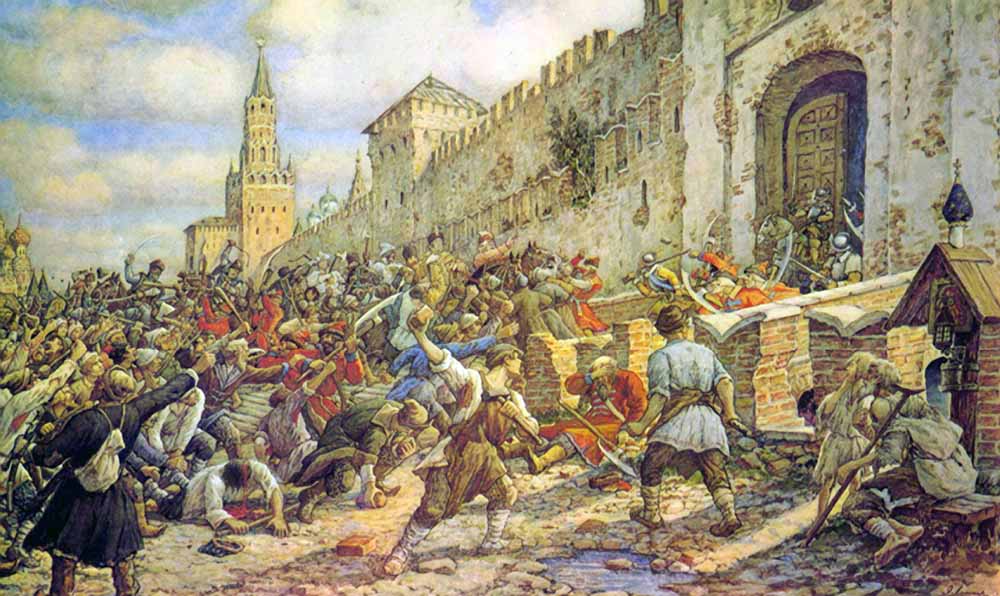
Salt riot, 1938. Artist Ernst L Isser
* According to the rules adopted in historical science, the date related to events until the beginning of the 20th century is indicated by the Julian calendar, operating in Russia until 1918. According to the Moscow uprising of 1648, adopted in the Modern Russian Federation, the Moscow uprising began on June 12
** Bakhrushin S.V. Scientific works. M., 1954. T. 2. P. 46–91
On the Orthodox Festival of the Set, June 2, 1648*, large street riots began in Moscow, which soon covered the entire capital of the Russian state. The indignant crowd of citizens, to the side of which the archers and part of the nobles passed, managed to break into the Kremlin. For several days, the authorities actually lost control of the situation in the city. Historian Sergei Bakhrushin called these events the “revolution” **. A typical Russian rebellion, however,, as always, turned out to be not only merciless to human life, but also meaningless from the point of view of the struggle for freedom - the historical result of June 1648 was the triumph of the “old order” in Russia.
How does the rebellion begin?
No, not from salt, of course. The sadly famous fee, three times increasing fees with salt trade, was canceled shortly before the events. The economic policy in the first years of the reign of Alexei Mikhailovich, who at that moment transferred all the brothers of the reign to the head of government and his teacher Borisa Morozov, is a separate topic.
It is only worth noting that measures aimed at increasing the income of the state treasury due to the introduction of new indirect taxes in Russia did not give the expected results. On the contrary, the paralysis of salt and fish trade, the reduction of imports due to tightening customs rules, the increase in prices for primary necessity instead of the “economic breakthrough” led to even greater financial destabilization. To the fall of the standard of living, as they would say today, corruption unprecedented in size was added. Of course, bribes in Rus' were always taken, but so shamelessly - never earlier. The government included many random people who rose from the lower service officials and sought to enrich themselves as soon as possible at the expense of their new posts. Not only do traditional requisitions have grown several times, “strong people” in power invented various kinds of “non -traditional schemes”. For example, the head of the Zemstvo order, in fact, the then mayor of Moscow, Leonty Pleshcheyev, was engaged in the fact that under a fictitious pretext he put the rich but not related to the authorities of the city’s residents, and then through the dummies, extorted a ransom for liberation from their relatives. The head of the Pushkarsky order, Peter Trakhaniotov against this background, looked quite innocent - he did not pay the salary and gunners of the Moscow garrison on time.
“Strong people” felt confident and impunity. To everyone who was lower in position, they treated arrogantly and contemptuously, like ink. God forbid, it was not to give way to the carriage of some nobleman: the guard from among the slaves of the “big boyar” could make reprisal against anyone, whether it was the middle hand of the Posadsky man or even a nobleman. For money, “issues” were “resolved”, positions were sold, access to the markets opened. At the same time, the elite completely lost a sense of danger: when, shortly before the uprising, the boyar Morozov spoke of possible riots, he only dismissed, believing that disagreements could always be dispersed with the help of strength. Discontent meanwhile accumulated. The main object of popular hatred was the head of government and his closest associates. The people of the king were popularly treated as sacred, seeing in him the intercessor from the oppression of “strong people”. That is why Muscovites decided to turn from the petition to Tsar Alexei Mikhailovich. On June 2, during the festive activities for the meeting, the group of citizens managed to break through and transfer their complaint directly into the hands of the king. The young Romanov was clearly confused, he promised to figure out and punish all the perpetrators. According to foreign eyewitnesses, in response, assurances were made in loyal feelings. And everything would be good, but the boyars who were traveling behind the king tore the petition and threw it into the petitions in the face. It was a limit, after which it was no longer possible to stop the spontaneous popular outrage - the redness and rudeness of “strong people” in an instant provoked mass street riots.
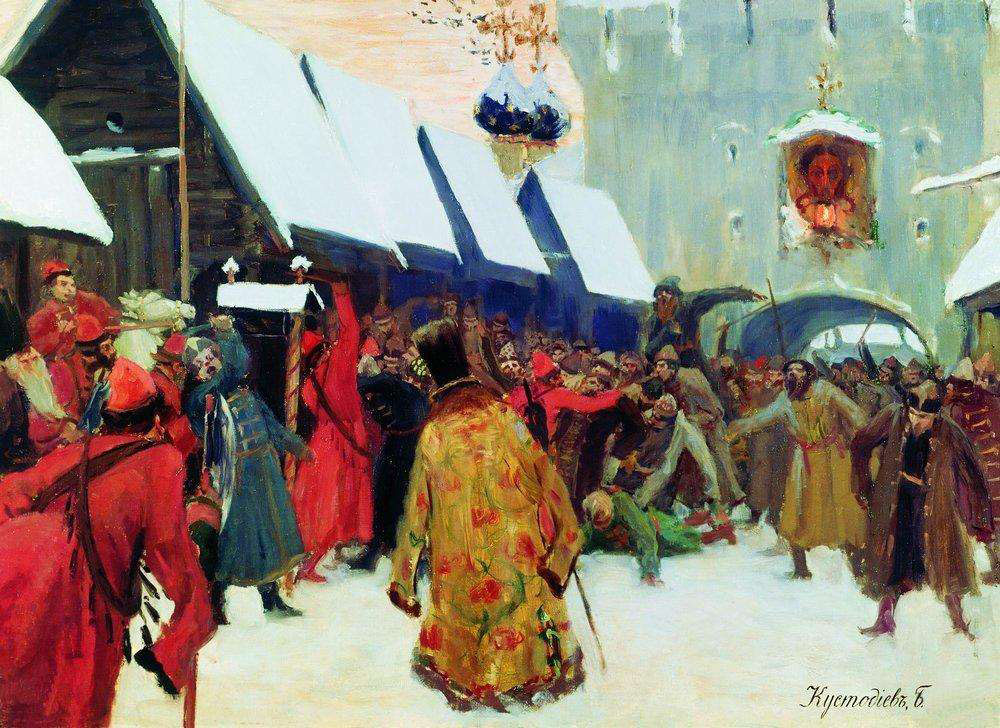
Illustration from the site art-catalog.ru
God forbid, it was not to give way to the carriage of some nobleman: the guard from among the slaves of the "big boyar" could make a reprisal against anyone, whether it was a middle-sized Posad man or even a nobleman
"Came and noisy"
*** The most fully events are presented in the reports of the Swedish resident in Moscow by Karl Pommerening (see Yakubov K. Russia and Sweden in the 1st floor of the 17th century, 1897) and in the description of travel to Muscovy, Adam Olearius (M., 1996)
Sagittarius and a significant part of the small nobles, who spent for a look in the capital, went over to the side of the rebels. The crowd burst into the Kremlin and at the red porch began to “brutal petition” to demand the issuance of “thieves and traitors” - Boris Morozov, Leonty Pleshcheyev and Peter Trakhaniotov. As stated in Russian sources, people of "all sorts of ranks ... with an impolite custom came to the sovereign’s court and made noise in the yard." However, reading more detailed reports of foreign observers and residents in Moscow, you understand that the picture of the Russian riot looked much richer ***. Soon the house of Boyarin Morozov was defeated. Seeing the luxury that reigned in the chambers of the head of government, the rebels fell into such fury that they even began to tear gold salaries from the icons belonging to him. Everything that was in the house was “chopped, broken and pulled out”, saying: “That is our blood!” A luxurious carriage trimmed with expensive brocade and precious stones turned into a pile of chips - a royal gift to an omnipotent favorite. The Morozov clerk who came to hand was simply thrown from the upper floor of the tower, which is why he broke to death. Only the wife of Boris Morozov Anna did not touch, she was saved by kinship with Queen Maria Miloslavskaya.
The rebels did not touch the sovereign of the courtyard, where frosts and other mortally frightened “strong people” managed to hide. Those who did not have time to hide, were waiting for a ruthless reprisal. The head of one of the financial departments, a large entrepreneur Nazariy Chistoy, who was attributed to the authorship of the ill -fated salt tax, was lying at home with a broken leg. Upon learning of the ink approaching his house, the merchant tried to hide in the attic in a heap of bath brooms, but the servant, deciding to profit from the good of the master, gave him out. The court oligarch was grabbed by the legs, pulled down the stairs, scored in the yard with sticks, and the torn corpse was thrown into a dung pit. The next day, Leonty Pleshcheeva suffered the same fate - going towards the requirements of the street, the authorities themselves decided to execute it. However, they only brought the Moscow mayor to the frontal place, the crowd attacked him: they beat mercilessly who, as best they could, were torn to shreds. As a foreign source writes, Pleshcheyev’s head turned into porridge, so that the brain sprayed the citizens pushing him in the face. On the first day of the uprising, mansions of almost all major boyars were defeated, regardless of whether they were supporters or opponents of the Morozov government. The house of the famous frontier Nikita Romanov burned down - the royal uncle, the first in the Russian court, who dared to wear a European dress. Marauding began. The loot was immediately sold for nothing. The golden brocade was cut into pieces and divided among themselves. They smashed wine warehouses and taverns: wine poured from broken barrels, they drank it, drawing some with caps, some boots. Some were drowned in wine cellars, flooded with a hop swra. Next to the main sovereign tavern in Kitay-Gorod there were so many drunk that the street turned black from insensitive bodies lying on it. It is not surprising that soon a fire broke out, covering most of the capital. In total, about two thousand people died as a result of riots and fire.
"Conservative revolution"
It would be completely wrong to introduce the Moscow uprising of 1648 only as a rebellion of some lumpenized lower classes. Characterizing the general political situation in Europe of that time, the famous British historian Eric Hobsbaum even spoke of the “XVII century crisis” ****, which covered the Continent country from the Atlantic to the Russian Plain. Judge for yourself, in England, the revolution and the civil war of the Parliament and the king in the midst of the most in full swing, in France, the first front is the movement of city layers against royal power, German lands in ruins after the thirty years of war, in the Commonwealth - the uprising of the Cossacks of Bogdan Khmelnitsky, in Muscovy - a salt riot.
**** Hobsbaum Ej The General Crisis of European Economy in the 17-th Century./past and Present, 1954. No. 5–6. P. 4
***** The first point of view was the historian Pavel Smirnov (in the book B.I. Morozov and the uprising in Moscow of 1648 Tashkent, 1929). Of the last works on this subject, see Andreev I.L. Alexey Mikhailovich. M., 2006. S. 113–117
According to most historians, the main active force of Moscow events in 1648 were precisely the middle city layers - Posad people and the lower service officials sympathized with them *****. It would seem that here it is, the city revolution, albeit overshadowed by medieval cruelty. However, if we analyze the requirements and line of the street behavior, the initial political limitation of the “Russian Front” will become obvious. The political program was mainly reduced to the replacement of officials in the government. Here the authorities successfully maneuvered: on June 5, Pyotr Trakhanitov was executed. Boyarin Morozov was suspended from the posts and a month later went into exile in the Kirillo-Belozersky monastery-Tsar Alexei Mikhailovich literally asked Muscovites to leave the life of his teacher with tears in his eyes. The government led the popular military leader Prince Yakov Cherkassky among the lower ranks. Another Kremlin man with an unsuccessful reputation, Prince Nikita Odoevsky, began work to draw up a new code of laws. Social requirements cannot be called revolutionary. Rather, on the contrary. In addition to such simple things as an increase and timely payment of a salary, the nobles demanded the introduction of a delightful investigation of fugitive peasants, that is, in fact, the final introduction of serfdom. It was the owners of small estates that primarily suffered from the flight of peasants who went through to live in rich estates, where the quest was lower, and the “big boyar” could intercede, if that. In the cities, a similar picture - the inhabitants of the “black” taxable posades went into the “white settlements” belonging to the boyar nobility. Their return to the common tax “tract” was demanded by residents of Posad - in fact, the introduction of the same serfdom in urban performance. It turned out to be all simple with the Sagittarius - generous gifts, monetary salary, wine and treats from the king, the queen and the patriarch made the internal troops again loyal to the authorities. Having received the power support again, in early July it was possible to execute some of the leaders of the street. Others were arrested and sent from the capital under the pretext of economic offenses - for the illegal trade in wine and tobacco, for example.
Soon, the Zemsky Cathedral was convened in Moscow: in fulfillment of the requirements of the middle layers, he canceled the statute of limitations of the detective of fugitives, the “White Slobodes” were handed over to the state, and only the citizens were allowed to keep trading shops. But the main thing, under the pretext of the fight against the arbitrariness of “strong people”, the tsarist power only intensified, its borders expanded. The Boyar elite pragmatically agreed with the "voice of the people." As a result, for more than two centuries in Russia, a regime based on serfdom and despotism was mothballed. The Cathedral Code of 1649, thus, could be called our anti -constitution - especially in comparison with the Bill on Rights about the same in England.
The riot ended as irrationally as it began. In October 1648, boyar Morozov returned to Moscow. A formal pretext was the birth of the first -born Tsar Alexei Mikhailovich. Bells called in the Kremlin, walks were going on, gifts were handed out to the people - it seems that a few months earlier nothing happened! The next day, Prince Cherkassky lost his posts. The government was headed by Ilya Miloslavsky, the father -in -law of the sovereign and nomineed boyar Morozov, he had just returned from the embassy in Holland and therefore was not associated with the government overthrown in June. Little by little, “strong people” came to their senses after the shock experienced. Now they knew exactly who was able to protect their power and property. Yes, yes, right - only the almighty anointed of God. The “Russian Revolution” of the mid -17th century turned into even more lack of freedom.
First published in NT No. 23 of June 9, 2008