
Translated material
Expulsion and crowding out
Historians in the hybrid war
History today is becoming more and more a field for political battles. In Russia, domestic history has long turned into a means of promoting and conducting a hybrid war in the post -Soviet states, and many Russian historians were retrained into propagandists. The ideological struggle on the historical front is irreconcilable, and honest and professional historians often become victims, not involved in any political games.
The Russian-Polish "historical" war passed into the hot phase in the fall of last year. First, the Novosibirsk historian Dmitry Karnaukhov, who was generally engaged in Polish history of the XV-XVII centuries, was expelled from Poland, but in recent years he also investigated the problems of historical memory of the 20th century. In support of his expulsion after a four -year stay in Poland, it was argued that Karnaukhov "acted against the state interests of Poland, initiated elements of a hybrid war against Poland, and also maintained contacts with the Russian special services."
How true these accusations are is difficult to judge. I believe that one of the real reasons for the expulsion was that Karnaukhov represented a very specific institution in Poland - the Russian Institute for Strategic Research (RISI), which really is engaged in the fact that the Poles were charged with the Russian professor. RISI was created in 1992 from the former Research Institute of Intelligence Problems of the First Main Directorate of the KGB of the USSR as an analytical center of foreign intelligence service of Russia. In 2009, he was reorganized and reassigned to the administration of the President of Russia. And since the beginning of 2017, RISI has been headed by Mikhail Fradkov, the former head of the SVR. Most employees of this institute are characterized by monarchical views and the desire to restore the "unified" Russian Empire, which is actively used in the "hybrid war" in the post -Soviet space. They see their main task in historical research in the search for manifestations of Russophobia.
A symmetrical answer immediately followed from the Russian side. The Polish historian Henrik Glebotsky was sent from the country. They did not publicly bring any specific accusations against him, clearly making it clear that this is just a response. Glebotsky is known as a major specialist in the history of the relations of Russians and Poles, the Russian state and Polish society in the XIX and at the beginning of the 20th century, even before the restoration of Polish independence. In the center of his scientific interests is the history of the Polish uprising of 1863-1864. In recent years, Glebotsky has also been engaged in the “Polish operation” of the NKVD of 1937-1938 and before his expulsion gave lectures on this subject in the St. Petersburg Memorial, but was hardly punished for such an “sin”.
And now a new round of the "historical" war has passed, this time with political science subtext. At first, at the entrance to the Schengen countries, at the request of Poland, two Russians were refused, Oleg Bondarenko and Alexei Martynov, proudly calling themselves political scientists, but actually state propagandists, including in the field of history.
By 2014, Bondarenko headed the Russian-Ukrainian information center in Kyiv and was suspected of assigning a significant part of the funds allocated to this institution in Russia. He is also known for his close ties with the extreme right and extreme left pro -Russian parties, such as the Serbian Radical Party, the German Left Party and the Alternative for Germany, etc.
And Martynov also led quite specific structures - the Russian -Podnestrovsk Information and Analytical Center at the College of Military Experts - Veterans of military service, the apparatus of the Inter -Parliamentary Assembly of the Social Facility Participants "For Democracy and the Rights of Peoples" (the name is quite human rights, if we do not know that only Abkhazia, South Ossetia and South Ossetia are included in the "Commonwealth", and the name of the Commonwealth. Transnistria), and now he is the director of the non -governmental organization "International Institute of the latest states" (the same unrecognized states plus Nagorny Karabakh). So before us no political scientists, but hardened fighters of the "hybrid war".
The professional historian again had to pay for measures against the propagandists - this time Slavomir Dembsky, director of the Polish Institute of International Affairs, author of the books "Between Berlin and Moscow. German -Soviet relations in Russia in 1939-1941." (The topic, I note, is as painful for the Kremlin as the “Polish operation” of the NKVD). Dembsky was sent to Moscow for Primakov readings - a conference on the problems of international relations. But they not only did not let him across the border, but also tried to place it in the camera for the night (the closest reverse flight was only in the morning) and threatened to apply physical strength to it. Polish historians are now already going to Russia. And now, probably, they will still think tightly whether it is worth going at all. Moscow clearly wants to limit the contacts of Polish scientists involved in the "hot" topics of the history of the 20th century, with Russian colleagues and archives.
But historians need not a war, but a dialogue, and above all in the triangle of Russia - Poland - Ukraine. In the history of the three countries there are many painful topics, especially relating to the events of the 20th century, according to which the controversy between historians and politicians does not subside and who are increasingly acquiring actual political sound. In order to cool passions and prevent political speculations, it is necessary to try to develop a common view of the tragic events, acceptable for historians of all countries, whether it be the Volyn massacre and Katyn, the Soviet-Polish and Polish-Ukrainian war, the Polish operation of the NKVD, the deportation of Poles in the USSR and Ukrainians in Poland ...
Recently, Polish, Russian and Ukrainian historians and philosophers gathered in Paris under the auspices of the Order of Bernardinists to achieve mutual reconciliation on the model of the Franco-Germanic and German-Polish reconciliation achieved after the Second World War. The process of German-Polish reconciliation began in the early 60s, under the communist regime, from the letter of the Polish bishops who called the Poles to repent the crimes, accomplished against the civilian German population in the last months of the war and immediately after it.
The initiator of the project was the head of the research department of the college of Bernardinsev Antoine Arzhakovsky. Andrei Zubov, Nikita Petrov, Irina Karatsuba, Nikolai Epple were invited from Russia. Ukraine was represented by the president of the Ukrainian Catholic University Bishop Boris Gudzyak, historian Oleg Turii, philosopher Konstantin Sigov. The joint declaration was also signed by the poet Olga Sedakova, the Polish theologian Wojciech Surovka and the French historian Corinn Defrans, a specialist in the franco-German reconciliation.
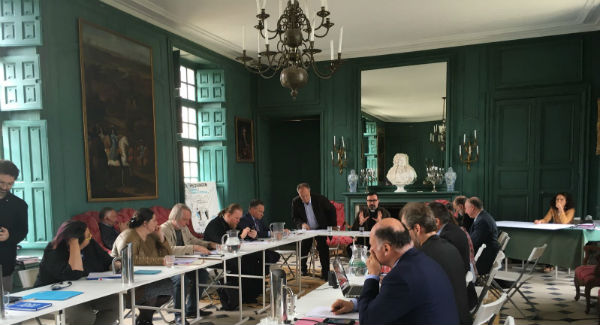
Paris seminar of historians and philosophers. Photo by Maria Schur /Radio Freedom
It is hoped that famous Polish and Ukrainian historians will join the undertaking. Indeed, today repentance and forgiveness are equally necessary for Russia, Ukraine, and Poland. Contradictions on history are actively used today by Russian propaganda to quarrel Ukraine and Poland. And only the true Ukrainian-Polish reconciliation will knock out this dangerous weapon from the hands of the Kremlin. It should be remembered that the Russians and Poles, Russians and Ukrainians will be able to finally reconcile only when democracy triumphs in Russia, the imperial thinking will be rejected and the occupied Ukrainian territories will be liberated. But you need to start the reconciliation process now.