
Translated material
Only the Slavs
There is discrimination in Russia, but it is almost impossible to prove it in court

Russian lawyers and human rights activists, who at least once encountered an attempt to prove discrimination on the floor, age, sexual orientation or nationality, admit that it is almost impossible to win such a matter. Most often, the courts refuse the plaintiffs or, at best, satisfy their claims partially. Medusa tells how Russians are trying to fight discrimination in court - and why few people do it.
The crown question
On June 6, the vice-president of the Otkritie Bank and the co-founder of the Bank “Point” Yana Gannik published a post on her Facebook about how she chooses employees (now it is deleted). “I really love interviews. I found and interviewed almost all the guys in the team myself, ”wrote Gannik. “It is very important for me that the person whom we invite has the same feeling of the beautiful, a firm life position and his opinion that he is not afraid to express.”
Gannik said that recently her crown issue during the interview with applicants for the position in the company - “Our Crimea?”. She explained that it is important for her not so much the content of the answer as the willingness to express her opinion to the employer. At the same time, she emphasized that “uragic-patriotic or, conversely, left-guided answers with excesses, indicating the washed brains”-an unambiguous occasion to refuse the applicant. People who refuse to answer a question about Crimea or discuss politics as a whole, according to Gannik, she also immediately says “no”.
The post caused a great resonance. In the comments, Gannik reminded that the opinion on Crimea was in no way connected with the professional qualities of employees, and to refuse work due to political views is a discrimination that is prohibited by labor and even criminal law. The top manager of the “discovery” and “points” wrote that this post harms not only her own reputation, but also discredits both banks; Some users promised to withdraw their funds from them.
Two days later, Yana Gannik published a detailed explanation on Facebook. She wrote that “loves his country and recognizes its laws,” believes that “he [Crimea] is in fact and legally,” never refuses to hire work for political reasons, and her first post was interpreted incorrectly.
Non -Slavic appearance
The second chapter of the Russian Constitution says that the state guarantees the equality of rights and freedoms to any person - regardless of his gender, nationality, attitude to religion, beliefs and other characteristics. The overall discrimination stress is enshrined in Article 5.62 of the Code of Administrative Offenses and in Article 136 of the Criminal Code. In particular, the Criminal Code for violation of the equality of human rights and freedoms has a fine of one hundred to three hundred thousand rubles, deprivation of the right to occupy certain positions up to five years, and in some cases even a prison term. Discrimination is also prohibited by the Labor Code: Russians cannot refuse to work (or somehow limit their right to work) in connection with their age, gender, nationality, religion or beliefs.
Despite this, a few years ago, in ads for hiring, many employers directly wrote who they were looking for a particular position: a man or a woman, and also indicated a “suitable” age. In 2009-2010, the Center for Social and Labor Rights and HSE conducted several research in large Russian cities and found out that such requirements met about 70% of vacancies. “It never occurred to anyone that it was not normal,” says Elena Gerasimova, director of the Center for Social and Labor Rights and Associate Professor. “At the same time, people could say that our discrimination is prohibited, but still to write such ads.”
In 2013, employers were forbidden to indicate in the descriptions of vacancies the requirements for age, gender, nationality, skin color, family position, belonging to public associations and other characteristics that have not been related to the professionalism of the employee. From this moment, everyone who disseminates information about free positions, indicating in it discriminatory restrictions can be brought to administrative responsibility. The author of the amendments, a member of the State Duma Committee on Labor, Mikhail Tarasenko, admitted that this could not completely eradicate the discrimination - but will still keep some of the companies from violations. “There are unscrupulous employers who want 20-year-old saleswoman to work,” Tarasenko explained the meaning of the amendments. - And there are people who, being law -abiding, did not know that this was a violation of the law. And now they will invite both 20-year-olds and 30-year-olds for interviews. ”
Despite changes in the legislation, discriminatory descriptions of vacancies continue to appear. In May 2018, the group “There is work - need work” on Facebook published an announcement about the search for an employee in the “Kafeterius” of the studio Artemy Lebedev. The applicant required "Work experience, Slavic appearance, love for people." Many were outraged that the company does not give a chance to people with a “non -Slavic” appearance, but others began to protect the announcement. In the discussion of the post on the page of the journalist Alina Farkash, Facebook users wrote that the employer has the right to make such requirements when “customers are more comfortable when they are served by people of Slavic appearance”, or when this is the “concept of the institution”.
Even more often, the expression “only to the Slavs” is found in announcements about the rental of the apartment. The director of the Owl information and analytical center, Alexander Verkhovsky, says that many prefer not to react to such ads-believing that they will not be able to change the situation. “In world practice, people in such cases file claims against the sites on which this was published, and the problem is quickly solved,” says Verkhovsky. - Even if they beat off in court, the lawsuit itself is already a rather discrediting fact. We have this not even a reputation issue. It is not considered shameful to publish this. In the meantime, it is not considered, it will be so. ”
Accountant Pensioner
If there is no hint of the floor, age or nationality in the announcement, this does not mean that the employer will not choose a new employee based on these criteria. According to Elena Gerasimova, people “completely and nearby” tell how employers refuse to hire them due to age or gender. “When the eicars work with specific candidates, they proceed from these requirements and sew up [inappropriate] people,” Gerasimova says.
An accountant from Voronezh Yuri Stopo began to look for work in 2006. He was 57 years old, he had thirty years of experience and a forced break in his work - he looked after elderly parents. Before entering the labor market, the man went through advanced training courses and registered with the employment service. From there he was sent to the company, where they were looking for an accountant for a salary of 15 thousand rubles; There were no additional requirements in the vacancy. Stuko went to an interview, and left him with an official refusal: in the direction of the employment service, the employer wrote that the accountant "does not fit in the age category." Lawyer Igor Sildaev, who defended the accountant in court, adds that at the interview the man was said that he was not suitable for the floor: they searched for a woman’s accountant.
Stuko decided to fight, sued the company - and won. According to Sildaev, this was the first in Russia won about discrimination, and it attracted a lot of attention. But the accountant did not receive compensation awarded to him.
The court of second instance made an half decision - recognized the fact of discrimination when hiring on the basis of age, but did not take into account the sign of gender. Stuko was supposed to receive compensation for non -pecuniary damage and the payment of an unexplored salary - according to his lawyer, about 190 thousand rubles . “At that time - the middle of the zero - it was a lot of money,” says Sildaev. - But the employer, apparently, attracted specialists in “throwing” firms. All funds and property were transferred to a similar company, the debtor was “dug up”, and then re -registered on dummy persons in another - distant - region of Russia. ” As a result, Yuri Stsko could not get anything from the debtor company. To bring to justice its leadership and founders, too.
In 2008, Rossiyskaya Gazeta wrote that Yuri Stopo failed to find a job; He was going to retire. The man does not want to communicate with the press either - after he went to the program “Let them talk”. According to the accountant’s lawyer, Stupko hurt that he was "put up for the laughing stock." “Representatives of the employers attacked him: why he, an accountant-pensioner, tried to get a job in a young team, and did not go to any horticultural partnership,” recalls Sildaev.

Traditional values
The Voronezh accountant was “lucky” to have in hand a referral from the employment service with the official reason for the refusal. Elena Gerasimova says that this is one of the few cases when you can go to court and count on victory. She recalls that in 2013, the tradinger of social and labor rights was engaged in a similar business. A man, a representative of one of the northern Russian peoples, refused to hire a waiter in a cafe with the formulation of “there is citizenship of the Russian Federation, but non -Slavic appearance”. Like Yuri Strako, he received a referral to employment from the employment service, and the refusal with this formulation was official. This case also managed to win.
Discrimination not recorded on official paper is almost impossible to prove. According to Elena Gerasimova, even the audio recording will not help: “They will say that this is a personal opinion of the person who was talking to you, he made a mistake.” Fire correspondence with the employer or messenger messages also do not guarantee victories in court.
Three years ago, the Petersburger Denis Davydov (the name and surname were changed at his request) was going to move to Moscow and was looking for work there. He published his resume on one of the popular recruiting sites, a representative of a potential employer responded to him and suggested discussing all the details. The interview was conducted on Skype, and after that they promised to make an official offer about the work. “They told me that they were waiting for me as quickly as possible,” Denis recalls. “Moreover, they are ready to help with the purchase of a ticket and even partially compensate for the cost of housing in Moscow.” He himself also liked all the conditions, so he was ready to agree to the proposal.
An employee of the company, with whom Davydov spoke on Skype, asked him for a link to his account on the social network - for a quick connection. That same evening he received her message by mail: "Denis, are you gay?" On the page of the young man there really were photos with his boyfriend - and the company representative decided to "clarify his orientation."
“I tried to find out what this was generally influenced by, but she replied that they could not get me to work because they adhere to traditional values on some issues in their company. In PM in the social network, she stopped answering my questions. And she sent me the same answer to the mail - from his corporate address, ”Davydov said Medusa.
It hurt him very much, and he decided to go to court - not because he wanted to work in this company or get compensation, but to “create a precedent”. I was almost sure that he would lose. “But the more such things are, the more understandable what is happening in the country: not only [homosexual] teachers are expelled from work, but also a person who does not work with children can safely refuse,” Davydov explains.
As evidence of the fact of discrimination in the court, a notarized correspondence was used with an employee of the company who communicated with Denis Davydov - and refused him to hire. But the defense could not prove that she was a representative of the company authorized to conduct these negotiations. It didn’t even help that the woman herself responded to Davydov’s resume, offered to go through an interview, talked with him on Skype and corresponded with him from the company's corporate mail.
Denis Davydov and his lawyers passed all Russian courts, and lost everywhere. It took three years. Davydov admits that the situation not only outraged him, but also scared him. At the new work that he still found, the man did not even try to make friendly relations with someone, closed profiles on social networks and cleaned the list of friends, went to a psychologist.
In March 2018, Davydov’s complaint was accepted in the European Court of Human Rights, and he expects that at least there will be possible to restore justice there. According to the lawyer of the St. Petersburg LGBT-Initative Group “Exit” Max Olenichev, this is the first Russian case of refusal to hire on the basis of sexual orientation that reached the ECHR.
The burden of proof
In Russia, trials on discrimination cases almost always become exhausting - and it is possible to achieve a little. In the best case, the court recognizes the fact of discrimination and may recover financial losses from the offender. As a compensation for non -pecuniary damage, as a rule, small, and often completely symbolic amounts are prescribed. For example, a transgender woman whom a fitness club refused to renew the subscription was decided to pay compensation of 10 thousand rubles, and the club was obliged to re-conclude an agreement with her. But she herself refused - the desire to go there disappeared.
According to Elena Gerasimova, the situation is complicated by the fact that in most cases in Russia the victims of discrimination must themselves prove that their rights were violated. She explains that in many other countries - such as, for example, in the USA - the burden of proof of labor discrimination (more precisely, its absence) lies not on the injured from discrimination, but on who allowed her. “This is not a panacea, but at least prompts employers and any organizations to think about how not to get into an unpleasant situation,” adds Alexander Verkhovsky. “It doesn’t even matter what they think about certain people.” This is a question not of their personal racism or sexism, but financial interest. ”
Verkhovsky says that various European instances have repeatedly recommended the Russian Federation to adopt not only the declarative law on countering discrimination, but also to prescribe how exactly such cases should be considered. In addition to the “burden of proof”, which lies on the plaintiff, it is necessary to formulate that in general it can be considered evidence in discrimination matters.
To prove the fact of a violation of human rights, it is often necessary to compare the attitude to one person with the attitude to others in the same conditions. In countries where this area of law is well developed, in such cases they can use statistics - for example, to see who and how much earns. In Russia, such data is almost impossible to get. Employers refuse to provide lawyers with information about the working conditions of other employees - referring to the protection of personal data or commercial secret.
Even if this information can be obtained, Russian courts will consider it “ineffective to the case,” says Elena Gerasimova. Instead, the person’s position is compared with what is written in local regulatory acts. Lawyers who take Russia for discrimination are convinced that this is a serious obstacle. To remove it, it is necessary to change the Civil Procedure Code and the Labor Code - including changing the definition of discrimination. “It is incomplete, incomprehensible. It follows that a violation of rights is discrimination, and an unequal appeal not related to a violation of rights is not. But this is not so, ”says Gerasimova.
The most striking example was Aeroflot flight attendants Evgenia Magurina and Irina Jerusalem, who accused the airline of discrimination against appearance. Formally, all Aeroflot employees flew the required number of hours. But in practice it turned out that the “young and slender” stewardesses could operate five long flights per week (for example, in the USA), and those who are older than 40 and larger than 48 sizes were put on a larger number of short and less prestigious flights, which was a heavier graphics.
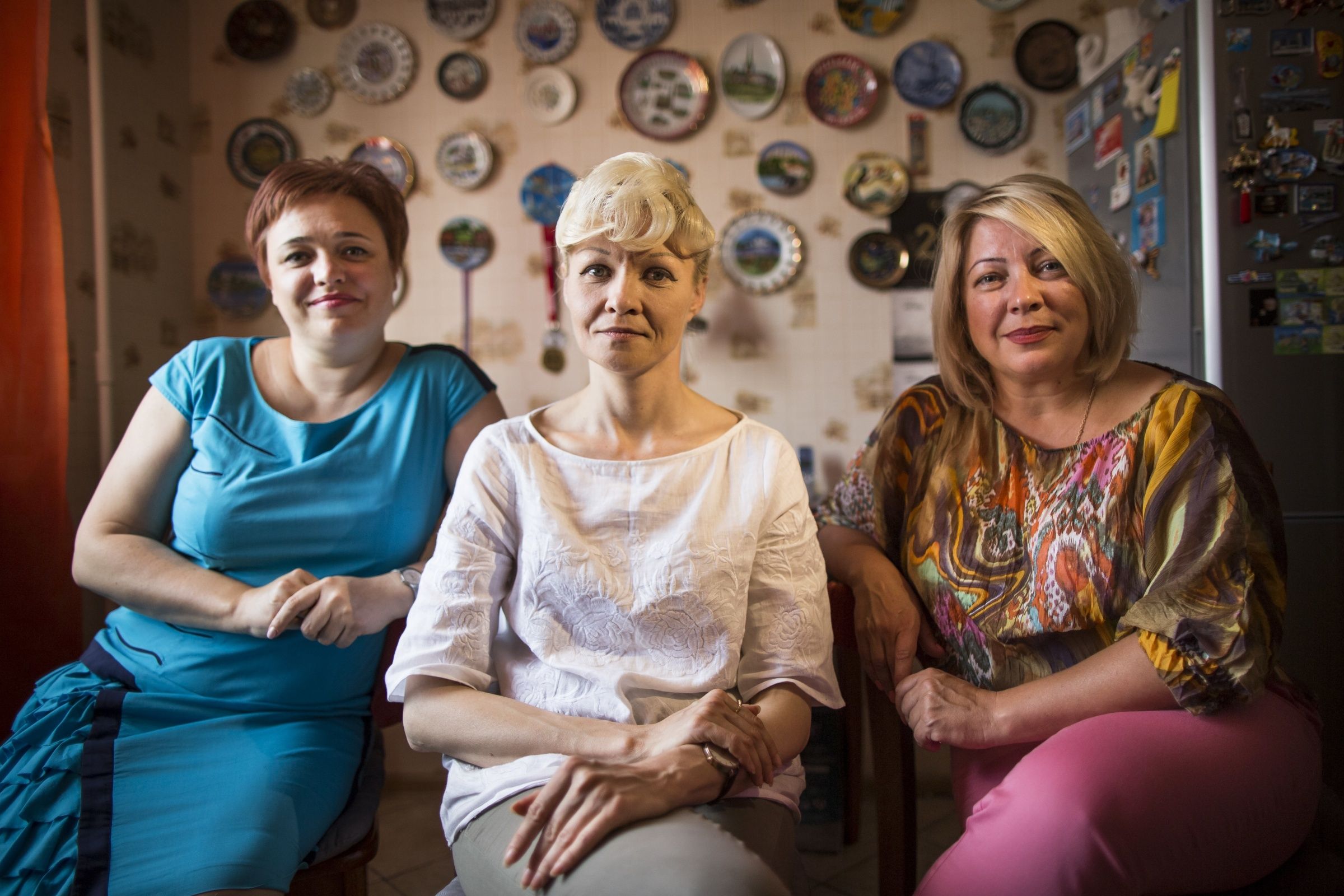
The lawyers could not bring this as an argument, but it was still possible to win - as Gerasimova says, "through the tricky scheme of criteria." Among them were age and physical data, depending on which a person was assigned wages. “The opponents did not give up to the last, they said that this was not discrimination, but the requirements for business qualities: the stewardess, in their opinion, should be in a certain weight category,” Gerasimova recalls. Доказать дискриминацию удалось только в суде второй инстанции, который обязал «Аэрофлот» отменить внутренние правила, по которым размер одежды бортпроводниц влияет на надбавку к зарплате, и обязал компанию компенсировать бортпроводницам материальный и моральный ущерб.
Нет жалоб — нет проблемы
Точной статистики, в том числе судебной, по фактам дискриминации в России нет. Юристы говорят, что дел, которые рассматриваются по этим статьям, немного, а выигранных — единицы. Поскольку судебные решения — один из главных официальных показателей наличия или отсутствия какого-либо явления, то принято считать, что и дискриминации в России тоже нет.
14 мая 2018 года Россия представила в ООН доклад о соблюдении прав человека за последние пять лет. Глава Минюста Александр Коновалов заявил , что многие случаи нарушений прав человека ими на самом не являются, и ситуация в стране в целом становится лучше. В докладе говорится, что незначительное количество обращений в суд в связи с случаями дискриминации говорит об эффективности принятых государством мер.
Елена Герасимова отмечает, что на самом деле единственный «признак прогресса» за последние годы — принятый в 2013 году запрет указывать требования по полу, возрасту и так далее в текстах вакансий. «Больше ничего не было, — говорит Герасимова. — Наш Центр социально-трудовых прав и еще несколько организаций прежде активно занимались этой проблематикой, разработали массу предложений. Есть исследования, рекомендации. Но ситуация такова, что никто ничего менять не хочет. Например, сейчас есть госпрограмма поддержки женщин, но там всеми силами пытаются уйти от риторики недопущения неравенства в более патриархальную сторону».
Активисты и юристы пытаются своими силами исследовать проблему. В марте 2018 года российская ЛГБТ-сеть опубликовала данные мониторинга дискриминации и насилия в России. Исследователи выяснили, что только за 2016 год 17,3% респондентов (653 человека) столкнулись с дискриминацией в трудовой сфере из-за своей сексуальной ориентации или гендерной идентичности. Из них 521 были уволены по гомофобным причинам, а 49 из-за этого же не взяли на работу.
Большинство нарушений, по словам экспертов, остаются латентными, потому что люди не готовы публично защищать свои права и рассказывать о случившемся. Особенно это касается уязвимых групп — ЛГБТ, людей с инвалидностью или живущих с ВИЧ. «Общество часто считает: «А что такого? Ничего страшного не произошло!», — говорит адвокат «Выхода» Макс Оленичев. По его словам, люди не чувствуют потребности идти в суд, понимают, что им не помогут. К тому же работа адвокатов — не бесплатная, а статистика решений по таким делам оптимизма не добавляет.
Елена Герасимова тоже считает, что это сильно демотивирует пострадавших: «Мало находится правдолюбов, которые из принципа идут в суды, чтобы доказать — да, дискриминация есть».
Анна Вальцева