
Translated material
The terms of occupancy
The judge of the Central District Court of Simferopol, which was controlled by Russia, Sergey Demonok announced the verdict of the Crimean Tatar activists - defendants of the fabricated "February 26 case." This was reported by the correspondent of "faces".
All the defendants received conditional terms: Ali Asanov and Mustafa Degermmenji - 4 and a half years, Escender Kantemirov and Arsen Yunusov - 4 years, Eskender Emirvaliev - 3 and a half years. Each of the defendants has been appointed a 3-year trial period.
The defendants were announced guilty under Part 2 of Article 212 of the Russian Criminal Code (participation in riots).
The testimonies of all 38 witnesses to which the demon referred to the verdict had a general character. None of the witnesses reported any details regarding the role of the defendants and not one recognized them. The verdict also mentions videos on which conflicts with the participation of persons similar to the defendants are recorded. However, the portrait examination of these videos was not carried out.
The trial took 103 meetings. In the debate of the parties on April 24, the prosecutor Dmitry Taran requested for Asanov and Degermmenji to be conditionally for 5 years, and for Kantemirov, Yunusov and Emirvaliev - 3 and a half years conditionally. He demanded that each of the defendants appoint a 3-year trial period.
Thus, the sentences to Asanov and Degermmenji were somewhat less severe, and Kantemirov and Yunusov were more severe than the prosecutor sought.
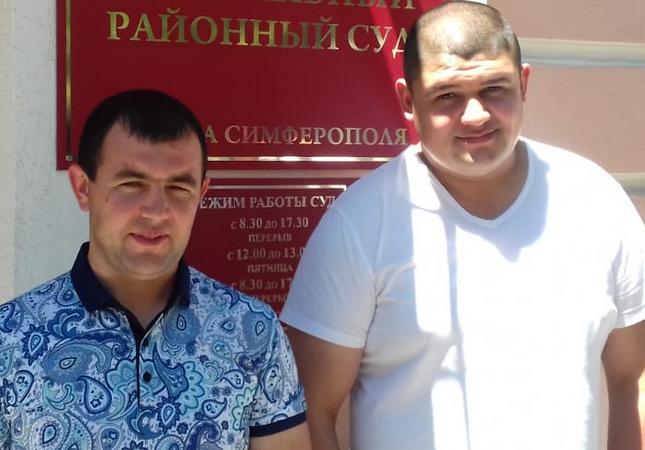
Escender Kantemirov (left) and Arsen Yunusov after the announcement of the sentence. Photo: Grani.ru
Asanov and Degermendzhi were not plead guilty. On May 14, speaking with the last word, Degermendzhi touched the reasons why only the Crimean Tatars were brought to criminal liability, who participated in the rally against the annexation of Crimea, but not opposing the pro -Russian militants. The official of the TFR Pavel Nickel to the direct question of the accused, asked in the investigation, replied: "The winners are not judged."
Kantemirov, Yunusov and Emirvaliev recognized participation in a fight with pro -Russian militants, but the charges of riots were also rejected. In February 2017, Kantemirov declared a different position. He petitioned for the allocation of materials in relation to himself in a separate production and consideration of them in a special order . Such a measure can be applied only if the sane guilt is found. However, judge Demenok rejected the petition.
Prior to the entry into force of the preventive measure, the defendants were left unchanged: house arrest for Asanov and Degermenji and a guarantee for the rest. The time spent by convicts under house arrest and guarantee, and earlier - in jail, is not counted within the trial period.
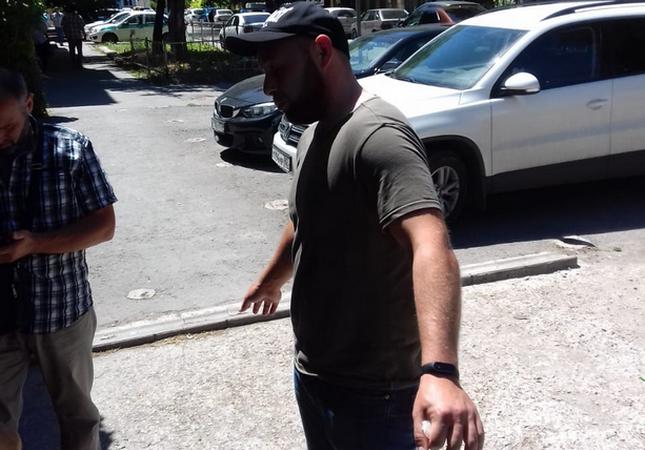
Mustafa Degermendzhi after the announcement of the sentence. Photo: Grani.ru
The announcement of the sentence, originally appointed on June 4, was postponed three times: first on the 13th, then on the 18th, finally on the 19th. For the first time, I reported the Crimean Solidarity with reference to Azer Azamatov’s lawyer, the judge explained the wire by the fact that he was not yet ready to make a decision. In the second, on the eve of “15 minutes”, Eden Semedlyaev’s lawyer said , Demenok referred to the fact that the officials of the FSIN criminal-executive inspection were delayed late at the hearing of Degermendzhi, who was under house arrest. The reason for the third transfer of the meeting, the lawyer added, unknown. “This is an unprecedented case when the sentence is postponed for the third time,” he concluded.
In turn, the lawyer Azamatov noted that the defenders of the defendants will not fall for a meeting on the 19th, since on this day they should be present in the North Caucasus District Military Court in Rostov-on-Don at the hearings inthe Yalta-Alushta case of Khizb Ut-Tyrir . Indeed, on Tuesday, Semedlyaev placed a photo on Facebook, in which he, Azamatov and their colleagues, stand at Skovs's building.
Each of the four days for which the sentence was appointed to support the accused to the court and dozens of their fellow countrymen came to the court. Only a few people - relatives of the defendants were allowed to a meeting on Tuesday in the hall. The rest of the audience, including all journalists, expected the end of the meeting in the corridor.
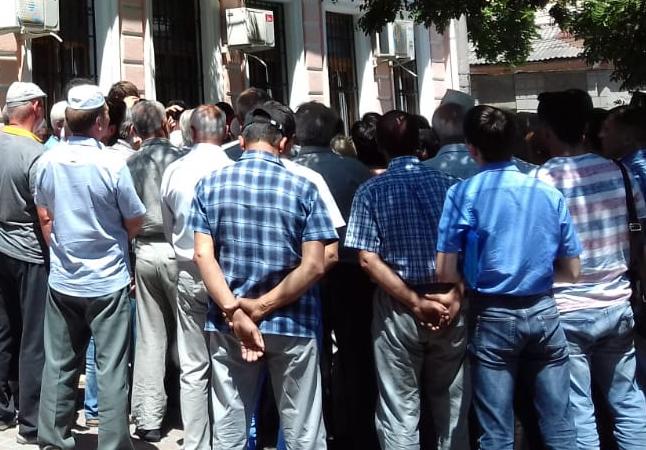
Sentence on the "case of February 26": support group. Photo: Grani.ru
On February 26, 2014, the protests of the Maidanites, mainly Crimean Tatars, tore the vote planned in the Verkhovna Rada of Crimea on the appointment of an illegal separatist referendum. A year later, the occupation authorities began to factory the case of "riots." The occasion was the clashes between the supporters of the Euromaidan and the participants in the rally of pro -Russian forces, at the same time passed by the parliament. Then the Russian prosecutor’s office of the region stated that during these clashes two people died, and dozens received various injuries.
However, in September last year, the prosecutor asked for a significant softening of the prosecution . He petitioned the exclusion from the plot of the case that the defendants burst into the building of the Verkhovna Rada of Crimea. He also announced the need to significantly reduce the list of “victims”, excluding 83 of them from 86 people from them.
As a result, Degermendzhi and Emirvaliev were charged with the attack on the “victim” Shlyagin, Asanov and Yunusov - to Alexei Ivkin, and Kantemirov on Sergey Berbents.
In total, during the trial, the text of the indictment was cheated three times.
It is known that in the pre -trial detention center in 2015, four defendants in the case were sent. Kantemirov and Emirvaliev was released for guarantee after two months of imprisonment; Asanova and Degermmenjitransferred under house arrest only in April 2017. Whether the Yunusov was previously in custody, there is no information.
Also in the case was originally the deputy chairman of the Majlis of the Crimean Tatar people Akhtem Chiygoz. He was the main defendant - unlike other accused, Chiygoz was charged with part 1 of Article 212 of the Russian Criminal Code (organization of riots). The politician spent more than two and a half years in the pre -trial detention center.
The first process in the case began in December 2015 in the Supreme Court of the annexed Crimea. The accusation was personally supported by the then occupation prosecutor Natalya Poklonskaya. However, already in February 2016, the collegium returned the materials to the supervisory authority. At the preliminary hearings in the framework of the repeated process, the judge of the Supreme Court Viktor Zinkov shared the case. He left the materials in relation to Chiygoz for consideration in the region of the region, and transferred the main case to the district court.
In the fall of 2015, it turned out that Asanov and Degermmenji offered the release from the pre-trial detention center in exchange for a negotiation of Chiygoz, but both political prisoners rejected the proposal. On March 6, 2017, speaking with witness testimonies at the trial of the deputy chairman of the Mejlis, they reported that the proposals to stipulate Chiygoz emanated from the mufti of Crimea Emirali Ablaev , known as a collaborator and a scammer. The conversations of Ablaev and the Politseki took place in the premises of the TFR.
The court on the merits of the Chiygoz case started in August 2016. The process took more than 150 meetings. On September 11, 2017, the collegium of the Supreme Court of the annexed Crimea as part of Zinkov (presiding), Alexei Kozyrev and Igor Kryuchkova sentenced the deputy chairman of the Mejlis to eight years in general regime . This is the minimum period provided for by the Code of this charges.
Chiygoz himself refused to plead guilty. In the last word, he stated that the sentencewould be a sentence to all Crimean Tatars .
On October 25, even before the sentence entered into force, Chiygoz, along with another deputy chairman of the Mejlis - Ilmi Umrov, sentenced to the real term in the case of separatism - was sent to Turkey . From there, both politicians moved to the continental Ukraine. The basis for the liberation was the decrees on the pardon issued by Vladimir Putin after the appeal of the Mufti Ablaev.
Later it became known that Chiygoz and Umarova were exchanged for Russian agents arrested in Turkey, Yuri Anisimov and Alexander Smirnov, involved in the murder of the former Chechen field commander, the administrator of the Caucasus Center site Abdulvakhid Edilgereyev.
In October and December 2015, in the “case of February 26”, two more defendants were convicted in a special order - Escender Nebiev and Yunusov Talyas. Both received conditional terms.
In November 2017, Bekir Degermendi - the father of the defendant of the “case on February 26” - was arrested on a fabricated charges of extortion (“Vedzhe Kashka case”). After sending to the pre-trial detention center, 57-year-old Degermendzhi, who has a disability of group III in connection with a severe form of bronchial asthma, did not receive adequate treatment for several weeks. As a result, in mid -December, he fell into intensive care. The Politzeck is returned back to the Politzec insulator only next month. As of the end of April, Degermendzhi was contained in the medical unit of the pre -trial detention center; The lawyer of another person involved called the conditions in the medical unit "inhuman." Like the rest of the arrested in the case, Degermendzhi-Sr. rejects.