
Translated material
Close contacts of the first kind
The dialogue between the wounds and the popularizers of science began
On June 6, 2018, the Academy of Sciences met the popularizers of science with the President of the Russian Academy of Sciences Alexander Sergeyev . The impulse for the meeting was an interview in Kommersant on March 29, 2018, during which he expressed his readiness to meet the leading enlighteners of the country.
At the very beginning of the event, the head of the Russian Academy of Sciences said a few words about the important role of scientists and journalists in reporting to the society as reliable information about scientific research. “Now, with increasingly increasing volumes of scientific information and information in general, filters are needed that would bring it to the consumer in the most reliable form.” He advocated building an interface between scientists and media, which would serve as such filters, because "scientists are responsible for the supply of new knowledge, and the media are translators who can convey scientific information in a simple and visual form." According to Alexander Sergeyev, scientists in the field of popularization of science are very underdeveloped, not always thinking about how to formulate the results in a form understandable for society. In this, journalists can help them.
“The Russian Academy of Sciences has a significant drawback: educational activities among the members of the Academy are very weak. Members of the Academy receive a state scholarship, the state supports the Academy by this, <...> and members of the Russian Academy of Sciences should conduct educational activities, which just meets the interests of the state. We will insist that the educational work be in the list of official duties of members of the Academy precisely as work within the Russian Academy of Sciences. And we will insist that they actively do this with you, ” the president of the Academy emphasized.
He invited enlighteners to cooperate with the academy, express his proposals, criticize the activities of the Russian Academy of Sciences. “So I look at Olya, she sometimes criticizes it correctly,” said Alexander Mikhailovich laughing, looking at the leading popular and popular programs to OTR Olga Orlova .
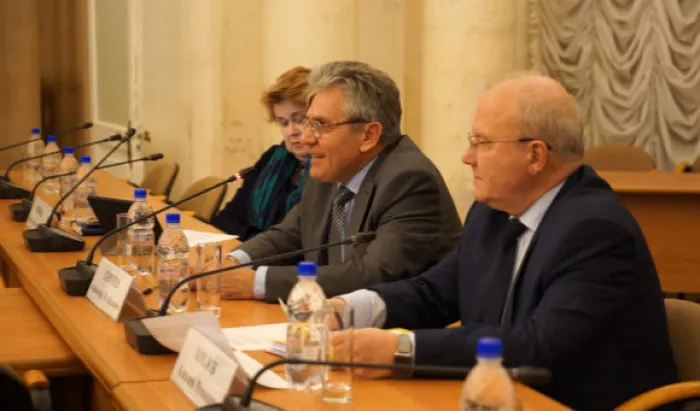
Vice-President of the Russian Academy of Sciences Alexei Khokhlov presented a general meeting plan, noting that representatives of funds contributing to the popularization of science were invited to it; science festivals, popular science lectures and museums, scientific and educational media, projects that contribute to the involvement of schoolchildren in science; and individual popularizers (Vladimir Surdin, Asya Kazantseva, Alexander Pankin, Sergey Popov, Stanislav Drobyshevsky). Asya, in her presentation sent on the eve of the meeting, aptly called himself a “wandering lecturer” (which can be attributed to her colleagues who are traveling in Russia) ( download presentations ).
The first presentation was made by Pyotr Talents , which presented the main activities of the Evolution Educational Fund . He said that this organization arose two and a half years ago, which became a reaction to the termination of the activity of the Dynasty Foundation. Pyotr invited the head of the Academy of Sciences to speak at the opening of the next “rally of enlighteners” on November 10, 2018.
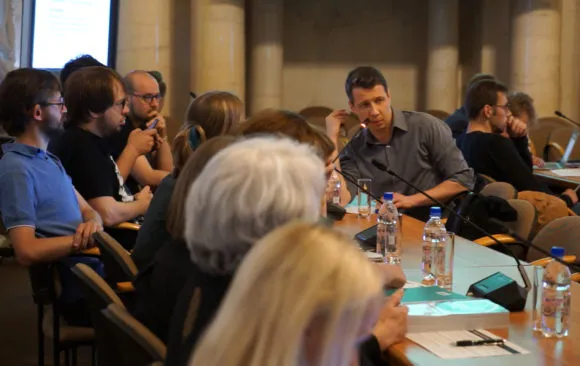
After the performance of Peter, Alexander Sergeyev asked him: “And how does crowdfunding work in the field of enlightenment? Is it a million people who pay five rubles, or five people in a million? ” “There are not many people who are ready to give us the amount with five zeros, ” Talentov answered. “ There are about ten to twenty of them.” And there are many people who regularly transfer to us amounts from 50 rubles. The ratio is about 60% (large donors) by 40% (small donations). Both those and those are really important. ”
Sergei Filippov , representing the Fund of Infrastructure and Educational Programs, Rosnano , spoke about the program of “ Workshops of Innovation ”, which supported interesting projects in the field of scientific popularization throughout the country, which had the potential of self -sufficiency.
He proposed to conduct, along with the wounds, such recognition of formats as Scienceslam and Science Bar Hopping recognized. The last project provides for the performance of scientists in bars. Lectures are arranged as “one physicist and one lyricist”. “Yes, there people drink beer and sing songs. And we must go to where your audience is, ”said Sergey Sergeyevich. - In the bars there are people who are discussing football, fashion, and we offer them to discuss the structure of the world. People are ready to listen to lectures and even pay money for it. ” The project was recognized as successful, and in September it will be repeated in several dozen bars. Filippov noted that Rusnano is also interested in cooperation with video bloggers telling about science.
"How do you find scientists who are ready to work with a non -standard audience?" - asked S. Filippov A. Sergeev. He replied that the Scienceslam project and his leader Arina Pushkin was responsible for the lecturers, who was also present at a meeting in the Russian Academy of Sciences and spoke about the festival of scientific cinema (Funk) . “They have several hundred people in all academic institutions and universities in the database. We need great courage to speak in front of a new audience. And they are preparing scientists to ensure that in ten minutes they could be interesting to talk about what they are doing in their laboratory. This is a lot of work. "
Then Leonid Gusev presented the All -Russian festival of science “Science 0+” , setting himself the goal as widely and interestingly to tell society why science is needed and how it develops. This year, the theme of the festival, which is held annually in October throughout Russia, will be “Megascience projects”. This topic may be interesting to the Academy of Sciences.
Alexei Sivukhin spoke about the Arche lecture , existing on self -sufficiency. "And who are your main sponsors?" The head of the Russian Academy of Sciences asked. “Most of our events are paid, but we have large discounts to students and schoolchildren. We are sure to pay lecturers. ” "Who are your listeners?" - “50%-post-denselous youth, which now has the opportunity to replenish gaps in their knowledge. And the remaining 50% are high school students, students and older people. ”
The representative of the project “ Scientists against myths / Anthropogenesis.ru ” Stanislav Drobyshevsky said that since 2016 four forums in Moscow and two were held in St. Petersburg, and on June 16 is coming the next. Forums are held thanks to sales of ordinary tickets, more expensive tickets in the front rows and even more expensive for sponsors. “And how do you attract listeners? Names of people? Brightness and abandonment of them? " - the president of the Russian Academy of Sciences asked him. “Both that and the other,” answered Stanislav . So far, the forum takes place only in two capitals, because in other cities of Russia it is difficult to recoup the event. We need a large platform (since the interest of people is great, and one or two months before the start of the forum, all tickets are sold out), and the rental of such a room is expensive.
The turn of scientific museums came up. Anna Klyukina spoke about the activities of the Darwin Museum , created 110 years ago, in 1907. “Contrary to the current ideas, we work not only for schoolchildren. School groups come to us only 15% of 600 thousand visitors per year, we work for a wide audience ... Our museum is on the front line. Everyone who is not laziness enters the museum and begins with us such a dialogue: “Did Darwin have already been replaced?” - "No, have not yet been canceled." “Was we descended from the monkey?” “No, from fish (because the first vertebrates - fish)“ ... I share the concern of Alexander Mikhailovich in that scientists are given little attention to scientific popularization, ” said Anna Iosifovna.
Faina Rubleva , the scientific director of the Moscow Planetarium , said that this famous educational center in 2019 will turn 90 years old. The range of events is great: “The School of Fascinating Science” is for schoolchildren, “Popular astronomy for beginners” and “100 hours of astronomy” - for adults, lectures within the framework of the “podium of the scientist” - for those who are seriously interested in science.
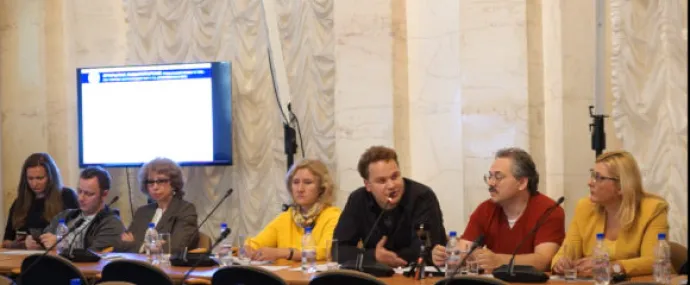
Kirill Vvedensky spoke about Cosmodis , and Denis Andreyuk and Sergey Ershov - about the “quantorium” - large projects that allow schoolchildren to enter the world of scientific and engineering work. In turn, Evgeny Nasrov said about the rapidly developing project “Open Laboratory” , where people not only listen to lectures, but also answer questions themselves and discuss their answers with experts (the Academy of Sciences acts as a strategic partner of Laba). Then Nikolai Drazvanyuk briefly introduced the Sirius educational center (the construction of the largest museum of science in the country - the Park of Science and Arts ends there, there will be a planetarium in it).
Sergey Lyulin , deputy. The chairman of the Coordinating Council of the Professors of the Russian Academy of Sciences, director of the Institute of High Molecular Compounds of the Russian Academy of Sciences , spoke about the night of museums, with success in them in St. Petersburg. At one in the morning, hundreds of Petersburgers stood in line to come to the institute and look at his laboratories. The night of the museums was accompanied by a scientific competition of schoolchildren in two rounds (full -time was held in the form of an oral report and a posture session). Sergey proposed this experience to extend to those scientific institutions that are interested in. During the discussion, Alexei Khokhlov said that in Moscow in August it is planned to spend the night of science.
At the end of the first part of the meeting, the President of the Russian Academy of Sciences also asked Elena Lozovskaya , the editor -in -chief of the magazine Science and Life , on which many of those who sat in the hall grew up. Now the circulation of the paper version of the magazine is 32 thousand copies, which cannot be compared with circulations of three million in the old years, but by current standards this is a very good result.
For those half an hour that remained until the President of the Russian Academy of Sciences had to go to another meeting, several important performances took place. The namesake of the head of the Russian Academy of Sciences, journalist Alexander Sergeyev (for his theses , see the Trav-Nauka No. 255) proposed to create a portal of the Academy of Sciences with a story about her activities. He believes that the popularizers have already learned how to coordinate their efforts and from the wounds they need not so much org support as help in obtaining contextual/background information about a particular scientific event and which of the experts could provide reliable information.

It was about the commission to combat pseudoscience (hereinafter KBL). “She is in a very strange, perched position, because in fact her activities are now regulated by an outdated position that creates serious legal risks,” said Sergeyev-journalist. He said that the head of the commission Academician Aleksandrov, together with the Russian Academy of Sciences, will sue homeopaths who filed lawsuits in the arbitration court. “In the Naval Railways there is some kind of scatter, there is no one understanding that we are standing for science.” Academician Kolesnikov was introduced into the commission two years ago, who publicly opposed the memorandum of homeopathy and stated that homeopathy should be maintained. “We cannot do anything about this, for two years there is a new position on the commission, but they do not consider it,” complained the representative of the KBL.
“We, scientific journalists, are engaged in social advertising of science ,” said Sergeyev-journalist, “ and the Academy of Sciences is actually our main customer.” He suggested that the Academy organize round tables on key problems of science: science, financing, methodology and philosophy of science.
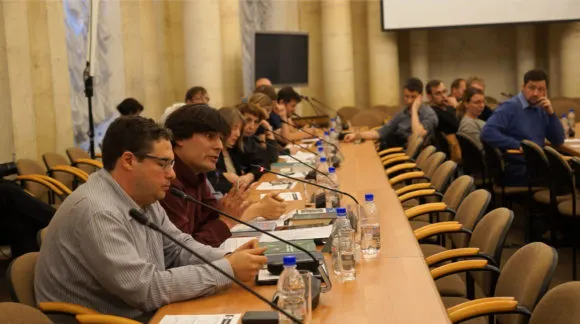
Then the astrophysicist, the representative of the Coordinating Council of Professors of the Russian Academy of Sciences, Yuri Kovalev, presented a whole project-the proposals of the working group about the press services of the Russian Academy of Sciences; He and colleagues are very worried about how the Academy of Sciences and Institutes popularize the new scientific results from them. Following him Nikolai Andreev , the head of the project “Mathematical Studies” and the head. The laboratory of popularization and propaganda of mathematics Mian noted that the state should support popularizer activities in institutes, giving some financing to this, introducing this work into state assignment. He and other colleagues during the meeting said that the Academy of Sciences needs to significantly improve the work of the press service, as well as update the RAS website.
In his final word, President of the Russian Academy of Sciences Alexander Sergeyev thanked the participants in the meeting for the offers sounding (and then they sounded for another 50 minutes after his departure, and the main will be transferred to the head of the academy). He promised to promote that the institutes of the popularization of science become one of the state premises for which they will receive money and report to the work performed (this will finance the work of press secretaries and the press service).
Responding to the replicas of his namesake (A. Sergeyev-journalist) about the press service of the Russian Academy of Sciences that does not meet the requirements of time, the head of the Academy said that this is partly a financial question. “We came to the Russian Academy of Sciences when the budget of this year was already over, although we have proposals for informatizing the press service.” He expressed the hope that the situation will soon change.
Further, the President of the Russian Academy of Sciences expressed his attitude to homeopathy, noting that yes, homeopathy is pseudoscience, but in society and the Academy of Sciences there are different points of view on this account and the opponents should be carried out by dialogue. He also recalled “what means, blood and even life was worth the struggle with Petrica” to the members of the commission to combat the pseudoscience academician Kruglyakov and his colleagues. You must be prepared for such a confrontation in court.
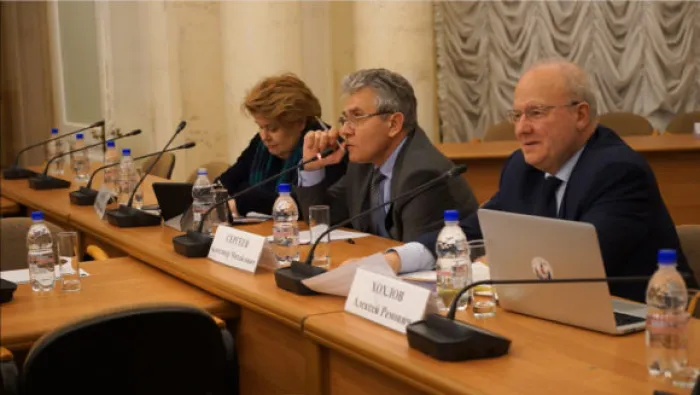
In conclusion, Alexander Sergeyev, responding to Sergey Lyulin’s performance that it is very important to lead a direct dialogue with society, invite the audience to open door days, thereby protecting the institution from moving from the city center, noted that “yes, the appeal to society can be even more important than the appeal to the authorities. Especially if we build a democratic society ... An appeal to society is just about what we are talking about today. It is worth appealing to society if it receives an interesting information for him in a normal language understandable for him. ” Already leaving, Alexander Mikhailovich proposed to make such meetings with traditional popularizers.
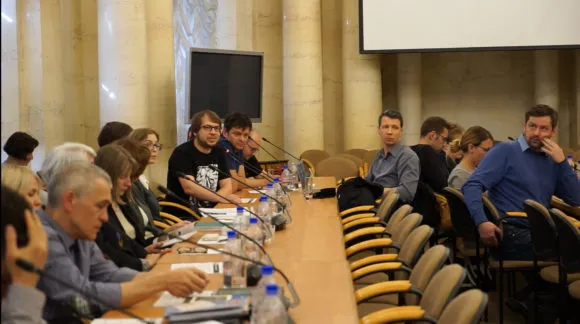
Immediately after only the vice-president of the Russian Academy of Sciences, Alexei Khokhlov, and the press secretary of the President of the Russian Academy of Sciences Svetlana Popov, was in the hall from the leadership of the Academy, was the representative of the KBL, Alexander Pankchin . He said that thanks to his efforts and efforts of his colleagues, the International Scientific Journal recalled the article of the corresponding member of the Russian Academy of Sciences Oleg Epstein about the so-called release-acting drugs (a new name for homeopathy) both due to discovered errors in the study and because of the author’s editorial a conflict hidden by the author. “In this confrontation between the commission to combat pseudoscience and individual members of the Russian Academy of Sciences, who spoke out about homeopathy, the position of the Academy of Sciences, its presidium itself, is not clear. I would like to have some kind of reaction on this subject, ” said the laureate of the Enlightener Prize 2016 for the book“ The Summary of Biotechnology ”.
Academician of the Russian Academy of Sciences Alexei Khokhlov supported the point of view expressed by A. Panchin about homeopathy. He also informed the meeting participants that there are plans to create a coordination council in the Russian Academy of Sciences, which would unite three commissions: a commission on popularizing science - a new one, as well as a commission to combat pseudoscience and a commission to combat falsification of research, which bakes from one large commission. He called on the meeting participants to enter these commissions or make proposals on its composition.
Natalia Demina
From the conversation of Alexander Chernykh ("Kommersant") and Alexander Sergeyev (RAS):
- But you are the president of the Academy of Sciences, have a serious status. You can well call to a cup of coffee owners of television channels and explain the real danger to them for the country of such programs about psychics and flat land.
- I think that over time, such a meeting would be possible. But immediately there will be a counter question: give us an interesting scientific program that will provide ratings similar to psychics.
- There are such people. In the past few years, the country has independently formed the real movement of enlighteners, young scientists: Asya Kazantseva, Irina Yakutenko, Alexander Panchin and many others. These people write popular science books, expose fakes in their blogs, constantly speak to adults and schoolchildren. This is a whole movement, but I personally do not see his support from the Academy of Sciences.
- You are right, there is something to work on. I need to meet these people, discuss how we can help each other.