
Translated material
Energy system "G.N.r."
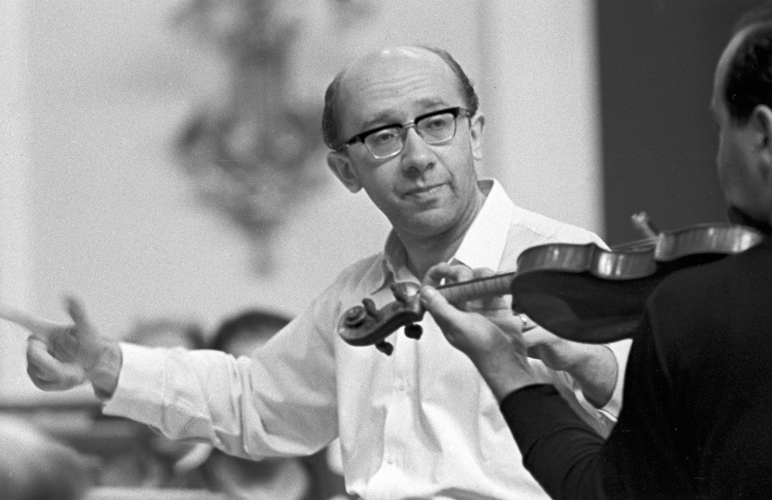
In May 2016, I wrote a small article for the 85th anniversary of G.N. Rozhdestvensky. Now, after only two and a few years, I re -read it, and it seems to me that today she is very accurately conveying my attitude to this amazing person. But two years ago, the reason for creating the article was very joyful, now, on the contrary, it was very sad, therefore, although I allow myself to generally reproduce the same text, I do this with a number of changes and additions to the present day to the present.
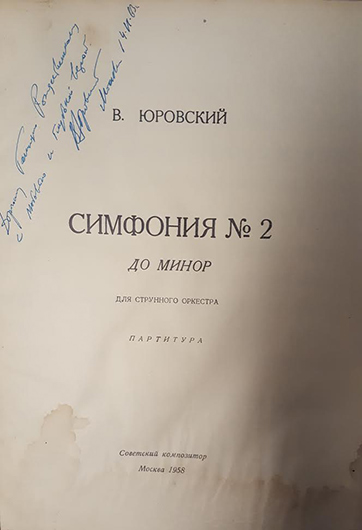
It so happened that I never knew my grandfather, composer V.M. Yurovsky. He passed away occasionally two months before my birth, thereby leaving my name to me (I am his full namesake) and eternal longing for the times that I have never lived. I had a direct connection with them during my growing up, thanks to the stories of my grandfather’s grandmother and friends - representatives of his own and the older generation. Nevertheless, it always seemed to me that “a grandfather would be alive, everything would be different, and now he would tell me how it really was ...”
 © from the archive of Vladimir Yurovsky
Gennady Nikolaevich Rozhdestvensky was younger than my grandfather for as many as 16 years, but also the older my father for almost the same period - 14 years, so for me he was always a kind of connecting link between the generation of my grandfather and the generation of my father. My grandfather and G.N. were not close friends, but G.N. He played the premieres of some works of my grandfather, and extremely benevolent and respectful relations reigned between them (dating back to contacts with the parents of G.N. - conductor N. Anosov and singer N. Rozhdestvenskaya). And since the late 60s, my father, having graduated from the Moscow Conservatory, began to work as an assistant G.N.r. In the Great Symphony Orchestra of the All -Union Radio and Central Television of the USSR. According to family legend, on April 4, 1972, my father announced before the start of the birth rehearsal, after which G.N.r. He announced to the orchestra that “today Vladimir Mikhailovich Yurovsky was born” (it was the full name of my grandfather, such is my full name), in response to which the BSO played a triple carcass.
 © from the archive of Vladimir Yurovsky
The name of G.N.r. It was familiar to me long before I started to make music professionally. Firstly, it did not leave the mouth of the father and his colleagues. The domestic ones spoke about him if not as a family member, then as a person close and at the same time possessing a huge authority (his father respectfully called him G.N., and his grandmother at home-Genya). Father often told various colorful and funny stories from his assistant being in the BSO at home, most of which were associated with the name of G.N. (Shortly before my birth, all-Union celebrations were held on the 40th anniversary of the BSO. The orchestra was at the peak of glory. But soon all this ended sadly when, on the initiative of the then boss of the radio and television of the USSR, S. Lapin in the BSO was announced in order to get rid of the “cosmopolitan element” (that is, Jews) in the ranks of BSO musicians. As a result, my father lost his own. Assistant place, many wonderful musicians left the orchestra, and then left the USSR, and G.N., who could not stop this arbitrariness, in 1974 left the post of the Orchestra artistic company ...)
Secondly, at a rather young age, I began to listen to the houses of the gramplast-first “children's” (one of the first was “Doctor Aibolit” by K. Chukovsky with the unforgettable N. Litvinov, as well as the remarkable music of M. Meerovich, on the cover below was: “The orchestra of the G. Rozhdestvensky”), and then with classical music, and one of the first authors, to which I am to which I am to which I He joined, was Sergey Prokofiev (at first there was, of course, “Petya and the Wolf” with the same Great N. Litvinov, later “classical symphony”, Suite from “love for three oranges” and many other works came). Since then S.S. Prokofiev in my mind is inextricably linked with the name of G.N., who was a conductor in all sound recordings mentioned here.
I think it is extremely important in which this or that music will appear in front of you for the first time. A talented reading can guarantee love for her for life - and vice versa. In the case of Prokofiev - and many other composers - I was incredibly lucky: G.N. His performance often impressed not “readings” (interpretations), but of the self -authorized plan, congenially heard, guessed, felt and with the maximum clarity and simplicity of the listener conveyed to the ear and heart.
Much later, I got into several of his phenomenal concerts-lectures in the BZK. In the city ofN Everything was struck by: incredible erudition, and in the field of not only music, but also literature, painting, architecture, dance ... Its manner of staying on stage, almost acting, but with this extremely strictly strictly academic, ironic intonation and dry, prickly humor, mean, but at the same time the most expressive conducting gesture, live facial expressions ... By the way, I never had sensations, I never had sensations, I never had sensations. that his facial expressions and gestures were even minimally intended for the public. They were exclusively for the musicians, and in this way all the signals sent immediately found the audible response in music, because it was impossible to play under his hands not the way he heard it inside himself! He “played on the orchestra”, as others played on their instruments. At his concerts an almost mystical atmosphere arose, a sense of involvement in an inexplicable act of creation. Even a professional was not always clear how he did it. G.N. He often used to say that “the main thing in our business, in addition to technology is courage”, that is, deep inner confidence that the musicians will do everything exactly as the conductor wants, and the corresponding filling of the gesture with this inner confidence. And the older I become, the more I understand how much he was right!
G.N. He was not only a virtuoso conductor, a conductor, a conductor, a conductor-he was also a director of music, who, in any size of an essay, every time creating his “performance”. He possessed a rare musical and dramatic instinct. In other essays, where other conductors often suffered failure, only G.N. It was always possible to build the perfect design, without “sagging”, without unnecessary notes. This refers to such cyclopic works as, for example, the third and fifth symphonies of Brookner, Kantata “Muging Song” of Malera, “Pelleas and Melizand” by Schoenberg or the Third Symphony Enescu. In this G.N. - The heir to outstanding masters of the past: Bruno Walter, Henry Wood, Thomas Bichem, Erich Kleiber, Hans Knappersbush.
His voice made a great impression. Conductor - the profession is silent, but juicy, well -set voice G.N. Often was heard at concerts - both during lectures, and during melodiclamations, to which he also had a taste (which is worth one inimitable “Ferdinand eighth” on the texts from “Notes of a Madman” in the “Revisy Tale” by Schenitic !!). Recently, a comparison occurred to me: it resembles the voice of a priest who blesses the flock from the amvon, reads a preaching. So for me he is a musician, an actor, and a priest. And, of course, a person of encyclopedic knowledge, who not only “knows”, but skillfully re -melts this knowledge in creativity, and not only musical!
The famous Preambulas - a collection of his brilliant “annotations for concerts” - for a long time were my table book. I scrupulously studied his early conducting work on conducting (“conducting applique”) back in my student years and then thought a lot about it. I did not agree with him in everything, but in absentia dialogue I tried to find my way to the truth ... “Triangles” - an incredible fruit of many years of observation and thoughts, a treasure of legends, jokes, fuses and “truthful legends” about the life of a musician in the twentieth century.
I remember his joint performance on the same scene with Zubin Meta: in 1987, the orchestra of the New York Philharmonic came to Moscow for the first time after a long break and played as a symbol of improving relations between the two superpowers along with the orchestra of the USSR Ministry of Culture. The fifth symphony of Shostakovich was then conducted by G.N., and Berlioz - meta. And this “double” orchestra in Shostakovich and Berlioz under two conductors sounded like two different, unlike each other team.
My personal acquaintance with him occurred only in 1998. Then I was offered to become his assistant at the production of the opera Eugene Onegin, which was carried out in Baden-Baden by the forces of the Youth European opera troupe. We spent with him side by side for three or four weeks, filled with intense communication, joint walks in Baden-Baden, and obligatory visits to antique bookstores. Again, I was struck by how freely he was oriented in the features of publications, in the authors of illustrations (!!!) to books in English, German and French.
Once we went there to the concert of the Chicago orchestra led by Daniel Barenboym. Performed the fifth symphony of Mahler. In the orchestra, the legendary trumpeter Adolf Herset played, which was already in seventy. At the end of the concert, the Barenboim raised it, a thunder of applause came. And I saw that Rozhdestvensky was moved to tears with this scene: he remembered Herset well for his own performances with this orchestra. Then G.N. He was moved a second time when we left the hall and immediately recognized the thrombonist of the Südwestfunk orchestra Baden-Baden , who was also present at the concert. And literally a minute later at G.N. The mood was clearly spoiled, because after a lovely thrombonist a certain elderly lady (apparently also recognized G.N.) came up to him, who turned to him (in German) with the question “whether the respected maestro knows what work was just played by Bus by Mr. Barenboym” (after the fifth symphony of Malera, the slow entry to the third act was played to the third act. "Nuremberg Meistersingers" Wagner). Giving his face an “academic” expression, G.N. Feelledly declared (in English): “ Madame , that WAS Adagio by Ti C Hon C Hrenniko FF ! ” (Moreover, the word adagio was uttered precisely as “Adagio”!) An elderly lady left, scattering in gratitude ...
At the end of the same 1998, we had a joint work on the Golden Cockerel Rimsky-Korsakov in Covent Garden (the latter was then closed for major repairs, and all rehearsals took place in the industrial zone of East London, and performances in the building of the News Theater Sadler ' s Wells ). The difficulties of the rehearsal period (there were often ailments among soloists, the director bought out the production of absurd videos from the recent Soviet past, and from under the ceiling of the New Theater Sadler ' s Wells , recently renovated, regularly poured nuts and large and large bolts into the pit) led to the fact that G.N. He fell ill a week before the premiere and canceled his participation in the play, thus leaving the prime minister itself and all subsequent performances for me, then a 26-year-old and still inexperienced conductor (I am talking about “all performances” because according to the initial plan, G.N. had its own, the first, the composition of the performers and my own, the first, a series of representations, and I had the second composition and second series). And I remember very well how the evening before my departure from London G.N. He called me to his apartment with the party party party and, despite his ailment, instructed me for a long time in the details of this difficult score. Later, already in January 1999, when Rozhdestvensky recovered, I gave him part of the “my” performances, and at some point we conducted “cockerels” alternately with a distance of one day.
When in the fall of 2000 G.N. He returned to his native Bolshoi Theater to lead him as a Hour, in the first month of his activity he sent a fax to me by hand, in which he offered me to come to Moscow as an invited conductor and carry out some opera production on the BT stage. I still have a sense of gratitude for this truly royal gesture - after all, I was not even his nominal student! .. Unfortunately, I could not follow the invitation of G.N., but in the near future, fate gave me a wonderful opportunity to thank the master, more than once.
In 2008, my son was born, and I had to cancel the pre -planned tour with the London Philharmonic Orchestra in the cities of Scandinavia. At my proposal, the orchestra turned to G.N. (whom they knew very well: G.N. was, in my opinion, the only conductor in the world, with a certain regularity appeared in all symphonic and opera orchestras of London!), And he brilliantly spent this tour with them. I remember the day before the rehearsals for this tour, G.N. He came (along with V.V. Postnikova) to our concert in London. The first essay in my program was the eighth Symphony of R. Voan-Wilems, it was also in the tour program. Knowing that G.N. will also conduct it, that evening I was very worried. Moreover, with this Symphony G.N. It was especially connected: in the 50s, his father N. Anosov conducted the first execution of this essay in the USSR, and later G.N. The first to perform in the USSR the cycle of all nine Symphony Van-Wilems. During the concert break, he came to me for the curtains and very approvingly responded about my interpretation of the symphony, especially praised the correctly selected pace, but the next day on his own rehearsal many things, and above all the pace, transformed almost beyond recognition (before returning to Berlin to the family, I still could not resist and ran in a rehearsal for half an hour to listen, as G. interpret the compositions of the tour program)! The paradoxical was a man! After all, on the eve, he probably knew that he himself would or almost everything would do differently. Nevertheless, he recognized a completely different performance. Such tolerance in relation to other people's creativity is a sign of complete inner freedom and true greatness of the spirit. After all, the performance is so individual that the musicians often willy-nilly become extreme egocentric. Rozhdestvensky happily avoided this fate, remaining a deeply original artist, but recognizing the same right for others. The only thing he could not stand is any manifestations of amateurism, which in our profession today, unfortunately, is more than enough.
When in 2011 I became the artistic director of the Russian State Counter, the first conductor to whom I turned to the invitation to properiary the state order, of course, G.N. I am very happy that the new generation of GASO had happened - and more than once - to work with this outstanding master (the old generation of the state order was knew by G.N. as a young man)! At one of their joint concerts - in December 2013, when Tapiol was performed by Sibelius, Burlesca for the piano with the orchestra of R. Strauss (as always, V. Postnikov was brilliantly salted) and the sixth symphony of Brookner - I managed to visit myself. And again, this atmosphere of the Sacrament already familiar to me was completely stunned from childhood, only now it was still multiplied by the advanced age of the master, by the way, completely unnecessary in the process of conducting: such natural, “unnecessary” music came out from under his hands, which seemed to work out by itself, and he was simply “present”, swimming in the waves of the convening. And most importantly, what amazed was an accurate, elegant, completely “free” gesture of the master, subordinating the orchestra and the hall ...
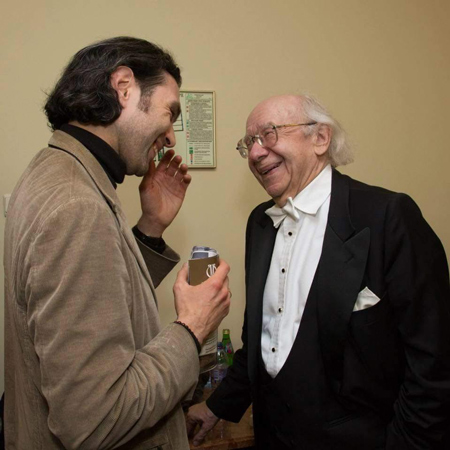 © Photo Vera Zhuravleva Gennady Rozhdestvensky and Vladimir Yurovsky. BZK, December 27, 2013
By the way, it was such a mystical atmosphere that reigned at one old Moscow concert, after which I only saw Rozhdestvensky unlimitedly embarrassed. This was in the Great Hall of the Conservatory on the Soviet premiere of the fifth symphony of Schnittke. At the end of the performance, the author went on stage (he already walked with difficulty) - and the next moment he sank down in front of the conductor to his knees, trying to kiss his hand ...
In general, about the relationship of G.N. With composers-modern ones, one can and should write a separate book! How many works were performed by him for the first time in his creative life! .. Any professional obstetrician with many years of experience would envy such a number of “children”, but the true artist is a obstetric doctor who facilitates the mother of childbirth and the child to be born healthy! ..
Truly mathematical verification of details in the interpretations of Rozhdestvensky was combined with their continuous variability. He himself somehow admitted that he was much more interesting to compare the performance of the same essay ... The same performer, recorded in different periods of his (performer) of life, than to listen to the same music that comes out of obviously different hands. That is, all his work was under the sign of the eternal movement, change. No wonder he turned out so well the “metamorphoses” by R. Strauss. Once in Baden-Baden during the production of Eugene Onegin, he left me alone for the conductor’s remote control for the whole (!) Pragon, saying that he had to go to listen to the orchestra and soloists from the side. Я осмелился выразить тогда сомнение: идут заключительные репетиции перед премьерой — не собьет ли мое дирижирование певцов? В ответ Г.Н. неодобрительно посмотрел на меня и сказал: «А вы что думаете, я каждый раз одно и то же им буду показывать?»
Человек небольших габаритов, он обладал впечатляюще большими руками, и дирижерская палочка, которой он владел чуть ли не более виртуозно, чем Брюс Ли нунчаками, была так же впечатляюще длинна. Казалось, он безо всякого труда может с пульта дотянуться ею до любого музыканта, сидящего на любом от него расстоянии. Кстати, и у музыкантов в оркестре, когда дирижировал Г.Н., часто возникало ощущение (они мне сами об этом не раз рассказывали), что он весь вечер дирижировал исключительно и только ими… Великое множество историй и анекдотов про Г.Н. слышал я от музыкантов самых различных оркестров и стран! Причем каждый из них по-своему коверкал его «непроизносимые» имя и фамилию. Англичане, никогда не затруднявшиеся произнесением его фамилии, поскольку всегда и ко всем обращаются исключительно по именам, окрестили его Gen nod iy (от англ. nod — кивок), а также Gen naughty (от англ. naughty — непослушный), итальянцы переименовали русского маэстро в Gennaro di Natale (итал. Natale — Рождество), а швейцарцы додумались до фамилии Роштигсцвеннцги (от швейц. roschtigs — ржавый, Zwännzgi — монета в 20 франков).
Когда-то в далеком детстве я спросил отца, что происходит с людьми, которые покинули этот мир (меня почему-то особенно волновала судьба обоих моих дедов, так обидно рано ушедших из жизни). Отец рассказал мне тогда про планету Памяти, на которой души умерших живут до тех пор, пока люди про них не забудут, и я на тот момент удовлетворился этим объяснением, ибо был уверен: если все мы вспоминаем моих дедов, они наверняка (где-то там ) живы и здравствуют… Со временем у меня появился еще один (свой собственный) вариант ответа на этот вопрос: человек за время своей жизни на Земле становится частью очень сложносплетенной энергетической системы, вовлекающей в себя огромное количество человеческих душ, и любой (даже оправданный преклонным возрастом) выход человека из такой системы (а в особенности тогда, когда душа этого человека за время земного пути выросла, набралась зрелости и мудрости и подпитывала своей деятельностью всю окружающую энергосистему) порождает своего рода «озоновую дыру» в атмосфере, которая, конечно, со временем затягивается, но еще долго слепит и глушит оставшихся вдруг возникшей пустотой. Однако энергосистема, созданная при участии человека в духовном пространстве, продолжает существовать и работать и после его ухода, и душа его (даже если ей по какой-то причине не дано отойти в Свет) продолжает жить и работать в этой энергосистеме.
Энергосистема «Г.Н.Р.» — это мощнейший духовный «портал», работающий в мировом культурном пространстве вот уже девятое десятилетие. В этом портале общались и продолжают общаться между собой великие умы и души людей разных эпох. Уход Геннадия Рождественского — это появление еще одной огромной «озоновой дыры» в мировом музыкальном пространстве. Со временем пространство «свыкнется» и с ней, как свыклось с пустотами, возникшими после ухода других выдающихся членов этой энергосистемы: С. Прокофьева, Д. Шостаковича, И. Стравинского, Б. Бриттена, А. Шнитке, Э. Денисова, Д. Ойстраха, О. Кагана, И. Менухина, М. Ростроповича, Г. Вишневской, Н. Голованова, Б. Покровского, Ю. Любимова, Д. Боровского, Е. Максимовой, М. Плисецкой, Б. Ахмадулиной, А. Вознесенского… Все эти (и многие другие) люди в свое время общались, дружили и творили одновременно и совместно с Г.Н.Р. Но в этой же системе находились и Моцарт, и Чайковский, и Брукнер, и Эльгар, и Глазунов, и Скрябин, и Рахманинов — все те, кому Г.Н.Р. посвятил свое служение, всю свою жизнь.
Даже фамилия Рождественский несет в себе заряд надежды, зерно новой жизни. Человек и музыкант Г.Н.Р. воплотился в свою музыку, в свои книги, в свои спектакли, в своих учеников.
Eternal memory!
Many summer !!!
Смерти НЕТ.