
Translated material
Their banner returned
Symbolic restoration of Soviet power at the MPSU: feel the pathos of the celebration
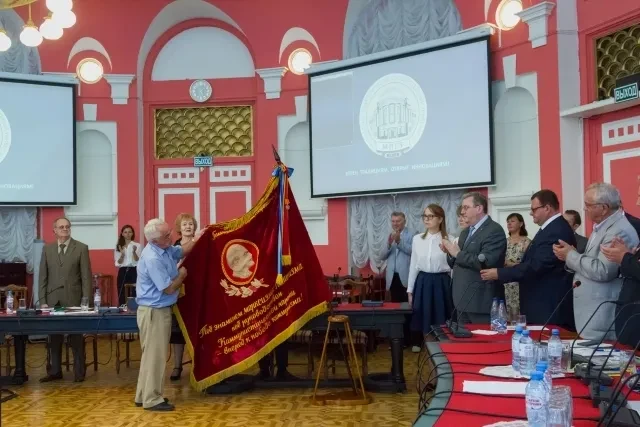
“In the legendary round hall of the Academic Council of the MPSU, the final meeting ended. “Colleagues,” the rector said quietly, “today we have a special day. We return our banner back. ”
The intonation of this message is important on the website of the Moscow Pedagogical State University-an enthusiastic-affected, marked by the importance of the event: " ... our banner ... "
What kind of banner are we talking about? The work of one of the forges of the ideological personnel of the USSR - the Moscow State Pedagogical Institute named after for years. V.I. Lenin.
Those who studied in the 70-80s-and just then I graduated from the Krupskaya Moscow Regional Pedagogical Institute-remember what these universities were. They prepared specialists in the introduction of children in the consciousness of children, which, according to the then theorists, should instill in them the loyalty of the Soviet regime. And also - a love of leadership: the Politburo of the Central Committee of the CPSU and the General Secretary (no matter how he was called), whose "portraits" were hung on the streets of cities and on the walls of classes.
“To live, study and fight, as the great Lenin bequeathed, as the Communist Party teaches,” the solemn promise of “young Leninists” read, whose squads were believed to be the core of the educational process. It was expected that their mentors would instill in children a willingness to life and struggle in the line of the CPSU program and the covenants of its leader Lenin. The teachings of which, as the textbooks said, "is invincible, for it is true." No wonder the leading pedagogical unit was called him in the name. And he himself was declared a prominent teacher. Like his wife, Nadezhda Krupskaya. Their works were studied, passed in exams, wrote diplomas on them and defended the dissertations. In such universities, thousands of specialists, using hundreds of benefits, stubbornly and purposefully formed the views of hundreds of thousands of students, instilling in them the skills of faithful fighters for the "bright future of mankind", where "the Lord of the world will be labor."
By the way, perhaps, having settled relations with capital, he will become his turn of the Lord of the world. But obviously not according to the prescriptions of the Soviet version of "developed socialism." And for her, pedagogical universities were prepared by the lords of the masses. Their views and choice. And these were not only teachers of social studies, history and literature, but also languages and accurate disciplines. Plus - labor, physical education and military training, without which the construction of a bright tomorrow was seen in the world impossible.
But not that was discussed by Marx and Engels. And that, which was dreamed of Lenin and Stalin.
The Red Flag already in the civil war actually lost a symbolic connection with the banner of the liberal European revolution of 1848 and the banner of the Paris Commune, Russian uprisings of December 1905 and March 1917.
The farther, the more it was filled with the blood of the victims of totalitarianism. And crimson stroke severity of gerontocracy. But there was in every university.
It was stored in the party committee of the MGPI. But after the failure of the Putch of the State Emergency Committee, the V Congress of People's Deputies of the RSFSR on November 1, 1991 approved Tricolor as the state flag. And the red flags were seized as symbols of power alien to the new Russia.
After the dissolution at the universities of the KPSS primary, the MGPI flag was removed from the former party committee. But he, according to the university’s website, “saved and preserved the then member of the party committee” Harry Kaziev. He kept it for 27 years and in July 2018 the flag returned the MPGU to "tears of joy and involvement with a great symbol."
Why is it great? Unknown. But he will be placed at the Museum of the MPSU. Good - not at the party.
It is known: symbols - fragments of the control sign system - tools of submission of consciousness, like violence and fear.
To someone, the busts of Stalin, sickles and hammers in the subway, crying according to the former banners, seem insignificant. But the restoration of the totalitarian past does not necessarily begin with a revolution of tanks and publication of decrees.
Specialists in political psychology believe: the beginning of it often puts the return of symbols, images, signs - emblem, melodies, banners - magnificent and solemn. And behind him is the triumph of former ominous regimes. The restoration of the symbolic follows the political.
Finding the news on the MPSU website about the return of one of these signs is easy. Read. Feel the pathos of the celebration.