
Translated material
West-point: balls and gun
Pictures from the exhibition
Alexander Genis: This release of the “American hour” is aired when trial explosions of funeral missiles and festive fireworks are already rattling throughout the country. Congratulating America on his birthday, we included in the summer anthology the release of “Pictures from the exhibition”, which will tell about excursions to the bastion of American power-its illustrious military Academy of West Point.
(Music)
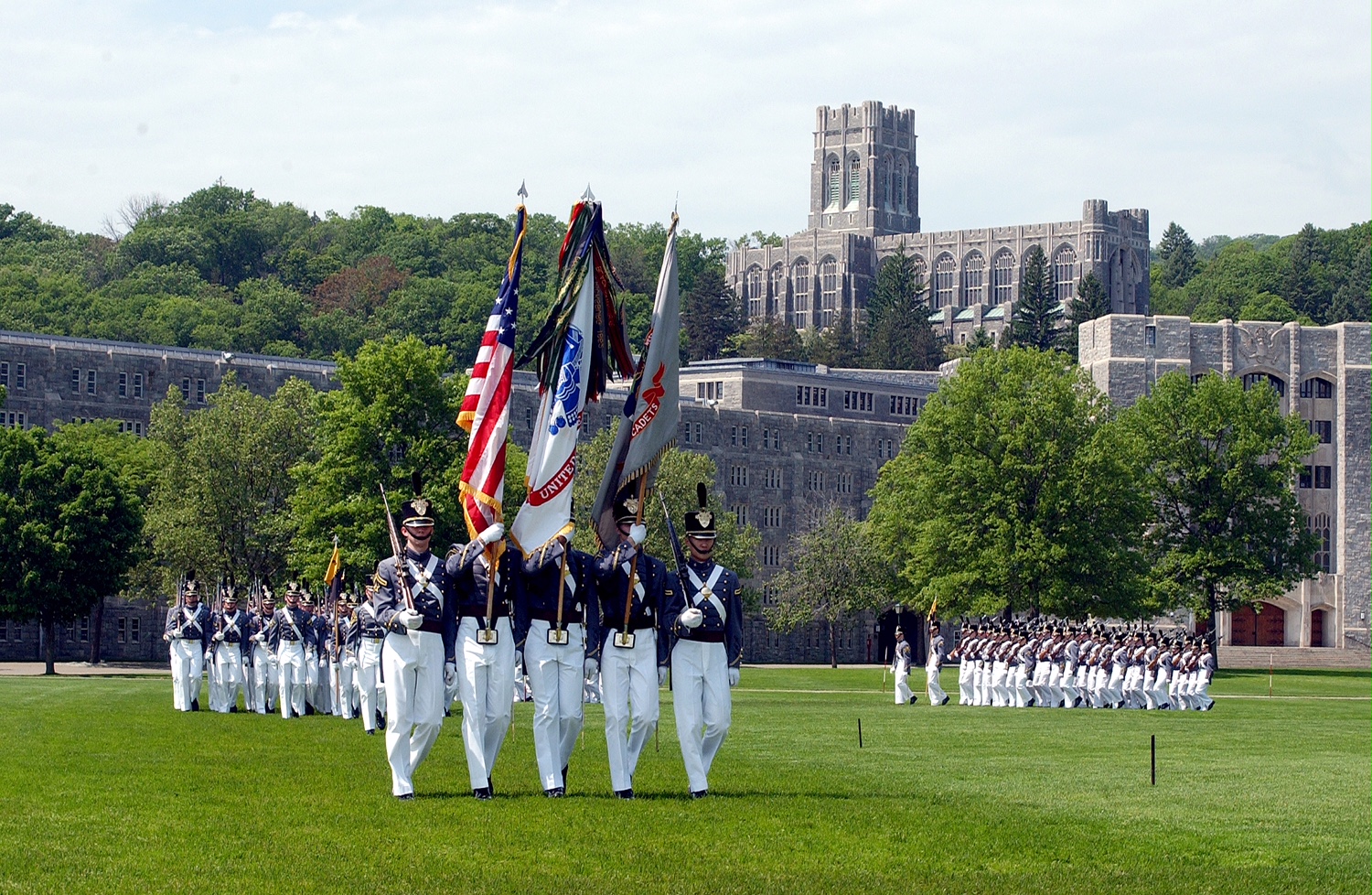
Alexander Genis: According to the non-accident coincidence, the West Point is located in the most picturesque corner of America, on one of those coastal cliffs that allowed romantic poets to compare the Hudsone with the Rhine, and to establish the Hudzon School with New York artists.
From the river, the Academy with its powerful zikuns reminds of the Babylonian tower. But, having got into (on a sightseeing bus, they don’t let it into the perimeter on foot, the visitor receives a complete set of architectural impressions - from Victorian frivolity of professorships to a strict ampir of barracks and modernism of the synagogue.
I liked the main cathedral most of all, erected in the special style of the “militaristic Gothic”. By tradition, each issue gives this church one stained glass, executed in the style of time. As a result, an ecumenical collection of colored windows was formed, which can be considered to the sounds of the world's largest horizontal organ, which occupied the entire cathedral - from the altar to the entrance.
Alexander Genis: Over its two -century history, the Academy acquired not only architectural monuments, but also dilapidated traditions. As expected, they all tell "about exploits and glory." The forge of the generals, the West Point is proud of them, and at once by all: both those who won, and those who lost. In equal honor, a graduate of 1842, General Grant, and a graduate of 1829, General Lee.
It is interesting to note that, having signed the surrender of the southerners, the commander of their army Robert Lee quietly graduated from his days at the University of Washington, whose president he was before his death in 1870.
The most successful in the history of the Academy was the 1915 class: out of 164 graduates, 59 graduated from the general. One of them was Eisenhower.
The most famous Petelaz West Pontent is General Mc Artur. When he studied at the Academy, his mother rented a house opposite the hostel to follow whether her son is extinguished in time, to whom she was preparing the fate of the American Caesar.
Surrounded by such legends, the Academy allows itself to be extremely selective. Only cream can come here. To enter the West Point, it is not enough to be an excellent student and athlete, you still need to get a personal recommendation of the senator. Four student years are filled with incessant labor - study in winter, in the summer - field exercises, on Sundays, which I myself witnessed, practice: parachute jumping. Only having received a diploma and the rank of lieutenant, a graduate can marry before going by distribution. It used to be a military base in Italy, or even Hawaii. Now - only Iraq, where smart officers are now needed.
For more specialists in this war, President Bush (more recently, in a speech at the graduation ceremony of this year) announced the reconstruction of the entire academic program. It will be replenished with the courses on anti -terrorism tactics and intelligence, the Department of Arabistic will expand, professors in Islamic law and Muslim culture will appear.
Judging by these innovations, the West Pout is preparing for a long war with terror.
Alexander Genis: Being a professional sleepcam (in my military ID was “private untreated”), I examined all the battal attractions of the West Point - a green parade ground for parades, trophy guns and the best athletic simulator in the world - with good, but extraneous attention. But my eyes flared up in an amazing museum of military history, which will lead the best specialists in the world. (At the Academy, for example, the teaching of an ancient story, which every cadet should study).
The West Pontent Museum is the dream of every boy who had tin soldiers (there are enough of them here). But in addition to visual diagrams, in the faces and figures telling about all the great battles, starting with the biblical and ending with the battle for Baghdad, the museum is rich in genuine relics. Among these rarities is the act of surrender of Japan, Hitler’s mother -of -pearl pistol, known for his close -minded nickname “Liliput”, and Goring's hunting dagger decorated with jewelry.
But I was most impressed by the exhibits of the First World War, naively imitated by knightly armor: the breast carapace and a tankman helmet with chain mail. It shows that, starting the first total war, the world thought in old heroic categories, not yet aware of the destructive power of modern technology.
Oddly enough, in the West Pontunt, who was preparing the elite of the most powerful army in all history, there is also a kind of anachronism. This fortress on Hudson cherishes every detail of its past. Finally, I asked the guide about the purpose of the frivolous structure with elegant empire columns.
“In this ancient palace,” they explained to me sedately, “the Cadets are lying with the ladies at the graduation ball.” From the day of founding in the West Point, dances have been taught.
Alexander Genis: Our special, dedicated to Independence Day, the release of the “American hour” will continue Solomon Volkov.
Solomon, celebrating the birthday of America, seems to me to talk about her patriotic music.
But, before giving you a microphone, I wanted to ask you such a question. Patriotic art, in general, is always very doubtful, very false. But in music, a patriotic theme is often solved remarkably - there are patriotic operas, patriotic marches. That is, music is characterized by the pathos of sovereign love, right?
Solomon Volkov: With American music, the situation is not entirely true. It seemed to me that I would easily find some patriotic musical fragments for our conversation. But when I began to listen to the music dedicated to America, modern American composers (in different genres, moreover), then I suddenly saw that they had such patriotism, I would say, bashful. This is absolutely not pathos music. There are some traditional hymns, but a modern composer, if he wants to explain to America’s love, does it extremely indirectly ...
Alexander Genis: shyly.
Solomon Volkov: Very shy. And a typical model, in this sense, is a song under such a meaningful name “America” by Paul Simon, a singer who became famous in the 1960s. And, of course, retroactively, I understand that in the 60s such frontal patriotism was probably completely impossible. And this song, written in the late 60s, approaches the topic of description of America, but this was done through the conversation of the couple in love, which goes on the bus in search of his own America, in search of his own country. All this is done in the Simon characteristic of the floor, unobtrusive, modest, lyrical, soulful manner.
Solomon Volkov: And here is another opus. You know, of course, about the huge epic play of Tony Kushner “Angels in America”.
Alexander Genis: Yes, I saw her in the theater.
Solomon Volkov: But I watched the film of Mike Nichols, shot on this play, and he honestly said to me.
And the music for this film is also very remarkable in its own way. She belongs to the feather of the composer Thomas Newman. She also combines this ironic and grotesque attitude to America, on the one hand, but, nevertheless, “angels in America” implies some flight. And this combination I hear in the main topic from this film.
Alexander Genis: Solomon, allow me to offer the third topic for our current release “Pictures from the exhibition”, the most patriotic, in my opinion, music in America, which was not composed by the American, but the Russian composer - Tchaikovsky. I talked about a tour of the West Point and said that there are many trophy guns, which, of course, do not shoot. But one of them still shoots. And she shoots every time they perform the overture "1812".
Solomon Volkov: Americans with this overture acted in a wonderful way. They saved her for Russian music, if you like. I was even curious, I looked into the most authoritative Soviet biography of Tchaikovsky, and the author in it makes a lot of complaints to Peter Ilyich precisely in connection with this essay. Firstly, there is the anthem "God, keep the king." It was from Tchaikovsky, according to Soviet research, a big political mistake. But even more political error, and he puts it in a claim to Peter Ilyich, was that there the “Marseille” is executed and sounds as a negative, negative symbol. This is a symbol of the enemy.
Alexander Genis: Indeed, Napoleon ...
Solomon Volkov: And this cannot be, because the “Marseillaise” is a symbol of freedom, revolution. Here, Tchaikovsky was completely guilty of all respects, and in the Soviet Union the composer Shebalin did such a virtuoso surveillance operation. There they cut out the theme of the royal anthem, instead of it they inserted other music, and, in this capacity, performed for many years. She sounded in a mutilated form. And in America, at this time, it became a national essay, which Americans turn to precisely in search of the missing in their own music of pathos.
Alexander Genis: And, most often, on July 4.
Solomon Volkov: Yes. And when they play this music, the Americans rejoice, like children, that they can finally give free rein to their patriotism in Russian music, which they hide in their music. And Tchaikovsky provides this opportunity to them. And it provides an opportunity to shoot from a gun.
(Music)