
Translated material
Beat for sure. Stalin is against genetics

Karl Marx was far from discussions about the principles of the development of life, and Friedrich Engels was interested in biological research as an amateur. The manuscripts of 1873-1886 remained from him, stored after his death in the German archives of the Social Democrats. The outstanding researcher of Marxism from Russia, who lived for a long time in the West, D. B. Ryazanov, resurrected them to life (Stalin executed this scientist during the years of great terror). In 1925, Ryazanov published the book of Engels in the USSR in Russian and German entitled "Dialectics of Nature." This work noted the possibility of changing organisms under the influence of living conditions - what began to be called "inheritance of acquired signs." This principle was also known before the Marxists, it was most clearly set out in the famous work of the “philosophy of zoology” by Jean-Batista Lamarka, published in 1809. In 1946, Stalin included in the first volumes of his works the book “Anarchism or Socialism?”, Completed from articles allegedly published in the Georgian language in 1906-1907. If the articles were actually written by Stalin (this can be doubted), then it follows that the ideas of Lamarkism fascinated Joseph Dzhugashvili at the beginning of the 20th century: the author insisted that Lamarck more correctly outlined the principles of evolution than Darwin. This thesis Stalin has followed his whole life.
 In the book “Stalin and Fraudsters in Science” and in an article in the Trav-Hunus No. 250 of March 27, 2018, I described in detail how Stalin told Stalinist philosophers about his disagreement with the conclusions of the German scientist Weisman (one of the founders of the genetic principles of evolutionary teaching). Those who listened to Stalin Mitin and others shared his views with Trofim Lysenko, who already next year switched from the previous reverent attitude to genetics to a sharp denial. In the USSR, a prolonged and dramatic struggle of scientists with the Lamarckist-Stalinists launched.
In 1947, Lysenko raised Stalin when he hoped to solve the most difficult food problems in the USSR with the help of a trivial panacea. The Georgian relatives of Stalin handed the leader a bag from 200 g of a special type of wheat - branchy. Now it was necessary to get a variety from the seeds that would allow fabulously high yields of the most important food product and feed finally the starving inhabitants of the country. Stalin called Lysenko, handed him a bag of seeds and asked whether it was possible to hope for the age -old meal of nutrition in the country of advice using branchy wheat. Lysenko in his later letter to Stalin mentioned such a conversation. It is extremely important for us today that already during that conversation Lysenko knew perfectly well that there was no hopes for success with a branchy wheat, because, as I discovered, studying Soviet newspapers, back in 1937, his father experienced a branchy wheat, but nothing good was released from the venture (see 637–643 in the fourth edition of my book “Power and Science”, the first American The publication in Russian in 1989, its facsimile reprint in Russia in 1993, the English -speaking edition of 1994 and a supplemented publication in Russian in 2002). However, Lysenko did not object to the leader, but humbly agreed with the assignment. Its employees (including father - D. N. Lysenko) began to propagate the Stalinist seeds and allegedly achieved unprecedented success, about which Lysenko informed Stalin in a long letter of October 27, 1947. He said that A. Avakyan achieved incredible success, who seemed to sow the glass of seeds, and collected " 327 kg, that is, 1635 times more than sown ." The world practice did not know such a pace of reproduction, it was an unusual miracle, but, apparently, Lysenko realized that Stalin’s unfamiliar with agriculture would easily “swallow” a clear invention and only rejoice in such a grandiose success. Lysenko even wrote to Stalin that " branchy wheat can give very high crops, about 50-100-150 and more centners per hectare." He asked to name the new variety of wheat "Stalinsky branching." After that, Stalin believed that one could really rely on the Lysenkovsky “Clopts”, which will soon fill the country with grain (running ahead, I must say that the undertaking with a branchy wheat never gave positive results and turned out to be a clean scam). Stalin, although he rested in the resort, considered the information he had reported extremely important and wrote Lysenko a joyful answer.
Academician T.D. Lysenko
Dear Trofim Denisovich!
I received your note from 27.x.1947. Thank you very much for the note. It is very good that you finally drew due attention to the problem of branchy wheat. There is no doubt that if we set ourselves the task of a serious rise in wheat productivity, then the branched wheat is of great interest, because it contains the greatest opportunities in this direction.
It is bad that you make experiments with this wheat not where it is “convenient” for wheat, but where it is convenient for you as an experimenter. This is the southern wheat, it requires a satisfactory minimum of sunlight and moisture provision. Without compliance with these conditions, it is difficult to reveal all the potency of this wheat. In your place, I would have been experiments with a branchy wheat not in the Odessa district (dry area!) And not near Moscow (little sun!), But, say, in the Kyiv region or in areas of Western Ukraine, where there is enough sun and moisture is provided. Nevertheless, I welcome your experience in the districts near Moscow. You can expect that the government will support your undertaking. I also welcome your initiative on the issue of hybridization of wheat varieties. This is an unconditionally promising idea. It is undoubted that the current varieties of wheat do not give great prospects, and hybridization can help the cause. We will talk about rubberous and crops of winter wheat on the stern in the near future in Moscow. As for theoretical attitudes in biology, I believe that the Michurinsky attitude is the only scientific attitude. Weismanists and their followers, who deny the heredity of the acquired properties, do not deserve to spread about them for a long time. The future belongs to Michurin.
Sincerely
I. Stalin
But their exchange of letters was not public. As everything around Stalin was braided by secrets, the facts of his interaction with Lysenko and the content of their letters remained unknown even for the closest employees. The reputation of Lysenko at that time in the country became bad. Scientists bombarded the Central Committee with letters in which they asked to immediately take measures to stop the dominance of Lysenkovschina. In July 1948, the appeals of I. I. Shmalgauzen, A. R. Zhabrak, E.V. Bobko and I. M. Polyakova came to the Party Central Committee, and Academician P. N. Konstantinov (the largest breeder, whose varieties were sown in huge squares, laureate of the Stalin Prize, and the department of the department, were addressed directly to Stalin, and the Laureate of the Stalin, and the Laureate of the Stalin. seed production and methods of the experimental case of the Timiryazevsky agricultural Academy). He insisted that Lysenko be eliminated from the leadership of the Academy of Agricultural Sciences.
Such a person does not have the right to be an administrator ... He uses the President’s rights to affirm his domination in science, to create the appearance of the inviolability of “laws” discovered to him. He clearly abuses your trust ... What did he do in these 15 years? Who did he become himself? This is the worst appearance of the dictator. He requires the elimination of everything that is not in accordance with him ... It is impossible to put up with this ... Many scientists of the USSR Academy of Sciences, vascular, Moscow University and TSH-Academy sharply criticize him ... Why no one wants to reckon with us? Why is the permission of these disputes is repaired either to people such as M. B. Mitin or ministries? Why do not listen to the opinion of scientists and practitioners of agriculture? Why does our official criticism not reflect the opinions of the scientific community, but is trying to please T. D. Lysenko?
However, Stalin was not interesting to the proposals of the largest scientist of Russia, and one line in his letter could cause extreme irritation. The fact is that Konstantinov accused Lysenko that he "instead of a Darwinist became a lamarkist." Of course, Konstantinov could not assume that Stalin himself was even more convinced Lamarkist.
As the former secretary of the Central Committee of the party D. T. Shepilov told me in January 1988, in anticipation of major successes with the branchy wheat of Stalin, at the end of the summer of 1947, he interrupted the secretary of the party Andrei Zhdanov when he criticized Lysenko. Stalin pointed out that Comrade Lysenko is now doing an important matter for the country, and if he is even fond of, promising to increase the yield of wheat as a whole in the country, and he will achieve only 50%, then this will be quite enough.
It is interesting to note that in the student and graduate years, the future son -in -law of Stalin and the son of Andrei Zhdanov Yuri (who, from his youth, had personal and favorable meetings with Stalin face to face), was a workshop on genetics by the famous scientist V.V. Sakharov and was convinced that the laws of Mendel genetics are well reproduced in practice. Based on this, Yuri Zhdanov, becoming the head. Department of Science of the Central Committee of the All -Union Communist Party of Bolsheviks (b), decided on public criticism Lysenko.
On April 18, 1948, he made a lecture before propagandists of the highest party level in Moscow, in which he criticized Lysenko and his methods.
This act of his own son -in -law outraged Stalin. He demanded that the Politburo of the Central Committee of the party, where he fell upon Yuri Zhdanov. It was required to write a repentant letter, what Zhdanov performed. As Zhdanov himself told me in my apartment in Moscow in 1987, he sent a “penalty” to the Moscow City Complex of the party, but the document was printed in Pravda as a letter to Stalin with a recognition of errors.
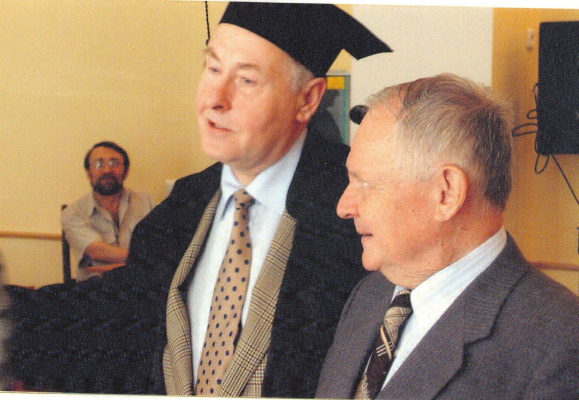
The photograph sent by the author Yu. A. Zhdanov in 2003 with the inscription on the back of the picture. Yu. A. Zhdanov invariably sent a book with gift inscriptions to V. N. Soifer, and in the book “Figability” he invested here a photograph taken in 2003 at a meeting of the Academic Council of the University of Rostov, when the Soifer was elected by the honorary professor of this university. On the back of the picture, Yuri Andreevich wrote: “For the amazing moment of mysterious life, with the hope of new meetings. Yu. Zhdanov. 05/30/2003 "
In the same year (May 31 and June 1, 1948), Stalin took part in the discussion of candidates for the next Stalinist awards for science and invention and rejected the theses of the lecture by Yu. A. Zhdanov.
Yu. Zhdanov set his goal to defeat and destroy Lysenko. This is wrong: we must not forget that Lysenko is today Michurin in agricultural technology. We must not forget that Lysenko was the first to raise Michurin as a scientist. Prior to this, the opponents of Michurin called him a little cushion, a provincial eccentric, an empty waste, etc. Lysenko has shortcomings and errors as a scientist and a person, he must be criticized, but to set his goal to destroy Lysenko as a scientist - it means pouring water on the Zhebrakov mill.
Yuri Zhdanov himself recalled the words of Stalin so.
... Suddenly [Stalin] stood in a muffled voice: “Here one comrade made a lecture against Lysenko. He did not leave a stone on a stone. The Central Committee cannot agree with such a position. This erroneous performance is the right, reconciliation in favor of formal geneticists.”
By order of Stalin, in the Central Committee of the Party under the leadership of Andrei Zhdanov, they began to prepare the draft resolution of the Central Committee on the support of Lysenko’s views and the ban on genetics in the USSR. A. A. Zhdanov received the draft of the Central Committee prepared by Shepilov and Mitin, made his corrections and handed over the text to Malenkov. The very next day, July 10, 1948, for their two signatures, the project was sent to Stalin and copies of Molotov, Beria, Mikoyan, Voznesensky, Kaganovich and Bulganin. But Stalin did not like the document. A. A. Zhdanov was generally suspended from work. The practical leadership of the defeat of genetics was entrusted to the new secretary of the Central Committee G. M. Malenkov (appointed by the Secretary of the Central Committee on July 1, 1948 and accepting cases from A. A. Zhdanov).

Stalin called Lysenko, after their conversation, they exchanged letters, and after a short time in Pravda a decision of the Soviet government was published, according to which an extraordinary session of the agricultural jacket (Vaskhnil) was supposed to be held, where Lysenko would have made a special report. The preliminary text of the report was written by a group of closest employees of Lysenko, then sent to Stalin, who himself sat down to edit the text on 49 pages. He completely threw one out of 10 sections, called the “Fundamentals of Bourgeois Biology”, preserving from it only one paragraph criticizing the statements of the Nobel laureate, physics of Erwin Schrödinger, about heredity and writing against him in the fields in the fields: “ This is in another place”. He emphasized the phrase “any science is class” and marked in the fields: “Ha ha ha ... and mathematics? And Darwinism? " - He removed the most odious revetors like the words “precious guidelines ... in the works of Comrade Stalin,” inserted the name of Weisman into the text (which he did not love much), after which Lysenko introduced 12 paragraphs with a variety of views of this great scientist. Having made many similar comments and corrections, Stalin personally finished some paragraphs. As an example, you can refer to an excerpt in which he crossed out separate words or inscribed the words and a whole paragraph (printed in italics).
Firstly, those known provisions of lamarkism, which are recognized as the active role of the conditions of the external environment in the formation of a living body and the heredity of acquired properties in the contrast of the metaphysics of neurvinism (Weismanism), are by no means vicious, but, on the contrary, are completely true and quite scientific.
Secondly, the Michurinsky direction cannot be called neither in Lamarkist , but it is a creative Soviet Darwinism, which rejects the mistakes of both and free from the mistakes of the theory of Darwin in the part concerning the darwin scheme of Maltese.
It is impossible to deny the fact that in the dispute, which was erupted at the beginning of the 20th century between the Weismanists and the Lamarckists, the latter were closer to the truth, because they defended the interests of science, while the Weismaists hit mysticism and spoiled with science .
He replaced some expressions (so, instead of a “bourgeois worldview”, an “idealistic worldview” appeared, “bourgeois genetics” was replaced by “reactionary genetics”, etc.). (A detailed analysis of the Stalinist set was given to Esakov and others and Russians.)
He made another important decision, saying that Lysenko needs to satisfy Lysenko’s request to bring the Procedure by force at the Academy and replace the elections to the vassal with the appointment of new members. The order was issued on behalf of the USSR government (Stalin was the chairman of the Council of Ministers of the USSR), it gave a long list of Lysenko supporters made by academicians without elections. In Pravda, on July 28, 1948, an information message appeared about this. At the so -called August session of the 1948, genetics was banned in the USSR.
Two years after this session, the vasculin (in 1950) Stalin ordered the Sector of the Science of the Central Committee to call the combined session of the Academy of Sciences and Academy of Sciences of the USSR, on which one of the oldest Bolsheviks, 79-year-old Olga Borisovna Lepeshinskaya, announced the possibility of cells from inanimate substance. Now the ban was carried out in relation to cytology. And so that everyone becomes completely clear in which direction Soviet biology will move, Stalin presented to the Lepeshinsky generous gift - the Stalin Prize. This was done in an unusual way. Stalin always carefully monitored the process of assigning himself to named after himself, established by him in 1939 in the peak of Nobel and considered in the country as more significant scientific awards. He always attended meetings of committees to award his names, personally looked at the lists of candidates, and made the names of those whom he considered worthy. And just once ordered to award a person’s prize not on a regular date, not on his birthday, December 21. On September 20, 1950, in the newspapers on behalf of the Committee on Stalin Prizes, a request was expressed to the Council of Ministers of the USSR to award the Lepeshinsky Stalin Prize out of turn for "outstanding scientific studies of non -cream forms of life and origin of cells." I did not have to wait for the government’s decision for a long time. The next day, the same newspapers reported that the Council of Ministers of the USSR satisfied the request and awarded the Lepeshinskaya Stalin Prize of the 1st degree for 1949 in the section of biological sciences.
Belief in a change in the heredity of living organisms under the influence of the external environment constantly dominated in the thoughts of Stalin. Now he needed to develop “success” in the new area - the study of behavioral reactions, the formation of the personality of a “Soviet citizen”. The skills, the style of behavior and thinking brought up by the Soviet man, brought up by the Soviet life, could not, in his conviction, disappear with the death of a person, should be preserved with descendants. World science rejected such an assumption, but he considered the rejection erroneous.
Сталин вызвал к себе Ю. А. Жданова (последний рассказывал мне об этом) и объяснил задачу: использовать предлог — празднование столетия со дня рождения Павлова — и наказать тех, кто ведет науку в неверном направлении и не признает роли среды на наследственность, или, иными словами, наследования условных рефлексов. Жданову пришлось приступить к новой — позорной и даже попросту грязной работе — сбору наветов на лучших ученых и поиску тех, кто не погнушается на такую грязь пойти.
Новое собрание ученых надлежало провести столь же помпезно, как сессии 1948 и 1950 годов. Выполняя это поручение, Ю. А. Жданов отправил 28 сентября 1949 года, накануне 100-летия со дня рождения И. П. Павлова, письмо тестю:
Товарищу Сталину И. В.
В эти дни по всей нашей стране широко отмечается столетняя годовщина со дня рождения академика Павлова. В статьях и выступлениях много говорится о значении его великого учения. Однако совершенно обходится вопрос: правильно ли у нас развивается павловское наследство? Факты свидетельствуют о том, что в этом деле у нас имеется серьезное неблагополучие. Около трехсот научно-исследовательских медицинских учреждений в той или иной степени занимаются физиологией, однако успехи медицины более чем скромны, они явно не соответствуют такой огромной трате сил и средств. Одна из причин этого, как мне кажется, заключается в слабом использовании идей Павлова, в целом ряде попыток отвергнуть и опровергнуть его учение.
Я просил бы Вас, товарищ Сталин, ознакомиться с моей запиской, посвященной этому важному вопросу.
В приложенной к письму записке Жданов назвал троих обвиняемых (наверняка предварительно получив от тестя указание, кого следует определить поименно): Леона Абгаровича Орбели (1882–1958), Лину Соломоновну Штерн (1878–1968) и Ивана Соломоновича Бериташвили (1875–1974). Все трое были людьми в советской и мировой науке видными и признанными.
Через неделю Сталин ответил Жданову, разослав копии своего письма еще нескольким членам Политбюро (грузина Бериташвили он именовал на русский манер Беритовым).
Товарищу Жданову Ю. А.
Получил Ваше письмо об академике Павлове и его научном наследстве. Я рад, что Вы взялись за дело академика Павлова. У меня нет разногласий с Вами ни по одному из вопросов, возбужденных в Вашем письме. Ваша оценка теории великого русского ученого, как и оценка его противников, — совершенно правильны.
По-моему, наибольший вред нанес учению академика Павлова академик Орбели. Фарисейски именуя себя главным учеником Павлова, Орбели сделал всё возможное и невозможное для того, чтобы своими оговорками и двусмысленностями, бесчестным замалчиванием Павлова и трусливо замаскированными вылазками против него развенчать Павлова и оклеветать его. Чем скорее будет разоблачен Орбели и чем основательнее будет ликвидирована его монополия, — тем лучше. Беритов и Штерн не так опасны, так как они выступают против Павлова открыто и тем облегчают расправу науки с этими кустарями от науки. Наиболее верным и толковым последователем Павлова следует считать академика Быкова. Правда, он, кажется, несколько робок и не любит „лезть в драку“. Но его надо всемерно поддержать и, если у него хватит мужества, нужно устроить дело так, чтобы он полез в драку, объяснив ему, что без генеральной драки нельзя отстоять великое дело Павлова.
Я согласен с Вашими выводами и даже готов возвести их в куб. Теперь кое-что о тактике борьбы с противниками теории академика Павлова. Нужно сначала собрать втихомолку сторонников академика Павлова, организовать их, распределить роли и только после этого собрать то самое совещание физиологов, о котором Вы говорите, и где нужно будет дать противникам генеральный бой. Без этого можно провалить дело. Помните: противника нужно бить наверняка с расчетом на полный успех.
Хорошо было бы заручиться поддержкой Вавилова и других академиков. Также хорошо было бы иметь на своей стороне министра здравоохранения Смирнова. Недели две тому назад я имел беседу со Смирновым, и мне кажется, что он поддержит это дело.
6 октября 1949 г.
Привет (И. Сталин) .
Своим письмом Сталин доказал еще раз, каким он был незаурядным мастером широкомасштабных интриг и политических провокаций. Пусть он писал не кому-то, а члену собственной семьи и стесняться было ни к чему, но ведь как ярко писал. Даже язык его поучений молодому политическому начальнику был чересчур откровенным: «собрать втихомолку соратников», «распределить роли», «бить противника наверняка», а не «робко» и т. п.
Ученые, которых он поручал «бить», в первую очередь Бериташвили и Штерн, прославили имя России на мировой арене, поэтому не было оснований называть их «кустарями от науки» и заявлять, что их никчемность в науке «облегчает расправу с ними». Причисление Штерн к числу подлежащих разносу было вообще необычным, поскольку она уже находилась в заключении — ее арестовали в январе 1949 года вместе с другими членами Еврейского антифашистского комитета за мнимую антисоветскую деятельность, единственную не расстреляли, а присудили к трем с половиной годам заключения (Лина Соломоновна была мировой знаменитостью в медицине, изучала геронтологию — науку о старении, что, видимо, очень интересовало Сталина, отсюда мог следовать и «мягкий» приговор). Штерн приехала «строить в СССР социализм» в 1925 году из Швейцарии, где получила высшее образование, стала известным ученым и, более того, вообще первой из женщин получила должность профессора за то, что сделала много открытий и в физиологии, и в биохимии, открыла фермент дегидрогеназу, стала соавтором учения о гематоэнцефалическом барьере. В СССР Штерн стала первой женщиной — академиком АН СССР (в 1939 году), академиком АМН СССР (с момента создания этой академии в 1934 году), получила в 1943 году Сталинскую премию 2-й степени.
Как казался странным выбор Штерн и Бериташвили на роли «антипавловцев», так со стороны поначалу было трудно понять, чем академик Орбели — прославленный советский ученый — мог прогневать Сталина. Но объяснение существовало: Орбели стал раздражать высокомерием, не пропел дифирамбов Лысенко и Лепешинской и позволил себе перечить главному тезису о возможности прямого изменения наследственности внешней средой. На состоявшемся 16-17 октября 1948 года общем собрании ученых, работавших в ленинградских институтах Академии медицинских наук СССР, он публично отказался признать, что условные рефлексы изменяют наследственность.
Представьте, что все условные рефлексы, которые в течение нашей жизни вырабатываются, будут передаваться по наследству, — какие потребуются мозги для того, чтобы из поколения в поколение накапливать все условные рефлексы и наследственно передавать их дальше.
Сталин много лет ценил Орбели и поручал ему всё новые задачи (получить «в обход Сталина» несколько орденов Ленина, звание Героя Социалистического Труда, Сталинские премии и звания генерал-полковника и академика трех академий, стать вице-президентом АН СССР было невозможно). Теперь настало время развенчать зазнавшегося любимца.
Главный доклад на «Павловской» сессии сделал К. М. Быков. В кулуарах совещания в день его открытия стали говорить, что его доклад лично просмотрел Сталин и внес в него свои поправки. Быков вроде бы вслух ничего не говорил, но, когда его спросили в лоб, согласно покивал головой. Таким образом, как и во время проведения сессии ВАСХНИЛ в августе 1948 года или сессии трех академий по живому веществу, Сталин повел себя очень заинтересованно. Пустить на самотек эту «Павловскую» сессию он не мог.
Таким образом, на протяжении многих десятилетий Сталин упорно сохранял неверие в законы науки генетики, административно запретил в СССР исследования в этой области, замещал их кустарными некачественными поделками и часто попадал на крючок обманщиков и фальсификаторов. Причем это происходило не только с генетикой, со многими другими дисциплинами. Несмотря на свое ничтожное образование, он навязывал свои непродуманные предложения во многих областях знания, брался судить о вещах, в которых не разбирался, рушил судьбы талантливых ученых, нередко проявлял не просто тиранию, а шел на очевидные преступления, когда посылал на смерть многих людей. Он был человеком хитрым и злопамятным, но неглубоким и предельно жестоким. Во всем мире наука и высшее образование развивались ускоренными темпами. Сталин пытался поспеть за мировым прогрессом, в стране появлялись новые университеты и институты, пусть их было и несопоставимо меньше, чем в европейских странах, США или Японии. Однако от диктатуры и самоуправства Сталина ни страна, ни наука в конечном счете не выиграли. А нездоровые тенденции в общественной жизни, морали и образовании нам не раз еще аукнутся.
Valery Soifer,
советский и американский биофизик, молекулярный биолог и
историк науки, профессор Университета им. Дж. Мэйсона (США)