
Translated material
Euromonets: What are dedicated - 2
Continuation. For beginning , see the TRV-HOWN No. 256 of June 19, 2018.
Netherlands
On all coins released in 2002, Queen Beatrix’s profile and a Gollandic “Beatrix-Queen of the Netherlands” is knocked out (Fig. 1) is knocked out. Beatrix is the eldest of the four daughters of Queen Juliana. Among the ancestors of Julian are representatives of the royal family of the Romanovs. Her mother’s grandfather is the son of Anna Pavlovna, and her father’s grandfather is the grandson of Elena Pavlovna (this is the daughter of Paul I).
During the occupation of Holland, Nazis Beatrix with his family was in exile; She became a queen in 1980, after her mother’s abdication from the throne. As if continuing the family tradition, on April 30, 2013, Queen Beatrix renounced the throne in favor of her eldest son Willem-Aleksandra, Prince of Orange. He became the king and the first man on the Dutch throne in 123 years! Accordingly, the design of coins has changed: a new king appeared on them, but the former queen remained (Fig. 2)!
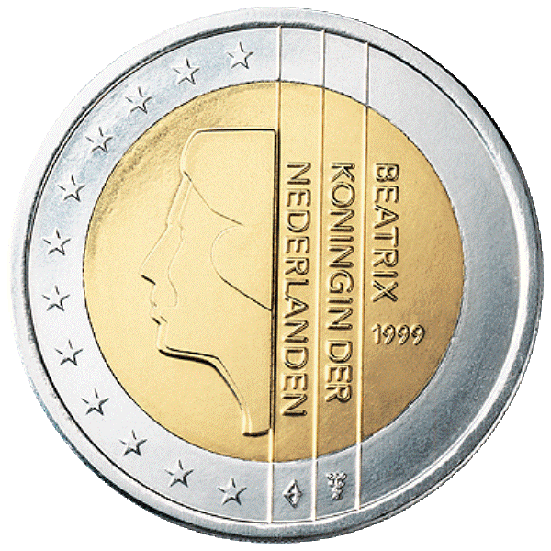 Rice. 1
 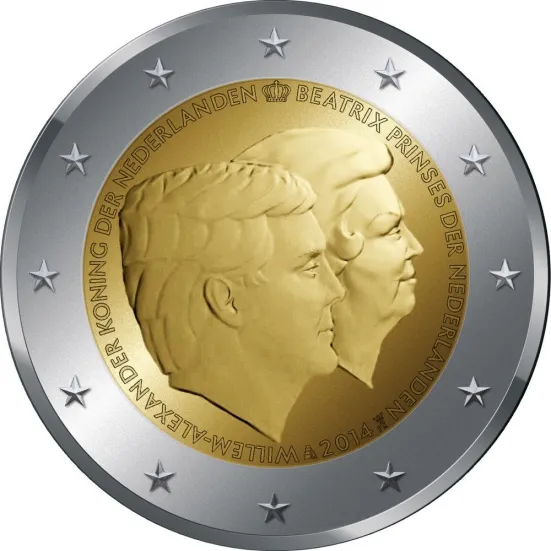 Rice. 2
Greece
On the coins of Greece, the face value is indicated not by Latin, but in Greek letters, and not in the cents, but in the petals (“Mulia” - the plural from “Lepton” - literally “without peel”, that is, thin, small). In ancient Greece, petals were called the smallest bronze coins, hence the saying to “contribute to”, that is, to take a feasible participation (the same root and in the word “Leptons”-the lightest elementary particles-electron, Muon, Tau-Reton, neutrino). Small copper coins, introduced in Greece in 1828 after gaining independence from Turkey, were also called studs. The design of coins (author - sculptor Georgios Stamatopolos) was chosen by a special state commission from many options submitted to the competition. Another feature of Greek coins is that Greece did not immediately fulfill the conditions for joining the European currency union, and therefore began to mint the coins much later than others. In order to timely provide the country with the necessary amount of exchange coin, I had to seek help from Spain, France and Finland. As a result, on some Greek coins, minted abroad, on one of the 12 stars you can see (better with a magnifying glass) a small stigma of the manufacturer: E denotes Spain, F-France, and S (SUOMI)-Finland. Such coins can become a decoration of any collection. This is what is depicted on them.
- 2 euros - scene of the abduction of Europe with Zeus in the image of a bull (Fig. 3). The original mosaic image (III century) is located in Sparta. Near the image-the inscription in Greek "Europe"
- 1 euro - an image of an owl (Fig. 4). This is a copy from the ancient Athenian coin - tetradrachma (V century BC).
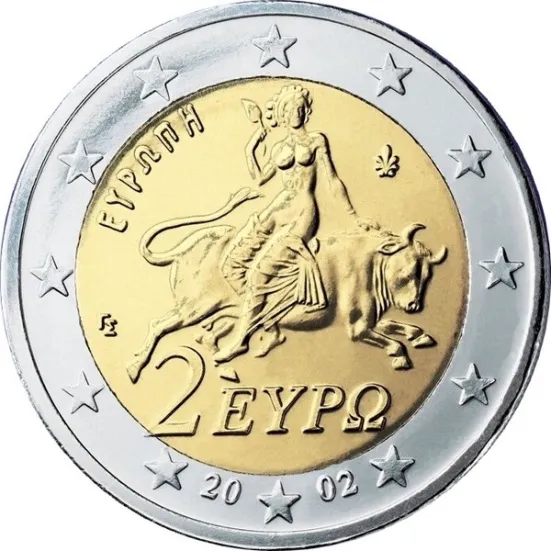 Rice. 3
 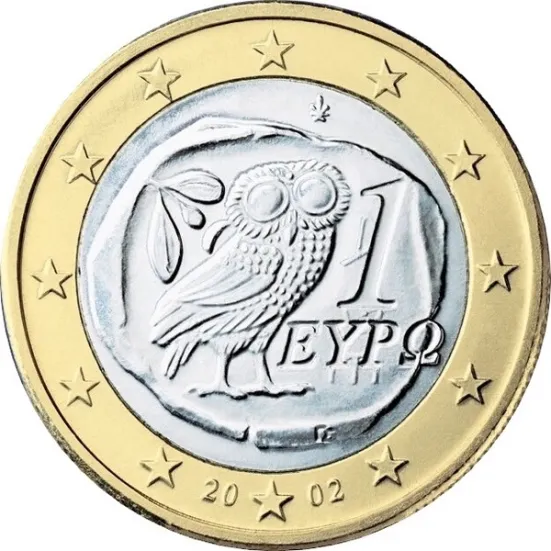 Rice. 4
- 50 cents - a portrait of the elevaselos elementeria (1864–1936), one of the most outstanding politicians of Greece (Fig. 5). The famous diplomat, initiator of social reforms, he played a key role in the modernization of the Greek state and the liberation of Northern Greece and islands in the Aegean; Five times headed the government.
- 20 cents - a portrait of John Kapodistria (1776–1831), a famous Greek and European politician and diplomat (Fig. 6). In 1809, he switched to the Russian diplomatic service, and after the end of the war for the independence of Greece (1821–1827) was elected its first president.
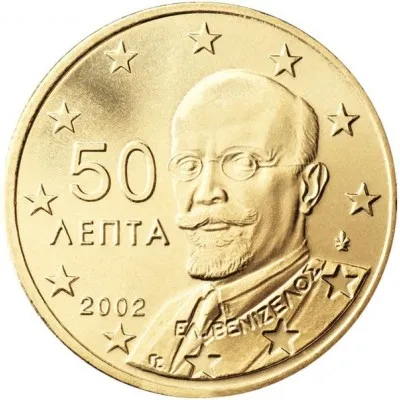 Rice. 5
 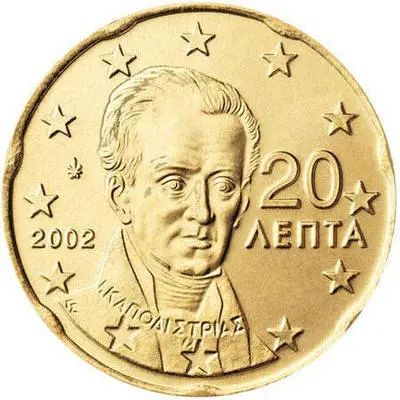 Rice. 6
- 10 cents - a portrait of Rigas Fereos (1757–1798), Greek poet and patriot (Fig. 7). Rigas Fereos is a prominent figure in Greek education, dreaming of the liberation of the Balkans from Ottoman rule. He hoped to enlist the support of Napoleon, but was captured in Trieste by the Austrian authorities, issued by the Turkish governor in Belgrade and executed.
- 5 cents-a modern marine giant tanker symbolizing innovative trends in the Greek Trade Fleet (Fig. 8).
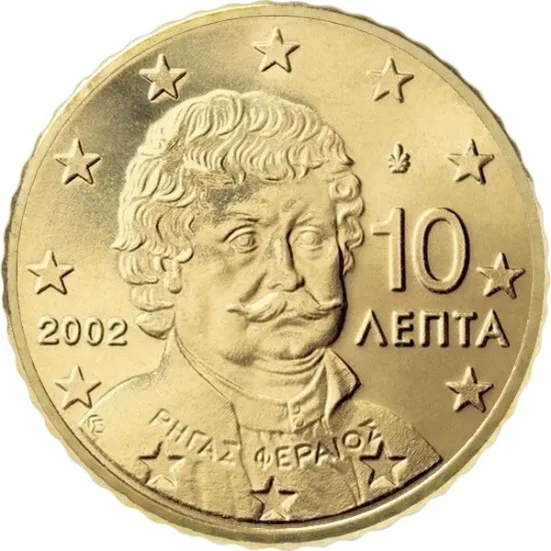 Rice. 7
 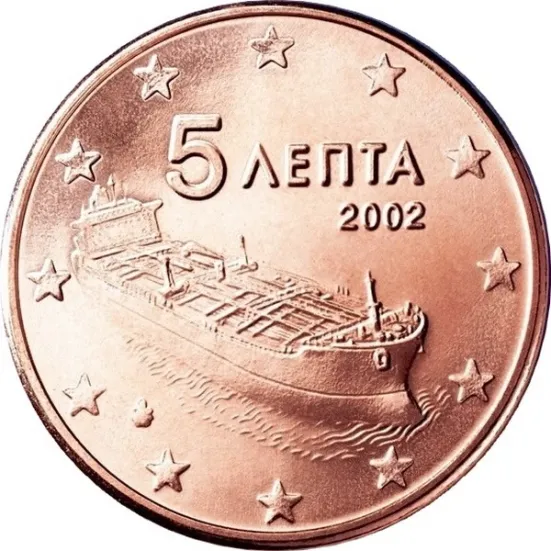 Rice. 8
- 2 cents-a corvette, a three-masted sailing warship with 20-30 guns (Fig. 9). Such ships took part in the war of Greece for independence (1821–1827).
- 1 Center - Athenian triremes, a rowing vessel with three rows of merry, which from the 7th to the 4th century BC. e. It was considered the largest warship in the world and dominated the Mediterranean (Fig. 10).
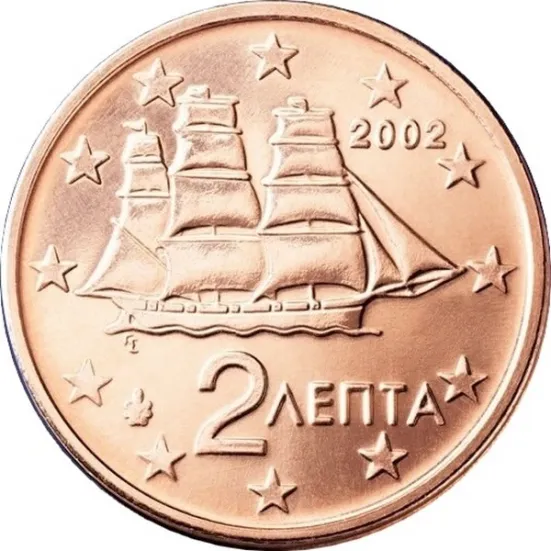 Rice. 9
 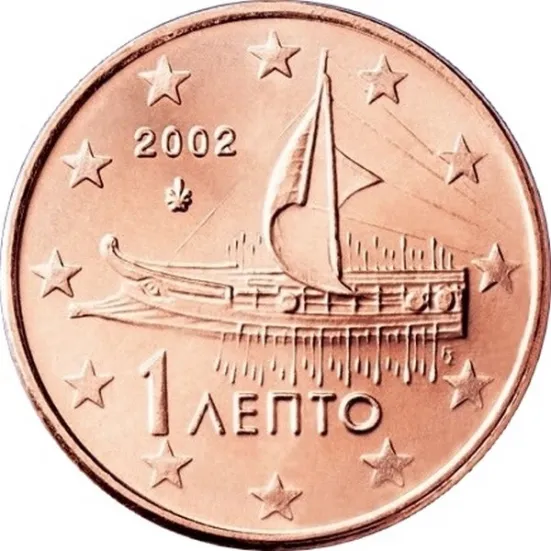 Rice. 10
Ireland
By the decision of the Irish government, all coins of this country have the same traditional national symbolism, Celtic harp (Fig. 11). The Avers also has the name of the country - Eire - in the Irish - one of the Celtic languages.

Spain
1 and 2 euros - since the introduction of the euro on these coins, there has been a portrait of the Spanish king Juan Carlos I de Bourbon (Fig. 12). He was born in 1938, and became the king in 1975, two days after the death of the dictator Franco. June 19, 2014, after the renunciation of Juan Carlos I, his son Philip VI entered the throne; Accordingly, the design of coins has changed (Fig. 13). On the coins of 2014 - the profiles of the new and the former king.
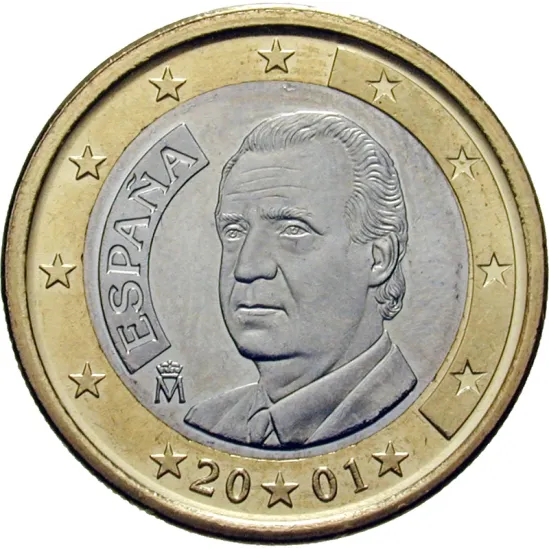 Rice. 12
 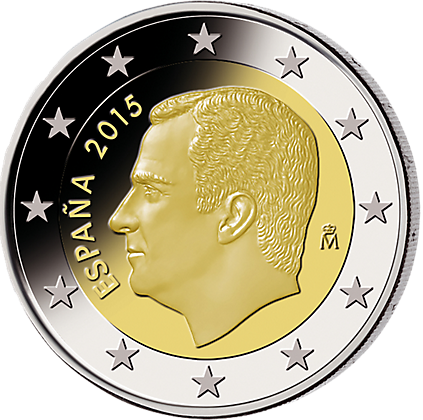 Rice. 13
10, 20 and 50 cents - a portrait of the classic of Spanish literature Miguel Cervantes (Fig. 14). The Spaniards believe that Cervantes's work symbolizes the "universality of man and his labors."
1, 2 and 5 cents-the monumental facade of the Cathedral in Santiago de Compostel, pearls of Spanish architecture (Fig. 15). Santiago-de-composts-the main city of the former Spanish kingdom of Galicia, in 1985 it was declared UNESCO as a monument of culture of world significance. The cathedral is one of the most famous places of religious pilgrimage around the world. He was erected in honor of the Holy Apostle Jacob (in Spanish sounds like “Sant Iago”), a cartridge of Spain, whose body, according to legend, was moved and buried in this city in 829. The cathedral was built in 1078–1211, was rebuilt in the XVII - XVIII centuries, the towers were erected in 1675-1680. The Baroque facade of Okadero (by the name of the square on which it reaches) was built in 1738-1750 by the architect Fernando Casas-I-Novoa.
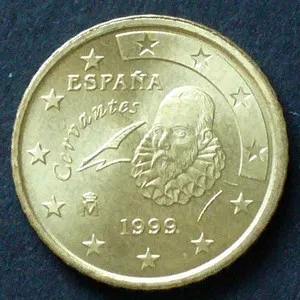 Rice. 14
 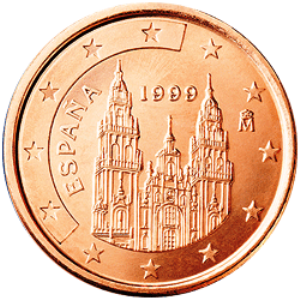 Rice. 15
 Ilya Lenson,
cand. chem. sciences, associate professor of the Higher Chemical College of RAS