
Translated material
The intimacy of the past
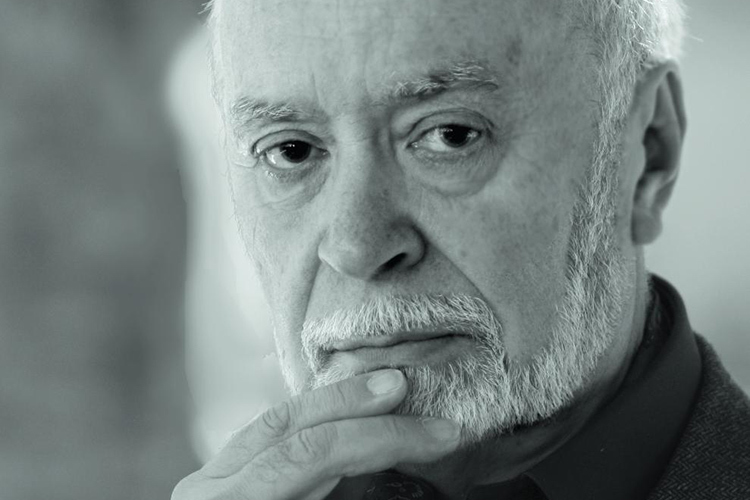
As Mikhail German himself wrote shortly before his death, his memoirs are his main book. Such a statement, at first glance, may seem strange if we take into account the fame of the author and many books issued by him, but “Memories of the 20th century” - the least of all memoirs in the usual sense, they have quite little about the “external” side of life - it is only present in them as much as necessary, to explain the hero’s movement in time. In the main thing, this is a book of impressions and reflections, and first of all-a book of memory, that is, the narrative is not about the past, but about how the former is remembered and memorable.
Probably, with each similar text, the story is similar-Mikhail German wrote his notes from the mid-1970s, starting to collect them, not yet very intentionally, on top of the left diary and along with sketches to books in the Black folder. That is exactly what the corresponding chapter is entitled-about the period in life, about how already a certain text about the past begins to grow together, the collection of the past: firstly, slipping away-and the memory is a way to prevent him from leaving completely, moreover, to return: after all, recalling and fixing, you suddenly restore it, which seemed completely forgotten for yourself. And secondly, on the contrary, that is more significant than the present or, in any case, no less real: memory is also a way to collect yourself, experience timelessness. Personal or general - it is not important, because, regardless of how many people experience the present in this way, for you this experience remains not just true, but at the same time the reality from which you act: timelessness is “stopped time”, something that is not a direction, that is, meaningfulness, is a pure course of time that you fix biologically: you are old, something is happening with you, others die, others die, others, others die, others. Formers of the elders, suddenly are near you by age, since that age distance that separated earlier has ceased to be significant. And in this empty flow flow, the past becomes a dwelling of meanings - not for the future, but in relation to the present; The latter in this case turns out “what the past” became, what has grown out of it.
In this book there is also an enchanting freedom from “too high opinion” about their official classes: according to the author himself, it is more convenient to despise rewards when you have them, to despise the titles - when you possess them, otherwise it is already difficult to see where the Lafontaine fox says in you. And the possession and recognition by external - first of all, is a way to protect yourself and what really matters to you: the significant outside will never coincide with your own assessment, except by chance, but even if it is happened, it is better not to enter the details - after all, it will almost inevitably find out that here the understanding of the appreciated is completely different, the coincidence seemed.
 © ABC-Atticus, 2018
A wonderful art critic, Herman repeats over and over again for various occasions, in relation to himself or appreciated by them the authors, one praise and one goal - "fall into a word into the image." Hence the assessment of their own texts with neglect of the early. In them, he sought to write “correctly”, correlating not with what he sees and worries, not with his own experience, but with how others wrote, and these books turned out to be “strangers”, including because they were written “good” (in the sense of “correct”), that is, they were necessary “student”, a school that needed to be held to write as you perceive, because it would be much more complicated because at least because it was already because at least because it was already because of it. that you don’t only need to choose the words yourself, find the rhythm corresponding to your experience, but this should also be intelligible for others - for everyone, of course, it is impossible to write, but at least get out of the circle of dividing the same personal memories and associations, be able to oppose the individual for others - so that they can make the path to the individual textbook “Madeline”, which is the very long time It also turned into a universal, far from Pristovsky, so an educated reader, when meeting with a text with a text, has to discover the specificity of the image for himself.
In Herman’s story there is nothing heroic or exalted about himself: the author is not so harsh - no, he understands himself, accepts as given and free from the desire to appear better than he is, what he frees him from the trial of others: after all, he recalls, not wanting to narrate in detail about the last decades, where he threatens the transition either to journalism, or in the essay of the modernity, “to the phrase of Blok Blok” Unfortunately, the habit of judging in the end repulses the hunt to explain. ” From modernity it is impossible to move in the text about yourself so as to start explaining exactly - it remains either to cross yourself or go to the court, but in this case the text ceases to be a story about time and is only a certificate of it. The explanation for Herman is an analytics of his past, the experience of events from which - both from events and from the experience - is remote enough to decompose them like a color in the picture in order to re -collect in a single perception of the viewer. And in this analytics it is precisely the free from pathos by Herman that is so valuable - in the ability to convey to the reader and a sense of Soviet fear, so easily subsided, sticky and all -seeing - in the fact that any situation can turn into them. But the main thing is in the transmission of the images of Soviet humiliation, constant dependence, on which the “simple worker” turned out to be much more freer than it seemed a much more prosperous person, since the well -being of the latter had no guarantees, it was hung in the air, which could not be forgotten. The humiliation of luck is on foreign trips, where exactly the “released” was supposed to remember his non -freedom every minute - the three of us, about the absence of comments “by behavior” by the observers, about poverty - and pursuit of things, the desire to save several coins, denying themselves in a coffee shop, since one could exchange a strictly indicated amount. The West turned out to be not even in its own shock, but in special, specially created conditions - it is so incredibly beautiful and free to appear, becoming affordable, different, simply becoming other countries where other people live or you yourself live. Combining diary records, photographs, his own, already completely different, experience, Herman recreates the perception of European capitals and provinces through the eyes of an enlightened, but completely wild Soviet tourist, each time perceiving everything as a “only” or “last” chance, not hoping for repetition, knowing that nothing depends on him - “released”, a miracle. In this experience, the “tourist trips” was exposed - inside it was dulled as inevitability, here she constantly reminded of herself in contrast to the world of people who are clearly free from this experience.
But the best chapters of the book are the memories of childhood and youth, from Leningrad, the 30s to the beginning of the 60s-those years when it was understood a lot, but there was a lot of perceived: after all, the ability to impress dull, squeezed out with experience-and German with sensitivity to household, everyday, to cars and lamps, routes of trams and radio shops and electric trains He restores his daily routine of those years through the details, through surprise by what was remembered in the imposition of a later knowledge of the “significant”, but not noted in memory. In one of the last chapters, he asks himself why he wrote so little about his mother - and here the reader is amazed: after all, the mother (which is not very much written about it was not very much) constantly present in all the previous text, was the only unchanged “others” against the background of flashing various characters, most of which German does not call the memoirist, who did not want to invade his memory, Who happened to cross with him, and appropriate them through a cathand nomination. This is a very careful book - others enter it as the memory and images of the narrator, not at all claiming to know them “as such”: the life of others is free from the author’s omniscience, and he can only tell about himself what he understood or remembered. About me - and about the mother, remembering her still young - and on the last trip to Riga. “Of course, my mother believed in me. But I believed that she was addicted. " Irony is the protection of the most expensive, the salvation of the weak and smart, who know that any force has its own limit.
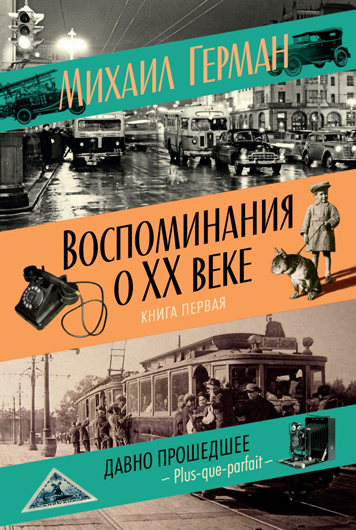
Mikhail German. Memories of the XX century. In 2 book. Book One. Long past: Plus-Que-Parfait. The second book. Inappropriate time: Imparfait. -St. Petersburg: ABC, ABC-Atticus, 2018. 560 p.: Ill. + 480 p.: Ill.