
Translated material
“We are building the“ TV of the future ”: how Yandex will turn“ Zen ”into a business for several billion dollars
As it became known to The Bell, the Yandex Board of Directors recognized the experiment with the Yandex.Zen recommendation service and decided to highlight it in a separate business area. Its general director will be Dmitry Ivanov, who had previously headed the Yandex Discovery direction (Dzen and another experimental product of the search engine - Yandex.Lner still developed within him. Victor Lamburt, who represented Zen to the general public a year ago, will become the executive director. They have a difficult task - to make the competitor Instagram, VKontakte and YouTube from the “Zen” of the competitor worth several billion dollars. About how this can be achieved and why Google is no longer a competitor to Yandex, Ivanov and Lamburt were told in an interview with The Bell.
New business "Yandex"
- You highlight Yandex.Zen into a separate company. Why is this done?
D.I.: It is more correct to say that Yandex allocates Zen into a separate business. This means that Yandex believed in the prospects of Zen as a business. Previously, we were one of the dozens of experimental areas of Yandex. Once upon a time, such experiments were, for example, “taxi” or “media services” (Yandex.Musika, Yandex.Fisha, KinoPoisk. -The Bell ). And now these are separate fast -growing businesses. Now Zen has long-term plans and specific business centers.
- That is, the financial indicators of Zen will appear in the general reporting of Yandex?
D.I.: In our reporting, nothing will change yet. We do not see the need for detailed disclosure of the financial information of Zen.

Dmitry Ivanov, photo of the company
- Yandex revenue in 2017 - 94 billion rubles. Yandex.Zen revenue, as I understand it, you estimate at 4 billion rubles. What is the size of the source of money for Yandex? What plan does the company have, what numbers do you focus on?
D.I.: I’ll clarify, 4 billion rubles are Run Rate, that is, extrapolation of revenue for May of this year for 12 months in advance.
VL: We expect that over the next five years, Zen will significantly grow - both in the audience and income. I will not name specific indicators, but I can give a comparison with China, where the platforms similar to ours are developing rapidly.
The main search in China is made by Baidu, its market capitalization is about $ 85 billion. The main Chinese Newsfid Toutiao is not yet bargaining on the exchange, only going to go there. Today it is estimated at $ 30 billion, that is, 40% of Baidu capitalization. At the same time, Baidu is not particularly growing, and Toutiao continues to grow.
In China, the Newsfid revolution began earlier, and we have some temporary handicap, but the scale of the business is about the same.
- That is, you focus on assessing Zen at $ 30 billion?
VL: The Russian market is less than Chinese. But this is definitely a business scale. Maybe a little less.
- What scale of the search is now?
VL: $ 11.4 billion costs the entire group of companies, which includes, for example, Yandex.Taxi and a little Uber. It also includes “media services”, “vertical” (classifids “Yandex.Nom -Writing”, “Yandex.Planstat”, “Yandex.Mans” and “Auto.ru”. - The Bell ), “Market”.
D.I.: We want to build a company that will cost several billion dollars. We have no doubt that the prospects of this market and our technologies allow you to do this.
- We noticed that the contracts had previously concluded with the Russian LLC, and now it is the Swiss Yandex Services.
D.I.: “Zen” represents the service in different countries, not only in Russia, and therefore we use our Swiss legal entity. But there is a Russian legal entity that is used for calculations with the authors of Zen.
“But why still a Swiss company?” As far as I understand, you have a "daughter" in Holland. Does Switzerland have any advantages over Holland?
D.I.: Well, these are some kind of nuances of financial and organizational, about which it is difficult for me to say something significant. This is not so important.
“You have headed before and maybe still head Yandex Discovery.” What will happen to this structure and its projects?
D.I.: The division within the Yandex company, which was called Discovery, was the same experiment that has now ended. Just recently, the Yandex Council decided that the experiment was recognized as successful. Discovery, as a missile carrier, played a role.
We had several experiments within this structure. The main was Zen. We also worked on the shell for the Yandex.Lucher Android Telphones. Now this part of the product has been separated, wait for the news from the team that Loncher did.
-That is, it will be another independent business direction?
D.I.: No comments for now. There will be some news, but the bottom line is that the company through experiments came up with a way to grow new products and businesses.
Competitor Instagram and YouTube
- Over the year, the Dzena daily audience has doubled - up to 13 million users. How many of them go to Zen consciously, and not just clicks on the headlines on the main Yandex ? How many people use a mobile application?
VL: To answer a question about consciousness, to be honest, it is quite difficult. It is not very clear how to technically divide people who unconsciously hide the tape or go to the browser, because they want to have been interested in spending time.
We do not disclose the exact distribution of the Dzen audience on the platforms. I can say that it is divided approximately in half - into mobile and desktop. Sometimes there are a little more mobile, sometimes desktop. It also depends on whether the working day of the week or the weekend.
- The main users of Yandex.Zen are users of Yandex.Browser?
VL.: Its share is noticeable. But not 90%.
- Some time ago you launched a partnership program with large sites with a stable audience, like RBC, RIA Novosti. The purpose of this program was to create a stable nucleus of readers from the Yandex.Zen service? Did you manage to do it?
VL: Yes, we are very pleased with this program, and the publishers who place the Zen widget are also satisfied.

Victor Lamburt, company photo
- Some refuse, I heard. RBC seems to have refused.
VL: We are in negotiations with colleagues. Here I, perhaps, will not comment.
- Before the meeting, I looked at the statistics at Simlar Web ...
VL.: Not the most accurate statistics ...
“You can’t argue, but she shows that your audience’s growth continues.” Due to what?
VL: Firstly, people get used to Zen. And Zen adjusts to them, he understands them better, people become better in people and they often turn to it. This is a natural process, it will continue for some time. Secondly, we are constantly working on the product, we improve ranking. Thirdly, new Dzen distribution channels are growing-for example, a mobile application.
D.I.: Usually in the product category of Social Media they say about Time Spent (the time that the user spends in the service. - The Bell ). We have Time Spent in Zen - for more than 20 minutes. But if you take users of mobile applications as the most advanced audience, then there we see 35 minutes there.
This is, firstly, that Time Spent Zen is comparable to social networks, where also about 30-40 minutes (Facebook-42 minutes , Instagram-26 minutes).
Secondly, we have great growth opportunities: if some part of the audience has been using the service for 35 minutes, and some 20 minutes, then you can grow in half. You can grow further. If we look at Toutiao - the Chinese service, which we conventionally call the “Chinese Zen”, we will see him Time Spent 70 minutes a day.
- Unlike Tim Cook, do you believe in algorithms in the news?
D.I.: Yes, of course.
- So Cook is mistaken?
VL: Mistakes. Especially his phrase is beautiful ( the smartphone takes out ): “We at Apple believe that the main news should be selected by people in order to be confident in the non -ango of news and sources.” It's more complicated. People by definition are biased. At the same time, we have no illusions that robots will replace people.
D.I.: We believe in the man-machine complex.
-From colleagues you often hear that Yandex.Zen is similar in concept to the main page invented in Rambler in the mid-2000s. And there are grounds for this. As far as I understand, Victor from Rambler came. Are these really similar products-Rambler of the 2000s and Yandex.Zen in the mid-2010s?
VL: If we talk about the very idea of personalizing content, then it was still promoted by Yahoo !!!! In this sense, probably, every successful idea has a lot of parents. If we talk meaningfully about the level of the product that we then made in Ramblera and now in Zen, then, of course, the difference is enormous.
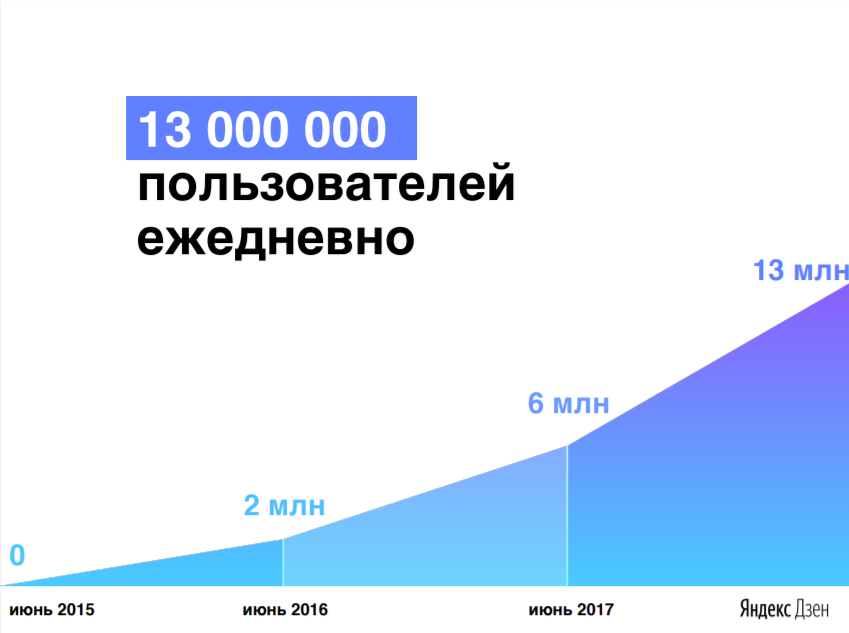
Statistics of the Yandex.Zen service. Data of the company
- What is the difference?
VL: "Zen" stands on the shoulders of the giant. We use a huge number of developments that are made to create a search for Yandex. These are algorithms and methodological approaches to how to work with big data, it is a technical, technological infrastructure, this is a school analysis that prepares personnel. I can compare, and the difference is very strong.
D.I.: The difference is not only in technology, but also in how we see the development of the product in the future. Every time I discuss Zen with someone not from our team, I feel difficult feelings. After all, I already imagine a wonderful picture of the future, and people from the outside see a today's, very imperfect product. We waved to something very large, we build a kind of “TV of the future”. It is based on artificial intelligence technologies, which will very soon fully determine media consumption. Even the television broadcasting stream in a home TV in 10-20 years will work on the same algorithms that we are now developing at Zen. It will be a mix of those formats that we already see in the Social Media-video, TV broadcasting, text, pictures. There will be personalized Newsfid, which will accompany us everywhere on different devices - primarily on smartphones.
If we talk about business reference to Yandex, then Zen is an opportunity to increase the mobile audience and enter the Social Media market. The market that has traditionally been a stranger to Yandex. This is the territory of VKontakte, Instagram, Facebook and others. And we began work in this territory.
Google is no longer a competitor
- Do you want to use Zen to fight Google, which has Android and which with it greatly crowns the Yandex position even in Runet?
DI. : No. This is an outdated concept - to perceive Yandex only as a search and talk about the search share and the confrontation with Google. Yandex has not been the first year - this is a group of companies, a set of different businesses. Including very large ones, such as Yandex.Taxi, for example, which has nothing to do with the search and does not compete with Google at all.
Zen competes with Instagram, with VKontakte. With Google-only to a very small extent, since Google, a year after us, inserted something similar to Zen into his browser.
- I just wanted to ask how your service is different from the Google Chrome Articles for You?
D.I.: Google launched a web content aggregation. In fact, this is personalized news built into the browser.
We did much more. We opened a platform for authors, media and brands, we rely on the development of this platform, we develop tools for creating content, create new formats, we invest in it in series.
Recently announced new formats, including posts. Now in Zen you can place a short text, text with a picture, a picture. Then you can post a short video directly from the phone.
VL.: Until now, all materials in Zen demanded a click. At the same time, people do not click on Instagram, people do not click on Telegram (unless some kind of interested link comes across). This is a very important format that was not on our platform before.
-Will there be any restrictions on the number of signs at the post?
D.I ..: 200 characters are the restriction that we have yet introduced. Let's see how it will work.
-That is, something like Twitter turns out?
D.I.: Yes. Then we will make tools for monetizing publications in different formats.
“They seemed to be present before?”
D.I.: Now we are monetizing articles and narratives. As for Google, while he is not building a full cycle media platform. It does not compete seriously with the same Instagram and Facebook. And, in my opinion, this is a serious omission.
- They tried, they just didn’t succeed. But Google+ is still alive.
D.I.: Google+ was created in another paradigm - "Let us make another social network." It was the wrong statement of the question. Nobody needs another social network. And so Google+ failed.
We do not make another social network from Zen. We are building a social media platform. And the further, the more social. In particular, on Friday, we opened comments for users to all the content that is published in Zen. Now the authors can communicate with the audience.
Together with the launch of posts on the platform, a completely different life may begin. For example, the author can ask a short question for the audience, and get answers in the form of comments. This is not at all the same as writing Longrid, the article is what we started.
VL: If you return to Google, then Zen will rather compete with YouTube, and not with Articles for You.
- A genre narrowness is not embarrassed? You have three genres: article, narrative, video, but if you take the average media, we will see that it gives the reader a much more diverse content.
D.I.: Embarrassing. Formats are one of the areas of our work. Now we are launching posts - something without which you cannot survive in 2018. Then there will be many new formats that are necessary to communicate with the audience. For example, tests and questions-fasteners.
- If you compare you and the social networks with which you want to compete during the users, now your strong competitive advantage is only innovative monetization. But will this be enough in order to really overcome competitors and translate the audience from Instagram, Facebook, VKontakte?
VL: Sociality is both a strong side of social networks and weak. Although social networks also use different artificial intelligence algorithms, they are still forced to show you photos of your friends from vacation, even if it is not interesting to you. Because otherwise you do not play them. And if you do not like, then friends will stop posting to the social network sooner or later.
- Mark Zuckerberg has a different explanation. He says that social networks show this so that a person does not feel lonely.
D.I.: Mark Zuckerberg over the past couple of years gave a lot of public explanations due to severe pressure on Facebook, we must keep this in mind.
VL: Social networks have a problem associated with a decrease in the activity of their audience in terms of creating content. And so they twist the tape a little in the other direction. It is important that your friend receives a certain number of likes, because the social network has social obligations to its audience.
Zen is free in this sense. The main task, the mission of Zen - to help people be interested in spending time and doing it so that they do not spare about it. And in this sense, we are not at all obligated to show someone the author’s uninteresting content only so that this author will receive as much coverage as usual.
If he creates good content, and he has everything good with karma, then he will receive some additional bonus shows or something else. And in this sense, we see a significant opportunity to make a tape for the user more interesting. And Time Spent's numbers say that this is more than real.
- Only money is ridiculous from advertising in Zen, I can tell you from the experience of The Bell ...
D.I.: The existing “Zena” economy is based on automated advertising and can only feed the information fast food. When I say fast food, please understand me correctly. There is no negative in my words. Fastfood is also good. People read such content, so the authors create it.
But The Bell is not the most skillful maker of information fast food. You seem to be strong in a different genre. And you earn, respectively, not enough. And other guys earn wow how many-dozens and hundreds of thousands of rubles a month.
The same economy is the basis of traditional media production on the Internet. And in a sense she is vicious. It to a large extent orientates the media not on quality, but on quantity, forces contrast manufacturers to chase shows.
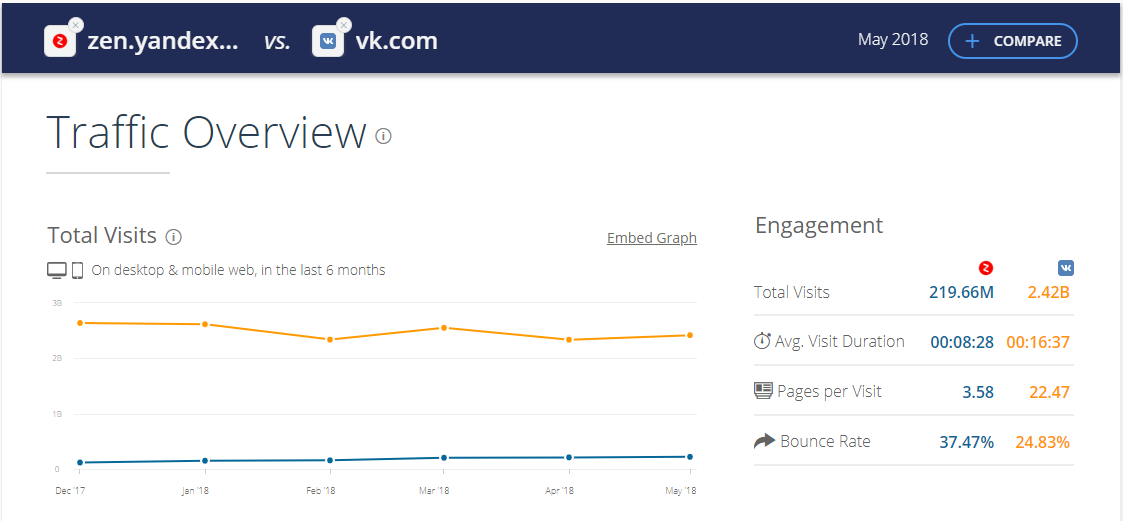
Comparison of the audience of sites zen.yandex.ru and vk.com. SimilarWeb data
VL: It so happened that the creators of content of different quality have the same monetization tools. You know, there is a saying that God created people large and small, weak and strong, and Colonel Colt equalized everyone.
D.I.: And this is unfair. Therefore, we see a great future in native advertising. We believe that native advertising is a real alternative for a media business that focuses on quality and builds its brand on reputation. This is just a story about you, it seems to me.
We think that in the coming years there will be a lot of tools, technologies and practices in the field of native advertising. We largely see “Zen” as a platform for native advertising and we want to be among the leaders in this market.
There is also an interesting aspect of this topic: content marketing. The point is that everyone is becoming media today. Brands are also media: they create channels in social networks, in Zen. Фактически, происходит полное смешение всего со всем: вчерашние медиа становятся продюсерскими центрами, блогерскими агентствами, а блогерские агентства берут на себя некоторые функции медиа. И все они взаимодействуют с рекламодателями: либо размещают нативную рекламу этих брендов, либо создают контент для каналов на разных платформах.
Платформы в свою очередь предоставляют все больше и больше инструментов для всех этих участников рынка – для агентств, медиа, блогеров. И конкурируют друг с другом, предлагая новые инструменты, программы поощрения, спонсорство и так далее.
На что «Яндекс» потратил $1 млн
– Год назад, когда запускали «Яндекс.Дзен», вы обещали потратить миллион долларов на авторов. Вы его потратили? Помог ли он вам вырастить внутри «Дзена» какое-то количество авторов, для которых платформа стал ключевой площадкой? Какова сейчас доля публикаций, которые находятся внутри этой системы, в общей доле трафика?
Д.И.: Мы последовательно развиваем платформу. В первую очередь, с точки зрения того, что авторы и медиа, которые публикуют статьи, нарративы, видео, теперь еще и посты в «Дзене», получают все больший и больший охват. При этом стоит оговориться, что «Дзен» в целом продолжает расти, поэтому те медиа, которые заинтересованы в направлении пользователей на свои сайты, по-прежнему получают аудиторию.
Миллион мы дотрачиваем. И это позволило нам вырастить новые имена и привлечь внимание авторов к новой платформе. В результате в том числе спонсирования авторов мы поняли очень важную вещь. Для того, чтобы на платформе росли таланты (а именно это – наша стратегическая цель), нужно, чтобы вокруг нее создавалась целая экосистема. Чтобы возникал рынок и приносил деньги.
То есть надо, чтобы появлялись рекламодатели, заинтересованные в продвижении у авторов «Дзена», чтобы возникали агентства, которым было бы выгодно вести посреднический бизнес. Возникали бы блогерские агентства, которые бы растили таланты, вкладывались в имена, а потом продавали рекламу у своих авторов.
Поэтому в этом году мы меняем акценты в спонсорской программе и будем направлять деньги в первую очередь на рост этой экосистемы. На рост всех тех игроков рынка, которые нужны, чтобы возникла естественная рыночная активность вокруг платформы.
– То есть платформа должна не только поставлять инвентарь для «Яндекс.Директа», но и генерить дополнительный денежный поток для «Яндекса»?
В.Л.: Я бы немножко иначе сказал. Главная задача платформы – это, конечно, не быть еще одной площадкой «Яндекс.Директа». Главная задача – расширить ассортимент интересного контента для читателей. Сегодня «Директ» для нас – это инструмент вознаграждения авторов. Инструмент несовершенный. Его недостаточно, чтобы растить новые медиа.
Д.И.: В ближайшие годы будут созданы тысячи, десятки тысяч новых медиа. Не только в «Дзене», но и в Instagram, в Telegram, на YouTube. Бренды становятся медиа. Это большое такое бурление. Этот рынок основан в большой степени на репутационно-имиджевой экономике, на нативной рекламе. Мы хотим направить наши деньги на то, чтобы стимулировать этот рынок.
В Китае, например, есть так называемые MCN'ы – Multi Channel Networks. Это продюсерские центры, блогерские агентства, которые создают новые медиа и дальше монетизируют их, продают нативную рекламу. Это огромный рынок – миллиардные доходы, бешеные темпы роста.
Все это нас тоже ждет. И мы заинтересованы в том, чтобы в России это направление развивалось. Тогда и «Дзен» свою долю на этом рынке будет иметь.
– Вы не ответили на вопрос, какова доля контента, создаваемого внутри «Дзена», в общем трафике?
Д.И.: Очень большая уже. Многие десятки процентов.
– Но не половина?
Д.И.: Пока еще не половина.
Как «Дзен» перевернул рынок СМИ
– Ваша концепция оказалась крайне уязвима для fake news или новостей, которые сложно отнести к журналистике факта. Некоторое время назад, если верить статистике Liveinternet, вы отдавали значительную часть трафика ресурсам, вроде «Царьград» или РИА ФАН. Сейчас ситуация немного изменилась, но по-прежнему доля одного из этих каналов велика в вашей трафикогенерации. Как вы планируете с этим бороться, если вообще планируете?
Д.И.: Давайте разберемся, что такое fake news. Во-первых, начнем с того, откуда за последнее время пошло широкое обсуждение этой темы. С Facebook и выборов в Америке.
Я хочу напомнить, каким образом распространялись fake news в Facebook. Статьи создавались на неизвестных сайтах, мимикрировавших под медиа. Этими статьями дальше массово делились пользователи Facebook. То есть система была хакнута через механизм шеринга, он был использован для того, чтобы люди делились сенсационными фейками.
– Под фейками ставят больше лайков, их чаще сохраняют и прочее.
Д.И.: Совершенно верно. Здесь очень важна социальная механика соцсетей. И я хочу обратить внимание на то, что «Дзен» в этом смысле сильно отличается от соцсетей: в «Дзене» нет друзей и нет этого механизма «делиться с друзьями». То есть, буквально, то, что стало бичом в распространении fake news – к «Дзену» неприменимо. Я не хочу сказать, что у нас этой проблемы нет. Просто она другая.
В «Дзене» есть разные медиа. Мы в нашем разговоре уже много говорили о том, что не делаем разницы между разными традиционными медиа, блогерами, брендами, – для нас они все едины.
Мы исходим из того, что если речь идет об известном, признанном медиа, то фейк – это его ответственность. Мы же должны сделать так, чтобы у никому неизвестного Васи Пупкина не было возможности массово распространить фейк. И мы в этом направлении успешно работаем. Система ранжирования в «Дзене» так устроена, что этот фейк не будет показан большой аудитории. А если это большое медиа, то, повторю, это его ответственность.
В.Л.: Объясню, как это работает. Итак, есть Вася Пупкин, он все время писал про природу и искусство, и тут с ним что-то случилось и он публикует фейк.
Алгоритмы далеко не всегда могут отличить фейк от не фейка. Нам здесь, к счастью, помогают наши 13 миллионов пользователей. Потому что есть все-таки возможность пожаловаться на фейк. Если у публикации значимый охват, то среди ее читателей найдется некоторое количество неравнодушных людей, которые пожалуются. Мы эти жалобы внимательно разбираем, и в случае, если явно видно, что это фейк (например, нет никаких отсылок к источнику), то у этой публикации будет ограничен охват.
Д.И.: В общем все медиаплатформы делают приблизительно одно и тоже. Поскольку полностью исключить фейки невозможно (тот, кто говорит обратное, просто мало об этом думал), то задача и ответственность каждой платформы в том, чтобы как можно быстрее останавливать распространение фейков среди аудитории.
– Давайте я объясню, к каким последствиям приводит работа алгоритмов, которые вы описали. Есть медиарынок с устоявшимся числом игроков, у которых есть какие-то доли. Все привыкли к тому, что есть РБК – очень крупный игрок, есть «Комсомольская правда», РИА Новости – очень крупные игроки. Потом приходит «Яндекс» со своими возможностями и за счет того, что вы не отделяете СМИ друг от друга, в некоторые дни вы переворачиваете рынок с ног на голову. Среди лидеров оказывается, например, «Царьград». То есть лидером оказывается маленькое нишевое СМИ, к качеству продукта которого могут быть вопросы у участников рынка. С другой стороны, у реально крупных СМИ есть обязательства перед рекламодателями, которые привыкли воспринимать эти издания как лидеров рынка. Ваши алгоритмы переворачивают с ног на голову и рекламный рынок.
В.Л.: Есть один аспект, который сравнительно легко учесть в алгоритмах – это фактор масштаба издания. Зимой мы объявили, что при ранжировании начинаем учитывать собственную аудиторию издания. Сейчас в целом довольны тем, как это работает.
Теперь, если человеку одинаково релевантны две публикации, то мы покажем публикацию более крупного издания. Вы привели в пример «Царьград». Так вот, его собственная аудитория не такая большая, и это теперь влияет на ранжирование в «Дзене». Но оговорюсь: это не означает, что ранжирование в «Дзене» будет полностью совпадать с тем, как распределяется трафик в интернете.
Во-первых, ни на одной из платформ такого нет. Во-вторых, «Дзен» задуман как пространство для роста: небольшое издание может получать из «Дзена» заметную аудиторию.
– Просто вы понимаете, что Daily Mail будет всегда опережать по аудитории газету Times?
В.Л.: Конечно.
– Вопрос в том, на кого «Дзен» хочет быть похожим, на газету Daily Mail или на Times?
В.Л.: «Дзен» хочет быть похож на аэропорт, который приветствует всех своих посетителей.
Д.И.: «Дзен» – универсальный продукт для любой аудитории. Но при этом мы очень хотим, чтобы контент у нас был качественный.
В.Л.: Есть люди, которые с одинаковым энтузиазмом читают и Times, и Daily Mail. Потому что и там, и там есть классные публикации на разные темы, и вообще медиапотребление людей достаточно широкое.
Но мы, конечно, хотим развивать качественные издания и авторов. Поэтому недавно мы придумали партнерскую программу. Мы планируем вместе с партнерами выработать некоторые каноны того, что можно считать качественным контентом. После того, как мы это сделаем, качественные материалы в «Дзене» начнут получать больший охват.
Определить низкокачественный контент сравнительно легко. А понять, что есть на самом деле качественный контент, уже сложно. Мы здесь хотим диалога с медиарынком, чтобы вместе выработать критерии качественного контента.
– А вы ведете переговоры с ключевыми игроками?
Д.И.: Да, переговоры идут. Надо признать, что у нас не все ровно складывалось за прошедшие месяцы. Мы очень быстро росли, какие-то детские болезни у нас были и мы постепенно их пытаемся преодолевать. Мы хотим предложить медиасообществу вместе с нами изучить публикации на разные темы и дать им оценку. У нас нет иллюзий, что это решит все проблемы. Но мы надеемся, что удастся поднять планку качества в целом, задать какие-то стандарты, в том числе для новых авторов «Дзена». Нам важно, чтобы опытные журналисты и блогеры показали им пример.
Вместе с тем мы понимаем, что это бесконечный диалог, что это будет снова и снова кругами продолжаться, но, мы к этому разговору готовы. Сейчас более готовы, чем были год назад.
– По мере того, как растет «Дзен», доля «Яндекс.Новостей» сокращается. А что будет с сервисом? Для него есть место в будущем?
Д.И.: Не знаю, почему вы решили, что доля сокращается. «Новости» прекрасно себя чувствуют. Это разные продукты, соответствующие разным потребностям человека.
«Новости» – это продукт, который призван отражать информационную повестку дня. По сути, это топ-5 на главной странице «Яндекса». Это про то, что происходит в стране и мире. Это совсем не похоже на то, что делается в «Дзене».
«Дзен» основан на персонализации. То есть в стране может идти чемпионат мира по футболу, а если я, например, не люблю футбол, то в моем «Дзене» может не быть ни слова об этом. «Новости» себе такого позволить не могут.
Можно отдельно поговорить о том, что «Новости» оказались в достаточно сложной ситуации с точки зрения законодательного регулирования. И есть ограничения. Но это, строго говоря, отношения к делу не имеет.
– Те сложности «Яндекс.Новостей», о которых вы говорили, связаны в том числе с интересом, который проявляют власти к этому сервису. На «Яндекс.Дзен» они уже обратили внимание?
Д.И.: «Дзен» – большой сервис, заметный. И про него говорят в разных местах, в том числе и в органах власти. Ничего в этом странного нет, это нормально. «Дзен» с точки зрения продуктовой категории может и должен сравниваться с social media. Власть интересуется тем, что происходит, например, во «ВКонтакте». Так же она может интересоваться тем, что происходит в «Дзене».
Если у любых представителей любых институтов возникают вопросы про то, как устроен «Дзен», или, например, про какие-то конкретные публикации, то мы всегда рассказываем. Мы абсолютно открыты, в диалоге со всеми: и с коммерческими структурами, и с государственными, и с авторами, и с медиа.
– Из-за переноса расследования Навального с их площадки на площадку «Яндекс.Дзена» были какие-то проблемы?
Д.И.: Мы действуем в правовом поле страны, в которой мы живем. Соответственно, мы работаем с юристами, которые на тот момент истолковали юридически ситуацию как то, что мы не должны были предпринимать никаких действий. Если бы это было юридически не так, мы бы, возможно, действовали как-то иначе.
– Вы говорили, что те алгоритмы, на основе которых строится сервис, универсальны, то есть могут масштабироваться, на их основе можно создавать сервисы и за пределами России. Насколько я понимаю, «Дзен» изначально пытался выйти и в другие страны, но, похоже, что большой аудитории там не нашел. Or am I wrong?
Д.И.: Вы правы. Мы очень быстро растем в России и стараемся поддержать этот рост. Соответственно, все наши силы мы направляем на тот рынок, где все растет.
В других странах все растет не так быстро, хотя аудитория «Дзена» за пределами России измеряется сотнями тысяч людей. Проблема в том, что пользователей в разных странах хоть и много, все они более-менее равномерно распределены по Земному шару. И это не позволяет нам сосредоточиться на конкретном рынке и совершить там прорыв.
Поэтому развитие за пределами России – это, скорее, возможность дальнейшего роста. И у нас есть идеи, как там расти. Но именно большой бизнес, уже приносящий существенные деньги, конечно, у нас складывается в России.
Владимир Моторин, при участии Дарьи Сережкиной