
Translated material
Euromonets: What are dedicated - 3
Continuation. For beginning , see the TRV-HOWN No. 256–257.
Italy
In Italy, design was treated as an important state affair. A special commission, which also included technical specialists, carefully examined the projects presented by the best Italian artists. The selected work was then provided by the country's largest television company to familiarize themselves with the public. For each coin, its own drawing was chosen. Italian coins are easily recognized by the inscription IR, i.e. Repubblica Italiana.
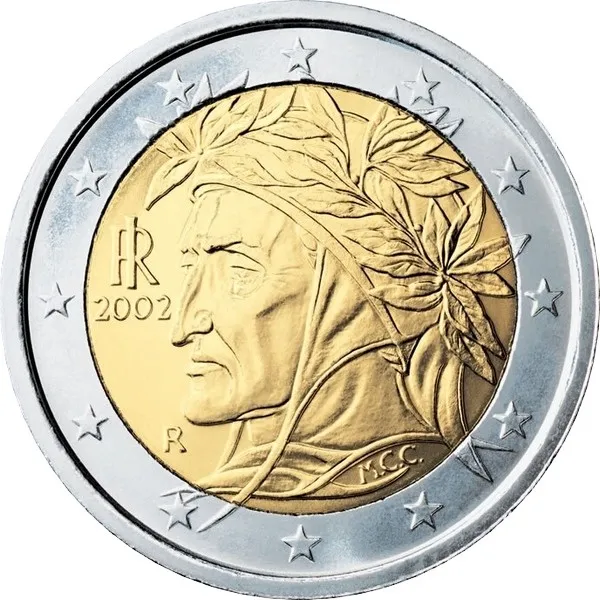 Rice. 1. Two euros - a portrait of Dante Aligieri, the work of Rafael, part of the frescoes of Dispi Pope Julia II of the Vatican Palace created between 1509 and 1510.
 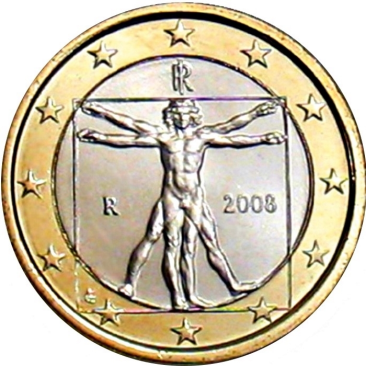 Rice. 2. One euro is the famous drawing of Leonardo da Vinci at the Academy Gallery in Venice. The drawing depicts the proportion of the human body
 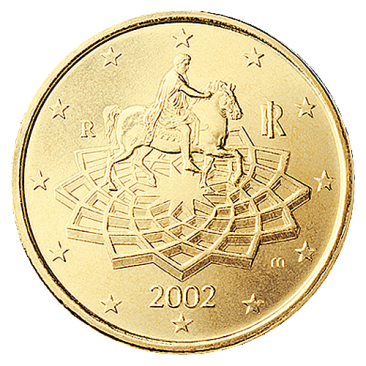 Rice. 3. Fifty cents - an ancient bronze gilded equestrian statue of the Roman emperor Mark Aurelius. The original is located in the building of the Capitol Museums in Rome, and a copy is installed in the center of the square on the Capitol Hill. A wonderful decorative game of the area designed by Michelangelo is also conveyed on the coin (on an enlarged scale)
 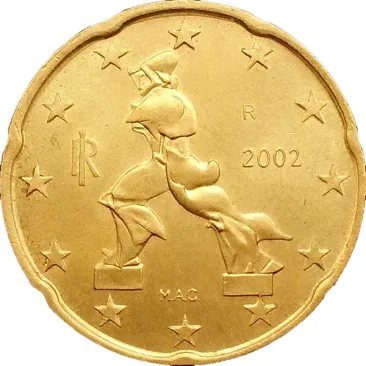 Rice. 4. Twenty cents - the sculpture of Umberto Bochchoni (1882–1916), the Italian painter and sculptor, the head and theorist of the Italian school of futurists. He conveyed the dynamism of the industrial era by the vortex -shaped movement of mutual overcoming shapes and planes. The bronze sculpture “Unique forms of duration in space” (1913, a gallery of contemporary art in Milan) depicts a figure that is rapidly walking, “dissolving” in the oncoming wind and personifying the spirit of the “storm and onslaught”, characteristic of the early vanguard. During the First World War, Bochchoni was drafted into the army and died, having received a fatal injury when falling from a horse; The era of futurism ended with his death
 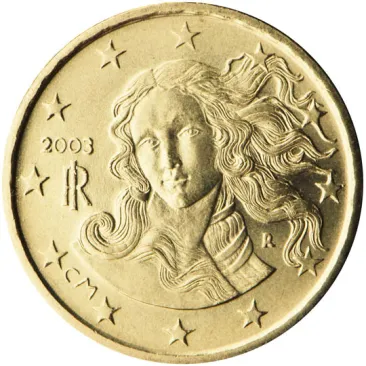 Rice. 5. Ten cents - a fragment of a picture of an outstanding Italian painter of the Renaissance of Sandro Botticelli The Birth of Venus. The picture is located in the Uffizi Gallery (Florence)
 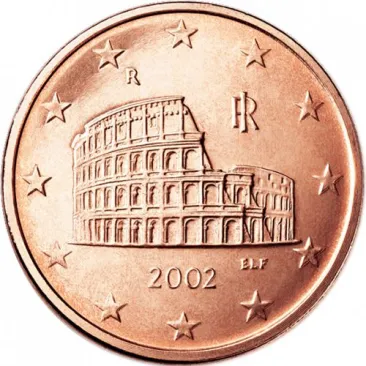 Rice. 6. Five cents - a flavoy amphitheater, better known as the Colosseum, a symbol of the greatness of Rome. The construction of the amphitheater was launched by Emperor Vespasian in 70–72 BC. e. and completed by Emperor Titus in 80. In Latin Colosseus - “huge”, “colossal”. The Coliseum was intended for the battles of gladiators and circus spectacles and could accommodate up to 50 thousand spectators. The ancient structure was largely destroyed in the XIV - XV centuries as a result of earthquakes, as well as the barbaric use of its stones for other buildings, including famous Italian palaces. From the Coliseum, in particular, all marble seats and decorative decoration disappeared
 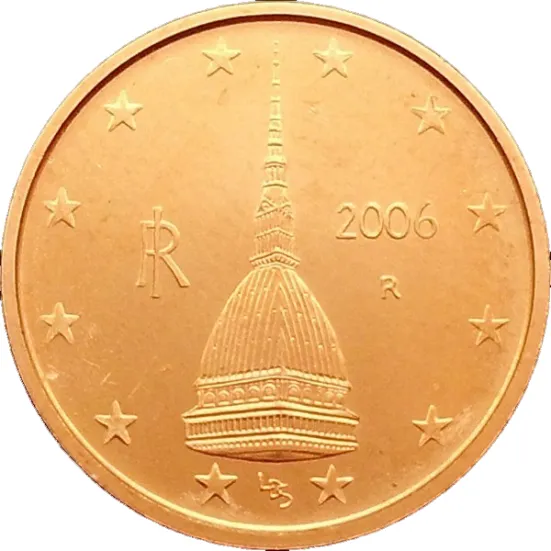 Rice. 7. Two cents - a dome with a spire of Antonellieva Gromada (Mole Antonelliana). This symbol of Turin until 2011 remained the highest design in Italy (167.5 m). The building was designed by the architect Alessandro Antonelli (1798–1888) in 1863 by order of the Jewish community as a city synagogue. In subsequent years, it was bought and completed by the municipality of Turin for the Rimerjimeno Museum, restored in 1961 after the tornado (now there is the National Museum of Cinematography)
 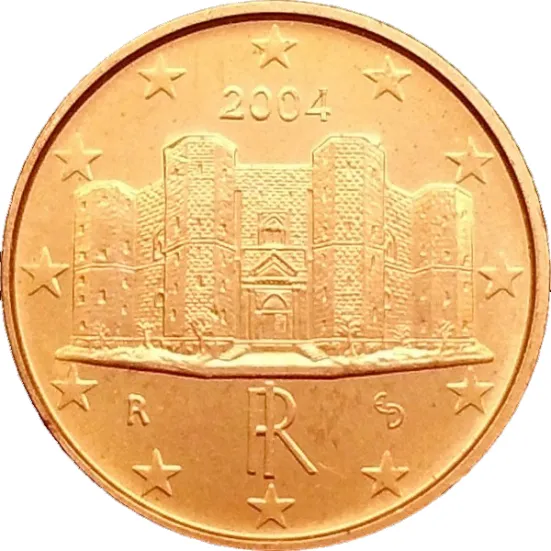 Rice. 8. One cent is a massive octagonal castle of Castel del Mont. The castle is located 17 km south of the city of Andria in southern Italy). Built in the Gothic style in 1240–1246 by the Emperor of the Holy Roman Empire Frederick II Hohenstaufen (1194–1250)
Luxembourg
On all coins of the main issues-a portrait of the Grand Duke Henri, or, in German, Henry (Fig. 9). On the coins, the name of the state of Lotzebuerg in the Luxembourg language is also the old dialect of the German language, enriched with many French words and expressions. It speaks only in Luxembourg, while newspapers in the Duchy are printed mainly in German, and official documents in French are printed.

Portugal
All standard Portuguese coins depict ancient seals and the inscription Portugal. There are one and two euros on the coins - the royal seal of 1144 (Fig. 10). Ten, twenty and fifty cents - the royal seal of 1142 (Fig. 11). One, two and five cents - the first royal seal of 1134 years of the first Portuguese king Afons I the Great (Fig. 12). In addition, in the upper part of the obverse of all coins, seven stylized images of ancient castles are visible, and in the lower part there are five stylized images of the Portuguese coat of arms (Fig. 13).
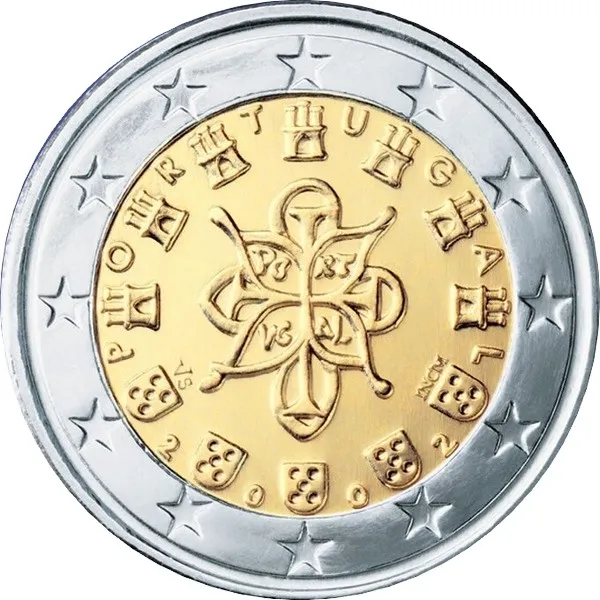 Rice. 10. Two euros
 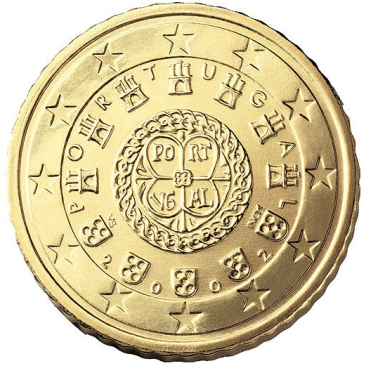 Rice. 11. Fifty cents
 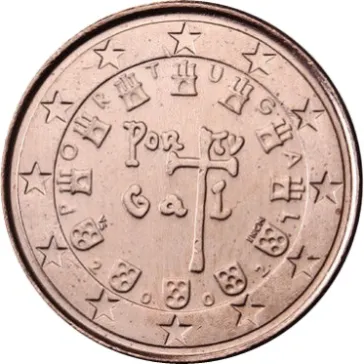 Rice. 12. Five cents
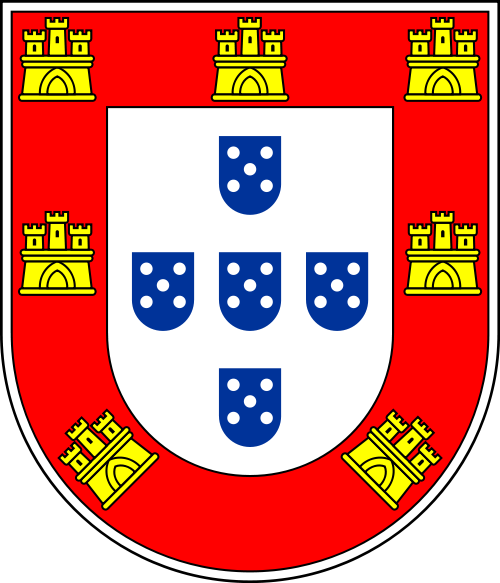 Rice. 13. Coat of arms of Portugal
 Ilya Lenson,
cand. chem. sciences, associate professor of the Higher Chemical College of RAS