
Translated material
"Now some good moment for the opera"
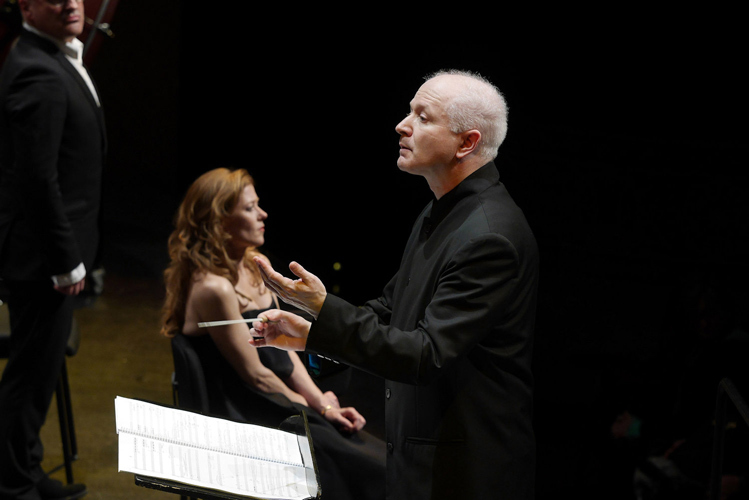
Thanks to last year's tour of cult opera products from ex-en-product “It is written on the skin” in the production of Katie Mitchell the glory of the author of music by George Benjamin also reached Moscow. The British author has just confirmed his almost impossible status of the “successful modern opera composer” by the new premiere: his “Lessons in Love and Violence”) took place in the London Royal Opera, and then moved to the Netherland National Opera , where Anton Flara spoke with George Benjamin.
- During a meeting with the audience before the premiere of “Loads of Love and Cruelty” in London, you said that the opera genre is now experiencing a wonderful time. What happened? Why, in your opinion, the opera has become more adequate to the modern public and the modern world?
-Yes, I don’t know ... It seems that she was adequate ... although the truth is: now there is some good moment for the opera. I don't know the audience. I only know that, fortunately, there is an audience. But I do what I can and what I want. And if there is an audience, then this is fine. But actually I have no guarantees. I only know that Martin (Martin Crimp, playwright.- Ed. ) And I work a lot, many, we are very self-critical and reflect on each of our things for a very long time. The last project is five years, and five years of incredible isolation for both of us.
- I will ask more specifically. You and Martin have already done three projects. What has changed in your work during this time? What has changed when creating “lessons of love and cruelty” compared to “written on the skin”?
- I began to work more tightly with Martin, we are discussing more. Of course, not music. But drama, the intentions of the characters, their feelings, psychology. The new is also the fact that in the “lessons” of the picture is much longer, sometimes up to 20 minutes (in “It is written on the skin” paintings for 4-8 minutes, very short). And in every picture there is its own character. This was the main compositional task for me: to maintain drama, to maintain dynamics and Saspens - and at the same time focus on a separate character. Show how it changes to the end of the picture. Create a separate world within these 20 minutes. Finished, but with a large amount of variability inside.
In the "written on the skin" the characters tell about themselves: "He said, she said." This is not in the new opera. In the “It says on the skin” there is a cold frame, external observation of the inner world, the angels look. In the "Lessons" we abandoned the framework, more and more naturalistic.
But if you return to your question and answer in general - I do not know. I didn’t think too much about “written on the skin” when I wrote a new thing. I sent all my energy to the world of the new opera and lost contact with the previous one. I try to change, try not to repeat success or duplicate something. There are many new techniques in "Lessons". For example, in the third picture - when two women sing music saturated with lemon balm, and a dramatic effect unfolds around them. I didn’t do this before, it was difficult to write. Or, for example, duets for baritones in the third and sixth paintings. This was a new task to write music for two low male voices, preserving their differences. This is not easy for any composer and any tradition. It seems that this is in “Don Carlos” with Verdi.
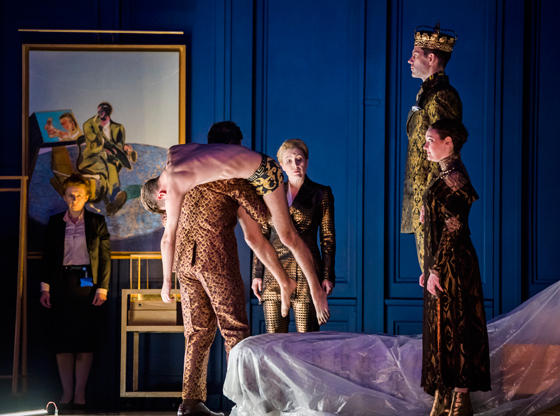 © Tristram Kenton
- In your new opera, the story is not so simple, but more literal, less symbolic. Is this a conscious choice?
- No, this is inaccurate. We refused the "framework". And this made a drama to some extent easier, there are no two dimensions that are constantly coexisting: inside, out, outside-offers. In the new story, nevertheless, a large number of metaphorical, even mystical. But dramatic yes, simpler.
- You invariably emphasize the determining influence of Martin on your opera. But now Katie Mitchell is also in your team. Do you work with it at the composition stage?
- In some ways. The main partner when creating the play is still Martin. I think we already had a plot and even, perhaps, Martin had already written the text of the libretto when Katie joined us. But, probably, this happened before I started composing music. However, her contribution is very important. Musical text is one hundred percent I, alone. But it was important for me to listen to Martin and Katie. And her scenographer Vika Mortimer. The final result - the performance - owes many to these people. Including musically. For example, the duration of interludes. I knew that there would be a serious change in the scenery: in the performance a room in which the whole action of the play is spinning - it seems that it is so simple, but it is incredibly difficult! 30 people are involved. A miracle how well they do it in London and here, in Amsterdam! And therefore I knew that I had to give them enough time for all this.
- That is, the idea of a spinning room arose at the very beginning of your work?
- Well, not in itself ... I don’t remember exactly ... But, probably, at least a couple of years before the performance.
Or casting. My singers are always selected before I start writing notes. They listen to them, as a rule, I, Martin and Katie. She evaluates the dramatic side, I am musical. For me, a limited vibrato, a good sense of rhythm, a beautiful sound are very important. Martin also has a great hearing, he is a good pianist, although he looks, first of all, at the theatrical qualities of the singer. We choose the three of them, all three should come to an agreement. In general, this is a real joint effort.
Well, take Trump and his story with refugees from Mexico.
- How much is a story in the opera, narrative?
- For me? Incredibly important. Necessary. I do not write opera-installations, static operas or ritual operas. This is not mine. What Martin gives me is an opportunity to tell history in a new way. This is the most important. Before meeting with him 15 years ago, I did not understand how to tell a story in the 21st century so that it would not be the history of the beginning of the 20th century. I do not understand how to compose an opera without history. At the end of the “Enufs”, “Katya”, “Boris”, “Pelleas” you are excited, because there was some kind of movement in a person, there is emotion and tragedy. And this requires a story.
- At the same time, for your projects you choose non -modern stories. Why? Moreover, these are stories with magical elements. Do you need a fairy tale?
- A little. Something from us distant often acquires a magical sound. But I also want to talk about something significant. About how to be a man. About the tragedy, fear, love, passion. Old stories have a great shadow, there can be more truth in them than in a story similar to a report, a story that is near us, when we recognize the names, are distracted by them. I think that if the story is distant, it can be examined deeper. It is easier to figure it out: who loved or did not like whom, who supported whom. There are more opportunities for interpretation. So could say Wagner. And even Mozart. But this does not mean that one day I will not begin to think otherwise.
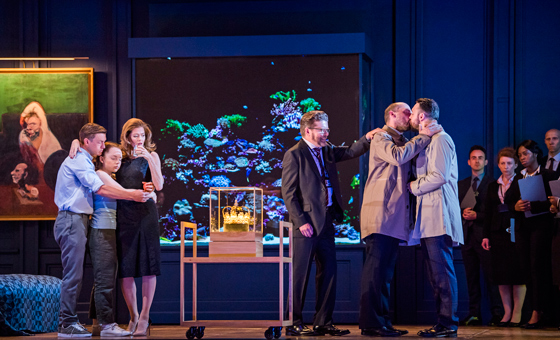 © Tristram Kenton
- And by the way, about the truth. Do you think that the concepts of love and politics-how do you show them in “lessons”-are still relevant? Indeed, today, politics is no longer concentrated in the figure of the king, it is rather in other instances - in the media, in social services. And all love is on the Internet.
- Well, take Trump and his story with refugees from Mexico. And Trump's wife went there and criticized her husband in the press, saying that these people are pity. Of course, all these concepts are relevant. People fall in love. And people want power so scary! I can understand this. Although this does not cause me sympathy. I have no desire to possess at least some power. But I admit that she provokes the most powerful desire, fears and the greatest tragedies.
-Do you attribute yourself to any opera or musical tradition?
- I don’t think about it at all, I do what I can and want. But I love the opera - “Votzka”, “Pelleas”, “Boris”. And the tradition does not care about me. I understand that someone like Wagner thought a lot about this. I am interested in the play, history. And writing music. And the desire to be honest, new and the best for yourself. Everything is simple. And writing music is difficult, terribly difficult.
- Do you work alone? Do you have assistants?
- Not at all. And I write by hand. This is a long time. Although it is not so long to write, to think and feel - this takes time. Even the expression of the slightest emotion requires great preparation. A lonely and difficult task. But this is what I want to do. And I was incredibly lucky.
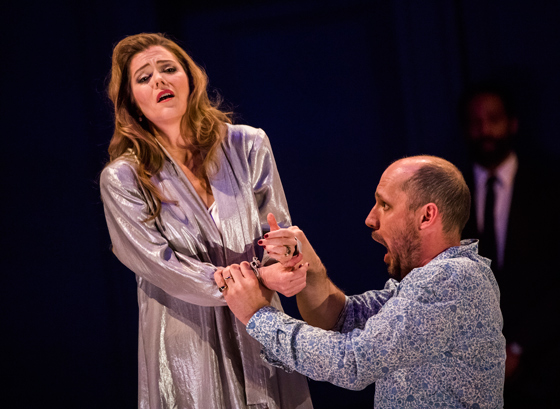 © Tristram Kenton
- Have you already begun to discuss the next project with Martin?
- We want to work together. We have not yet decided what. It was necessary to finish this thing. Now she begins to leave us - you can think about the next one. None of us can work on two things at the same time, we cannot plan for many years to come. But I really like this medium - opera. And I like not only to write, but also to perform.
- Do you like to conduct?!
- Adore. I should not do it too often, I have to sit at home and compose. But as a composer you are lonely, and in your performance you have such a cool team and the process gives such a pleasure! I just love it!
- Are there any orders?
- Yes, there are several proposals in relation to concert works and in relation to the opera.