
Translated material
Flute with greetings
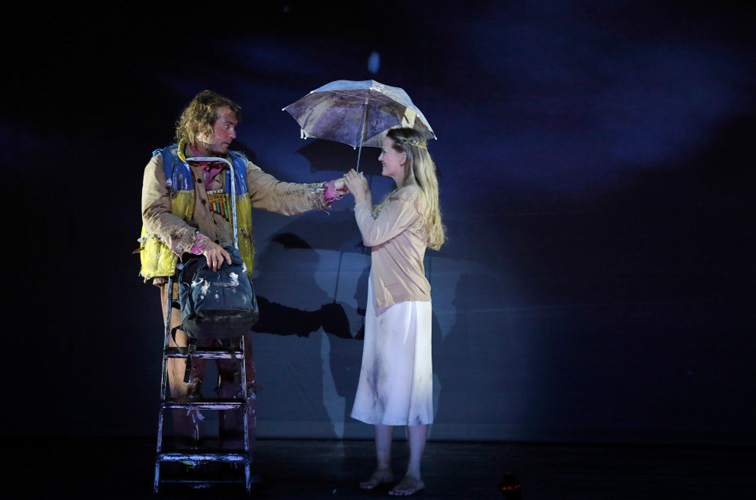
The “magic flute” of Simon McBberney was resumed at the Festival in Ex-en-Provence four years after the premiere , decorating the anniversary of the 70th season of the festival and the farewell season of Bernard Fokrrule's farewell season. The performance did not become worse from time. There is nothing to grow old in it, since McBerni almost defiantly did not “solve” the numerous problems of the Libretto of the “magic flute”. He did not change a single storyline and did not even rewrite conversational dialogs in which only a couple of jokes on the anger of the day and place appeared. Everything remained in their places-and a rather strange virtual and portrait love of Tamino and Pamina, and the foggy meaning of all Zoroastrian rituals, and an inexplicable change in the character of the Queen of the Night and her three ladies (first, rather kind, and then unequivocally angry). Everything is like the authors - Mozart and Shichedra, with the exception of a few important finds.
The success of this “flute” is, first of all, in its playful and fun fascination even for the most unprepared viewer. The conservatives like it, because the author’s text was practically not affected, neophytes - since a lot of entertaining happens on the stage. Plus, a very charming composition of young singers under the control of Rafael Pishon, very dry and briskly conducting Pygmalion with his ensemble. A good half of the composition, including the maestro, are graduates of the Festival Academy. This year there are no international stars among the singers, but they all quite possess the Mozart style and nuances, are good in ensembles and are expressive in conversational dialogs. The queen reigned, as expected, performed by Katherine Lewik, who, four years ago, brilliantly replaced the sick Albina Shagimuratov in this party and now repeated her success (being, it seems, at the last stages of pregnancy). Tenor Stanislas de Barbeyrak was also good in the role of Tamino - first of all, thanks to the plasticity and nobility of his cantileine.
 © Pascal Victor / Artcompress Festival d'Ax-Een-Provence 2018
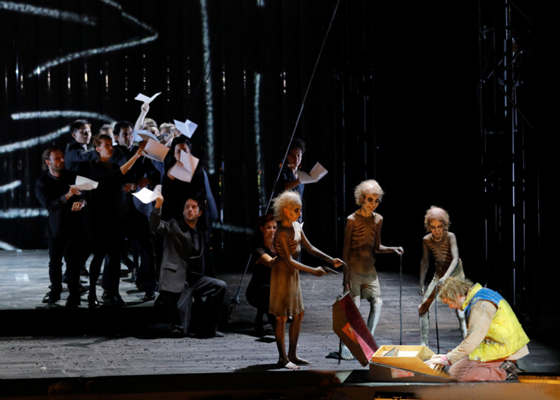
Nevertheless, this performance is much more complicated than its audience success. The action takes place on an almost empty scene, but it is a very expensive and inventive emptiness. In the middle is a square suspension platform, which, depending on its changing position (slings are regulated by the program), can be a sloping slope, a ring, and a huge table of meetings at an international conference (artist - Michael Livine). Behind the platform is the screen, and on the forefront two stations are one video, the second acoustic one. Everything that is projected onto the screen is modeling the video station operator before our eyes, which in live mode under the Live lens writes the caps (either clearly to music, then intentionally out of place), draws the arrows indicating the heroes, or puts the brilliant fabric depicting the starry sky for the queen of the night. The acoustic station is a glass closet in which the operator girl sits and does what the masters usually do in the cinema-imitates the sounds of steps on different soils, the noise of water, thunder, lightning, etc. And this sound “support” suddenly makes every step of the heroes along the stage, every micro-jet or remark.
On the stage there are types, slightly “trained” by modernity.
McBberney seems to be transmitting two greetings at the same time with these two stations at the same time: Katie Mitchell with her skill of three white sheets of paper, a hair dryer, a dry branch and a handful of leaves thrown behind the actor of a handful of leaves on the film screen (Mitchell, however, are more spectacular) and Robert with his famous play. “Lipsink”, where, within nine hours, the actors of the Canadian troupe weaved repeatedly and the complex interconnections of sound and images, including with the help of cinema receptions.
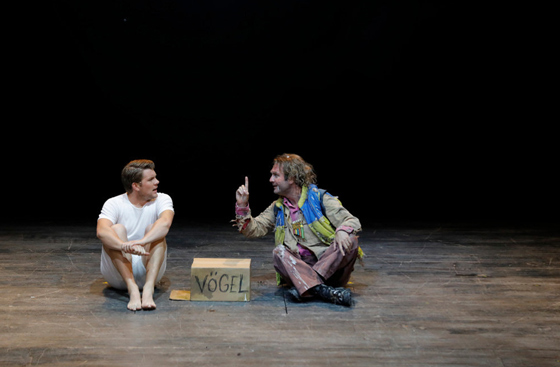
The performance literally jugles the styles and techniques of the modern theater, many of which are still quite copyrighted, who have not passed into the category of “air of the era”. The platform and an empty scene are obviously sent to Peter Brook and his Empty Space (and there is still a mim, who runs after the papageno with paper leaflets - birds). And in the scene where animals come to the sound of a magic flute Tamino, a video artist puts an old yellowed newspaper on his table, it seems, with photochery of colonial safari - and suddenly animals in the pictures begin to come to life in an abstract graphics. There is not even a hidden quote or a directorial Ommage, but it seems that this fragment in the play simply put and drew William Centridrid himself.
 © Pascal Victor / Artcompress Festival d'Ax-Een-Provence 2018
Inside all this theatrical wealth, a rather unpretentious, at first glance, performance unfolds. For all the rigidity and density of the acting-large drawing, McBberney does not set the singers of large acting tasks. On the stage there are types, slightly “trained” by modernity. Tamino in a tracksuit with an embroidered dragon on his back (costume artist - Nicky Gillbrand), Zarastro (Dimitri Ivashchenko) and his retinue - a sort of international secret government in expensive suits of the Brussels bureaucracy. Papageno (Thomas Olimans) is colorful and bumzhev. Three ladies are a sort of rather poorly trained female special forces. Pamina (Marie Ericksmone) is a fair -haired girl in a lyrical white dress. The Zingshpil genre itself is reproduced in all its glory - with apartments, monologues at the ramp, care and exits from the auditorium. But at the same time, such a “vintage” nature of acting unexpectedly turns out to be quite appropriate inside a very inventive and technological stage box.
In the Libretto of Shikander, sexism of the most unpleasant property blooms with magnificent color.
Of all the characters of the “flute”, only the queen of the night and three boys were subjected to a significant retreat from the canon. McBberny turned the wise youths literally into very old boys, wrinkled, gray -bearded, on crutches. The idea itself is not very original, but it works very well in this performance, since the director managed to achieve an amazingly organic, detailed and diverse existence of young elders (soloists of the choir of boys of the Dortmund Academy, their names are not even in the program). This is a creepy and attractive sight, and all three are singing surprisingly cleanly and confidently. The plot, however, did not particularly move anywhere, but, of course, acquired a new and rather unexpected paint. The materialized metaphor of the wise youth suddenly ceases to touch and makes you think about what kind of creatures are and how useful their tips are.
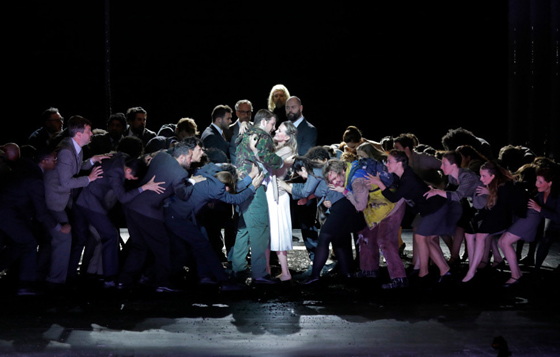
Significantly more significantly throughout history, the change in the image of the queen of the night influenced. In this performance, she is an old, obviously sick and moving mainly on a reception chair, an imperious and impulsive, but deeply unfortunate woman, from whom her daughter was taken. Such a decision not only makes the queen’s behavior more logical, sharply changing from the first to the second act. Her passions and fears cause sympathy and understanding. And the confrontation of the queen and stupefire becomes not such a clear fight of evil and good. Moreover, on the side of the good is some reminiscent curly bearded with a noble gray -haired and in an expensive suit, speaking pompous banality. He is surrounded by faceless and fully controlled subordinates, who, if they object, then only within the framework of procedural needs, and so quite unanimously “for”.
 © Pascal Victor / Artcompress Festival d'Ax-Een-Provence 2018
Here, probably, it is worth recalling that this opera has one feature that personally always puzzles me - especially when the flute is recommended for children's viewing. In the Libretto of Shikander, sexism of the most unpleasant property blooms with magnificent color. “All troubles are from women”, “I took her daughter from her, because she (the queen) understands too much about herself” and all that is so. A woman is an attack and temptation that needs to be able to control or avoid. And she certainly never shines the highest wisdom. McBberney does nothing radical with these meanings, but he clearly notices them and presents them to the venerable public, not hiding, but enhancing the dissonance with modern ideas.
During the existence of this production (and after the premiere in Exca it was played in Amsterdam ( DNO ) and in London ( ENO ) and both times was recorded on the video), quite a few critical complaints accumulated to her. It is quite fair - in the part where McBberni reproaches for insufficient density of directing compared to his dramatic work, as well as in the fact that he in every possible way tried to avoid the author's directorial look, leaving unanswered questions to the libretto of both the plot and ideological nature. Nevertheless, this is a great performance, where the game, frivolously-philosophical and very difficultly arranged simplicity of Mozart’s opera is quite correlated with a difficultly constructed playful simplicity of a stage solution.