
Translated material
What do sellers read?
From church shop to hum: the circle of reading Russian retail
Gorky continues the cycle of materials about the practices of reading different social and professional groups: in past issues, one could find out about the Ural workers, prisoners, authors of the translite almanac, punk, bartenders, football players. Today, on the eve of the Trade Day, we talk about the circle of reading Russian sellers.The day of the trade worker (was established in 1966) is celebrated on the fourth Saturday of July - this is “floating”, as it should be for any almost religious triumph, a holiday. Trade of the entire visible history of the twentieth century was a difficult matter. The Soviet seller is a complex, idolator (little unkind God), in the twenties and nineties (times of economic trouble), trade saved from hunger, in the two thousandths there was a period when the trading sphere seemed almost heavenly - every purchase was a sacrifice on the altar of universal future well -being. Now in the country thirteen million people (according to Rosstat) are occupied by wholesale and retail - this is one of the largest professional communities. Who are they - sellers and saleswomen of the new Russia? What groups and estates did this trade human sea form? I suppose that now it is one of the most compound and various social strata, which has grown as educators (scientific and technological intelligentsia), and the city middle class, and the working class, which lost its place and glory. At least, the readership of sellers and their attitude to reading vary in the most bizarre way.
 Vitalina Sofronovich, owner of the store "Bread & Sweets", Eastern Administrative District
You ask that I read the last? That's just this morning I read a conspiracy for good trade. A short, so -called "small" conspiracy. This is done like this - only the first buyer enters the hall, you need to clamp a ten -ruble coin in a fist and say to yourself: “Take my goods. Take it, he is inexpensive. Take it, you need him. Take it, you want him. You will take my goods, give me your money. Take my goods, give me the money. Amen. Amen. Amen". And the penultimate that I read was a book, I will not say anything. The work book of my employee, who was about to retire. It was - and now it is not clear when. I am responsible for twelve people, I have two businesses - a store and a hairdresser. I have been doing business since 1992. You can say a pioneer. Yes, I probably did not particularly rise, but raised the children.
I have a difficult relationship with reading. I am from a reading family - at least from a family revered a book. In perestroika, my father wrote out up to thirty magazines and newspapers: I remember that going to the mailbox was my duty, and our box was the most full. This was the subject of pride. And today there is a parent library in the house - how many books are there, I will not say, but I have a catalog. Dad was, he was a neat. Parents worked in offices (in work books - engineers), and I want to say that they had a lot of free time. But there was no money. For me, this is still connected - "Money is time." Reading time is little money. Something like that. The most insulting thing for me is that what hurts me is when a person works to exhaustion, but there is still little money. In this I see injustice. Here you are asking what they are talking about in my hairdresser. For several years almost nothing. Women come to the salon, sit in chairs and fall asleep. The hairdresser why is considered a “talkative” person - because he needs to speak by professional necessity. Like the driver. The driver says not to fall asleep, the hairdresser says that the client does not fall asleep. But they still sleep, our clients.
I always studied well, and I read everything that I had to read at school. And then she repeated with the children, with my two sons. Psychologists say: you cannot teach children what you yourself do not. If you do not read it yourself, then no matter how much children say, what needs to be read, they will not. Nonsense. It's more complicated. Everything is in the child. You give birth to something ready. I have two sons. Weather. Raised the same way. I did not read it myself. She said that it was necessary to read. One son graduated from the Institute of Physical Education, is engaged in business. Doesn't read anything. The second son graduated from MEPHI, already writes a doctoral dissertation. Reads everything that rustles.
But still I have an author who is the main thing for me. I re -read all the classics with the children - I checked all the tasks after them. I am careful in my father. I read all the texts, listening calmly. Except Nekrasov. As soon as I hear Nekrasov’s poems, I begin to cry. No need to tell me that there is a “female share” and other history. Not so. I cannot explain this situation for myself. Children read Pushkin - I'm calm. They memorize Yesenin, Mayakovsky - everything is in order. They just begin to read Nekrasov - tears from the eyes. Tell me: “Frost-Voivodes by the patrol bypassing his ownership,” and I will pay (crying). What is it?
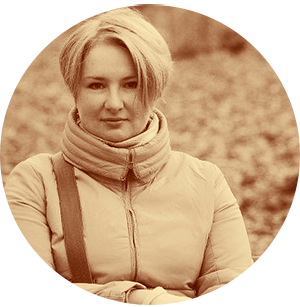 Vavilova Natalia, buyer "Gastronoma No. 1" (GUM)
The last book that I read was Erkina Tuzmukhamedov's booze. This is sufficiently an exciting and cheerful book, I rested with her, although, if you think about it, it was no coincidence. Her theme is related to my work. I have been working in GUM for a long time, in Gastronom No. 1, in the department of alcoholic beverages, but for a year now I have had a new position - I have been a product buyer. There are only three such workers in the gastronomer - and I have the opportunity (in fact, the obligation) to choose which goods will be in the store, which can still be considered the main thing in Moscow. I am responsible for the purchases of alcohol, tea, coffee, a number of more goods. Are you interested in what vodka is the best in the country? Vodka, with a certain degree of purification, it is in Africa vodka. It can only be about advertising history and fashion. In fashion - among the customers of wealthy ones - now historical brands, in the field of special interest - distillates. An example of a product that has fallen in interest and having a really worthy quality is “half -man”. Do not even ask me about the best brands of soluble coffee - this is in any case not coffee, but a coffee drink. Actually, since I took the position of the buyer - this is soon a year - I have no time left for reading. How do you explain what kind of work this is? Conducting many lines and contracts, knowledge of ambitions and real capabilities of manufacturers, but also related to the fact that you have to personally control the process - to go down to the car, to view the goods. In principle, you are a critic of a large number of goods that are simultaneously texts, because each product also carries in itself advertising, PR, to a certain extent literary history. These are texts about farming and purity or about fault and cultural complexity - this is part of the "functional" literature.
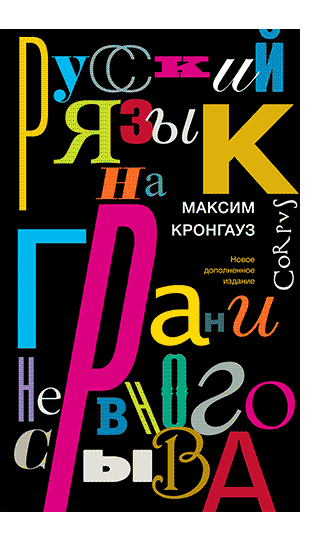 But there is a genus of reading that I am not ready to let go - I like to read about the Russian language. Favorite book in this area is the text of Maxim Kronhaus “Russian language on the verge of nervous breakdown”. Literacy is a bastion that cannot be handed over. No document can be made with errors. I try to write correctly - I hope it turns out. At least, colleagues cope with me how to write a particular word.
For reading, a certain time is given - most of us read before bedtime or on weekends. For me now and it is difficult to. But I read in the subway - small stories and essays that can be read between the stations. I give preference to the stories of Glory SE.
Five years ago, I loved to read fantasy and science fiction, but it has passed. The last of what really excited me is one of the books of Rushdi and all the books of Chinese Yan Mo, especially his thing "is" tired of being born and die. " You asked me if it is possible that my interest in the Chinese writer is connected with what we once talked about - that the GUM has been filled with Chinese buyers for several years. That's absolutely not connected. No way. Yan MO is an experience that is most remote from the idea of well -being, in which the purchase is the main emotional event. He talks about the real story of China, in which the main event is execution and death. What a purchase is here!
 Yuhann Nikadimus, managing the Center "Design Workshops"
For ten years I worked in retail, traded clothes in the mass market segment. This is the middle segment, as you know: say, three thousand jeans (let's take jeans for the golden measure). There are jeans above five hundred dollars. And below is for a thousand rubles - in stores, say, "surname". He went from the seller to the store manager.
All the time of my work, I read some texts. I will try to explain which ones.
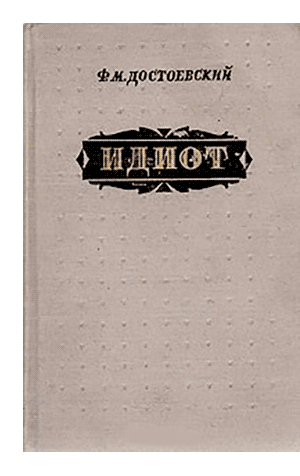
The book that I read now is the text of Vera Nikitina "Letters of folk musicians (the last quarter of the twentieth century)." This is the greatest underestimated book, which has become a second "idiot" for me. Vera Nikitina is a researcher of folk folklore music and rural life, since the sixties she communicates with the musicians living in the village. The basis of her book is correspondence with members of folklore ensembles, mainly from the Belgorod region. These are great musicians, known mainly among folklorists.
I know them all from the voice, even on those rare records that came out in Soviet times. Why did I become interested in this melodic direction at one time - well, how to explain? I felt that it was something hyperxy, mine.
The importance of Vera Nikitina’s book is that she explores the method of folklore. A typical folklorist was more likely to be a record - to make as many records of songs and melodies as possible (folk, socialized melodies) - and the device recorded in some typological framework. That is, we perceived the sound as a record, as a melodic product with certain laws, and not as a person’s personal statement with his history, psychology, with his biography and fate.
 And Nikitina says that it was necessary to engage in individual - to find out as much as possible about the personal fate and life of the performers. She does this work. Most of her heroes have already passed away, but the author collects information about them, publishes correspondence, analyzes the epistolary genre - in most cases, the genre of expression unusual for her heroes. She thinks about them, revives them. Why do I call her research the second "idiot"?
Because this is another book that reveals human nature. “Idiot” is the main book for me, telling what a person is, how he is arranged and how he acts.
At school, I did not read anything; At 28, it became interesting to me what literature is and how it works. I decided to read the entire school curriculum and close Gestalt. The most interesting thing is that I began to like everything, but when I read Dostoevsky, I could no longer turn on any other writer. And the "idiot" turned out to be my main literary event. Then I became interested in Petrushevskaya, her book “Number one, or in gardens of other opportunities” and the collection “Requires”. But I realized that I actually read the same book. Only about how a person works. Only about the mechanisms of his behavior.
But I did not read business books about sales. They are useful, but uninteresting.
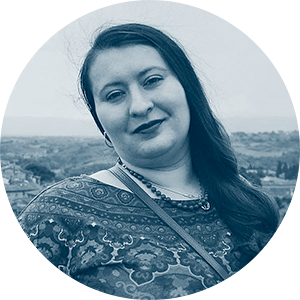 Maria T., employee of the church shop in the temple of St. mts. Tatiana at Moscow State University
I have been working in a church shop for three years. I can’t say that often, but periodically you have to act as a “psychologist”-heterist, because the church shop is usually the first person with whom people who have entered the temple are dealing with. It often has to answer various questions related to the ritual side of church life, to advise books, debunk myths, fears and superstitions (for example, quite a lot of people are sure that nobody cannot be given or accepted as a gift, but to accept as a gift, but to accept as a gift. The women who have entered are afraid that they will not be allowed into the temple without a scarf and in trousers). Sometimes strange, inadequate and even mentally unhealthy people come, you also need to be able to communicate with them, not being involved emotionally. The experience of reading secular literature does not help here, except that non-fiction in psychology.
I myself am now reading the book of Svetlana Adonyeva, “Tradition, transgression, compromise. Worlds of the Russian village woman. " I chose it after the lecture on the basis of the book read on the Sakharovsky Center for the Sakharovsky Center, because the topic of traditional culture has always been interesting to me. I like the book, but without an appropriate scientific base it is not easy to read it. In general, usually I read two or three books at the same time, although I think that this is not very good. But sometimes you need to be distracted from serious reading to something easy and entertaining.
Do I have a "main" book of life? Complex question. The problem is that there are several such books.
First of all, this is a new covenant, although I somehow are not used to perceiving it precisely as a book. Secondly, Harry Potter is, I can say with confidence that this book formed me in many ways. In the third - “letters of Balamut” by K. S. Lewis.
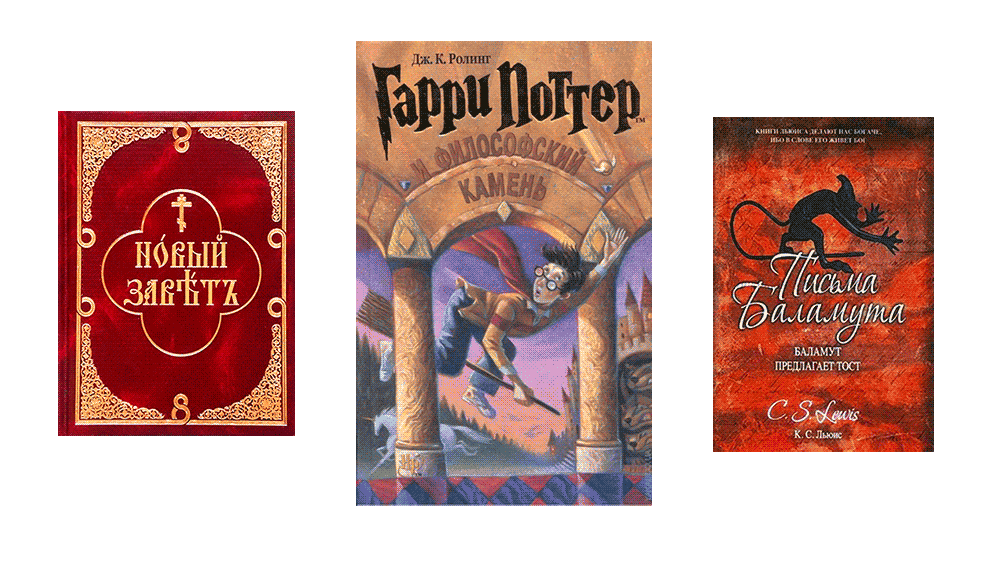
In general, it is clear that one of my favorite writers is Joan Rowling. I literally grew up on her books and now I'm looking forward to a new book from the series about Kormoran Starka. No less beloved - Jane Austin. My best friend and I even have a joke on duty that, how much we are friends, we discuss her novels so much and we always have something to say new. I also really love Sigrid Unset, although it can hardly be called a particularly life -affirming author.
Of the male writers, I also give preference to the British-the famous Trinity Chesteron-Tolkin-Lyuis; I love the first more as a thinker, the second - precisely as a writer and creator of the worlds, and the third - in general.
Of course, I read Russian authors-classic authors, but only Pushkin loves from them. The Captain's Daughter is the best anti -stress for all times. Of the modern I love Alexei Ivanov.
Of the British, I will also add Bernard Cornwell-with his cycles of historical and adventure novels about the arrow of Sharp and Utred Bebbanburgh, and from the American-Stephen King. I will also add Neil Gaiman and his female alter ego, a wonderful writer Diana Winn Jones. This is about those that are roads.
There are much more interesting authors to me, but it will be difficult for me to list everyone, since often I read not so much for the sake of the author, but for the sake of the topic or genre affiliation. Favorite genres - science fiction and fantasy, city mysticism, South Gothic. I read memoirs, anthropology, theological literature.
For relaxation and pleasure, I read love novels with any melodrama and experiences, often also in the fantasy genre, which is needed here for the sake of surroundings. Good English detectives, “big” novels, family sagas, historical and adventure novels. And - I write myself.
Basically, the fanfictions of the romantic genre: what could be more pleasant than to bring your favorite heroes together? From the "original" on my account several small stories. I do not consider myself a writer, although I like to write. I have a dream to learn how to write high -quality female novels - such as I would like to read it myself.
 Anna Komarova, Director of the Perekrestok supermarket in the shopping center "Atrium"
Now I'm on vacation, and, to be honest, here, in the country, with my family, I want a light and unobtrusive reading. Therefore, from the summer book shelf I chose the first and fallen book that turned out to be the detective Daria Dontsova.
The most important books for me (books “My Life”) - “Anna Karenina” by Leo Tolstoy and “Green Mile” by Stephen King.
Since school times, I adore the works of remark; Most of all his “three comrades”, I periodically reread this book and every time I find something new. What do you like in it?! Probably, sincerity and those best feelings and actions that can only be in a person: friendship, disinterestedness, willingness to go to the end, self -sacrifice. Everything that, alas, is not so often found in our time.
I believe that in books a person should rest, switch from routine weekdays. Therefore, even in work, not business publications help me, but just fiction-in it I draw inspiration.
 Dmitry Rusakov, Director for the implementation of general -industrial projects and programs X5 Retail Group (stores "Pyaterochka", "Crossroads", etc.)
The book that I am reading is called “sapiens. A brief history of mankind. " The author is Juval Harari.
She had long been in my list of books for reading - finally she reached her. In general, I have a large list of literature “Reading”: at present, in the list for the coming year, about 50 books are completely different, from business literature and ending with art.
The book is very interesting, exciting, explaining the origin and development of a person, placing a lot in places. Various social and political moments are explained and described from the point of view of evolution, which gives a reason to reflect on current work and how and why certain decisions are made both at the business level and at the level of politics.
I do not have a single book that would affect my formation and forever remain “the same”. At different ages there were different favorite books. There are several favorite authors - Haruki Murakami, Max Fry, the Strugatsky brothers. But even with them I can not highlight one thing. If we talk about “here and now”, then on the current life segment, the favorite book “The Singularity is Near” Ray Kurzweil [the futurological composition “Singolarity is close”; сам Курцвейл — ученый и футуролог — занимает должность технического директора в области машинного обучения и обработки естественного языка компании Google. - approx. Ed.].
Что касается моей любимой деловой книги — нет такой книги, которая бы была ответом на все вопросы. Я, бывает, возвращаюсь к тем книгам, которые читал ранее, и нахожу в них новые смыслы. Но это не значит, что автор их закладывал в свое произведение, — ведь фактически мы читаем через оптику собственного опыта.
 Анна Гаврилова, продавец магазина «Продукты» (Восточный административный округ)
У нас очень старый магазин, да вы и сами знаете. Самый старый придомовой магазин в районе. Во, раньше домовые церкви были, а теперь магазины. С 1993 года работает. Я сама служу в нем с 2000-го — уже восемнадцать лет. Как старая учительница почти: помню, как мамы с детьми в магазин заходили, а теперь выросшие дети со своими к нам идут. Как мы еще держимся — непонятно. Вокруг три «Пятерочки», три «Биллы» и один «Магнит». Единственное, что спасает, — они все фасадом на улицу, а мы во дворах, и закрываемся позже на час. В выходные до ночи работаем. Каждый год обновляем лицензию на алкоголь, и с каждым годом все дольше и труднее ее возобновить. По два месяца сидим без лицензии, и тогда продажи падают на ноль — хотя вообще-то мы зарабатываем не только на алкоголе, но и на конфетах, мороженом и печенье. В общем, весь антистресс — наш.
Я, можно сказать, почти что управляю магазином: заказываю продукты и весь ассортимент. Наизусть знаю, что пойдет в продажу. Бывает, пельмени имеют разницу в два рубля и называются почти одинаково — какие-нибудь «Свои» и «Наши». И вот одни покупают, а другие нет. It is impossible to explain this. Это своего рода чудо. В торговле есть элемент чуда.
Я читаю вот уже много лет только духовную литературу. Не только жития святых, но и современные записи о народных святых и чудотворных иконах.
Для меня нет литературы с вымышленным сюжетом. Мне неинтересно, что писатель придумал. Мне интересно, что на самом деле произошло. Хотя писатели пытаются написать «как в жизни», а то, что реально происходит, кажется вымыслом.
Я и сама немного пишу: у меня страничка на сайте нашего прихода. Я описываю маленькие чудеса, которые у нас происходят. Judge for yourself. Каждый прихожанин, у которого что-то случается, пишет на сайт, просит молитвенной помощи. И мы организуем совокупную молитву двадцати, тридцати человек. Чаще всего молитвы просят те, кто идет на медицинское обследование по пугающему поводу. И ни разу — вдумайтесь! — у нас еще не было такого, чтобы обследование показало совсем уж плохие результаты.
В детстве я любила читать сказки. Но книги о православных чудесах совсем не сказки. В них чудо не случайное, а чудо как результат работы. Только тот, кто никогда не молился, не знает, что это работа — и сосредоточенная, большая работа.
Я так и живу: молюсь и продаю, продаю и молюсь. Для меня это гораздо интересней чтения.