
Translated material
Black square ruin
Review of Andreas Schunle's book "Architecture of oblivion"
How does the Russian spleen differ from the English spell and other Western European melancholy? Today, in the section “Demonstration Reading of Dmitry Bavilsky”, we will talk about Andreas Schunle’s book “Architecture of oblivion: ruins and historical consciousness in Russia of the New Age”. Andreas Schunle. Architecture of oblivion: ruins and historical consciousness in Russia of the New Age. M.: New Literary Review, 2018. Authorized translation from English Andrei Stepanov
For the first time, I read one of the heads of this book of Russian literature of the Korolev Mary of London University in a slightly different version in No. 89 (No. 3, 2013) of the magazine “Unaccounted Reserve”, published under the general cap “Infoilated Heritage of Art Nouveau: Nostalgia, Melancholy, Ruin”.
In the essay “Breeded History and Squinting Stones: About the Romantic Understanding of the Preservation of Architectural Heritage”, Andreas Schönl said that the admission of the ruins in Russia of the late XVIII - XIX centuries was perceived by the unconditional sign of Western influence: and, if even more specifically, the influence of the ideology of education.
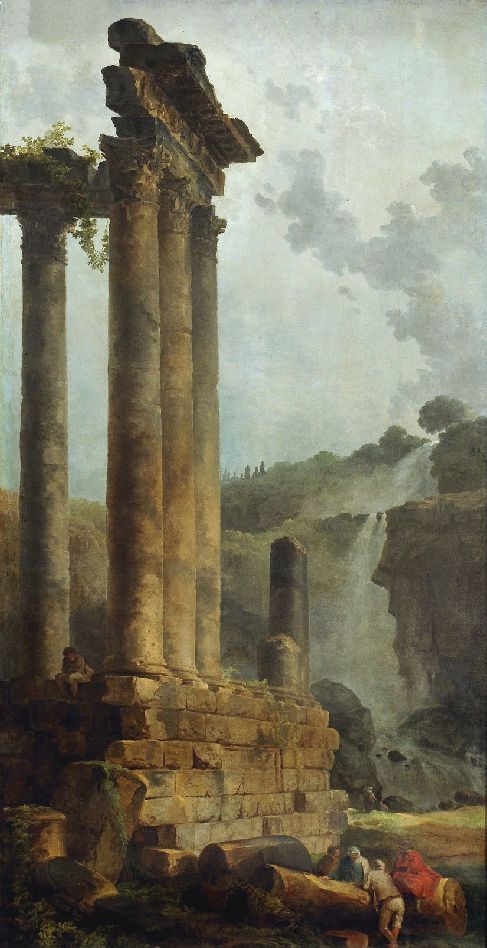
Fashion for the paintings of Gustav Robert and his invitation to Catherine II to work in Russia is exactly about this. But it is symbolic that, despite the victory of the Great French Revolution, because of which Robert’s art abruptly went out of fashion, the artist refused to come to Russia. The empress was disappointed with this.
Some writers (Nikolai Karamzin in “Poor Lisa”) used a description of the ruins to emphasize the rupture line between the “traditional society” of the pre -Petrine era and the onset of new times of modernity, but other artists (Karl Bryullov in their most famous picture) used the image of destruction, in order to once again emphasize the continuity of world history.
The “last day of Pompeii” manifested the continuity of European culture and the inclusion of Russia in the general process: “The most important thing is that it brings antiquity to Russia, as if proclaiming its right to inherit it. Here, the incomplete past of Russia becomes a condition for effectiveness, as it liberates the present and allows the artist of the New Age to appropriate the classic world in the process of self -affirmation ... ”
By definition, the ruins show us the signs of the past-another thing is that you can interpret them differently.
Each time, meeting in books, a description of abandoned, destroying buildings or examining them in paintings, engravings and drawings, we must understand that they appeared here not by themselves, but by an expression of some important, socio-political ideas.
At the same time, images of cultural remains are dynamic matter: the meaning of the ruins changes not only depending on the tasks set by the writer or artist, but also because of the mood of their historical eras.
In the situation of postmodern and even the current post-poster of the ruin-that is, the “cultural layer” literally revealed to us, which, however, is higher than the level of the earth, it seems one of the last refuge of authenticity.
During the time of simulacra, total substitution and manipulations, these authenticity signs play the role not even in time or bridges into the past, but the pass is currently in the present, which allows us to come as close as possible to undetected reality.
Ruin raises us to see beauty in everything - in the technogenic skeletons of a long -term construction overgrown with a swan, as well as in any gaps and gaps, traces of destruction and decline. Just like in the antiquity of admission, when the “traces of centuries” and destruction are included in the mandatory repertoire and additional reasons for aesthetic experiences. There are few who now represents marble Venus with hands and faces painted with multi -colored pigments.
Fragments of buildings are oozed with melancholic snowdrift, being punctured signs of current trends. The “inviolable stock”, which quickly monitors intellectual mods and trying to get ahead of the discursive request, it is no coincidence that one of the most successful numbers devoted nostalgia and melancholy.
The article by Schönl is framed here, for example, the essay “Psychoanalysis of the Ruin” of the Dublin phenomenologist Dylan Trigg, a fragment of Svetlana Boym’s book “The Future of Nostalgia”, as well as the texts of Alexander Chang’s “Japanese melancholy”, Alexei Levinson “Depression and Fear”.
The state of the world, which jumped out of the grooves of binary oppositions and has become as complicated as possible in recent decades, is overwhelmed with eschatological fears and decadent mindset, causing emotional burnouts and chronic depression.
In recent years, in addition to the journal, all the same “new literary review” shot a whole clip of books reflecting over melancholy in its various departments. From the fundamental “inks of the melancholy”, Jean Starobinsky (2016), studying the primary sources, and not so much literary as scientific (primarily medical), to the “person without content” by Georgio Agamben (2018), which is incurred on a sense of chronic tear.
From Krivoy Gereli Alexander Etkind (2016), describing the neurotic reactions of Soviet art to unlimited and still not recycled injuries of Russian history of the twentieth century to a simple -minded and straightforward (because scientific) “history of melancholy” Karin Yuhannison (2011).
The pathos of Schönl, however, is closer to the studies dedicated to modern developments in line with “historical memory” and “memorial culture” associated with two recent monographs of the German researcher Aleid Assman.
Her “new discontent with a memorial culture” (2016) and “the connection of times has broken up. The take -off and fall of the temporal mode of modernity ”(2017) try to find new features of collective memory, tied to a change in the sensation of the current time. With the end of the Art Nouveau era, it, finally losing linearity, has changed radically, becoming an individual temporite of any autonomously feeling personality.
The current ubiquitous spleen, completely woven with chthonic fatigue and symptoms of the “end of history” (that is, “large narratives”, despite the fact that life has long proved the premature of the conclusions of Francis Fukuyama), is caused, in addition to other respectful reasons, also a sense of lateness, which causes a modern person to live “after all”.
The fact that the conceptualist Vladimir Druk described in the poem "Orlyate" dedicated to Alexei Yesenin.
After the twenty -sixth
After thirty -seventh
After the forty -eighth
After and again
 Joseph Brodsky, one of the main characters of Schönl, was also sad from the hopeless: "The century will end soon, but I will end earlier ..."
However, against the backdrop of the current undivided aimlessness, his situation looks simply an allegory of optimism: our century has just begun, so we will end up, in turn, we will be in the final one.
With all these books about the modern reincarnation of the decadence, which descended from elite heaven in the thick of mass consciousness, there is a truth one problem: the subject of their description seems to slip away from the final fixation and is visible "as a dull glass."
After reading thousands of dense pages, you remain hungry: the authors touch very thin matters, but somehow, apparently, straightforwardly in the forehead.
To capture and understand the specifics of modern spell, you probably need some kind of congenial perpendicular-an intonation move, which provides, say, the current fashion of Vinfrid Georg Max of our Zebald or, for example, Alexei Makushinsky.
Schönl's book (a collection of articles where each describes the attitude to the ruins in important and turning strokes of Russian history) closer to the version of Jean Starobinsky, as well as Aleide Assman-with his humanitarian and humanistic pathos: the reflection and the preservation and conservation of the ruins ultimately turn out to be the most important features of modern memorial culture, necessary for people not only for people, not only for people not only for people. “To be remembered,” but also in order to continue to consider themselves people.
So that on the way to the future they do not be wasted and not lost the most important features from a set of their anthropological basket.
Features of Russian history are the absence of continuity - Schönla leads the words of Batyushkov and Chaadaev about the feeling of permanent shame under his feet.
They are echoed by guests like the Marquis de Custine, who was surprised at the absence of antiquities, replaced by simulacu.
The fire of Moscow in 1812, on the one hand, was cleaned up by an authentic appearance of the city, on the other hand, he allowed advanced aesthetes like Pierre Bezukhov to enjoy the appearance of burned residues, and from the third to include the events of the Patriotic War in the system of general cultural codes: from biblical, with the destruction of the Jerusalem Church, to the antique - yes, with the destruction of Herkulanum and yes, with the destruction of Herkulanum Pompey.
The cult of antiquity in the country arises only at the end of the 19th century, so that reconstructors from the World of Art can compose idealized Russia to the destructive landowner estates and the fleeting golden age, from which it is important to be expelled in time.
Even the revolutionary avant -garde, dumping the classics from the steamer of our time, nevertheless, takes into account the cultural heritage, so as not to freeze without it in the final airlessness.
“Acting in the name of progress and trying to strengthen the practice of demistification that underlies it, modernity is dialectically connected with the past that wants to overcome, and this leads to infinitely repeated acts of iconoclammation.”
The desolation of the dilapidated Petrograd after the revolution and the survival of the devastated Leningrad, surrounded by the burned palaces-museums of the suburbs in the blockade, continues at a new stage the tendency of imitation recovery.
Only if earlier the ancient cathedrals (the case of the decimal church - the first stone structure of Kyiv, built by Prince Vladimir, in commemoration of the baptism of Rus', but the cleaning of demolished in the 19th century, so that in its place, Vasily Stasov could build a temple imitation of the ideal “Russian style”; it is very unfortunate that the drawing of the destruction of the decay of 1826, published in the melancholy could be impressed. The number of the “inviolable reserve” fell out of the book) demolished the cleaner, outside their sacred significance, giving way to new buildings, now in the USSR they have been concerned about accurate, pointed copying of the originals.
“It is characteristic that the restoration took place in Leningrad much faster than in France, England or Germany. Unlike these countries, where a policy of combining reconstruction and new buildings was adopted, depending on the circumstances of each individual case, the Leningraders turned out to be true to the principle of accurate facsimile reconstruction ... "
So that nothing reminds Leningraders who untimely proud of their hero city, neither suffering, nor about exploits, or even more about loss: “State coercion to forget” (Lisa Kirshenbaum) is one of the axial leitmotifs of “architecture of oblivion”.
But not the only one. Eight chapters are eight plots (and not always as obvious as the fire of Moscow or the “last day of Pompeii”), characterizing the mental constructions of the key eras of Russian history of the New Age.
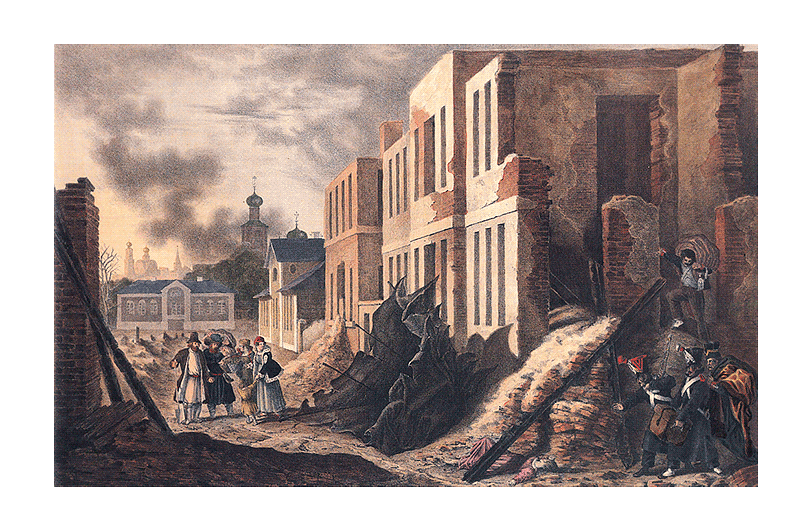
Moscow, September 24, 1812. Artist H.V. Faber Du Ford. 1830s
Photo: 1812.nsad.ru
That is, apparently, Schönl initially found the “nerve” of one or another period, then the way that the ruins speak with a person and society through the main medium of pre -romantism, romanticism, modernism or postmodern, and then creates spectacular chains of evidence - witty multi -income, including works of art of various types and genres.
To create an image of a dying city in the head of the “Ruins of Leningrad from the Blockade and Aesthetics of the Struggle for Survival”, censorship in film documentary and the techniques of “varnishing of reality” of Roman Carmen (as well as photographs of the beds of the photographer Boris Smirnov, opened by “Galeev Gallery” ten years ago) are no less important than the engravings of Anna Ostrunomova-Lobedeva and Pavl Shillingovsky.
At least, spyingomania in the besieged city and the narrative about the study of the script Vsevolod Vishnevsky, ultimately removed from the filming of the “film about Great Leningrad” occupy a much more space in the chapter than expanded ecfrasis.
The interdisciplinary approach based on the finest connections and invisible references allows Andreas Schönl to sometimes draw paradoxical conclusions. Thus, the types of Moscow in the “poor Lisa” of the European Karamzin are actually turning around the rejection of enlightenment and impending modernization.
One of the ideas of the head of the “Lessons of the Moscow Fire 1812”, based on the analysis of fragments of the novel by Mikhail Zagoskin “Roslavlev, or Russians in 1812”, the Pushkin’s passage “Roslavlev” and the main epic of Leo Tolstoy about the ruins as signs of the lost whole, retaining “invaluable remnants of the past - the energy that is necessary for contemporaries for contemporaries The researcher then transfers the foundations of his life in Soviet times - in the part of the book regarding post -revolutionary deprivations (they are symbolized by city species, mainly created by Mstislav Dobuzhinsky) and an unprecedented blockade experience.
Part of the “aesthetics and politics in romantic fashion for ruins” was logically given to the picture of Karl Bryullov “The Last Day of Pompeii”, which was a separate period in the history of Russian art. Schönl not only inspires the canvas itself with inspiration (and this is one of the most elegant ecfrasis of recent times), but also finds unexpected turns into seemingly completely transparent reactions to him by Alexander Pushkin and Nikolai Gogol.
To the Gogol interpretation of the picture of Bryullov Schönl enters through the description of the Roman ruins in the story “Rome” and through the interpretation of the launched household of Plyushkin in Dead Souls. “Plyushkin looks like a baroque artist in the interpretation of Walter Benjamin: in front of us, a person obsessed with the idea of the fleeting of life, aimlessly piling fragments and fragments and cherishing the vague hope that some miracle retroactively justify his efforts.”
And although the miracle does not happen, "Gogol aesthetizes the dilapidation - he is one of the main propagandists of the Western poetics of the ruins ...". Pushkin is even more interesting. The lexical analysis of the poetic passage “Vesuvius Zev opened - the smoke poured out the club - the flame ...” (1836) and the phrases from it “idols fall!” Allows you to stretch the intertextual chains to the texts, on which the poet worked at the same time.
To the “Copper Horseman” and his “end of the myth of Alexander I and the fragility of the Russian state ...”: “Thinking about the nature of the authorities, Pushkin combines the events of 1779, 1812 and 1824, and the story of the destruction of Pompei acts as an instructive history, which tells about the sudden collapse of the great civilization: such fate can wait for Russia.”
I like that Schönl juggles with an analysis of a variety of mediums, as if not daring to stop at any of them completely.
He uses the prose “descriptions of ruins, poems, maps, engravings, paintings, photographs, films, now existing buildings, artistic installations ...” and does it consciously, since in the preface it warns: “The first chapters are closer to literature, but as much as it approaches the twentieth century, vast visual materials will play, although literary sources are not played by literary sources. will disappear completely. This does not mean that the ruins did not function as visual signs before the appearance of mechanical reproduction tools. ”
For the “architecture of oblivion” is not essays of visuality or dry literary calculations, but it is precisely that voluminous interpretations of key historical periods. The time here is more important than artifacts - residual phenomena of different eras, blinded by forced museumification. Therefore, one of the tasks of the English researcher is to give fresh, witty interpretations to finally textbook authors and their creations.
The book is swinging between the meaning and meaning, literature and art, poetry and prose, its main characters are Petersburg/Leningrad and Moscow, the main clusters of the architectural or literary plots of Russian culture.
The “oblivion” is completed by the witty rhyme, which relieves the contrast between verbal and visual creativity. This happens in the penultimate chapter (“ruins as a transition to timelessness in the poetry of Joseph Brodsky”), which smoothly converts into an actualized epilogue (“ruins as an alternative reality.“ Paper architects ”and the vitality of destruction”), in the center of which the description of Peter Bely, Mikhail Filippov, Ilya Ukin, but especially Alexander Brodsky.

It is his installation “Coma” (2000) from the “Gallery of Marat Helman” - a layout of a city spread on a surgical table surrounded by droppers, from which oil constantly oozes, gradually flooding the toy landscape - is close not only to the aesthetics of the ruins of Andrei Tarkovsky “Stalker” (1979) and “Nostalgia” (1982), the general city Melancholy of modern culture, but also the timeless stiffness of organic and inorganic bodies in the verses of his namesake. Шёнле рассказывает о знакомстве двух Бродских в Нью-Йорке, чтобы качели между литературой и искусством схлопнулись, перестав зеркалить.
Англичанин, десятилетиями дотошно копающийся в русском хламе и понимающий его лучше большинства аборигенов, не может не быть темпераментным и увлеченным человеком со своеобразным чувством юмора.
Одухотворяя мертвые камни, он наделяет наши культурные символы дополнительной антропоморфностью, когда находит в них собственное какое-то бытие.
Подобно людям, руины имеют начало и конец, бывают востребованы или пребывают в окончательном небрежении, растут, развиваются, разваливаются, десятилетиями существуя в таком виде, далеком от совершенства, пока не исчезнут, обратившись в прах.
Однако открыто выказывать субъективность для ученого — дурной тон: несмотря на расхристанные «объекты исследования», сам Андреас Шёнле должен быть застегнут на все пуговицы и предельно корректен.
Единственная слабость избыточного жеста, которую он может себе позволить, проступает в «композиционном решении». Ведь обычно на него мало кто обращает внимание.