
Translated material
Memory. Militsa Mathieu
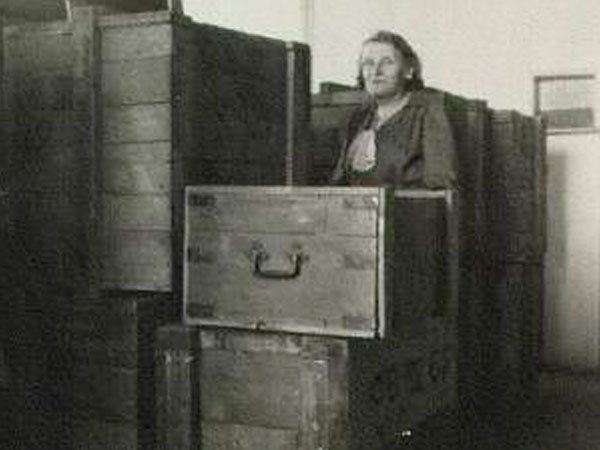
On July 24, 1899, Militsa Mathieu, an Egyptologist, and an employee of the Hermitage was born.
Personal business
Militsa Edwinovna Mathieu (1899-1966) was born in the village of Martyshkino near St. Petersburg (now as part of the city of Lomonos), in the family of a Russified Englishman. She graduated from the full course of the Alexander female gymnasium in St. Petersburg and entered the highest female (Bestuzhev) courses in 1918. In September 1919, the highest women's courses were included in the Petrograd State University. Even in the courses, Militsa Mathieu listened to lectures by the Great Russian Egyptologist Boris Turaev , and continued to study under his leadership at the university. The historian of the Ancient East, Vasily Struve, and an Egyptian art specialist Natalya Fittner, also had a great influence on her. Militsa Mathieu was an active member of the Egyptological circle at LSU under the leadership of Struve, who became the main center of Egyptology after the 1917 revolution. Its first articles were published in the "collections of the Egyptological circle."
Another student Militsa Mathieu began working at the State Academy of the History of Material Culture in the category of Olvia Antiquities, and since 1921 she became a researcher at the Hermitage, in which she later worked until the end of her life. In 1922, Militsa Mathieu graduated from the university and was hired by the Department of Egyptology of the University Institute of the Comparative History of Literature and Languages of the East and West. At the same time, she taught at the Institute of Art History. Militsa Mathieu led classes in the ancient Egyptian language and literature. In 1947, Militsa Mathieu became a LSU professor.
Since 1933, Militsa Mathieu headed the department of the ancient East of the Hermitage, then the entire department of the East. After the reorganization in 1953, she led the department of the foreign East. During the Great Patriotic War, she was the deputy director of the Hermitage for scientific work. In addition to scientific research, she, as a museum worker, was engaged in organizational activities related to the construction of exhibitions, the transfer of exposition to new premises (during the years of Militsa Mathieu Hermitage from the museum buildings itself expanded through the entire palace complex), the storage and restoration of collections. In 1940, the Hermitage workers decided to create an Egyptian hall on the site of the former main buffet of the Winter Palace. Until now, this exposition remains one of the most attractive to visitors to the museum.
In 1945, Militsa Mathieu defended her doctoral dissertation on the topic "Theban art of the XXI - XV centuries." Its other works concerned Coptic art fabrics and descriptions of the monuments of Egyptian art in the collections of the Hermitage and other museums. But ancient Egyptian art was the main, but not the only topic of its research. She was engaged in philological work - reading and interpretation of Egyptian texts (“texts of the pyramids” and others), and on the basis of texts - the reconstruction of Egyptian mythology and rituals.
For many years, Militsa Mathieu fought with a serious illness: since childhood she had tuberculosis of the spine, nevertheless she did not stop her scientific work until the end of her life. Militsa Mathieu died on April 8, 1966.
What is famous
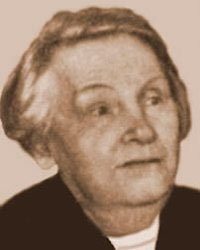 Malice Mathieu
 The result of the research of Militsa Mathieu in the field of Egyptian art is summed up in her monograph “The Art of Ancient Egypt”, which remains to this now. But art criticism is not exhausted by Mathieu’s contribution to Egyptology. Back in 1936, Militsa Mathieu published a small book on Egyptian mythology. Since then, she continued to collect material on this topic, translating Egyptian texts. One of the main sources with which she worked, the memorial rituals of the pharaohs recorded in the texts of the pyramids became. She also examined the hymns of Egyptian deities, texts of temple rituals, conspiracies and spells. In addition to written sources in the reconstruction of the Egyptian religion, it relied on monuments of material culture. The result of her work was the monograph “Ancient Egyptian Myths” (1956), the main theme of which is myths about the creation of the world, solar myths and myths about Osiris. For each cycle of myths, Militsa Mathieu put forward a hypothesis about its origins in the primitive era, and then traced evolution during the development of Egyptian society. A separate chapter of the monograph is devoted to such a little -studied area as the ancient Egyptian religious drama.
An example of a combination of the research interests of Militsa Mathieu as an art critic and as a specialist in Egyptian religious views is the article “Ancient Egyptian rite of opening of the mouth and eyes” (1958). In it, Mathieu shows that the inlays of the eyes of statues and anthropomorphic sarcophages served in ancient Egypt not only to give them a living more living look from the point of view of the viewer, but also to “revive” these images in a different being. She finds confirmation of this in ritual texts, as well as in the data on similar rituals among the peoples of Africa, for example, on the inlaid of the eyes of the skulls of the deceased in some peoples of Cameroon, which should give the ancestors the opportunity to see. Militz Mathieu connects similar rituals with a common idea of vision as the most important living conditions, including the afterlife.
Militsa Mathieu's works were reprinted in 1996 in the book “Selected Works on the mythology and ideology of ancient Egypt”. The monograph “ancient Egyptian myths” and articles about the texts of the pyramids, the book of dead and Egyptian rituals were included there.
What you need to know about
Militsa Mathieu was also the author of popular science works about ancient Egypt. The first two books “The present, the past and the future of the calendar” and “What the Egyptians were read 4000 years ago” were popular. She wrote two art books for young readers “The Egyptian Boy Day” and “Kari, a student of the artist. Historical story. "
Direct speech
The school, to which belonged to M.E. Mathieu, retained a fair amount of positivist traditions and calm skepticism. This is what made Mathieu at one time brilliantly put and resolve, for example, the question of reading the “texts of the pyramids”. And the same forced her, establishing that the named texts record the memorial ritual; And their record, according to the concepts of the Egyptians, obviously magically fixed the effect of the ritual - to refrain from further hypotheses. In an internal tendency to positivism and evidence, it was held from the extremes of the theory rising to the works of Maspero about the magical purpose of the monuments of Egyptian art.
Few people know that at the end of my life, Mathieu came to fresh and extraordinary conclusions regarding the memorial cult of the ancient Egyptians. Back in 1961, she made a traditional emphasis for Egyptology on the duties of the living to the dead. Later, she found convincing evidence of the existence of faith among the Egyptians in feedback, in the care of the dead about the living. And in what she wrote together with I.A. Lapid to the book "Ancient Egyptian sculpture in the collection of state. The Hermitage ”we read that the ancient Egyptian memorial cult is based on“ relations due to the “mutual benefit” of the living and the dead. ” This example indicates the development of Mathieu's scientific views, and, therefore, the wealth of her research method.
A. N. Baranov “Militsa Edwinovna Mathieu (1899-1966)” in the book “History and Culture of the Ancient and Early Christian Egypt” (2001)
The notorious concept of the stagnant nature of the ancient Eastern societies, which came to Marxism from the historical theories of the first half of the 19th century. And an earlier time and turned into a dogma in our country, was completely shared by it and was taken at the original moment in all her works. However, as a historian of God's mercy, M. E. Mathieu, starting the study, immediately destroyed this baseless and artificial construction to the ground, although it did not recognize this itself. Any of her work, no matter what topic it is devoted to, is essentially a historical work, revealing all the diversity and diversity of the life of Egyptian society. Exploring the worldview, M. E. Mathieu paid special attention to the elements of stability, continuity, invariability, which allowed her to consider problems very widely in chronological terms of materials taken, but at the same time, even without setting such a task, she revealed the processes of a huge, sometimes very fast, sometimes slow and implicit development of representations and related religious practice. The talent of the scientist rebelled against the dogmas and albeit not always, but still often came out the winner.
In this internal contradiction - the tragedy of M. E. Mathieu and our entire post -revolutionary historical science. In more favorable conditions, Militsa Edwinovna could make much more and avoid many mistakes, but, by the way, her contribution to Egyptology is very significant (especially if you take into account that for many decades she fought with a serious illness), her best work has already passed the test of time, and they have been destined for a long and happy life.
A. O. Bolshakov "Mathieu is a researcher of the ancient Egyptian religion and ideology"
The sensitive hands of the scientist touched thousands of subjects, as if emitting the living warmth of amazing masters of antiquity. She read in papyrus, as if capturing the thrill of inspired poets, the zeal of nameless scribes. In the halls and pantries of the Hermitage, she heard the noise and dialect of ancient cities, the deaf knock of the hoe of farmers, a shout of the supervisors and the moan of slaves who built the tombs of the pharaohs.
The work of the Honored Artist, Doctor of Historical Sciences, Professor Mathieu was invariably awarded a high appreciation of Soviet and foreign scientists. “In the days of Nefertiti” and the amazing monograph “The Art of Ancient Egypt” are translated into many languages of the world, they are included in the Golden Fund of Egyptology. Scientists from Cairo and Alexandria after meetings and conversations with Mathieu admitted that at first everyone took for a hoax. It was not difficult, but it was simply impossible to believe that they talked with a man who did not drink Nile water, never breathed the sultry air of Africa, with a man who never climbed the steps of the Karnak Temple.
Mathieu books attracted not only specialists. It would seem that you can’t lure a person, an alien Egyptology with such a monograph as “myths of ancient Egypt”. But the secret of Mathieu’s work was that the pages of her truly scientific works were reflected by the earthly, very real human troubles and joys. And therefore they worried, took the reader, far from purely scientific historical interests. Always very busy, absorbed in his business, moving through the halls and corridors of the Hermitage in the stroller, Militsa Edwinovna Mathieu studied Egyptian monuments, translated ancient Egyptian papyruses into Russian.
G. Dubrovskaya preface to the book "Day of the Egyptian boy"
- Network, get up! It's time to get up, son!
The mother’s voice, quiet and affectionate, sounds above the head of a sleeping boy, her soft hand strokes his dark shoulder.
- Get up, it's time to school!
The nets open the black eyes a little and immediately closes them. Oh, how unpleasant it is to get up! And he did not get enough sleep, and I don’t want to go to school. But the mother’s hand is still on his shoulder.
- Get up, get up, a lazy boy! Look, you will be late - and try the teacher's skirts!
This threat acts. The boy jumps to his feet and open his eyes wide.
The usual environment of the home immediately covers it. Narrow bedroom with purely bleached walls. A small window with a lattice arranged almost under the ceiling, through which light streams pour and a delicious smell of fresh barley tortillas comes. Opposite the wall - the bed of the older brother, and in her headboard, on the motley Qinovka, are two chests on low legs: one with clothes, the other with scrolls of manuscripts and writing accessories. The same chests, only smaller, are also near the bed of the network. The corridor is visible to the open door where the mother went. The voices of his father and older brother, engaged in something in the middle, main room of the house, are heard.
M. Mathieu "Day of the Egyptian boy"
Four facts about Militsa Mathieu
- Militsa Mathieu was married to the outstanding Africanist Dmitry Olderogge.
- The story "The Day of the Egyptian Boy" was translated into Armenian, Latvian, Lithuanian, Kyrgyz, Chinese and Ukrainian.
- One of the articles of Militsa Mathieu “Heb-Sed. From the history of the ancient Egyptian religion ”is dedicated to the royal holiday of the heb-sed, which was celebrated in the thirtieth year of the reign of the pharaoh and then, usually every three years of his reign. In the article Sobarna, the data on the Hybsedes of 46 pharaohs. Attracting data from African ethnography, Militsa Mathieu considers the connection of the heb-seda with the ancient custom of the ritual murder of the aging leader in order to resume the fertility of the country.
- The articles prepared by Mother Mathieu continued to come out after her death. The last of them - the “Amarn portraits” - was published in the “works of the State Hermitage” in 1969.
Materials about Militsa Mathieu
Article about Militsa Mathieu on Russian Wikipedia
Militsa Mathieu on the site of the Center for Egyptological Research of the Russian Academy of Sciences
Article about Militsa Mathieu in the Great Russian Encyclopedia
Militsa Mathieu in the Network Biographical Dictionary of Historians of St. Petersburg University