
Translated material
Cutting languages
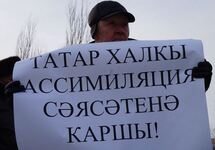
The State Duma adopted in the third, final reading amendments to the Law "On Education", canceling the mandatory study of the languages of national autonomies in schools. This was reported on the website of the lower house.
According to the Caucasus. Reals, 388 deputies approved the document, two voted against, there were no abstained.
The law establishes that "the free choice of the language of education, the studied native language from among the languages of the peoples of the Russian Federation, including the Russian language as a native language, state languages of the republics of the Russian Federation is carried out according to the statements of parents (legal representatives) of minor students."
The study of the Russian language in schools is still mandatory.
The document was entered on April 10 by a group of deputies of all four Duma factions. In the initial edition of the bill, on June 19, the first reading was contained, according to which "the teaching and study of the state languages of the republics of the Russian Federation is carried out on a voluntary basis and cannot be carried out to the detriment of the teaching and study of the state language of the Russian Federation." However, due to the protests in the regions, the chairman of the Duma Committee on Education, United Russia, Vyacheslav Nikonov, already promised that the bill would “radically recycle” by the second reading.
By the second reading, which passed the day before , the most frank chauvinistic nuances were excluded from the bill. Nevertheless, his main idea remained the same. In particular, amendments prepared in July by Tatar scientists were ignored. These amendments, on the contrary, fixed the mandatory nature of the study of state languages of autonomies.
The Russian bill caused response in the philological community abroad. July 22, 87 linguists from universities in Hungary, Estonia, Finland, Sweden, Norway, Denmark, Italy and other countries sent an appeal to the State Duma with a demand to reject the amendments to the Law "On Education". “A wide palette of small languages of the indigenous peoples of Russia is a unique cultural heritage of the whole world, all of mankind, and the death of these languages will be a brutal blow to the world language diversity and will significantly exhaust the intellectual heritage of mankind,” the Russian languages also have the historical right to obtain support of the state, which for centuries in various ways sought to suppress and assimilate small peoples. ”
The initiators of the appeal were Finnish scientists. Among his signatures were such world-famous linguists as TOVA SKUTNABBB-KANGAS (University of Roskill, Denmark), Janos empty (Budapest University), Johanna Laakso (Vienna University).
In July last year, Vladimir Putin announced inadmissibility to force people to learn languages that are not relatives for them. After that, an offensive on the obligatory teaching of national languages in schools began in the regions. So, on November 29, 2017, the State Council of Tataria canceled the mandatory study of the Tatar language , ignoring the protests of national activists.
More or less intense protests against the current amendments to the Law "On Education" were held in almost all autonomy. The initiative caused a particularly sharp rejection in the Volga region and in the North Caucasus.