
Translated material
"We made a deal"
Trump and Junker declared a truce in the trade war between the United States and the European Union
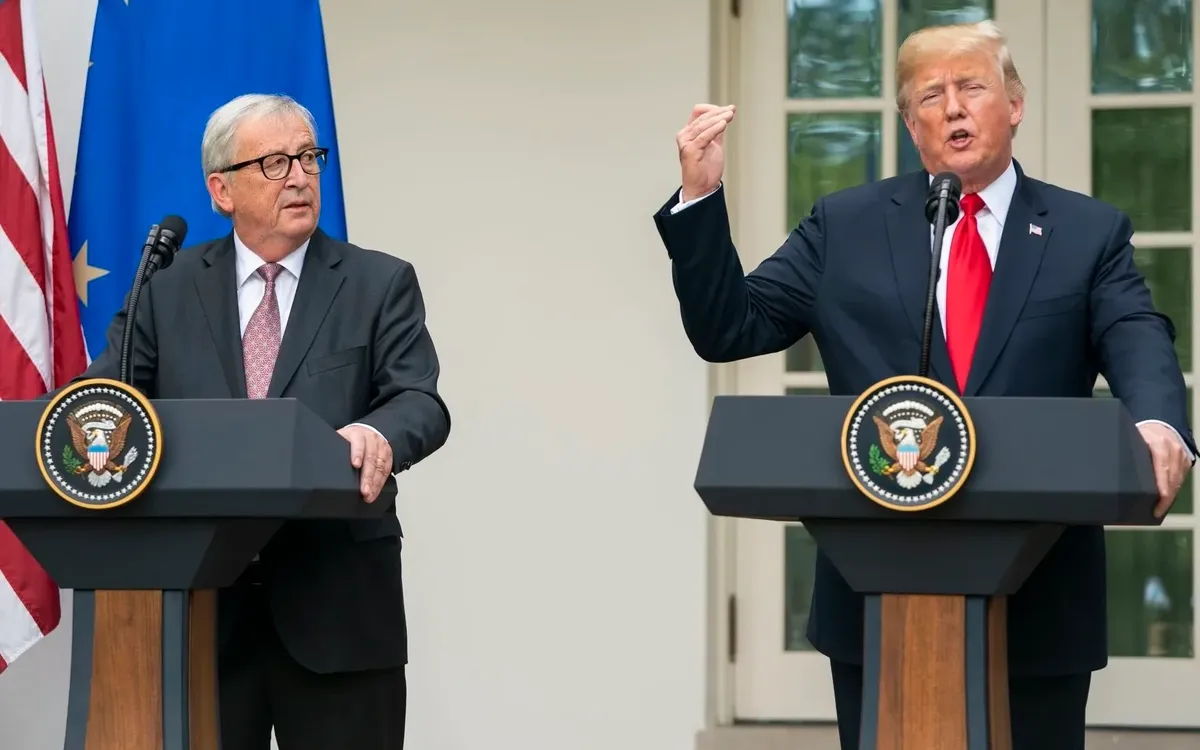
On Wednesday, the head of the European Commission Jean-Claude Junker flew to Washington to discuss customs duties between the EU and the USA with Donald Trump-in the context of the actual trade war. The result surpassed the expectations of many: Trump and Junker agreed not to introduce new customs duties and work on a decrease in old ones, in exchange to increase the import of American liquefied gas and soybeans with the European Union. Now the case is small - the parties must fulfill promises.
Background
The meeting of Trump and Junker was designed to resolve the trade conflict between the European Union and the USA, which seems to have achieved maximum exacerbation. On June 1, America raised customs duties on European steel and aluminum by 25% and 10%, respectively. European leaders, one after another, called the increase in tariffs unlawful, rash and harmful actions. The European Commission initiated a trial in the WTO, and also approved response measures - raising tariffs for the import of an entire list of American goods into the EU: from orange juice, whiskey and cigarettes to clothing and motorcycle items.
Then Trump announced a possible increase in duties on European cars - first of all, it would hit German manufacturers of BMW and Volkswagen. The European Union began to prepare for this scenario and announced their readiness to introduce additional duties - this time, on agricultural and high -tech products from the United States.
Trump explained the increase in tariffs by the national interests of American security. And criticism of European partners replied that America “like a piggy bank in which everyone climbs”, that the United States pay for the military security of European partners and that American manufacturers suffer, as a result,. On the eve of the meeting with Putin in Helsinki, Trump called the European Union an adversary of the United States economically, becoming the first American president to allow himself such a definition of the main strategic partner.
And before meeting with Junker, Trump took off his responsibility in advance for a possible failure of negotiations by writing on Twitter: “Representatives of the European Union will come to Washington to negotiate trade tomorrow. I have an idea for them.
Both the USA and the EU refuse all duties, barriers and subsidies! Then, finally, we will be able to talk about the free market and fair trade.
I hope they go to this, we are ready - but they will not agree. ”
The end of the trade war?
Trump was mistaken, predicting the result of negotiations. The European Union, in the person of Junker, agreed precisely what the US president proposed to strive for mutual trade without barriers and duties. Having appeared on a press briefing after negotiations, Trump and Junker designated the key points by which they managed to reach consent.
Firstly, the United States and the EU agreed to work in the direction of "zero duties and zero barriers."
Secondly, refuse to introduce new trade duties and continue negotiations. The United States promises to work on a revision of duties on steel and aluminum.
Thirdly, the parties agreed together to work on the reform of the World Trade Organization, which, according to Trump, is unfairly softly acting in relation to China.
The European Union in response will increase the import of liquefied natural gas from the United States, as well as imports of soybeans.
Commenting on the results of the meeting, both Trump and Junker did not skimp on positive grades. “I came with the intention of concluding a deal today, and we made a deal,” Junker told reporters during a press briefing. According to Trump, the EU and the United States switched to "a new stage of close friendship and strong trade relations, which for the good of both sides." Trump later wrote on his Twitter: “It is great to move with the European Union again in one direction. It was a great day for free and fair trade! ”
It remains to fulfill promises
The agreements of the junker and Trump are not documented in any way, however, according to the American president, work on the relevant documents “is already coming”.
The results of negotiations were warmly welcomed by American farmers for whom the production and export of soybeans is one of the main branches of agriculture. “Soybean beans are very important in Ayov,” Johni Ernst, a senator from Aiva, wrote on her Twitter. “Thank you for attracting the European Union and working for the benefit of the United States.”
The second part of the obligations of the European Union concerns the import of American liquefied natural gas. On the one hand, the situation is mutually beneficial. For Europeans, this is an opportunity to diversify the energy market in order to reduce the influence of large suppliers (primarily from Russia) - this task is enshrined in the EU Energy Security Strategy as one of the key. For Americans, this is the expansion of the market and the ability to compete with the northern stream-2-a project in which Trump at the last NATO summit actively criticized Germany.
True, the question of economic expediency may arise here. The desire to switch to liquefied natural gas, including the American, refusing Russian gas supplies, different European leaders regularly speak. But, ultimately, this is always a matter of price. The ex-USP of the United States in the European Union Anthony Gardner is skeptical of this part of the agreement.
“The idea to significantly increase the supply of liquefied natural gas to the EU is absurd,” he wrote on Twitter. “LNG cannot compete in price with pipeline gas.”
So far, Mexico, South Korea and China remain the main importers of American liquefied gas, about 10%accounts for Europe. However, which figures are understood by the “significant” increase in supplies, Trump and Junker were not voiced.