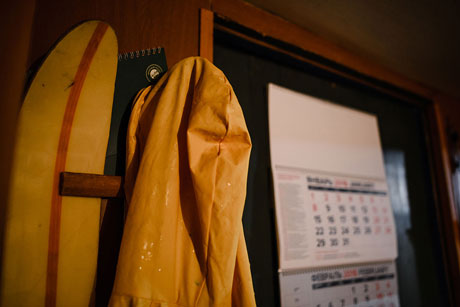
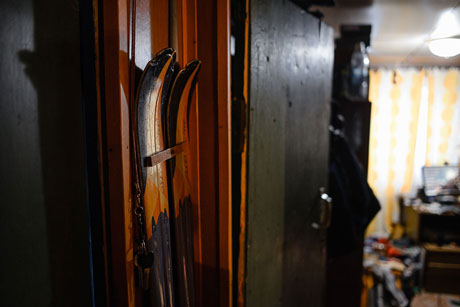
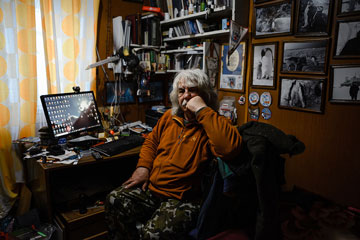
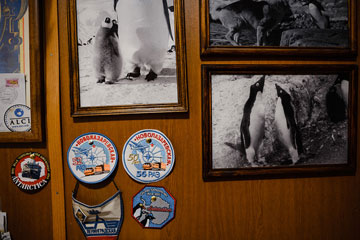
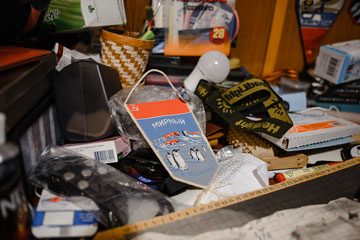
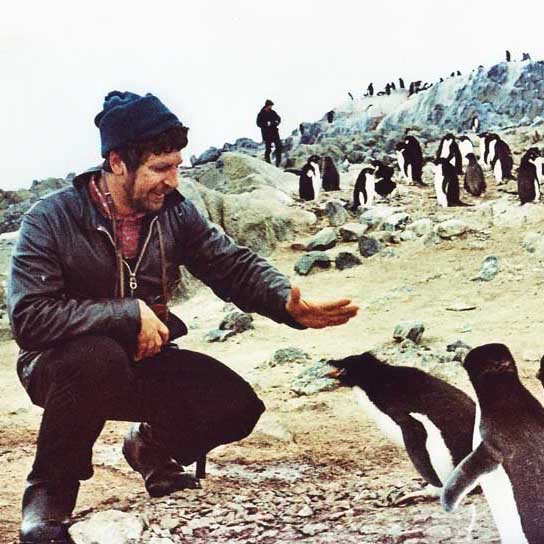
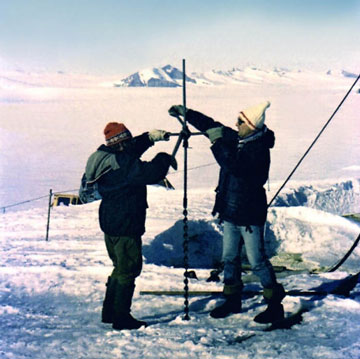
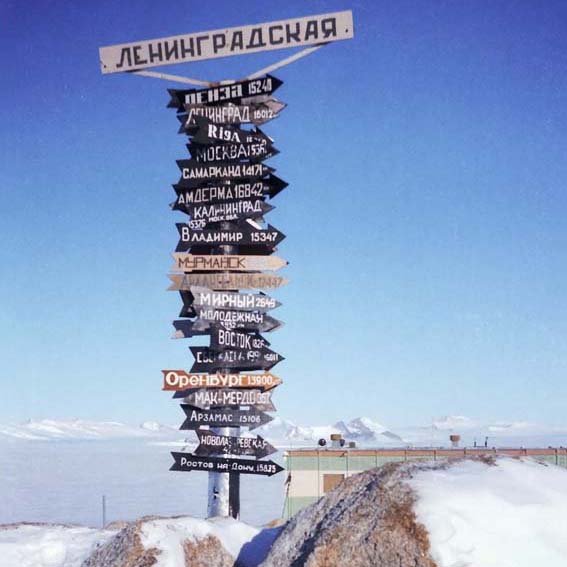
An avalanche went on the road was cleared in the evening. On the basis of the anti -vanity detachment, it was dark and quiet - everyone went home, only in the house on the opposite the light burns - the leading engineer of the detachment Oleg Ostaptsov lives here. - I do not get off here. You can hang a jacket here - he shows the skis attached vertically to the wall, which serve as a hanger, then leads me to another room. - But my iconostasis! Two walls were almost completely hung with black and white photos from the South Pole: in 1984, Oleg went on an expedition to Antarctica as a senior mute engineer and made a round-the-world trip. So the ice fell in love, and along with the ice and the sea and snow. - Things such as Antarctica begin from childhood. When I studied in elementary grades, a drawing teacher read us books about traveling. Approximately then I found myself fascinated by this earth. The native Rostov region attracted Oleg less, therefore, having graduated from school, he went to study at the railway worker. He served in the Soviet motorized rifle troops, and then entered the Leningrad Hydrometeorological Institute. - I needed to go to Antarctica! And you will not get there without appropriate education. The institute made travelers of us: in the summer on expeditions for Sakhalin, to the tundra, to Siberia. And no one even rushed home - the farther and more difficult the expedition, the more prestigious. For more than 20 years I went to her, to my Antarctica. When Oleg left for 20 months to his Antarctica as part of the 30th Soviet Antarctic expedition, he already had a wife and a one-year-old son. - It was so hard to leave! But the wife did not mind - I was not the only one. Someone is going normally, someone doesn’t: we divorced four months after my return. The expedition team was sent from Leningrad by plane to Vladivostok: from there, the ship saved in a roundabout. We entered the port of Singapore, through the Indian ocean they crossed the equator. Oleg, like all members of the expedition, received the “Printing of Neptune on the Ass” - they say when they have flown with fuel oil for those who first crossed the actor on water. On the island of Mauritius, local residents raised sugarcane, from which they made rum. This reed moonshine was cheap, so before leaving, the team stocked up with three -liter banks with firewater. In Uruguay, they scored fresh water and moved to Antarctica, to the Bellingshausen station. -We came on a polar night on the 20th of December 1984. I saw the raspberry-purple-pink sky and did not sleep all night-I walked on the deck, I stared. I was already pounding from the fact that the dream came true. Seven months of 200 people traveled around the world, and then they were divided into different stations: 100 people remained somewhere, and only 14 at Oleg’s teams at the Oleg’s teams. Having unloaded at the Mirny station, Mikhail Somov, a scientific and expeditionary vessel, on which the expedition participants arrived at the Southern Continent,-went to the Russian Rossa Seat With a March hurricane, he ended up in a forced drift. The remaining participants in the expedition, among whom was Oleg, were evacuated from Somov only in April, when another ship came to their rescue. The team drove for groceries to New Zealand to return and, albeit with a delay, change the withdrawn composition - this is the order. Winter has already begun, and the edge of pack ice, which surrounds Antarctica, began to quickly go north: a helicopter that flies to the station from the mainland could not get it - it flew only 50 kilometers, and now there were three times more to the station. The polar night dominated - the bright time of the day was no more than three hours. Flights took place in the dark, in conditions of poor visibility. The second helicopter crashed on unloading. No one died, but the further unloading was stopped - half of the fuel was not brought to the station for wintering. - Electricity and heating at the station were provided by diesel power plants. We were given the right to decide: to stay winter with a supply of fuel twice as lower than normal or leave. To cross the whole globe to leave? Of course, everyone remained. So they lived with minimal heating: it was cold and damp, I had to sleep dressed almost all year. There was not enough heat to dry the room, and condensation was going on the ceiling. These drops were so annoyed! It will drop you on the crown, then on the nose. And it was possible to sleep about five hours maximum. I overslept a couple of times, for half an hour, but I got up with such a high-I felt that I had finally rested. By the middle of the expedition, I dreamed that upon returning home it would not be necessary to get up at half past six in the morning. Six months later, the steamboats brought a new shift, and finally it was possible to get enough sleep. And what do you think? I woke up at half -past five and still get up so. For 11 months at the Leningradskaya station, Oleg was used to living surrounded by ice. Therefore, even in Rostov, where he returned after the expedition, he went to work in a snow -owned party - to study glaciers in inaccessible places. At the time of perestroika, he managed to beat avalanches in the Dombay anti -vanity detachment, but in the nineties they closed it, and it became very bad with work. -In the mid-90s he even tried to trade in the market. Then I started drinking tightly. You will enter the market, swallow vodka, flood the balls - it was impossible to stand sober there. Well, not mine! So several years passed: Oleg began working in the Anti -Lawn detachment of Elbrusya in 2000. - I came to the profession of a carrier consciously. At first, maybe because of romance, and then it became a way of life. I was very lucky: almost all my conscious life I was engaged in what I loved. In the Elbrus, I'm in the ways with myself. I was very lucky: Almost all my conscious life I was engaged in what I loved