
Translated material
To die young
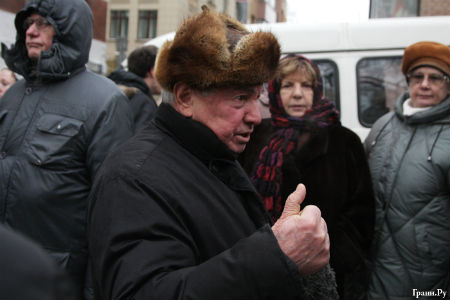
Vladimir Voinovich in 2010. Photo by L. Barkova
The necrologist genre, in principle, does not imply much fun, but you usually say goodbye to the celestials, reflecting on the fate of a great and distant person, but here is another case. They have been familiar for so many years, although I can’t say that it’s really close. But we managed to talk about a lot. At first, these were an interview - after all, the privilege of the journalistic profession is that you can sometimes easily get acquainted with your favorite writer, and come to visit, talk, and share this conversation with the public. Then - they simply talked, and each meeting became a personal life event.
And here is a strangeness. Vladimir Nikolaevich was a quarter century older than me, but it somehow did not think about it when they met. At 85, he was not at all an old man. A world -famous writer, he did not seem to be a patriarch. He seemed and was a very young man - with an aggravated sense of justice and an instant reaction to lies, hypocrisy and meanness. Therefore, until the last days he participated in this unhappy public life, standing up for innocently convicted and with youthful innocence, appealing to the minds of the pre -war authorities. Like, how do you not understand that Oleg Sentsov’s death will fatally affect the attitude towards you ... Illusions about this power, he did not have the slightest, but sometimes believed that the villains could be scared.
In a narrow circle, if they asked to read something, he certainly read his poems. A common friend, a subtle connoisseur and poet, expressed disapproval in this regard: they say, a wonderful writer, and does not comprehend that his poems, unlike prose, are mediocre. Vladimir Nikolaevich, I think, knew the price of Chonkin and knew the poems no worse, but in a narrow circle, after about the fifth, the rhymed works stubbornly preferred uniforms. Probably, at that moment he lived another literary life, not fully realized, albeit a noticeable mark on the dusty star paths. By the way, I drank not according to the rules - always to lower the degree, from forty -degree to dry blame, and felt great.
Actually, the writer Vladimir Voinovich did not live all his life according to the rules. In an authoritarian country, he made a program statement “I want to be honest” - and followed this canon to the end. He was a Russian satirist from God - and at the same time a cheerful, infinitely witty and charming man, completely devoid of a desire to shed secret tears through laughter, sorrowfully sad about the imperfection of the world, which is so characteristic of our satirists. He ridiculed us, not teaching, and mixed us, not hoping that we would correct. And he was always himself, breaking any idols, even those who had previously worshiped if they turned out to be false.
As a result, he achieved successes of unthinkable, subjected to reproaches at home and in emigration, from people who do not agree with each other in anything but hatred of mockingbird. For Voinovich, who attacked the shrines in the person of the Soviet soldier and the anti -Soviet idol, was able to reconcile the Moscow regional committee with Vermont. Despite the fact that he sincerely loved his heroes, as a real writer was supposed to, almost everyone loved - from the incompletely heroic death of the traitor of the Milyaga to the immortal Simych Karnavalov, who accepted the unprecedentedly heroic death. And the most beloved hero in world literature called Sobakevich.
Actually, this is a well -known truth: humor prolongs life. So it imagined that Vladimir Nikolayevich would live another hundred years and see all his prophecies for those who have come true, even Putin would be launched into space. On those same paths. But in the morning you turn on the computer, and the first news - Voinovich left, a heart attack, suddenly, as happens with the young. Recently, his son died, and this woeful event probably brought the death of the writer. It happens that life, designed for the preventive years, becomes unbearable, and a person leaves suddenly, without saying goodbye. Having shared with us pain, which can never be overcome.