
Translated material
About the "paradox" Sakharov
To the 50th anniversary of his "thoughts ..."
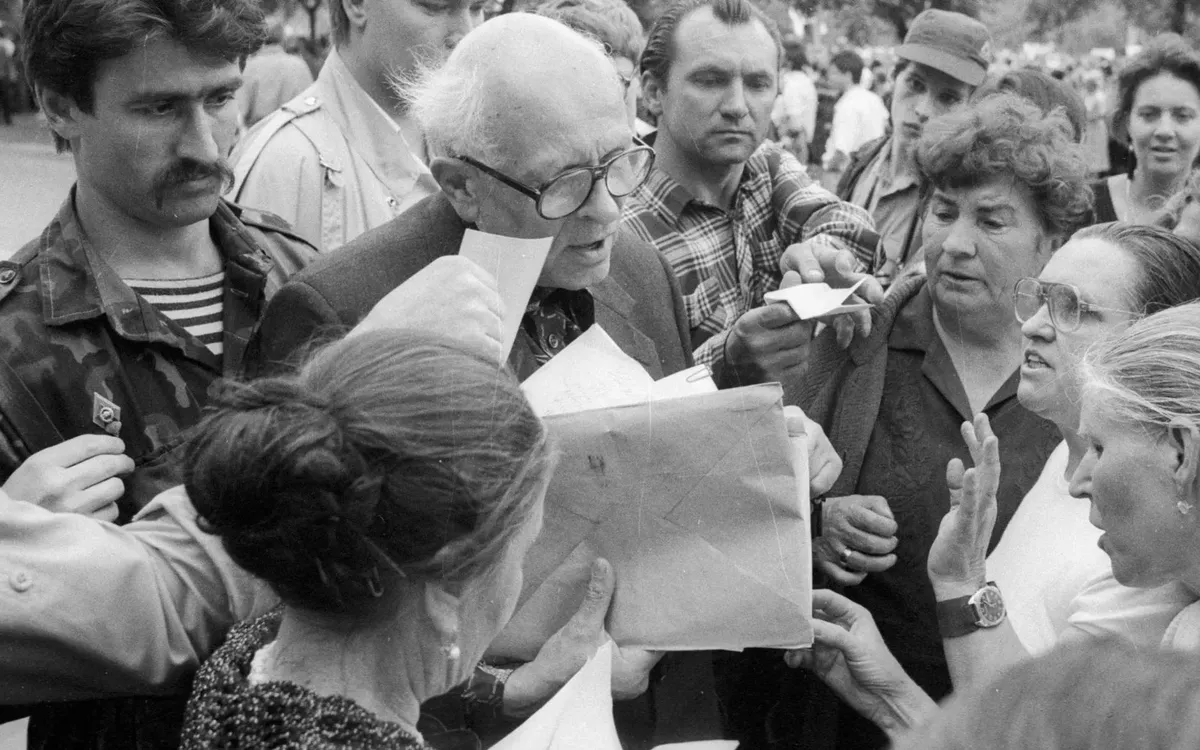
50 years ago, July 22, 1968, New York Times published Essay A.D. Sakharov “Reflections on progress, peaceful coexistence and intellectual freedom”, read by the highest leadership of the USSR in the manuscript and then published in the West with a total circulation of about 20 million copies. In the article “Andrei Sakharov’s thoughts on progress, peace and freedom - 50 years” (“Trinity Option”, 07/17/2018), its author of science, Gennady Gorelik, writes about the motives that prompted Andrei Dmitrievich to write this historical essay. And I must admit that for me a lot turned out to be new and interesting here, although I knew Sakharov for more than 20 years (1968 - 1989) and myself wrote a lot about him after his death on December 14, 1989.
I did not know that Sakharov’s writing in Samizdat, followed by the inevitable publication in the West, was preceded by the unsuccessful attempts of Sakharov, as well as Yu. Khariton and E. Zababakhin, to convince the Soviet leadership to agree with the proposal of US President L. Johnson of January 10, 1967 on the mutual moratorium on the deployment of missile defense (pro). The leading Soviet nuclear people, like their American colleagues, believed that the same “equilibrium of fear” (the threat of “mutual guaranteed destruction”), which kept holding for many years, and has kept (!), Humanity from self -destruction in the third of the already nuclear world war, could be disturbed in the process of creating a PRO and in the United States.
After the chairman of the USSR Government, N. Kosygin, who visited the United States in June 1967, rejected the US Sakharov proposal, Sakharov sent a completely secret official note to the Politburo with the justification of such a refusal. This note was ignored, however, the position of the USSR leadership in this matter changed after the KGB in May 1968 presented the first version of Sakharov’s “thoughts” of the Politburo who appeared in Samizdat. And already on July 1, the US President announced an agreement with the USSR to begin negotiations on the restriction of the pro.
These most important historical events today also need to recall in connection with the recent discussion about the “cannibalic” idea of Sakharov’s development of a nuclear torpedo (mines), capable of covering the United States with deadly tsunami and repeatedly repeated the question: how could it become a laureate of the Nobel Prize of the world? Below I will try to answer the apologists of this imaginary "paradox" Sakharov. But at first briefly-some personal memories of the 68th year in connection with the "thoughts ...".
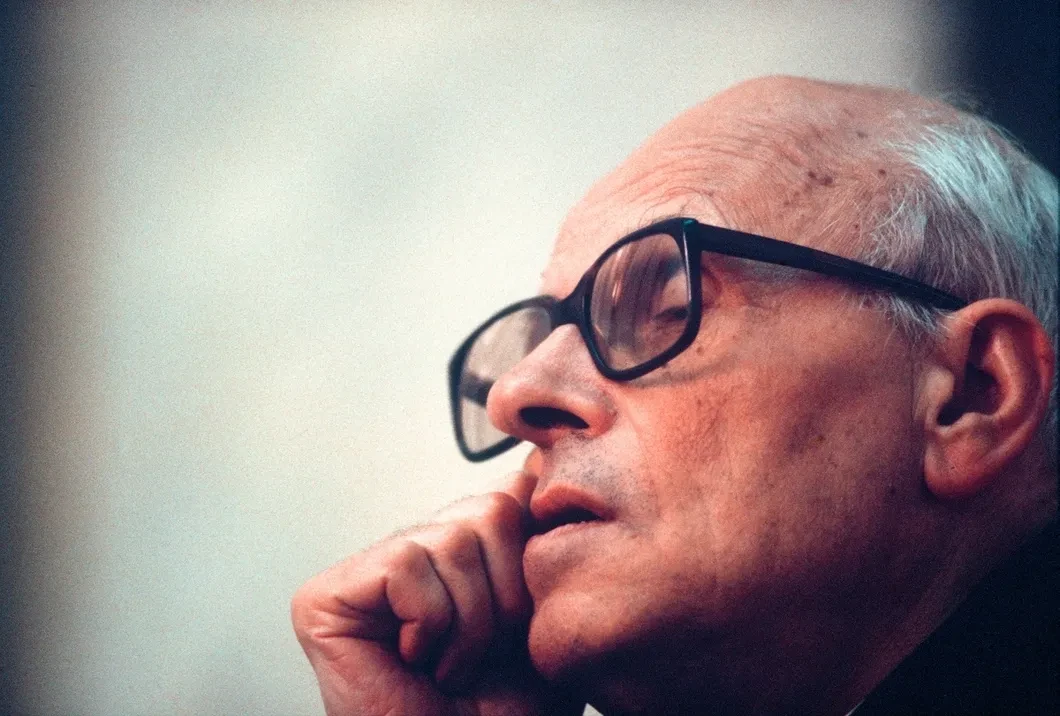
"Reflections ..." I read in May. The fact is that Maya Yanovna Berzina, my friend’s mother since studying at the physical faculty of Moscow State University Pavel Vasilevsky, was the first to print “thoughts” for Samizdat. And they brought them to her by the “King of Samizdat” Julius Telesin. I did not like everything in "thoughts". And the case provided the opportunity to discuss this a little with Andrei Dmitrievich.
Sakharov knew my father well from their joint work at a nuclear facility in Sarov. And I met Sakharov in 1968, when he agreed to become an opponent of my candidate dissertation on the general theory of relativity. In early August, he and I ended up on the same plane, heading for the II International Gravitational Conference in Tbilisi. Due to the thunderstorm over the main Caucasian ridge, the plane landed at night in mineral waters, and at the very moment when A. and I, standing in the aisle between the chairs, talked about something, the stewardess approached him and offered to spend the night at the airport hotel. When asked by Sakharov, where a young colleague will spend the night, she explained that, unfortunately, the hotel is very small, and only academics and foreign scientists will be able to spend the night in it. Then Andrei Dmitrievich, thanking the stewardess, refused the hotel, and we spent the night at the Russian chairs with him.
This is where it was given the opportunity to talk a little about “thoughts”, of course, choosing expressions, realizing that the “ears” around. By that time, in my 29 years, I was already configured quite anti -Soviet. In the spring of the same 1968, Pavel Vasilevsky and I graduated and launched into samizdat under the pseudonym S. Zorin and A. Alekseev a large sharply critical and simultaneously program article “Time does not wait”, which appeared in Samizdat in the early 1969 by a separate book, called “Leningrad Program” and was published in Paris in Paris in the publishing house “Sowing”. The "enemy voices" also spoke about her.
On my comments about the excessive, as I believed, “Sovietness” and the anti -American orientation of “thoughts” A.D. reacted very concisely and generally explained that the denial or even just a critical discussion of some ideological stereotypes would mean complete rejection from the potential reader; that in the work already quite capable of scaring unusual ideas, and he hopes that the “thoughts” will be read and heard by the Soviet intellectual, scientific elite.
On the secret theme of the pro and the fact that the first anti -full readers of “thoughts” can be in the Kremlin, Sakharov, of course, did not spread.
At the same time, I note that in the “thoughts” of Sakharov, as always, it is absolutely sincere, in 1968 he was still largely Soviet, who believed in the ideals of revolution and socialism and in the historical doom of capitalism. And the idea of the convergence of the two systems expressed by him in the “thoughts” as the only opportunity to avoid nuclear self -destruction of mankind was a new enough for him. In general, I have never met a person like Sakharov by the ability to dialectical creative self -development.
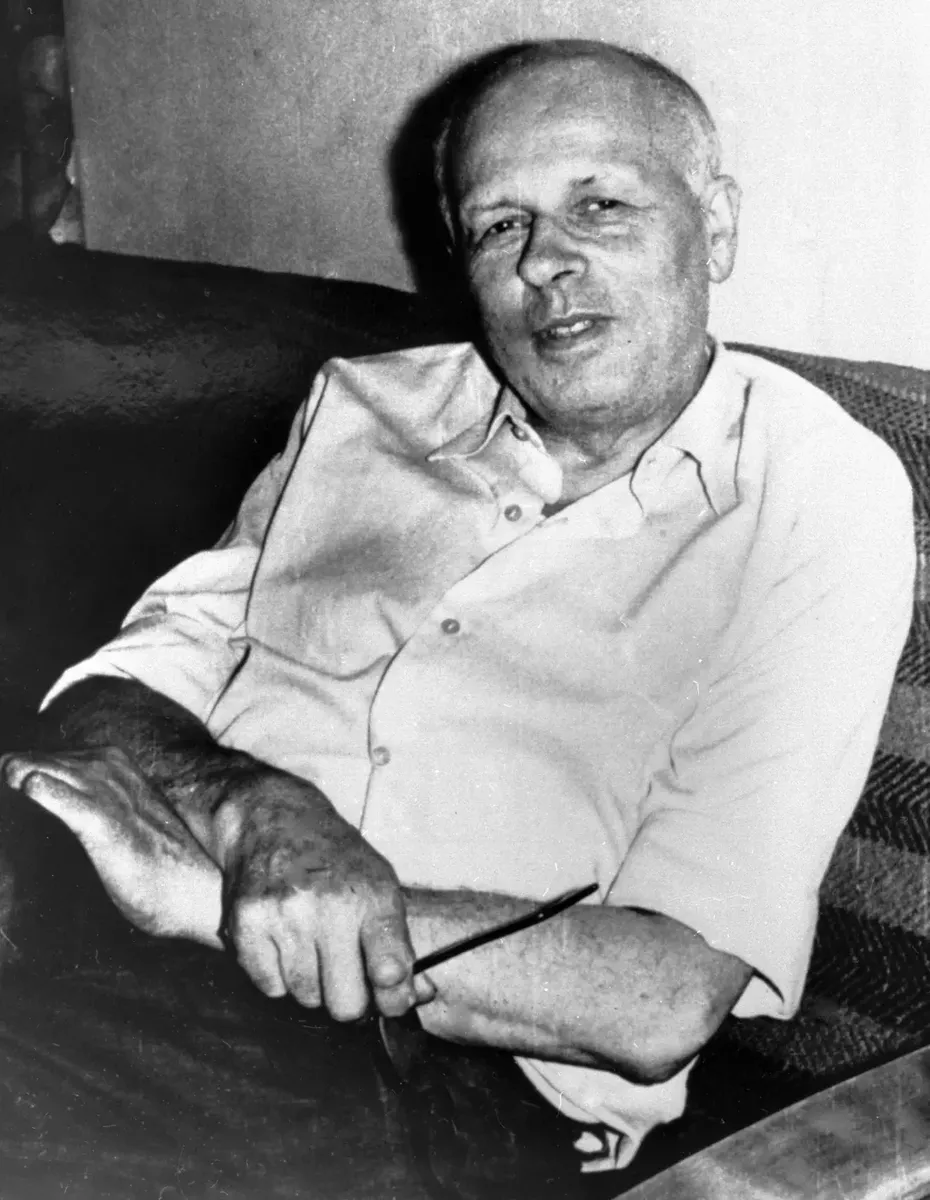
And a few words about the view of “thoughts” on a completely different side: “This article by Sakharov was a revelation for us,” the American scientist, an active participant in the movement against the war in Vietnam (1964 - 1975), told me at the “Sakharov Concress”. He explained that the information about the monstrous crimes of the Stalinist regime, the power suppression of the Hungarian uprising (1956) and the “Prague Spring” (1968) objectively encouraged them - American wrestlers for justice - to the anti -Soviet position with the anti -Soviet position of the American ruling elite. As a result, complete confusion, and “Reflections ...” Sakharov gave an answer, the ideological point of the support: the rapprochement of the two opposing systems while maintaining the best that is in each of them. And this is true - the article by Sakharov really became a revelation for millions of people in the West.
Now - about the nuclear torpedo and about Sakharov's “paradox”. The creation in the USA and independently in 1955 in the USSR of a hydrogen bomb potentially unlimited power and the test of such a Soviet - “Sakharov” super -bomb (artificially limited capacity of 50 megatons) on the New Earth in 1961 posed a question of the method of using such a super -weapon against a potential enemy in 1961. The idea of a nuclear torpedo was developed both in the USA and in the USSR.
Among the participants of the II International Sakharov Physics Conference in 2002 there were several American nuclear physicists in Fian. And one of them told me in a private conversation that when he worked in Los Alamos in his youth,
He was instructed to calculate the parameters of a hydrogen bomb, the undermining of which in the depths of the ocean would create a wave capable of destroying the USSR.
He honestly conducted calculations and came to the conclusion that it is quite possible to create a tsunami one kilometer in the Northern Arctic Ocean, but taking into account the geographical size of the Soviet Union, it is useless; The wave will not reach Moscow and Siberian nuclear mines.
In the USSR, on behalf of N.S. Khrushchev carried out similar calculations and even tests on the influence of the “tsunami” on the model of the Pacific and Atlantic coasts of the United States. The conclusion was the same - nothing would work out: the Atlantic is too shallow, and the tsunami in the Pacific Ocean will only lead to the destruction of California (the Cordillers will not miss the wave) that it is useless from a military point of view. One of the leaders of these tests was the same Admiral F. Fomin, about which Sakharov writes in his “memoirs” in connection with the idea of a nuclear torpedo.
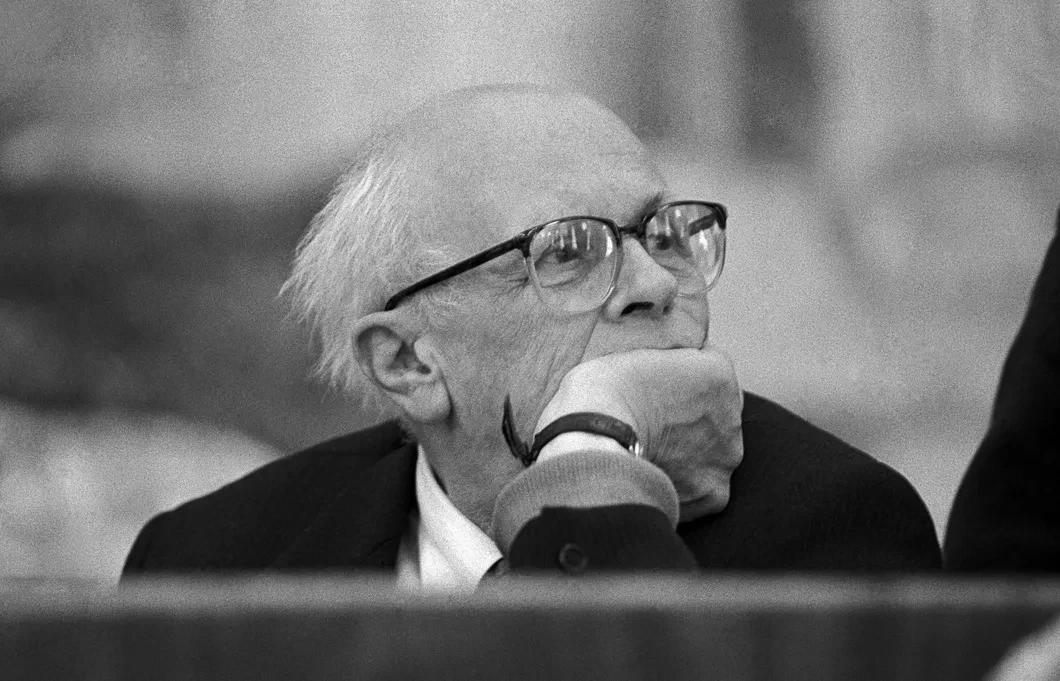
Sakharov did not know anything about these super-secret research, and in chapter 15 (1959-1961) “Memories” described his “fantasies” to create a torpedo capable of destroying the enemy ports. He shared this idea with a number of colleagues and with Admiral F. Fomin, who called the idea of “cannibalist”, since it is associated with gigan human victims. Further, Sakharov writes: "I was ashamed and never discussed my project with anyone again."
The question repeatedly repeated whether he feels remorse due to participation in the development of monstrous weapons, Sakharov replied that
No, he does not feel, because it was this weapon that kept him from unleashing the Third World War.
But at the same time, he always talked about the dangerous instability of the “balance of fear” - the same balance that could be easily violated by the creation of missile defense systems. In Chapter 6 of Part I “Memoirs”, Sakharov writes: “Today, thermonuclear weapons have never been used against people in the war. My most passionate dream (deeper than anything else)-so that this never happened, so that thermonuclear weapon restrains the war, but never used. ”
Yes, Sakharov is the creator of a terrible weapon, but he did so much so that it is never used! And his Nobel Peace Prize is quite well -deserved. There is no "paradox".
Nevertheless, perplexity of this kind arises all the time, sometimes in very respected people. So Viktor Astafyev, in an article in Izvestia on April 30, 1994, accused Sakharov of creating a terrible weapon and did not repent: "Such a little trick is to die a hero, committing a crime." We - members of the Sakharov Commission answered him. I give this answer completely:
“There is nothing to repent of Sakharov
With understanding and gratitude, we read and listen to articles and performances by Viktor Petrovich Astafyev. With gratitude, because they are about the most important - about primary values, about the hope of moral recovery. It was more painful to read the writer’s words about the Queen, Landau and especially Sakharov in the Izvestia on April 30 (“Having created a weapon that burned the planet, he never repented. Such a little trick is to die a hero, having committed a crime”). We consider it necessary to answer on the merits.
First. L. Landau tried to avoid participating in an atomic project. Recently published documents - materials of gabel surveillance - say that he did this in accordance with his beliefs. A. Sakharov, like S. Korolev, I. Kurchatov and many others, unlike the early ladowu, were people who believed in the Soviet system. And they were really convinced that the country, which incinerated Hiroshima and Nagasaki, could repeat the same thing with Moscow and Leningrad, and did everything to take this threat, considered it their highest moral duty. Is it possible to use the word "crime" in these conditions? In his “Memoirs”, Andrei Dmitrievich writes that, working at the “object”, he felt in the war: “It was my front.” And what is a war, the author of the "Damned and the dead" knows firsthand.
Second. About responsibility for the deed and repentance. The consciousness of its personal responsibility as the creator of a terrible weapon permeates the entire social activity of Sakharov. When he understood for whom he works, which monster is arming, he immediately joined the confrontation with the system. Sakharov always acted in strict accordance with his beliefs, the word "cunning" is impossible next to his name. Unlike many, many for him, there was no gap between thought and word, word and deed. The spiritual tragedy of our country is that the era of terrible crimes gave rise to many people, one way or another in these crimes of the involved and still avoiding cleansing repentance. Sakharov is not one of them.
We turn these lines to Viktor Petrovich with respect and hope for understanding.
S. Kovalev, B. Bolotovsky, B. Altshuler, Yu. Samodurov - members of the Public Commission for Malication of the memory of A.D. Sakharov and his heritage. " (Izvestia, May 6, 1994, p. 4.)
Friends from Astafyev’s circle told me later that Viktor Petrovich satisfied our answer, he accepted it.
Boris Altshuler , member of the Moscow Helsinki group, senior researcher at the theoretical physics department of the Physical Institute named after P.N. Lebedeva RAS