
Translated material
Cornflows in the snow. Continuation
Vasily Surikov, who is missing. From a personal diary
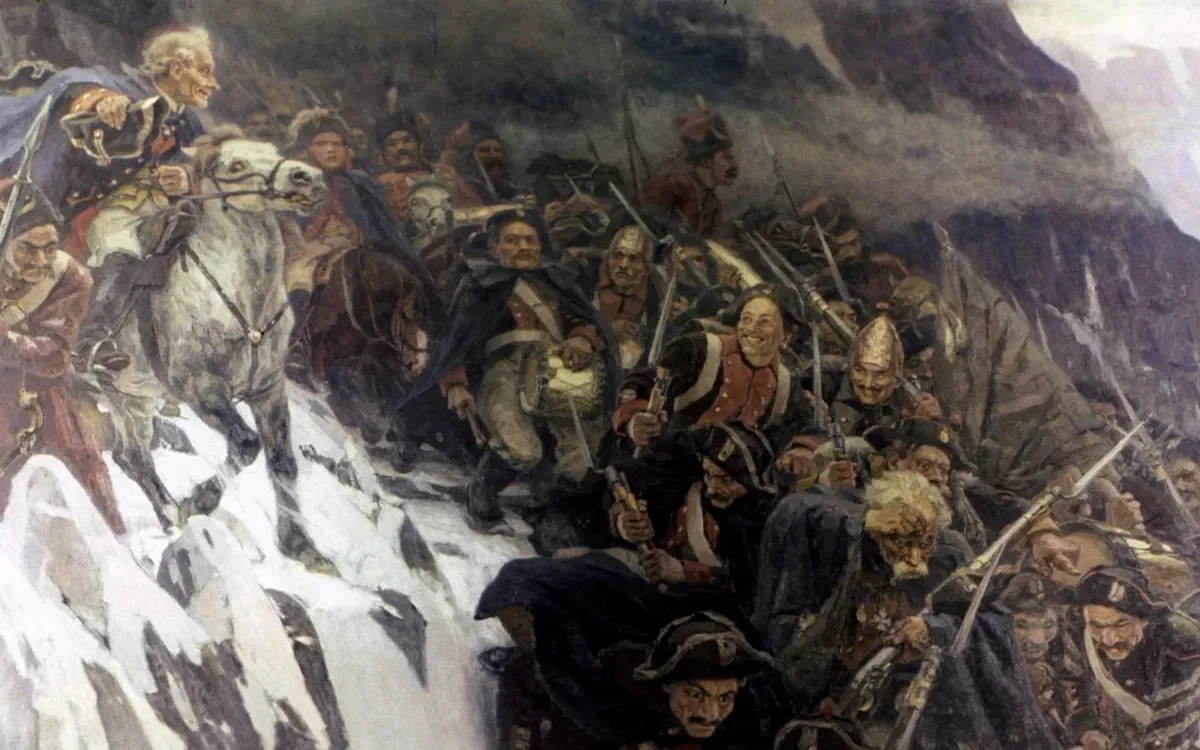
This year, the 170th anniversary of the great tragic of domestic painting turned 170 years old. Of all its classics, it is he who causes the most consonant with my personal impressions from today's people and events.
Continuing. Beginning on the website "New" for July 27, 2018
January 24, 2013 Thursday. *"Death death is corrected." *
Of my beloved domestic painters (except for Rublev, Serov, Levitan, Vrubel), Surikov, perhaps, more often than others gives rise to tunes with hacks in my memory, with personal impressions from current people and events, sometimes very distant from the personality and creativity of this great and paradoxical tragic of Russian art.
With his assessment of public opinion and critics-art, generally a strange thing happens. He is confidently called the "morning of the Strelets execution", "Menshikov in Berezovo" and "Boyaryny Morozov". Some add the “conquest of the Ermak of Siberia” and the “capture of the snowy town”. And then everything, it seems, is more insignificant, although after that he rose to such peaks as “Suvorov’s passage through the Alps” and “Stepan Razin”.
For medals in honor of the victory of the young Russian fleet over the invincible by the Swedish fleet, Peter the Great commanded to knock out the inscription: "The unprecedented happens." These words later overshadowed the whole history of Russia. But the one who correlates them only with this and other military Victorias will be deeply wrong. For in its historical being was also Blokovsky: "And the impossible is possible."
About all this - the Surikovsky “Suvorov’s transition through the Alps”. Not only about overcoming the soldiers of the "horizontal" country of alpine verticals of nature, but also about overcoming an insurmountable vertical of death and fate.
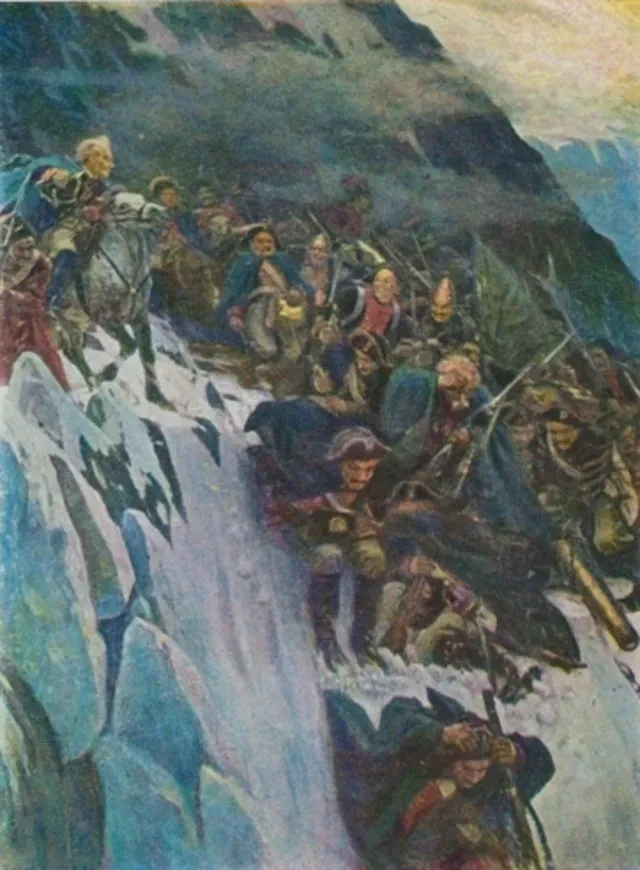
I met only twice my life with an accurate and deep understanding (of course, in my personal, subjective view) of the Surikovsky “transition of Suvorov through the Alps” as a tragic aspiration to the abyss of death, as a fight of life and death, as “death death” ...
The world is great, and there are probably much more cases of this understanding of this picture. But I'm only talking about my experience and two specific people. The first is Alexander Genis, writer, publicist, observer of our "new". The second is Vasily Kirillov, my old friend is still in student times, and then for joint work in Ulyanovsk Pravda.
So, Genis has an adultery, wonderful book - Fantiki. About the ten masterpieces of Russian painting from the Tretyakov Gallery and the Russian Museum, "included in the DNA of the nation." Why "candy wrappers"? In the annotation to the book, this is explained as follows:
“When a thing becomes familiar, like a candy candy wrapper, we stop noticing it, we do not see the need to think about it, even if it is a work of art. “Morning in the pine forest”, “rooks flew”, “the appearance of Christ the people” - these and other canvases have long turned into unshakable milestones of Russian culture, so that the sliding look on them noted little, in addition to their inviolability. As you know, Alexander Genis writes only about what he loves. And under his gaze <...> These unknown-recognized paintings come to life again ... ".
But what's interesting. When it came to Surikov, for “revival”, “resurrection”, he chose not “the morning of the Streletsa execution” or “boyar Morozov”, namely, “Suvorov’s transition through the Alps”, unlike “bears of the clubfoot” (who settled in the “morning in the pine forest” from the light hand of Savitsky, but at the request of Shishkin himself), it seems to not at all candy phantles. It has fallen, however, has long had a constant residence permit in primers and school textbooks of history.
Here is another:
“Of the seven great historical paintings by Surikov,“ Suvorov’s transition through the Alps ”is considered the most patriotic and the weakest. But I <...> I always liked it more than others, for it contained an obvious secret. In my opinion, this is the most incomprehensible and incomprehensible picture in the entire domestic canon. ”
Genis returns the canvas the status of the tragic, which is pretty faded under the influence of the Derzhavinsky “thunder of the Victory Sign” (by the way, dedicated to the assault on Suvorov, another vertical - the walls of impregnable Ishmael), too often remembered next to this picture. What is this about a feat - few will argue. But - the feat of what? Known for the textbooks of the history of successful maneuver to save the army that got into the trap with the subsequent access to the plain in an unexpected place for the enemy? Or a feat of accomplishment of the impossible, overcoming the death of death going to the death of the very death?
This canvas, perhaps, is much more than other works by Surikov, demonstrates the “non -linearity” of his artistic thinking, non -Evlids The nature of his painting, his famous discrepancies “Pravda of Life”, the literal perception of things, events, their proportions - for the sake of a more relief and acute disclosure of the main, deep intent. Well, how could the horse, on which Suvorov, in general, could get to the icy edge of the cliff, in which she could break at any second? Or - why are the soldiers rushing into the abyss with naked bayonets - so they will bite each other! Or - why are they dragging the barrel of the gun into the abyss - they won’t keep it, they will break down with him! Or…
However, Surikov needed this, an accelerated overturning of the human stream, a waterfall into the abyss. In this exaggerated, pointedly “vertical” picture, everything - both mountains and the psychological state of people whom the uncontrollable human stream is inevitably overturning into the abyss (but moreover - what is the different state in the beginning, in the center and already at the lowest edge of the picture!), Full of the maximum and even heavy tension. Written forty years earlier (and therefore, in much greater proximity to the real event), the canvas of Alexander Kotsubu on the same topic “The transition of Suvorov’s troops through Saint-Gard on September 13, 1799” in all these relations is much more calm and “horizontally”.
Alexander Genis in the Alps, in the vicinity of the Suvorovsky transition, tried to repeat the descent into the abyss depicted by a suuric method. And only thanks to a happy chance survived:
“Now I will never believe that you can go down from an almost steep cliff like Suvorov soldiers in the picture - face forward. And this means that Surikov depicts a march to death. ”
Yes, Surikov depicts a road leading right to death and only to death. And if you want, this is him, Surikova, the “apotheosis of the war”, no less strong in effect on the consciousness and subconscious of a person than the same anti -war manifesto of Vereshchagin. But - the watershed. Here, the final impression largely depends on the properties of the depicted human flow, materializing and biblical: “death is corrected by death”, and Petrovskoy: “It happens unprecedented,” and Blokovsky: “And the impossible is possible.”
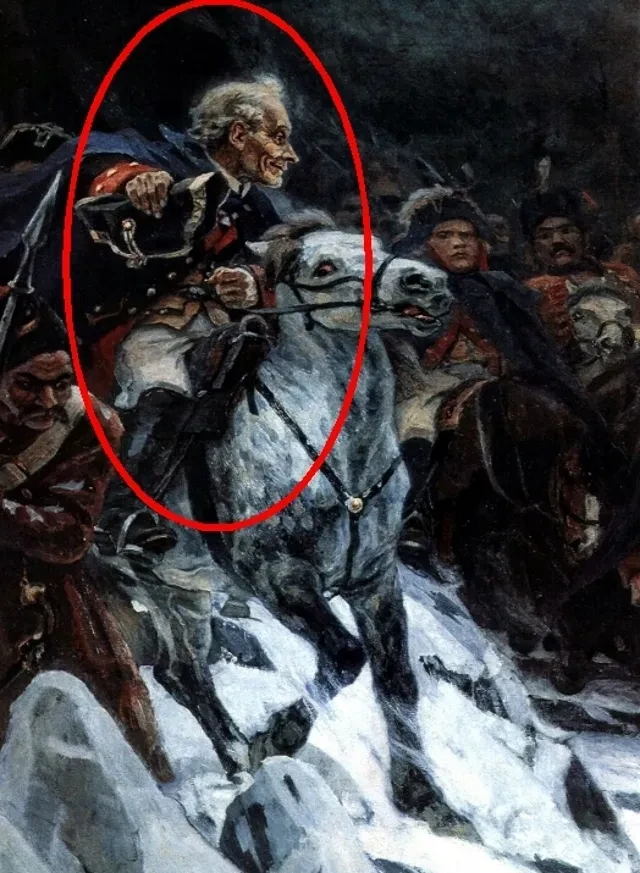
It is no coincidence that the same Alexander Genis aptly observes the same, Suvorov’s head on this canvas resembles Voltaire's head. Indeed, compare with the famous Voltaire of the work of Jean Antoine Gudon - are you like, right?
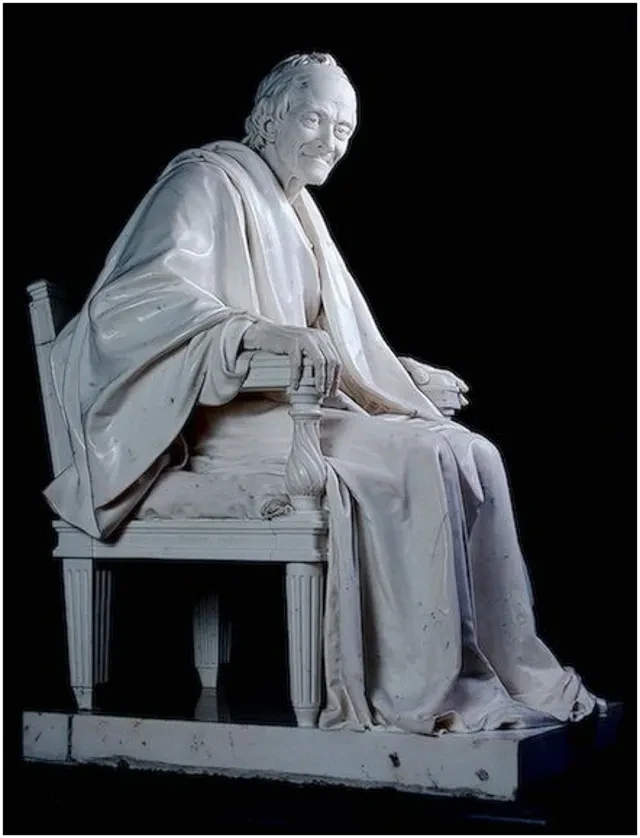
It is no coincidence that the same Alexander Genis aptly observes the same, Suvorov’s head on this canvas resembles Voltaire's head. Indeed, compare with the famous Voltaire of the work of Jean Antoine Gudon - are you like, right? If it weren’t for a meticulously, carefully, for a long time Surikov searched for the national characters to the historical characters of his paintings among real people in the surrounding life, then the idea that he wrote Suvorov from this Hermitage Voltaire.
What are the soldiers laugh in the center of the picture - what is so contrasting compared to the expression of faces at the top, where is still an alarm of the unknown, and below, where the abyss itself is already ahead? Most likely, Suvorov encourages them with any assertive, “volterian”-paradoxic aphorism in the spirit of his “science to win”. So the canvas is also voiced by inaudible, but specified by us in his voice.
Suvorov at Surikov is both human and monumental. It feels well and conveys the genis. Although he associates the image of Suvorov with the ideas of the 18th century, "appreciated gestures and glory," but many words cost a lot of things: "commander, frozen in a proud and impossible pose, the army indicates the path to immortality."
Yes, according to all the laws of evidence, Suvorov on his horses cannot be kept on a tiny ice patch. But - it is held back! And even freezes with a monument. For centuries. "Indicating the path to immortality."
And now about Vasya Kirillov. He has a poem " Surgeon":
The nurse will order a short time:
“In the wards! Radio - silent! "
And passes with a little retinue
A gray -haired mobile old man.
As if the land irrigated the earth -
Fathed with shaggy grass:
“There is no appetite, Lexander Vasilich!
Alexander Vasilich! I would go home! "
He will look frowning and seriously
Motorically, he will take the hand:
“If coal is in the furnace of the steam locomotive
Can't you put it - is it lucky? "
And to the one that is all broken down:
I say the song is bad -
He will pour in the pose of Petushina:
“I was silent! Have mercy on the old man! "
His speech is sometimes highly.
Maybe aloud from Heine a translation.
Assistants whisper on the sidelines:
"Kindness! Yes, old -fashioned here ... "
But in anxiously emergency nights
He is almost a semblance of a thunderstorm.
He will fluff and suddenly prophesies:
“Well, to the table! In the last times. "
Red light above the operating room,
Like a bacillus among autumn waters.
And then in the chicken the voice is sleepy:
- Who?
- Lexander Vasilich.
- He leads.
There, outside the door, - the scalpel is painted with blood.
Snow robes. Bulbs of gloss.
And the old man walking through the Alps,
Through the Sen-Gotard pass.
Once, even during his lifetime, I asked how he had the plan to write this poem - from the coincidence of the name and patronymic, the surgeon and Suvorov operating him? He replied:
“No, I was struck by the coincidence of Suvorov and his soldiers in the well -known picture of Surikov, and the real person already of our time, whom I know well. Surikov is not another battal of the epic for the glory of Russian weapons, written “under the date”. This is overcoming. What? Anything! In this case, death and fate. Both there and there-"a man walking through the Alps, through the Sen-Gotard Pass." And the coincidence of the initials is already so, a trifle ... ".
At the same time, he changed the ending of his own poems (instead of “old man” - “man” with a capital letter).
It seems? It seems. But there is, however, one difference between this surgeon and Surikovsky, similar to Voltaire Suvorov. In verses - "Blood Crane Scalpel." What simply could not have Surikov. Even if it is a scalpel of mercy. Yes, he was a great tragic. But on his canvases you will never see blood. Blood bleeding from the temple of Tsarevich Ivan on the canvas of Repin is not for Surikov.
Personally, I know only one case of a blood depicting them-in the watercrael-pencil sketch “The Bulls of the Bulls. Seville "from the Tretyakov Gallery. Who is familiar with his work more complete and deeper, maybe he will find another 2-3 examples. And that's it. Even in the “conquest of the Ermak of Siberia”, which depicts a direct military clash, there are smoke from the shots and flying arrows, but there is no blood.
In the “Valtasar Feast” written by a 26-year-old artist, liquid arising from overturned vessels is very similar to blood. This detail in the picture is really connected with the tragedy. But this is not blood, but the wine, which was blasphemously drank from the sacred vessels. For this, harsh punishment is coming - the death of King Valtasar himself and his kingdom. And the magic words “mines, tech, phary” are already burning on the wall of the royal palace (“calculated, balanced, divided”). But this is not a tragedy - only a foresight.
Even then, in his youth, a characteristic Surikovsky line was determined: not to portray the moment of the tragedy.
This is either an approximation to her (as in the “hawthorn of Morozova”, where torture is still ahead, but a character is depicted, which you can’t break torture), or the most eve (as in the “morning of the Streltsky execution”), or already after the tragedy (as in “Menshikov in Birch”).
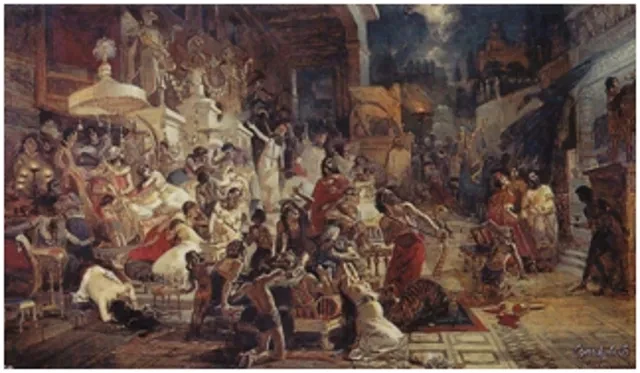
But - a paradox! - As a result of the lack of a stupid shock blow (at the sight of, for example, openly whitening blood), the tragic effect of Surikov’s paintings on the viewer only intensifies. Although he himself, who had written tragic canvases all his life, cared most of all about how not to shock, not to overturn the soul of the viewer into confusion:
“When I wrote Streltsov, I saw the terrible dreams: I saw executions every night in a dream. It smells of blood around. I was afraid of nights. You will wake up and please. Look at the picture. Thank God, there is no this horror in it. I had everything thought so that the viewer would not disturb. To be calm in everything. I was afraid of everything if I would have awakened an unpleasant feeling in the viewer. I myself am Holy,-but others ... I have no blood in my picture, and the execution has not yet begun. But I am all - both blood, and I experienced executions in myself. "Morning of the Strelets executions": Someone called them well. I wanted to convey the solemnity of the last minutes, but not at all execution.
I remember, I have almost finished "Streltsov". Ilya Efimovich Repin comes to see and says: “What is it that you have not a single executed? Here you would at least be on the gallows, on the right plan, would hang it.
How he left, I wanted to try. I knew that it was impossible, but I wanted to know what would happen. I painted the figure of a hanged man with chalk. And then just the nanny entered the room, - as she saw, so without feelings and crashed. "
I have with the Surikovsky “Suvorov’s transition through the Alps” another association, which is completely subjective.
It seems to me that there is a certain deep connection between the soldiers of the “horizontal” country, storming the alpine verticals that I saw them in their imagination and depicted Surikov, and those who, in the “horizontal” fields of this country itself, standing across fate and death, did not let the enemy into his capital. I'm talking about thousands of those who fell on the approaches to Moscow in the fall of 1941. Different eras, different wars, different people. But there and there - everything at the stake.
Confusion in the Polnobosvod
And the reality of defenseless roads.
October of the forty -first year,
The earth leaves from under the legs.
And a terrible outcome is terrible
Moscow in Vladimir ... somewhere
Again goes to the bayonet
Rush platoon. Until dawn
Victory fighters do not live
Names cannot be left in the annals.
It is bequeathed to us to cherish
Their eternal glory. Start
Immortal Russian miracle
In their death, to the pain of a simple one.
Already on the centuries everywhere
The graves stand up to
Where, by irrigation with blood,
The boys saved Russia.
I would all bring them to the saints.
But ... how many saints in Rus'!
(10/16/1996 from a personal diary).
Line: “And the reality of defenseless roads” has one long -standing full conversation in the train in the train: Minsk - Moscow. In perestroika times, we, three Izvestins, returned from a “signature” trip in Belarus and ended up in the same car with Vasily Bykov. He entered our compartment, where the fourth place was unoccupied. And far after midnight, an interesting, frank conversation lasted. It was not in our personalities. And definitely in the personality of Nikolai Yegorovich Matukovsky, our Belarusian Sobster, who in the most difficult times for Bykov, when he was poisoned in his homeland, fearlessly stood up to his defense. Hence the writer's respect for the "Izvestia" of those years.
By the way, Bykov, by the way, told one story (and Simonov told him, and Marshal Zhukov during the famous conversation, which was partially included in the film “If your house is dear to you”, about the battle for Moscow, then more fully published by Simonov himself in print publications, but completely not published to this day).
So, according to Zhukov’s testimony, during the Moscow battle there was a moment when German intelligence had data that three roads to Moscow were completely free. We simply had no parts to protect these directions. One of them moved German tanks. But they were detained by the newly arrived 316th Infantry Division. A blow was struck along the second road. But this gap was closed by the Podolsk cadets raised in alarm. And then on the third road, the Germans did not dare to advance immediately, considering that the information of their front -line intelligence is unreliable and require additional verification. Zhukov said that this, along with those who fought under the surrounded by Vyazma by our troops, allowed to win and tighten the reserves.
I heard this from Bykov personally. But then nowhere, neither in any printed publication, nor with Zhukov, nor at Simonov, nor by Bykov himself, nor in historical research and memoirs about the Moscow battle, he still has not met this fact.
In May 2010, two TV channels-the first and “Culture”-showed allegedly a complete record of the very interview of Simonov with Zhukov. He looked and - did not find this episode. In a general form, the thought of several days in October, when there was nothing to close the road to Moscow, sounded. But ... it is in the general form.
It turned out along the way: the record released by two television channels is also not complete. “LH” (May 12-18, 2010), referring to the critic of Vladimir Ognev, wrote:
“... The interview with Marshal lasted 2 hours, and indeed in it were very sharp statements at that time <...>. Most likely, this is why the head of the Glavpur Epishev, who oversee all documentary projects about the war, demanded that everything that did not enter the film destroy <...>. The leaders of the ETC (an experimental creative film studio under the Council of Ministers of the USSR - K.S.) <...> signed the corresponding act “On Encouraging”, but did not wash away anything, but simply from two boxes with a film, the inscription “Conversation with Marshal Zhukov” was erased and it was written: “Soldiers' memoirs”. <…> Сохранённую плёнку отправили в архив, а через некоторое время Константин Симонов <…> смонтировал именно тот, длившийся менее часа, <…> фильм, который мы увидели на Первом канале и на «Культуре». Более того, первый (закрытый) показ этого фильма-интервью, на котором Огнев присутствовал, состоялся в 1969 году в Малом зале ЦДЛ».
И — кто его знает, может и хранится где-то в архивах та самая, бóльшая, неведомая нам часть того, поистине исторического интервью, и там на самом деле есть сюжет о трёх беззащитных дорогах? Or not?..
Но так ли важно знать, как всё было на самом деле, с точностью до деталей, если известно, чем всё кончилось? Важно, очень важно, конечно, хотя во многих случаях, в связи с уходом в небытие последних из великого фронтового поколения, это уже физически невозможно.
Спорят вот о 28 панфиловцах. Сколько их было на самом деле? У того ли посёлка был легендарный бой и был ли он вообще? Произносил ли политрук Клочков ставшие крылатыми слова? И т. д. Важно ли это? Important. И всё-таки надо всем этим возвышается страшная и святая вертикаль высшей правды трагедии и подвига: по совершенно открытой, беззащитной дороге на Москву немцы двинули свои танковые армады. Пути им заступила только что сформированная в среднеазиатском тылу 316-я стрелковая дивизия, в историю вошедшая как Панфиловская, — численностью в 11 700 человечьих душ. И в ожесточённых, кровавых боях в эти смертельно опасные для столицы дни дивизия остановила врага, не пропустила его в Москву. Ценою 3 620 погибших бойцов и командиров (включая комдива), и 6 300 раненых…
Да, я за то, чтобы для каждой реальной точки на карте Великой Войны — где это только ещё возможно — устанавливалась истинная картина того, как тут всё было на самом деле. Но важно и другое: чтобы при этом в подсознании, да и в сознании нашем не отключался высший, гамбургский счёт истории!
Думаю вот: не слишком ли далеко события Московского сражения завели меня в сторону от реальной суриковской картины, где всё-таки, действительно, другое время, другие люди, другая война? Есть однако нечто «весомое, грубое, зримое», что связывает этого художника, его картину и эти события и между собой, и с небесами.
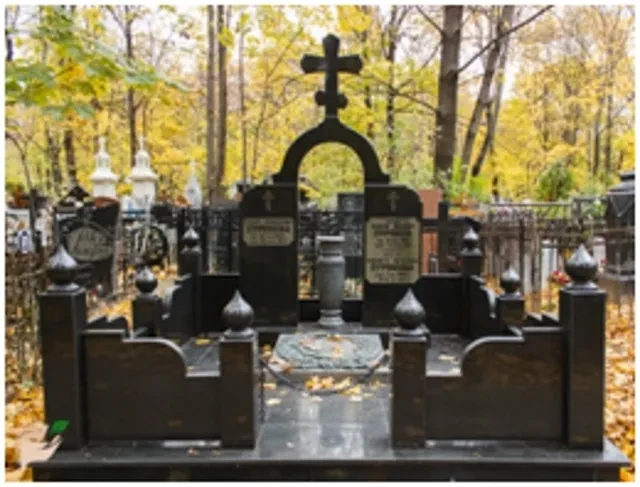
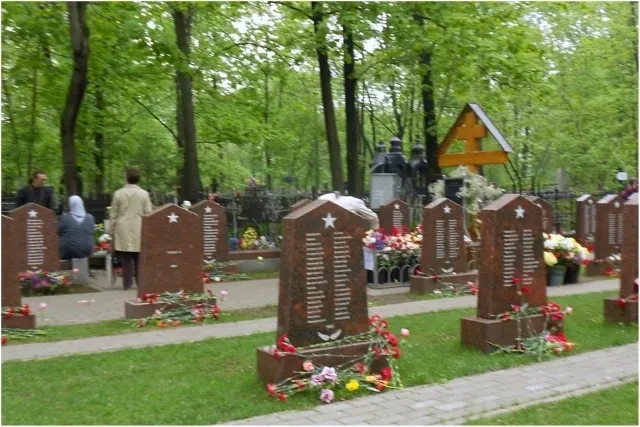
Внутри большого Ваганьковского кладбища столицы есть ещё одно кладбище — тех, кто погиб осенью 41-го под Москвой. Когда 9 Мая мы направляемся от родных захоронений к нему, чтобы возложить цветы, путь наш проходит по Суриковской аллее. И в конце её, чуть ли не впритык к стройным армейским рядам пирамидальных обелисков из красного капустянского гранита (такого же, как в Ракитках, над могилой мамы, готовившей в войну медсестёр для фронта), — могила Василия Сурикова.
PS
2018 г. Между прочим, по свидетельству историка, москвоведа Александра Васькина («Вечерняя Москва», 14-21.6.2018 г.), старообрядец, иконописец Абрам Балашов, совершивший в 1913 году первое покушение на репинское полотно «Иван Грозный и сын его Иван 16 ноября 1581 года» (совсем недавно случилось второе), «собирался повредить картину Сурикова «Боярыня Морозова», но передумал и направился к работе Ильи Репина».
Видать, есть у этой и у других картин Сурикова некая защитная аура, отвратившая нападение маньяка…
The ending follows.