
Translated material
Rich, poor man
The book of the outstanding economist Atkinson "Inequality" as a symbol of hope
Anthony B. Atkinson, one of the most consistent supporters of state intervention in the economy, in his newly published posthumous book “Inequality: how to be with it” offers 15 ways to make a gap between the poor and rich not so “excessive”. Vladislav Tolstov believes that it would be nice to read this book to Russian reformers - say, those who think about pension reform.  Anthony B. Atkinson. Inequality: how to be with him? M.: Publishing House "Case", 2018. Translation from English Oleg Levchenko
Sir Anthony (Tony) Barnes Atkinson, who died at the beginning of 2017 at the age of 72, devoted almost the entire scientific career to the study of the problem of economic inequality. At first, the young ambitious economist investigated the poverty phenomenon, but, the further, the stronger the Atkinson was not so much interested in why people become poor, but the question - and why did they have less and less opportunities to break out of this poverty? Gradually, Atkinson began to preach the ideas of social justice, for the implementation of which he proposed quite radical measures.
Poverty - she, sorry for the tautology, a poor relative at the festival of economic science. Everyone is interested in studying the rich, their conditions, their excellent consumption and sources of income. While the study of the poor, Sir Atkinson assured, could give much more to a tortured mind. If only because they, the poor (we, the poor, want to clarify), on the ground are ten times more. Therefore, “inequality: how to be with him?”, Published in Russia after the death of the author, sounds like his scientific and ideological testament.
There is an important point. As we understand justice and what it is. In the West, the greatest minds were engaged in this topic, there are thorough theories describing the phenomenon of justice (at least the three -volume work of John Rolsa “Theory of Justice”). In the world of great economic science there are figures such as Joseph Stiglitz and the Nobel laureate Amartia Saint (whose book also recently published the Russian publishing house - the ID of the Higher School of Economics). In Russia, there is no deep study of the nature of justice.
The whole problem is that justice in our country and they are understood differently. In Russia, justice is considered not as a result of a certain combination of economic circumstances, but as a metaphysical, existential, incomprehensible phenomenon. As a reflection of the general imperfection of the world order. Justice in the Russian understanding is not about the numbers, but about “to be honest”, it has special to become, which you can only believe in. Whereas in the West, justice is primarily justice, meaning strict adherence to certain procedures. That is, we have justice - faith, and in the world of economist Atkinson - science. Therefore, they have Sir Anthony Atkinson (Honorary Member of the American Academy of Arts and Sciences, President of the Royal Economic Society, Honorary Doctor of Sterling University, etc.), and we only have a fair Russia party.
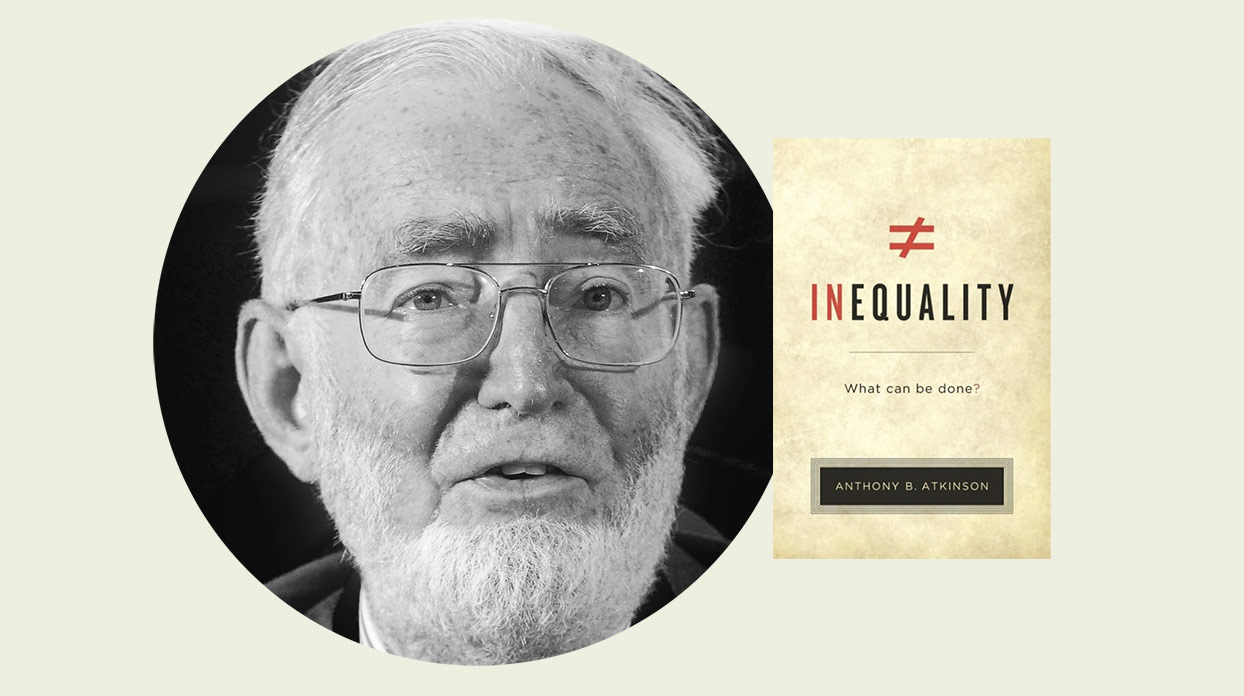
Anthony Atkinson, 2015
Photo: Niccolò Carati
Atkinson honestly says: it is impossible to solve the problem of inequality. This cannot be done either on the scale of the entire world economic system, or in the economy of an individual country. Market capitalism, competitive economy turns our individual characteristics (level of education, nationality, degree of elaboration of social ties, even hair color and weight) into factors of our personal economic success or failure. Therefore, complete equality will never come. The question is: is it possible to make a gap in the income of different social groups not the same as Atkinson is expressed, excessive. For the past half century, the rich are rapidly rich, and the poor are poorly poor.
What can be opposed to this? Atkinson proceeds from the fact that the ideas of socialist economists “to everyone in labor” are too idealistic idea of how the economy works. The same starting opportunities do not guarantee a fair result at all. Firstly, a person may not be lucky in life. Even today, he looked at the world from the window of his office, and tomorrow the crisis - and he packs his office belongings in the box. According to Atkinson, the results of the life race are not always associated with the concept of personal guilt: "We cannot ignore people for whom this result turned out to be deplorable."
Secondly, rich are not only people who, relatively speaking, are lucky in life. They have a strong enough influence to change social norms and transmit their advantages to the next generation. That is, society becomes class when the rich retain their power, and the poor have less and less opportunity to break out of the enchanted circle: Atkinson even uses such a thing as Poverty Trap - “Poverty Trap” - when a person with low income does not have the strength or will to change his economic fate.
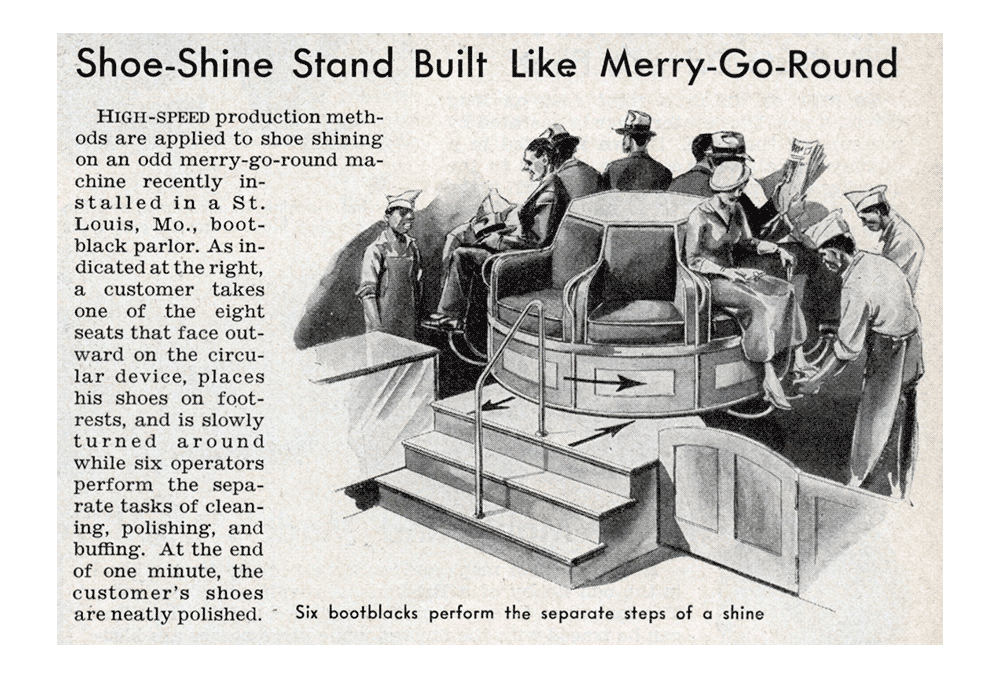
Carousel drawing for cleaning and polishing shoes, 1937
Photo: Blog.modernMechanix.com
And what does Atkinson offer? The only force that can violate this circle is the state. It is it that is obliged to limit the appetites of the rich and eliminating the undeserved advantages of the new generation of the rich. It looks globally like this: in order to maintain the optimal balance between the poor and the rich, you will have to increase government spending on social programs, as well as encourage social partners and interested non -profit organizations. In the book Atkinson gives 15 sentences to reduce inequality - from the introduction of the ethical code of wages (when the income of the poorest layers exceed the basic minimum salary) to restrictions on the maximum amount of savings per depositor.
Among other proposals, this is also heard: "To update the social insurance system, increasing the size of the benefits paid and expanding the coverage of the population with these benefits." Sooner or later, the states will come to the understanding that they will have to introduce compulsory basic income, otherwise it is impossible to restrain the strengthening of inequality.
And this is already directly related to what is happening today with pension reform. The Russian authorities act in a completely opposite way: instead of expanding the number of people included with the state support system, they are going to increase the retirement age and thereby increase the number of poor ones - respectively, increase the gap between the income of the poor and the rich. The current economic model of Russia acts in the interests of the “active” rich, which, according to Atkinson, is a very disturbing symptom. Economic inequality leads to social stratification and exhausts society, depriving him of his will to life. And this is a dangerous situation that deprives the state of hope for development.