
Translated material
Home spots IT
Why is national IT business in Russia good prospects
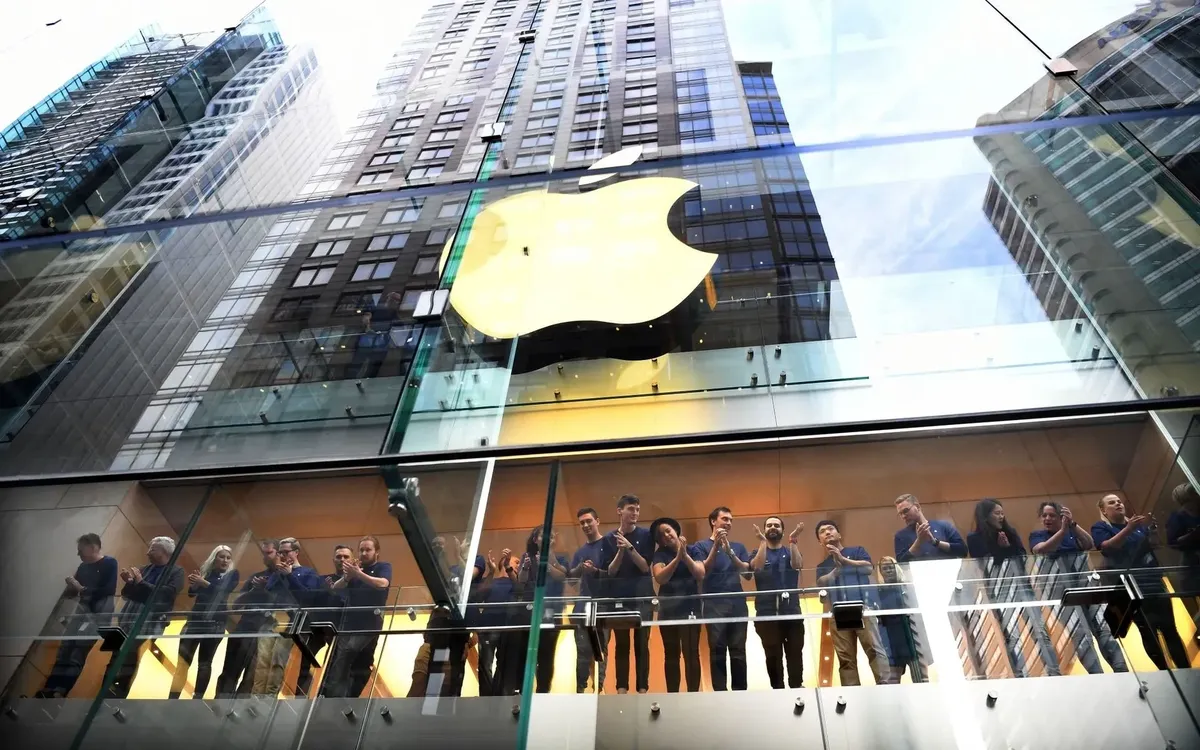
Apple published a quarterly report that broke the most daring expectations of analysts, and the company's exchange capitalization for the first time in the history of mankind exceeded $ 1 trillion. You can treat the amounts of capitalization in different ways, especially after Facebook last week for one trading session lost $ 120 billion. Nevertheless, such a dizzying order of numbers that accompanies the business activity of American companies that work in the field of information technology involuntarily causes a desire to compare and determine the place of domestic IT business, and most importantly, the prospects for its development in the near future.
At the level of philistine representations, the situation in the Russian IT, as well as its reputation, looks depressing. The main argument: “In Russia, they do not produce anything of their own, with the exception of the Elbrus processor, the only purpose of which is to amuse state pride, because there is no innovative, especially commercial attractiveness in this product. Everything else is Russian “iron” - nothing more than branding of Chinese gadgets with its own logos. ”
Within the framework of such thinking (designed, as we understand, in the best traditions of national negativity) for the role of a fresh illustration that “everything is lost”, Yandex suggests itself. The station ”is such a wonderful Chinese in its components and nodes of the Bluetooth column, in which the original is the most original-the voice assistant“ Alice ”.
Invented in Russia, made in China
I would not want to create a small -town sappress around the topic that I have been tracking for more than 20 years, so I immediately formulate the main message of my comment. If something is producing something in the state of a Russian purely positive impression, it is a business technology business. The development vector of Russian IT business consists as much as possible to world standards. Moreover, the standards characteristic of the Western paradigm of intellectual dominance, and not the rearguard of Asian forges of other people's ideas.
I’ll start with a paradoxical statement: the lack of my own computer production in Russia is not a minus, but a great plus. Already because such a circumstance indicates the assimilation of history lessons.
The horrors of the Soviet self -propelled person (from the automobile industry to household appliances and electronics) my generation survived in the endless lines of repair workshops, and the younger generation, fortunately, was no longer found.
The day when the authorities finally understand that the best alternative for the car Made in Russia is a complete rejection of its independent production, will be a red day of the calendar. The private Russian IT industry has long understood this, therefore it manages to prank on a horse in a situation where the creative initiatives of small and medium-sized businesses, it would seem, are suffocating in the root of repressive legislative acts.
For an adequate understanding of the prevailing world paradigm in the field of information technology, a fairly fluent view of the Apple business: the company that sold $ 229 billion in 2017 and deduced $ 64 billion from these sales (again for comparison: Gazprom reached $ 103 billion with a profit of $ 11 billion for the same period). It itself does not produce any computer “iron”, it collects everything in China at Foxconn factories, and owes its commercial success to adhesion marketing and intellectual developments in the field of design, software and design of the CPU.
Moreover, the five most capitalized companies of the planet as of the II quarter of 2018 do not produce anything themselves, and fabulous capital earn exclusively due to intellectual developments in the field of IT. In addition to the mentioned Apple, the five celestials include Amazon.com, Alphabet (Maternal company Google), Microsoft and Facebook.
The Russian private IT business quickly realized the advantages of intellectual developments and has long ceased to be burdened by the lack of a national production base. In this context, an example “Yandex. Stations ”is very characteristic, since the intellectual potential of the same“ small ” - the Alice voice engine - gives the head start any wireless acoustic columns.
The birth of it from the spirit of piracy
Of course, not to notice the weaknesses of the Russian IT business would be as naive as to ignore its undeniable trump cards. Here, however, it is important to understand that the strong and weaknesses of the domestic IT have common roots, namely: the specifics of the national mentality in which this business was formed and developed.
Commercial success in the field of information technology is achieved exclusively on the foundation of the unshakable intellectual property right. In 2002, President Putin complained: “Today Russia is the only one of the major economies that are not a member of the WTO. 95 or more percent of the world economy falls on the WTO. Staying aside is dangerous and stupid. ”
Here I would like to remind you that the agreements on tariffs and trade are only the facade of the World Trade Organization, which, after the adoption in 1994 of the “Agreement on Trade Aspects of Intellectual Property Rights” (TRIPS), has turned into a total control over the replication of virtual digital products in the world (computer software, music, video, electronic texts). Only after the adoption of TRIPS, the United States was able to transfer most of their production to third world countries with a clear conscience. It is understandable: the main income today Western civilization extracts precisely from intellectual property.
In 2012, Russia joined the WTO. Has anyone noticed at least some change in relations to intellectual property in the country at a practical level? The question is rhetorical, because no legislation and no international structures are able to change the mentality of the nation. The unshakable right of intellectual property triumphs only when it receives a proper response and understanding in the heads and hearts of ordinary citizens and consumers.
To thin or good, but in our Fatherland the attitude of the vast majority of the population to intellectual property is deeply communist: books, textbooks, songs, films - this is all our common. The author’s happiness is in the realization of the fact that his work is in mass demand and popularity.
The point here is not in the Bolshevik heritage, but in the unique worldview feature of the Russian person who perceives any product associated with knowledge and education, exclusively as a social property.
I have been trying in vain to develop an ethical assessment of this paradox for a quarter of a century and, I confess, and has not achieved unambiguousness. Therefore, I will not engage in moralizing, but only state an immutable fact: the Russian industry of information technology has formed and developed entirely under the influence of the domestic intellectual freemen. All the pros and cons of the Russian it flow from it.
If anyone does not know, then the whole software existing in the world, no matter how much it costs, in our country and in the 90s and zero, and today has been and remains conditionally paid.
A positive aspect of this legal lawlessness is constantly being formed, stimulated and gained by an unprecedented in numbers and professionalism an army of computerly competent youth. About the same situation can be observed in India and China.
In order to study at a professional level, computer layout, nonlinear video editing, graphic design or 3D modeling by the American, French, German or Belgian young man need to buy software worth $ 500 and higher. It is not surprising that such self -taught in the countries of the Western world is unit.
Our young man is nothing hesnah, he goes to the nearest “radio market” or a favorite torrent platform, receives a pirate software and begins to study that his peers in the “Chistan World” is banal inaccessible for material considerations.
Lost retail
Is it any wonder that Russian programmers (as well as Indian, Chinese, and at the same time, immigrants from the countries of the former socialist camp, who absorbed the Bakunian spirit with milk of the Komsomol member) the best in the world? Really the best, because the level of their knowledge and competence is higher than that of peers from countries “mutilated” by copy.
The domestic liberty in relation to intellectual property rights has a depressingly negative aspect. Since any software (audio, video, electronic book) in the presentation of our consumer is simply required to be free (and if it is not free, then it is subject to hacking and mass distribution), then the domestic programmer, who has gained amazing knowledge due to this free accessibility of software, cannot monetize his knowledge in the retail market. Because the miracle program created by this programmer on the second day will be hacked and laid out on a torrent tracker!
As a result in Russia, there is almost completely no software retail market, and the state and large commercial structures are the only customer and consumer of the Russian IT production.
But in this market, things are enchanting. See how, say today, say, EMIAS (Unified Medical Information and Analytical System) or State Services, Moscow Parking, Metro Metro, Russian Railways, Yandex services (metro, suburban electricians, taxis, navigator), how convenient and functionally, programs of large private retail chains are almost perfect (like the legendary Taskville), how legendary are already legendary). online stores, delivery services, ticket services for various events (such as Tilend or Afishi), search and purchase of air tickets (both aggregators and airlines) or, for example, client rooms of Russian banks, and be full of pride:
There is no need to even dream of this level of software decisions in most countries of the world.
As for the few Russian software retail (Abbyy, Kaspersky, Elcomsoft), it is almost entirely oriented to the foreign market, where there is a good tradition of buying rather than steal.
Optimistic end
Now the most important (and unexpected): how will the situation in the Russian market affect the further development of the industry? My deepest conviction: the prospects are revealed the most rosy.
The fact is that in the world the vector of retail software that dominates today is not even dead end, but unconditionally reactionary and harmful to the final consumer. The functionality of computer programs, which are only able to interest the unprofessional (that is, retail) audience reached its limit 10-15 years ago, so their further development went by adding meaningless “beautifulness”.
As soon as it became clear that buyers did not want to make an upgrade, software developers together went to a cartel conspiracy, replacing the traditional “bought and use” scheme with a signature model that requires regular monthly payments even for the most banal computerity (storage of passwords, accounting for tasks and purchases, using the calendar, collecting notes, grouping, group communication, group communication video editing, etc.).
The market response to agony of retail software was not long in coming: today the functionality of alternative and completely free software software often does not only correspond, but also exceeds the functionality of promoted commercial solutions. The only obstacle to the complete displacement of paid programs is certain difficulties in installing and setting up free software, but there is no doubt that this drawback will be eliminated in the near future, and then the commercial software retail will turn into a memory.
It turns out that the internally controversial vector of the development of the Russian IT in the historical perspective turned out to be winning?
I would be glad to close the topic on such a victorious note, but I do not dare to sin against the truth: the Russian retail market, completely and completely devoted to foreign software builders, is not only a platform for educating future programmers, but also the habitat of small and medium -sized businesses that is not related to information technologies.
Thousands and thousands of small and medium -sized enterprises in Russia that are not able to compete with the state and order Proprietary software for themselves from the local programmers who are spoiled by state orders, are forced to solve their problems either in the pirate market or using the services of non -Russian programmers.
Even if my prophecies come true and the entire software retail will soon become free, Russian small and medium -sized businesses will continue to talk to “you” with Apple products, Microsoft and Adobe, and not with the remarkable developments of domestic code masters serving the state and large commercial structures. This, of course, is not fatal, but it is clearly undesirable for the harmonious development of the Russian IT industry.