
Translated material
"What kind of sting is Georgia stung?"
Colta.ru, together with the Russian Scientific Fund, continues the project “The Island of the Empire: People and Events” .
Prince Ilya Grigoryevich Chavchavadze comprehended the features of the Georgian soul all his life, for which he was recognized as the most folk poet of Georgia and is depicted on a bill of 20 Lari. About the first householder of Georgia and his freedom -loving creativity - the essay of the journalist and editor Anastasia Vereskun and Amiran Urushadze, the author of the book “Caucasian War. Seven stories ”, the head of the RNF project“ National Outskirts in the Politics of the Russian Empire and Russian Public Thought ”.
Drilling
On the evening of October 27, 1837, Maria Kristoforovna went to sleep with a vague feeling of anxiety. The husband left for Tiflis affairs, he had to return only two days later.
The highlanders attacked at night or early in the morning - to take it by surprise. This time they chose a dark hour before dawn, a small detachment went down from the mountain gorge where they had a shelter, and sent horses to the rich village of quarters. The flowering, fertile Alazan Valley has long become a favorite robbery “pasture”. They got used to the mountain raids, were ready. In the princely estates, military towers were built, in which they took refuge during attacks. Such a three -story tower was also in the estate of Prince Grigory Paatovich Chavchavadze, whose ancestors had over 500 years owned Kvarel lands. The household, having heard the growing rumble of the struggle, hastened to wake up the newly sleeping Maria Kristoforovna and rather transferred her from the manor house to the tower, where a narrow bed stood on the second floor and it was possible to wait for a raid with relative comfort. On this bed, a stormy October night, the son of Maria and Grigory Chavchavadze - Ilya was born.
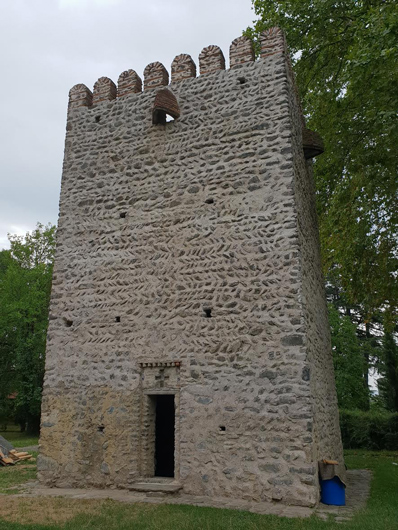 © Anastasia Vereskun Fighting Tower of the Chavchavadze Family in Quarrels (modern view)
Kvarelsky Chavchavadze
The snow -white museum of Ilya Chavchavadze in Carella resembles scribbled paper scrolls. Through this intricate building in the Art Nouveau style, you can get into the family estate of Chavchavadze, visit the house, a wine cellar (which is more than the house itself, but so, according to the representation of the Georgian nobles, and it should be) and see the very defensive tower in which, according to legend, Ilya was born.
His father, Grigory Chavchavadze, belonged to the famous princely family, was an officer of the Nizhny Novgorod Dragoon Regiment, took part in the Russian-Turkish war of 1828-1829. Maria (in the girlishness of Beburishvili) was a native of an intelligent noble family, she was well versed in ancient Georgian literature, especially poetry, whose love instilled her children.
The first folk poet of Georgia was not a relative of the famous Alexander Chavchavadze, Father Nino and father -in -law Alexander Griboedov. These were two branches of the old clan of Chavchavadze - Zinandal and Kvarelskaya. However, their representatives actively communicated, were friends. The Ilya brothers (he had three brothers and two sisters) even fought for the family of Alexander, when the highlanders attacked his family estate. The elder brother of Ilya Konstantin died in this skirmish. Like Alexander, Ilya chose literary and social activities for himself, in which he achieved success and recognition, during his lifetime deserved the honor and respect of compatriots. In modern Georgia, Ilya Chavchavadze is considered the “father of the Fatherland”, the theaters and universities are called in his honor, his portrait adorns a bill of 20 Lari. And in 1987, the Georgian Orthodox Church canonized Chavchavadze under the name of Elijah the Righteous.
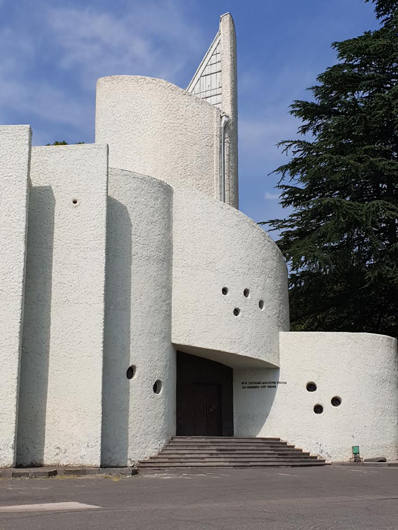 © Anastasia Vereskun State Museum Ilya Chavchavadze in Quarrel, Georgia
Tergdaleolebi
From Georgian translates as "drinkers of the Terek." So called people who were educated in Russia, the border with which passes along the Terek. Ilya Chavchavadze was just one of these “Terplaylabi”: he studied at the University of St. Petersburg at the desk department of the Faculty of Law. He showed the desire to rally the Georgian nation then, becoming the first chairman of the Georgian fraternity in St. Petersburg, the head of the Georgian Student Movement "Tergdaleulebi", which included Akaki Tsereteli, Nikolay Kipiani. Inspired by the works of Vissarion of Belinsky, Nikolai Chernyshevsky and Nikolai Dobrolyubov, the participants in Terdlayolebi advocated the expansion of the political rights of the Georgian people in the framework of the Russian Empire, and the renewing of the country's spiritual life. This is not to say that it met hot support in Georgia itself. “So I said goodbye to Vladikavkaz and moved towards my homeland,” writes Chavchavadze in “Notes of the Passage” about the return from St. Petersburg after four years of study. - I passed the bridge over the Terek, not only without drinking the water of the Terek, but not even glancing at him. I was afraid that they would not suspect me that I was Terdlayoli, one of those who drank Terek's water. People who have drunk this water somehow do not like our Georgians, do not like them. And for this they have quite sufficient reasons; Firstly, they do not like them because Tergdaleuli actually drank the waters of Terek; Secondly, because they are Terdlayuli; Thirdly, because ... because ... because they are thirdly-people who have a plowing the waters of the Terek. Go and refute such reasonable arguments of our Georgian society covered by doubts! ”
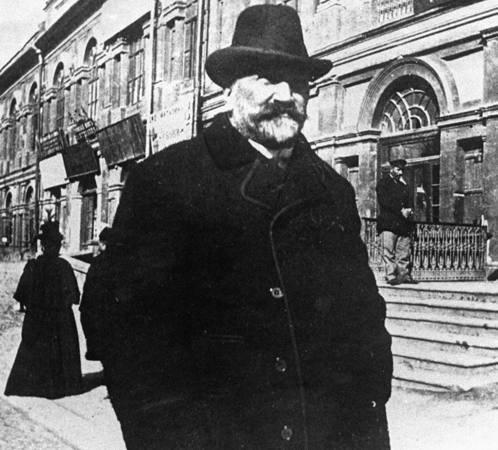 © RIA Novosti Ilya Chavchavadze
Language, Fatherland, Vera
This triad, like the Uvarovsky “Orthodoxy, autocracy, nationality”, Chavchavadze briefly and accurately outlined his views. The language, we note, is in the first place. Contemporaries often compared Chavchavadze with Alexander Pushkin: the poet was born in the year of Pushkin’s death and made the same valuable contribution to the formation of new Georgian literature as “our everything” - to the formation of Russian. Chavchavadze was the first to move away from the romantic school, in which the poets Alexander Chavchavadze and Grigol Orbeliani shone, and turned to the popular language and folk themes. They were close to Chavchavadze: after all, from eight years he studied at the parish deacon along with peasant children. Ilya Chavchavadze published the first poem in 1858 in the journal Tsiscari (Zarya). It was called “read” (“bird”) and was written in a simple, unpretentious language, without artificial pathos and magnificent rhetoric. Chavchavadze begins to actively popularize a new literary language close to folk speech. Including in the magazine Sakartvelos Moambe (Bulletin of Georgia).
Of course, defenders of traditional style and spelling took up arms against him. Princess Varvara Georjadze, the first Georgian feminist, reproached the converter of the literary language not only of a lack of building, but also in negligence. Grigol Orbeliani - the guard and legislator of the Georgian literary Olympus - spoke with disapproval.
However, Chavchavadze does not stop in the desire to bring the literary language closer to the people. In 1873, together with Prince Rafail Eristov, he gathered and published "The first book of peasant songs and sayings." He skillfully uses folk proverbs, conspiracies, song paths and figures of Chavchavadze in poems, prose, historical and archaeological works. One of his best poems-“Hermit”-he wrote to the plot of legend, popular among the Mohevites who lived in the area of the Georgian Road. For Georgian literature, such a folk element was a frank innovation. “I only try to give him [the people] to his thoughts his own shade and his words - his tone. If I succeeded, my intention is fulfilled. ” His poems became songs - is this not folk love?
As for the second element of the triad - the Fatherland, for forty years, until his death in 1907, Ilya Chavchavadze was considered the spiritual leader of the Georgian people, the leader of the Georgian intelligentsia. “The homeland, no matter how small it is, always occupies a large and honorable place in the heart of a noble person,” writes Chavchavadze. In his works, he opposed the social archaic and called for "national unity." This was different from the leader of the Georgian Social Democrats and, in the future of the head of independent Georgia (1918-1921), Jordania, who believed in the transformative power exclusively the Workers 'and Peasants' Union.
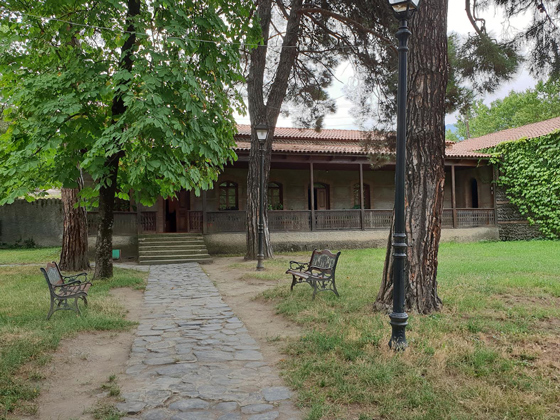 © Anastasia Vereskun Manor House of the Chavchavadze family in quarter (modern view)
Fiction and theater, according to Chavchavadze, should wake the national consciousness. “Will I then find the strength in myself, to say the word close to her [homeland] and this word to illuminate her, the hope of resurrection, inconsolable - to console, crying - wipe away tears, the worker - to facilitate labor and connect those sparkles that smolder and cannot but smolder in every person. Will I have the strength? Will the strength will utter a clear word to her? " The poet sought to find out the actual needs of the people, to understand how stung his homeland was. "
The opportunity to really help the oppressed peasant estate introduced in the 1860s-the era of great reforms. During the liberation of the peasants in Georgia, Chavchavadze served as a world mediator in the Dusheti district, like Leo Tolstoy, Nikolai Pirogov and Nikolai Ge. The poet welcomed the abolition of serfdom with the words "I hear, I hear the desired sound of the chases fallen from the people."
In 1884, police supervision was established for Chavchavadze, many of his works were prohibited by censorship. This, however, did not prevent him from becoming a member of the State Council from noble societies in 1906. The Council of Chavchavadze actively protects the interests of Georgia and its people. "I am dressed in a Russian dress, and with my heart, believe me, Georgians!" He describes his view of the place of little Georgia in the Great Russian Empire in a letter to Bishop of Ostrog Seraphim, with whom Chavchavadze was also familiar from the service of him in Tiflis: “The Georgians have a soil on which these good feelings arise and grow up, because they firmly believe that Russia was their savior and the defender. That calm, the possibility of peaceful improvement that we have gained under the protection of Russia, too much acquisition, so as not to value them with all the forces of our soul and our heart. This belief in the generosity and disinterested intercession of Russia is rooted tightly in the Georgian, and a feeling of deep gratitude arising from this and represents an inexhaustible spring that can turn the sprouts of good feelings for Russia into a luxurious tree of life, which overshadows everything and everything with its spread branches. ”
Understanding that the future of Georgians is inextricably linked with the Russian Empire, Chavchavadze demanded the abolition of the death penalty in Russia, the conduct of agrarian and social reforms in the state of the Romanovs.
"I am Ilya, don't shoot!"
1907, August 30. Ilya and wife Olga travel from Tbilisi to Saguramo, where they have an estate. Near the village of Tsitsamuri their open stroller stops. Bandits are five. Seventy -year -old Ilya rises with some difficulty and turns to the gang: "I am, do not shoot!" To which the leader Gigla Berbichashvili replies: "Precisely because you are Ilya, we must shoot." The shot kills Chavchavadze, Olga remains alive. Later, she asked the court to preserve the life of the robbers and thereby honor the memory of her wife. But the whole gang was executed. Although the bandits themselves did not admit their guilt and declared in the court that the faulty weapon "fired by itself." They also denied the fact that they had executed someone's order.
The murder of Ilya Chavchavadze has not yet been disclosed. There is a version that a deadly shot was made not in front, but from the back. Perhaps there was a second ambush that the bandits themselves did not know about. The common version - Chavchavadze was killed by the Bolsheviks led by Philip Maharadze. Some researchers believe that among the killers there was Sergo Ordzhonikidze. Chavchavadze openly criticized social democratic programs, and his popularity was popularly undermined by their political positions. Chavchavadze at that time headed the National Democrats and, as they say, took the electorate from the Bolsheviks. When the fake convictions about Ilya, published on the pages of the Bolshevik newspaper Mlyzauri (“Traveler”), did not give a result, the left radicals decided to kill. The Social Democrats themselves considered the royal guard as a “customer”, which was embarrassed by the poet’s national position and his struggle for the abolition of the death penalty.