
Translated material
Russia divided the Caspian Sea with neighbors after twenty years of disputes. But the countries never decided who will get oil and gas
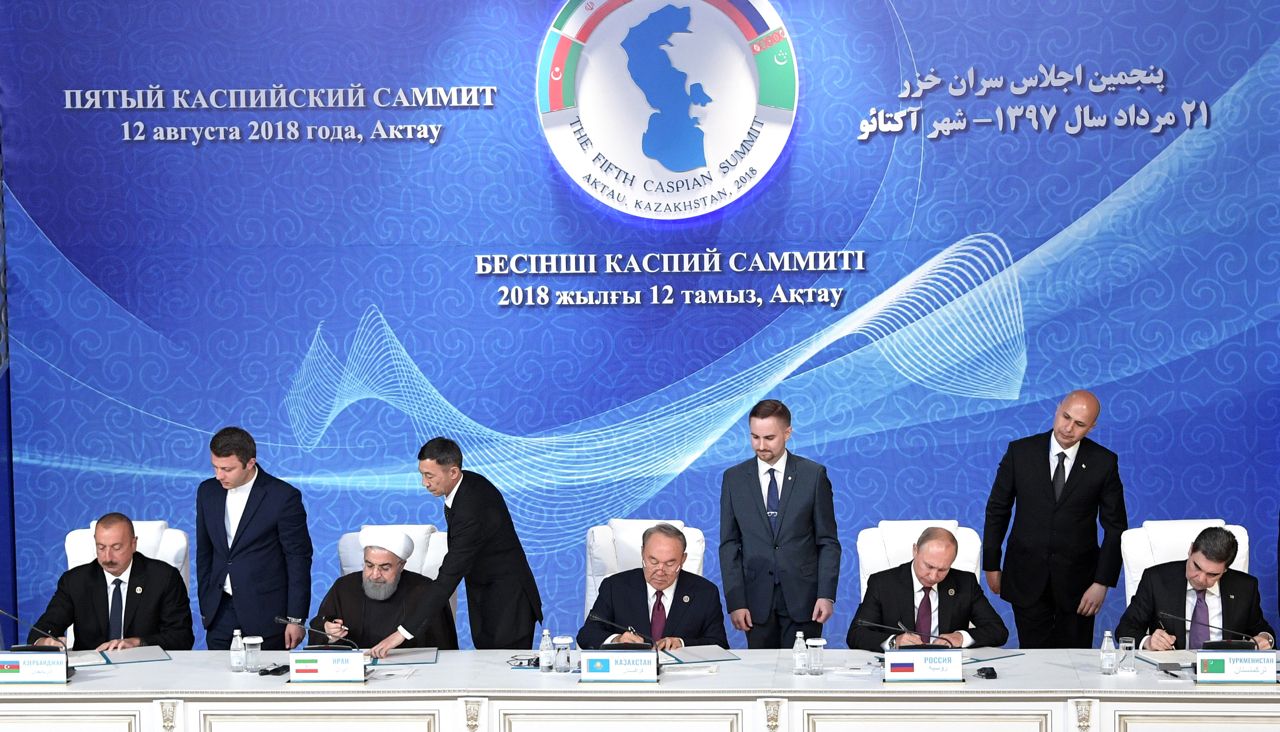
The countries of the Caspian Five - Russia, Iran, Azerbaijan, Turkmenistan and Kazakhstan - agreed on the principles of the section of the Caspian Sea. The Convention , adopted on August 12 at a meeting at the top in the Kazakhstan Aktau, has already managed to call the “historical”. "Medusa" talks about what the leaders of the countries really managed to decide, but what - no.
Was the Caspian Sea yet? Why?
The Russian Empire in the XVIII -XIX centuries actually turned the Caspian Sea into its own inner lake, having achieved the military fleet there from Persia (the old name of Iran). In the 1920s, the USSR abandoned the monopoly rights to the Caspian and agreed with Iran that both states could use this water area .
At the same time, Moscow and Tehran did not accurately establish interstate boundaries and have actively used this uncertainty for decades. In particular, both countries without any contracts were engaged in the development of oil fields, while the presence of a clear demarcation, most likely, would require coordinating such projects.
With the collapse of the USSR, three new independent states began to apply for its stake in the water area and shelf, in addition to Russia and Iran: Turkmenistan, Azerbaijan and Kazakhstan. This required a more clear multilateral agreement. The document began to be developed back in 1996.
Why have been divided for so many years? What is the problem?
According to formal geographical criteria, the Caspian Sea is the largest closed pond in the world and is not a sea. This means that it does not apply to the UN norms of marine law, which, firstly, determine the economic capabilities of the coastal states, and secondly, allow other states to use its water area for some types of activities.
For lakes, such clear rules do not exist-the states each time decide their disputes in their own way. Turkmenistan, Azerbaijan and Kazakhstan proposed dividing the Caspian Sea into national sectors, the size of which would depend on the length of the coastline. This was not satisfied with Iran, who has the smallest of all the Caspian coast of all. Russia was ready to share the bottom, but not the water area.
It turned out to be difficult to achieve an agreement between five countries, and this is one of the reasons why the proposals were sent to declare the Caspian Sea by the sea and extend the corresponding norms to it.
What did you manage to agree on?
The Convention adopted in Aktau largely corresponds to the decision that Russia proposed. The parties admitted that the Caspian Sea belongs exclusively by adjacent states. Each of them received a 15-mile plot of territorial waters and another 10 sea miles for fishing. In its zone, each country can develop subsoil and conduct scientific research. As a result, most of the water area remains in joint use. In addition, the countries agreed that the Caspian waters are prohibited from entering the warships of other states.
The Convention also endowed the Caspian countries with the right to lay trunk pipelines along the bottom of the sea. Now this does not require the consent of the other participants in the Five. This can revive the project of the Trans -Caspian gas pipeline, which arose back in the mid -nineties for the delivery of Turkmen gas to Europe along the bottom of the Caspian Sea, through Azerbaijan and bypassing Russia.
Russia was against laying the gas pipeline, because it was afraid that transit routes through its territory would not be so in demand. In 2016, however, Gazprom refused to buy Turkmen gas for supplies to Europe. After that, Turkmenistan reoriented to China, India and Pakistan.
The Russian gas monopolist also claimed to these markets, and, according to the Georgian analyst, Shot Utiashvili, in Moscow, considered that the risks from their final loss are higher than from the release of Turkmenistan to Europe through the Caspian. In addition, the Convention requires compliance with modern safety standards and compliance with environmental standards, so Russia has enough opportunities to prevent the laying if it seems that this project hurts its interests.
And what could not be agreed on?
About the most important thing - to whom the bowels belong to the "common" part of the Caspian Sea. According to the US Energy Information Service, the Caspian region has explored reserves of 48 billion barrels of oil and 8.76 trillion cubic meters of gas. In other words, these reserves are among the largest in the world. The extraction from deposits already commissioned is about two million barrels per day. For comparison: all explored oil reserves in Russia are about 100 billion barrels.
The development of individual deposits is carried out by international consortians, as well as national companies, but the uncertainty of legal status limits their capabilities. The Convention in the current form does not solve this problem. According to Iranian President Hassan Rouhani, clarity in this matter should be made “additional agreements”. When these agreements are adopted, it is unknown.
Dmitry Kartsev