
Translated material
Eurobanknots
Continuation. For beginning , see the TRV-HOWN No. 256–259.
Now about 15 billion banknotes are circulating in the eurozone countries, the total cost of which is almost 900 billion euros. This means that the “average banknote” has a face value of 60 euros; Indeed, the most common banknote is 50 euros. At the same time, 97% of the total turnover of the euro falls on paper money.
Banknotes of each advantage (from 5 to 500 euros) in all countries of the European Union are the same. However, they can have small differences, since in 2013 the design of banknotes changed slightly. So, the European map now includes Cyprus and Malta, there has been an inscription in Bolgarian euro (coinciding with Russian spelling), the signature of the new president of the European Central Bank, etc. At the same time, 500 euros are one of the largest banknotes in the world (in Europe only the Swiss 1000-francs banknote is ahead of it). Many Russian citizens could receive a monthly salary with one banknote with a face value of 500 euros ...
The author of the drawings of the Eurobanknot is the chief designer of the Central Bank of Austria Robert Kalina, the winner of the 1997-1998 competition, in which several dozen artists from different countries participated. All new banknotes were depicted (of course, very schematically) on the reverse of the Austrian bimetallic coin with a face value of 50 shillings released in 1999 (Fig. 1). On the coin there is a sign of the euro, 12 stars and the inscription in German Europäische Währungsunion (European currency union).

Drawings on seven eurobanknots represent seven European architectural styles, from antiquity to the present: classics, Romanesque style, Gothic, Renaissance, Baroque, Art Nouveau, “Glass and Metal”. The bills symbolically depict the greatest monuments of Europe, and not real, but conditional: on the front side - windows and gates, on the back - bridges. Together, this should once again recall the openness of the community and the connections between the countries within the European Union and beyond.
In addition, each banknote placed a picture of the territory of the European Union, made from a satellite, and the European flag: 12 stars in a circle on a blue background. The inscription Euro was duplicated in Latin letters in Greek (and on new banknotes and in Bolgarian)-political correctness! The size and color of the euro banknotes depend on their face value: 5 euros grayish-green, 10 euros red, 20 euros blue, 50 euros orange, 100 euros green, 200 euros yellow, 500 euros purple.
The banknote of 5 euros is depicted in the antique style of the arch and bridge; Such structures could be found in ancient Rome (Fig. 2). For comparison in Fig. 3 shows the reconstruction in Veron of the ancient arch of Gavi, which was built in the 1st century BC. e. And named after the old Veronian family of Gavia. In Fig. 4-Aqueduct Pon Do-Gar, the highest (about 50 m) Antique bridge on the Gar River in France.


On a banknote of 10 euros - an arch and a stone bridge (with its reflection in the water) in the Romanesque style (Fig. 5). Real arch and bridge in the same style - in Fig. 6 and 7.
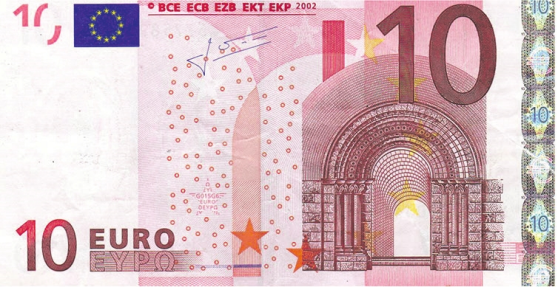
Rice. 5
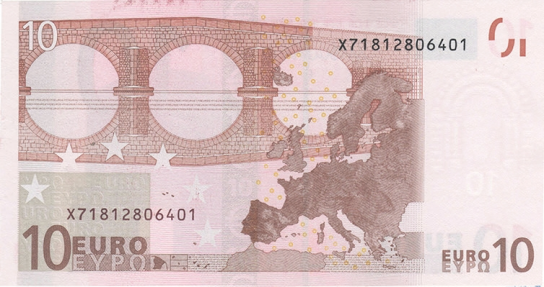


A typical Gothic with her stained glass windows is shown on a banknote of 20 euros (Fig. 8). And the Gothic bridge on the same banknote differs from a bridge in the Romanesque style only a little more elongated arches.

Renaissance architecture is presented on a banknote of 50 euros (Fig. 9). The balcony in this style in Verona - in Fig. 10.


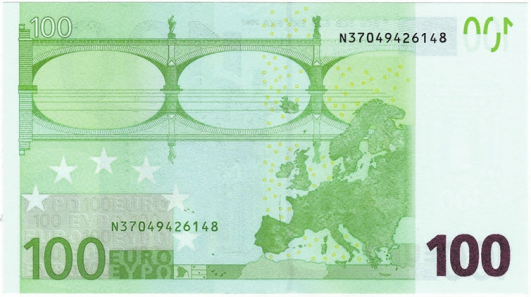
The arch and bridge with many elaborate decorations in the Baroque style are shown on a banknote of 100 euros (Fig. 11). In the same style in Moscow, the Red Gate arch was once built, demolished in 1927 (Fig. 12).
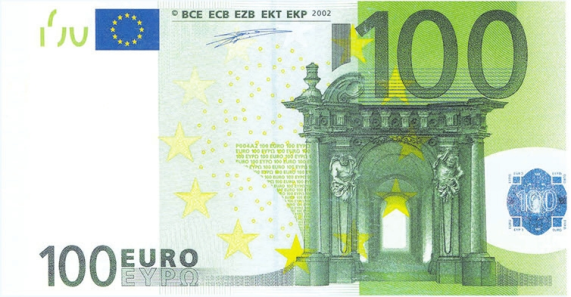
Rice. 11

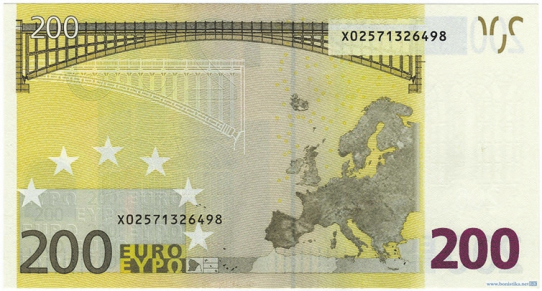
On a banknote of 200 euros - a gate and a bridge in the style of modern (Fig. 13).
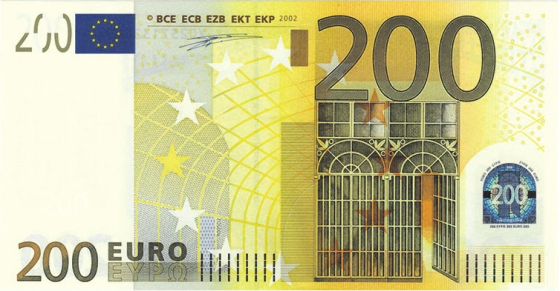
Rice. 13
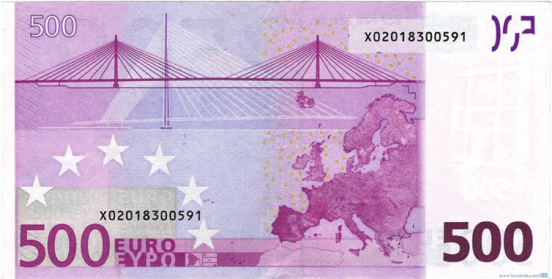
Finally, on the largest banknote, modern buildings of glass and metal and a cable bridge are shown (Fig. 14).
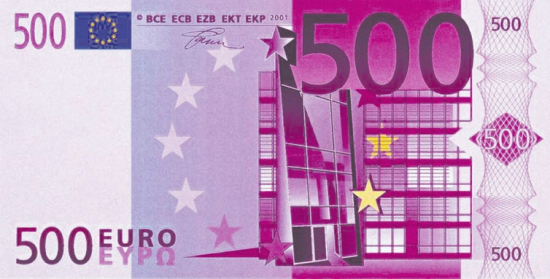
Rice. 14
Ilya Lenson,
cand. chem. sciences, associate professor of the Higher Chemical College of RAS