
Translated material
Blessed are peacekeepers
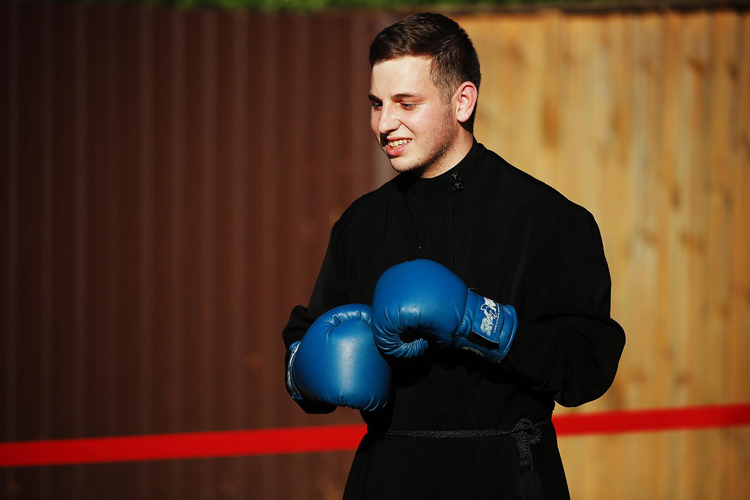
The fifth Sviyazhsk Artel Theater Laboratory, which was held in early August on the ancient island near Kazan, will go down in history primarily thanks to the documentary project “Calling”, where the audience got acquainted with the pupils of the Kazan Orthodox Theological Seminary. The curators of the Living City Foundation Diana Safarova, Artem Silkin and Inna Yarkova managed to provoke the first original Russian product of the Swiss team Rimini Protokoll , which makes the best theatrical non-fiction: Remote Petersburg , Remote Moscove , Remote Perm ” , “ Cargo Moscow ” and“ 100% Voronezh ”with all their huge local significance were still remakes, franchises.
Directors from Rimini Protokoll Stefan Kagi and Caroline Barno originally wanted to work in Tatarstan with Orthodox monks, but there was no time for theater laboratories in a dense monastery schedule, and the project heroes were found in the seminary. During rehearsals, the Swiss were assisted by local specialists - among them, for example, were director Dmitry Volkostrelov and Kazan artist Ksenia Shachnev; They also escorted the audience from one location to another, from one character to another.
“Calling” is a witness theater, the favorite format of Rimini Protokoll , when people on stage do not pretend to be, but speak from themselves. The four future priests are represented through their secular sides: an ITSHAN, athlete, photographer and synofil. The ITSHNIK shows the game that he himself once wrote, and discusses the benefits of the Internet for the Church, reinforcing his story with an animated presentation. The former boxer walks around the ring in gloves and a cash, demonstrating the main positions: his sport has turned into a hobby, now the priority is a struggle with himself. The photographer leads excursions on his own small exhibition in church ruins.
Sinefil, who dreamed of making a movie, analyzes several scenes from the “criminal reading”: the character of the trawol, they say, accepted a miracle for an accident and died, and the hero of Samuel L. Jackson saw an indication from above and received a chance of a second life. “I was born dead,” the seminarist continues. “Doctors have already recorded the time of my death, but their colleague intervened, who believed that I could be saved.” He could write off this for good luck, but chooses faith in God's fishing - like a repentant robber from his favorite picture.
In terms of execution, this is a brilliant work, for nothing that the format of the laboratory meant a modest budget and less than two weeks for training. Rimini Protokoll is a presentation masters: it is not enough for them to pull out a good story from the heroes, they always wrap it in a restoration-take at least the Cargo X project, where the audience is listening to real long-range workers, traveling around the city in a transparent truck. The “calling” is full of such finds, from a photo exhibition in the ruins of the Sviyazhsky temple to the final song “Golden City”, as if secular, but at the same time religious, it is proposed to sing under karaoke with seminarians.
The problem is that the heroes of “calling” are not even trying to answer questions accumulated to the Russian Orthodox Church in a noticeable part of society. A separate priest, and even more so the seminarist, naturally, cannot be responsible for the entire church (although the heroine Francis McDormand from the “Three Bilboards ...” would argue with that). The professional choice of a young man does not mean that he welcomes, say, a law on insulting the feelings of believers. It is with such a biased attitude, in essence, the creators of the project are fighting: organizations, they say, consist of personalities, and not obviously loyal to the same units.
At the heart of “calling” is also a conflict: Orthodox against stereotypes.
O'Kay, but then how does this private person feel in the church system? What is ready, but with what is not ready to put up for your ministry? What does it feel, knowing the reputation of the Church and Orthodoxy in general for many fellow citizens? What made Kagi, a former journalist, hush up these questions? Is it possible to imagine that, for example, Yuri Dud did not set them in an interview with a seminarist? After all, it is like not not to notice the elephant in the room-if you remember the disputes that are noisy and continue to make noise around the Russian Orthodox Church in the 2010s.
To get away from the conflict is not the director’s business, because the conflict is, perhaps, the only mandatory sign of theatrical art. Even the performances of Rimini Protokoll, with all their dissimilarity with the “ordinary”, conventional theater, have always been based on the conflict: a car against a person (any project from the series “ Remote X " ), poor quarters against the rich (also " Remote X ” ), weak countries against strong (“ Visiting Europe ”), truckers against the state ( “ Cargo Moscow ” ), fighters for peace against gunsmiths ( “ Situation Rooms ” ), dying against death ( “ Heritage. Rooms without people ” ).
Of course, the “calling” is also based on a conflict: Orthodox against stereotypes. But it is opened only in part, from the safest side. Rimini Protokoll convinced us that future priests do not live in isolation, accept Internet and pop culture and, in principle, are able to speak social language, but did not allow them to see their position on fundamental issues: the place of the church in the state, freedom of speech, sexual minorities, abortion, and the scientific picture of the world, and after all.
On the other hand, what was shown in Sviyazhsk is still the result of a ten-day laboratory, and not many months of work. Same -sex marriages, Darwinism and politics - perhaps not what it is worth discussing at the first acquaintance. Yes, now the “calling” leaves the viewer with a sense of lack of charge, but it will fade against the background of the precedent - cooperation of the Russian Orthodox Church with an “informal” theater laboratory and the best theater team in the world. The bridges are better than the walls, and the wall between the theater and the Church is high - the “tangia” did not forget either there or here.
And then, if the life of this project does not end there where it began, but it will continue, say, in the “angle” repertoire - the experimental Kazan site, which is led by the same “living city” - perhaps we will wait for answers that we have not received now.